


"I hope they at least remove the Prancing Horse from that car."
Luca di Montezemolo, former CEO of Ferrari, didn’t mince words when the luxury brand revealed its $640,000 electric vehicle, the Ferrari Luce. He bit his tongue to avoid doing Ferrari more damage than his comment already might. He later apologized, calling it a massive risk of destroying a myth.
Social media didn’t hold back either. Between a car that “looks like it was designed entirely in airplane mode” and “an Apple Store made a minivan and gave it trust issues,” the internet’s reaction matched the market’s. Ferrari shed nearly 8% of its stock price the trading day after the reveal, and the stock remains down roughly 23% over the past 12 months.
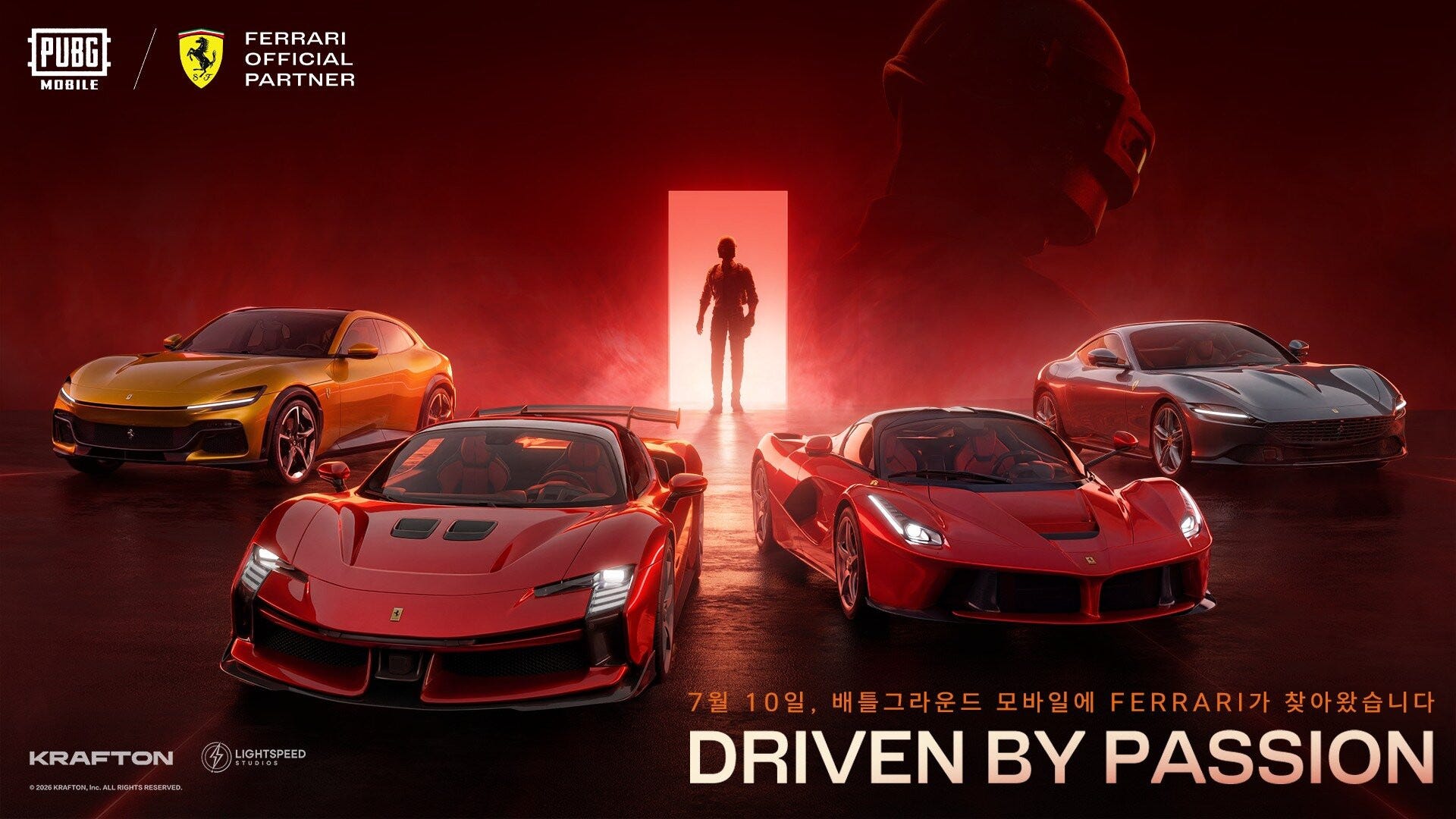
In its search for redemption, Ferrari may have found an unlikely ally: mobile games. A few days ago, the brand with the infamous prancing horse announced a partnership with the equally infamous, at least inside the gaming industry, mobile game PUBG Mobile. For the next eight weeks, players get to drive four of Ferrari’s most mythical cars inside one of the most popular and longest-running games on the planet. A little less than a week into launch, early reception suggests Ferrari has found its way back, and left the Luce behind as a Jony Ive-induced fever dream.
Why Mobile Games Are the Reach Play Most Brands Still Miss
Every brand executive I talk to has a media plan built around CTV, social, and increasingly retail media. Almost none of them have a real line item for mobile gaming, and that gap is becoming one of the most expensive blind spots in marketing.
The numbers explain why it shouldn’t be. 54.4% of the US population will be a mobile phone gamer in 2026, according to a new study from EMARKETER and Admazing surveying 108 US marketers. Nearly 9 in 10 marketers are at least slightly confident mobile gaming can reach their target audience, and a third are very or extremely confident their desired demographic plays mobile games.
Yet only 10.2% of marketers say their organizations regularly use mobile gaming for brand campaigns. Over a third neither use it nor actively consider it at all. The reasons are familiar to anyone who has sat through a media planning meeting: a lingering assumption that gamers resent advertising, and, historically, weak measurement. “There was a feeling that gamers would find advertising distracting and react negatively to advertising,” said Yory Wurmser, principal analyst at EMARKETER. “Secondly, the measurement was really kind of poor. That was a huge problem.”
That gap is closing fast. The IAB released its Gaming Measurement Framework last year specifically to help marketers benchmark in-game ads, rewarded ads, and interstitials. Kantar’s Pedro Sánchez López puts real numbers behind the shift: mobile gaming ad campaigns deliver purchase intent 3.5 times stronger than the US norm, a 7.1 percentage point lift, and consumer receptivity to gaming ads has climbed from 25% in 2012 to 54% in 2025. Separately, Bain & Company found 46% of game players regularly make in-game purchases triggered by in-game ads, up from 40% a year earlier. Don’t get me wrong. There’s still a ton of work to do here. But things are headed in the right direction.
In case you missed it: relevant post previously released

This is precisely the environment PUBG Mobile brings to the table for Ferrari. The game has racked up roughly 1.75 billion downloads and more than $15 billion in lifetime revenue since its 2018 launch, with upward of 90 million people playing daily across its regional versions. That’s a reach number most CTV buys can’t touch, inside an environment where 86.1% of marketers say attention quality, meaning whether the audience is actively engaged rather than passively exposed, is at least moderately important to them.
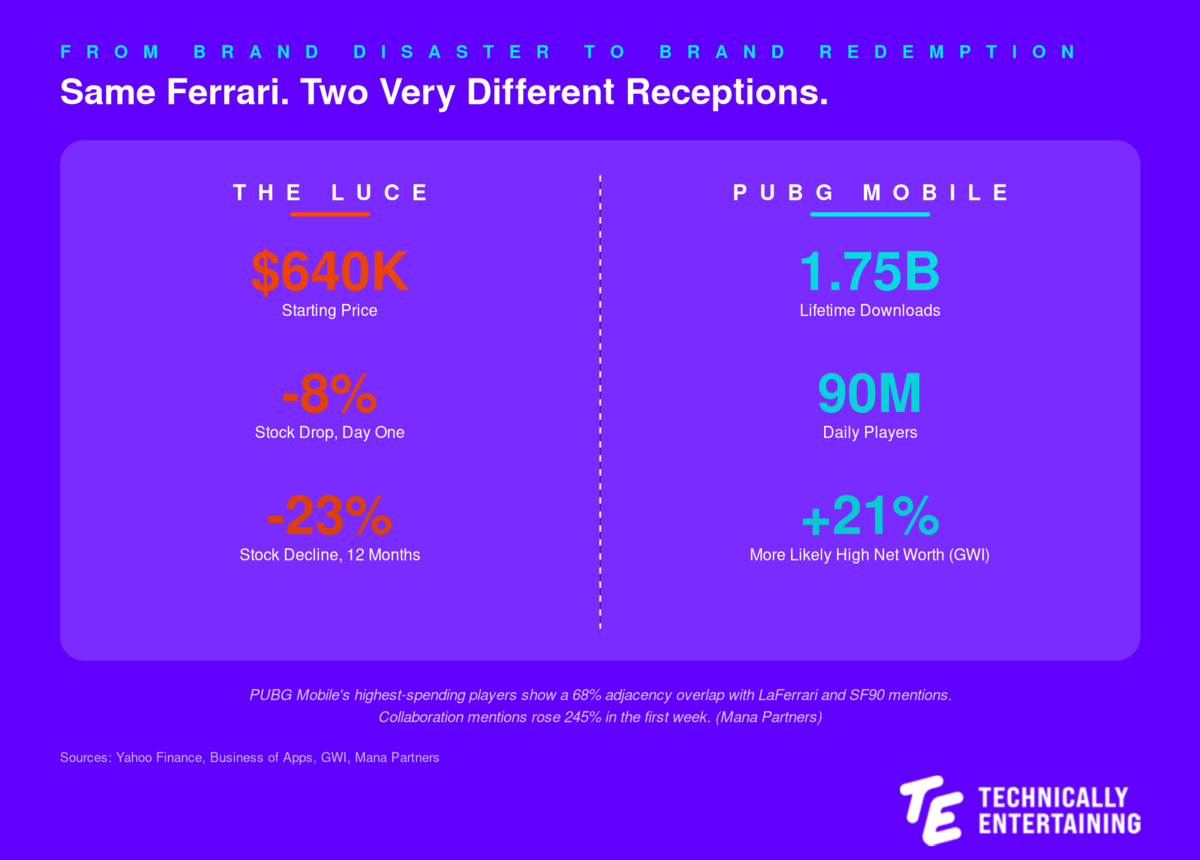
That reach is also wealthier than most marketers assume. GWI data shows PUBG Mobile regulars are 21% more likely to be high net worth individuals than the average consumer. The tired assumption that mobile gamers have no real discretionary income doesn’t hold up here, and it’s exactly the audience quality a car with the price tage and prestige of a Ferrari needs.
Inside the Collaboration
The “PUBG Mobile x Scuderia Ferrari HP” collaboration runs from July 10 through September 8, 2026, introducing four Ferrari models built around genuinely different identities: the Roma (style), the Purosangue (utility), the flagship hybrid hypercar LaFerrari (innovation), and the SF90 XX Spider (Ferrari’s racing technology built for the road). Each comes in exclusive colorways, and players can further personalize their cars through original rims, exclusive decals, and brake calipers in official Ferrari colors, alongside themed items like a Ferrari parachute, backpack, and ornament.
The centerpiece is an in-game exhibition of the actual 2025 Scuderia Ferrari HP Formula 1 car. Interacting with display stands scattered across the map triggers an immersive viewing sequence, and players can take in-game photos with the car to share beyond standard gameplay.
This isn’t PUBG Mobile’s first rodeo with automotive brands. The collaboration runs on the same Speed Drift structure that made an earlier Porsche partnership one of the game’s most popular crossovers. That matters because Ferrari isn’t testing an unproven format. It’s stepping into a playbook that already works, and early player response is already calling this one of the most anticipated collaborations of the year.
The early numbers back that up. According to Mana Partners, PUBG Mobile’s UC whales, the game’s highest-spending players, show a 68% adjacency overlap with mentions of the LaFerrari and SF90 XX Spider specifically, the two models built around innovation and racing pedigree, largely driven by the Speed Drift event tied to the launch. Mentions of the collaboration accelerated 245% over the first seven days, and cross-engagement between Tencent Games and Ferrari’s own follower base rose 31%. Ferrari reached the exact players most likely to spend, on the exact cars built to carry its halo, and pulled some of its own audience into the game’s orbit along the way.
What Elaris’ Audience Data Says About Ferrari’s Bet
I ran PUBG Mobile’s audience through Elaris to see how well Ferrari’s specific execution fits the player base, not just the game’s overall scale. The short version: directionally strong, with real gaps worth naming.
Where it fits
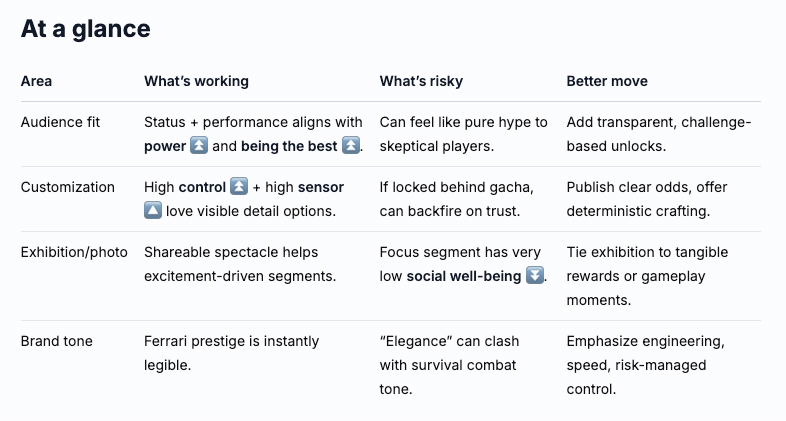
Ferrari sells status, performance, and dominance, and PUBG Mobile’s audience over-indexes hard on exactly that: very high power (89th percentile), control (84th percentile), and drive to be the best (81st percentile). A Ferrari skin reads as an instant status signal in lobby and in match. The audience also scores very high on teamwork (91st percentile), so matching squad liveries work as coordinated flex without requiring deep community bonding. And PUBG players skew high on “sensor” traits, meaning they respond to tangible, verifiable specifics rather than abstract brand feeling, exactly what real model names, rims, decals, and brake calipers deliver.
Where the risk sits
The largest single segment of the audience is also highly skeptical of brand promises, low on social well-being, and allergic to anything that reads as bought prestige instead of earned prestige. That segment wants to know exactly how to get an item, how long it takes, and what it includes, not to be sold on the legend of Ferrari. If the best cosmetics sit mostly behind spend rather than skill, this segment reads the whole partnership as pay-to-win status, cutting against the very “being the best” value that made Ferrari appealing to them in the first place.
What Ferrari got right
Splitting four cars into four distinct identities is smart segmentation without ever saying “this is for you.” The customization system, granular and visible, plays directly into the audience’s high control and high sensor preferences. And the F1 car exhibition creates a genuine shareable moment for the portion of the audience that already enjoys social proof, without forcing the whole collaboration to lean on social behavior the largest segment doesn’t actually want.
What’s still missing
The exhibition is closer to a museum piece than a competitive advantage, and a skeptical audience will ask what it does for them in a match, not just how it looks. There’s also a thematic gap: PUBG Mobile is gritty, tactical, and survival-driven, and the Roma’s “timeless elegance” framing can feel like a showroom dropped into a battlefield unless it’s grounded in something mechanical, like handling, sound, or a genuine chase-and-escape fantasy.
The fix is available and relatively cheap: pair the paid path with a transparent, skill-based unlock track, something like winning vehicle chases or landing precision drifts, so at least one model or signature part is earned, not bought. That single addition would convert Ferrari from a brand renting attention to a brand players actually respect.
From Brand Destruction to Brand Redemption
Two months ago, Ferrari’s own executives were fielding questions about whether the Luce had damaged decades of brand equity in a single unveiling. Today, Ferrari is trending for a completely different reason, inside a game most boardrooms have never seriously discussed as a media channel.
Mobile gaming didn’t fix Ferrari’s EV problem. It never could, and it wasn’t trying to. What it proved is that when a legacy brand needs to remind a skeptical audience why it still matters, the fastest, cheapest, most attention-rich place to do that might not be a keynote stage or a Super Bowl spot. It might be a battle royale map with 90 million people logging in today alone.
What do you think? Is your brand still treating mobile gaming as an afterthought, or is this the year that changes? Let me know in the comments.
Technically Entertaining is a weekly briefing on how gaming, technology, and entertainment are reshaping brand strategy for decision-makers at the world’s biggest brands. If this resonated, subscribe below.