


One of the best conversations I had at Cannes Lions this year was with Jonathan Stringfield, Microsoft’s Head of Measurement Science. He has spent his entire career at the intersection of gaming and advertising, and he does not sugarcoat what he sees:
“It’s time the industry stops with the chicken shit.”
His words, not mine. But I agree with his diagnosis of gaming’s advertising problem.
What he meant was specific. Games still can’t tell a brand, with any consistency, what it gets back for every dollar spent on a gaming activation, whether that’s a branded experience, an in-game ad buy, or something in between. That math has been solved and repeatable on social media for over a decade. In gaming, it remains a live debate at every conference I attend.
Put yourself in the shoes of the brand marketer and media buyer tasked with allocating $1 billion in ad spend over the next 12 months and maximizing predictable returns. The thought experiment makes it obvious why gaming still sits much lower on the depth chart of a brand marketer’s media channels of choice.
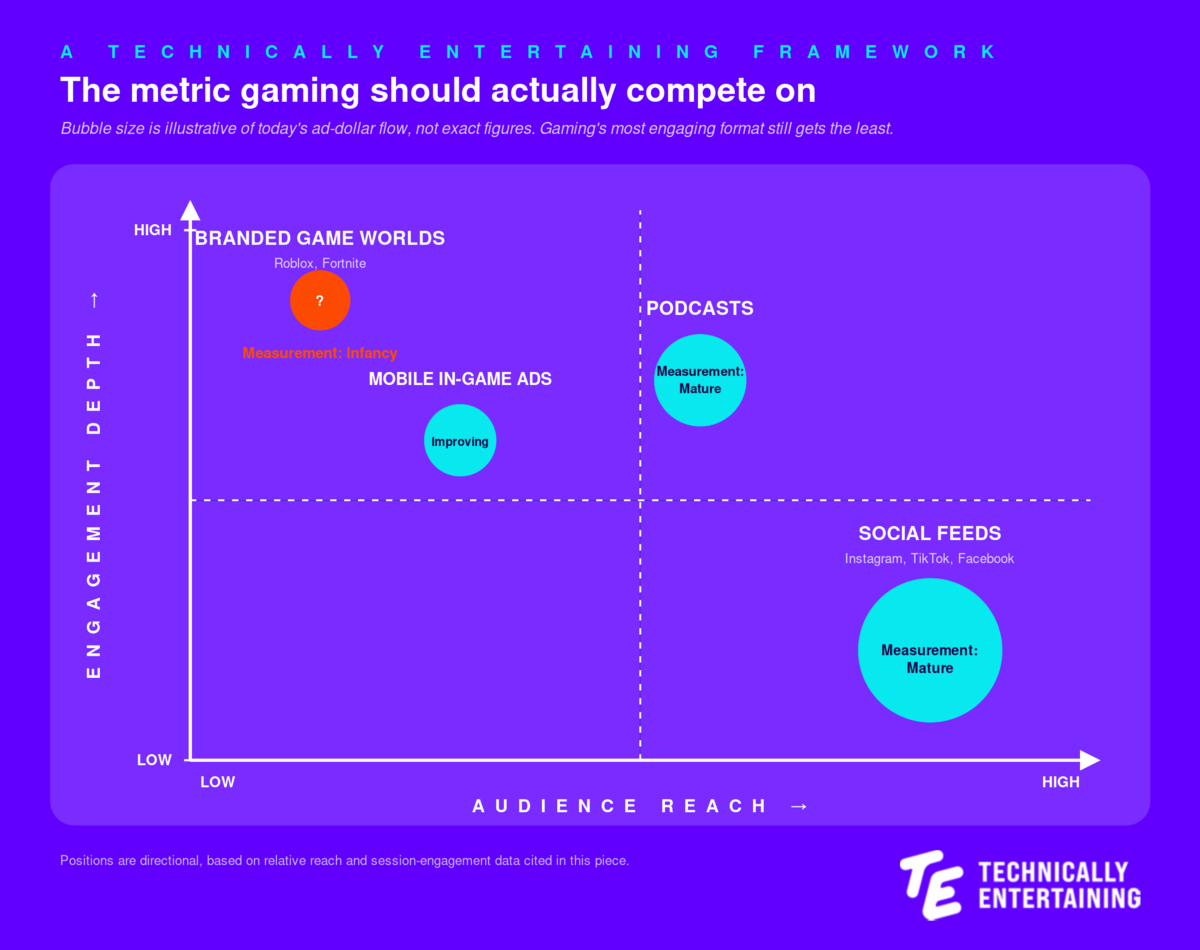
Stringfield’s sharper point, the one that stuck with me, is that gaming keeps trying to win an argument it was never built to win. Platforms keep leading brand pitches with reach, a metric gaming will always lose to social media by definition, instead of building the measurement standard around what only gaming can deliver: deep, active engagement.
The Reach Fight Gaming Can’t Win
Look at the numbers, and Stringfield’s point becomes obvious fast.
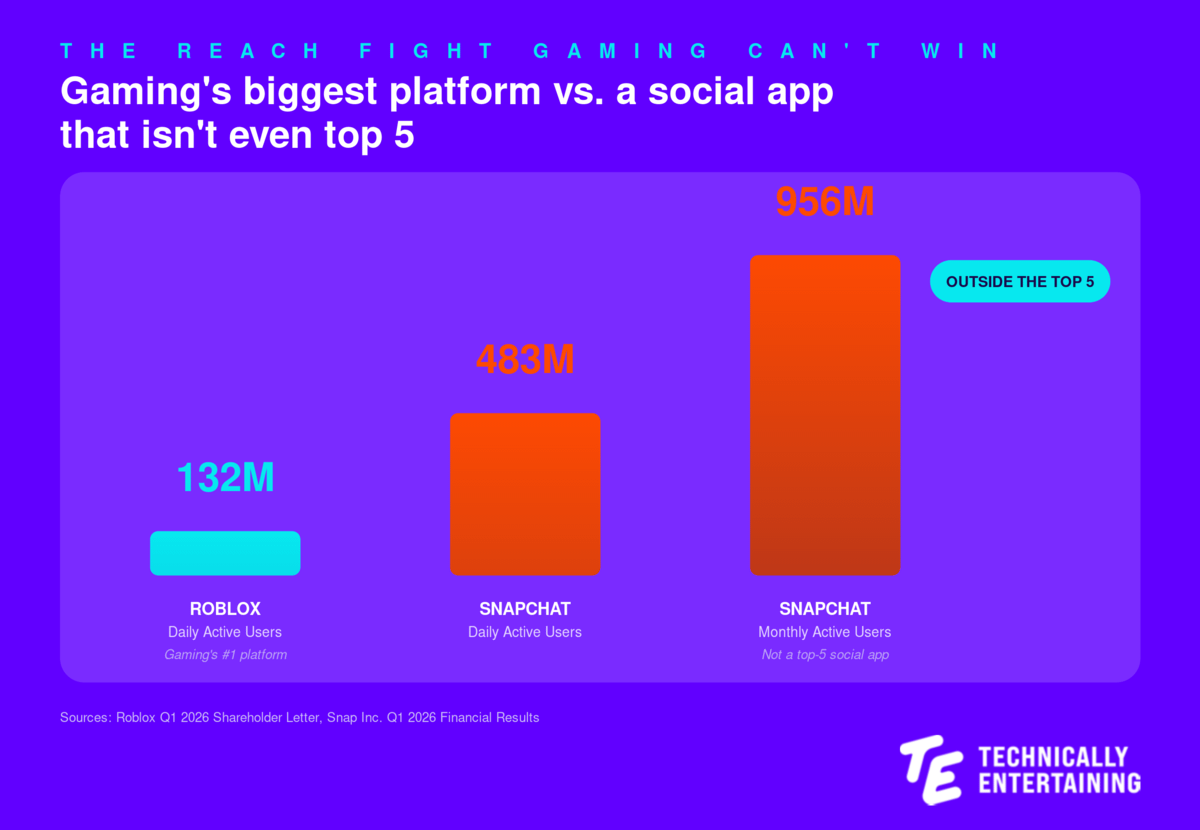
Roblox is the largest single gaming experience in the world right now. In its first-quarter 2026 shareholder letter, the company reported average daily active users of 132 million, up 35% year over year, an outstanding growth rate for a platform its size.
Now put that next to Snapchat, a social app (and not a hardware company - c’mon Evan!) that trails Facebook, YouTube, WhatsApp, Instagram, and TikTok and doesn’t crack the top five social networks globally. In its own first-quarter 2026 results, Snap reported 483 million daily active users and 956 million monthly active users. A social platform outside the top five still reaches roughly three times more people daily, and close to seven times more people monthly, than the single largest experience gaming has to offer.
That is the fight gaming keeps signing up for every time a platform leads a brand pitch with monthly actives or impressions. The audience gaming holds is enormously valuable. Reach was simply never gaming’s strength. Engagement is.
Where Gaming Actually Wins
The attention numbers gaming does own are extraordinary. The Entertainment Software Association’s 2026 Essential Facts report counts 212.3 million weekly US players, with 71% of Millennials, ages 30 to 45, and 56% of Gen X, ages 45 to 61, playing every week. That’s the 25-49 demographic advertisers pay the most to reach, engaged inside games at a higher weekly rate than most brands see on their own owned channels. Newzoo puts the 25-44 age band at roughly 40% of the global player base. McKinsey finds PC and console players report 76% receptivity to in-game advertising, nearly matching mobile’s 83%.
That’s a story about depth of engagement: fewer total users than the biggest social apps, but far more time, attention, and repeat behavior per user than a scroll-based feed will ever produce. That is the metric gaming should be measuring itself against, and largely isn’t yet.
The First Cracks in the Old Model
Some of the pieces of Stringfield’s fix are already showing up individually.
Roblox rebuilt its recommendation algorithm this year to weigh 28 days of player behavior, daily return rate and total session time, instead of the 7-day, click-driven signal it used before. Chief Growth Officer John Ciancutti was explicit about the intent: surface games players stick with, not games that win a quick click and lose the player by day two.
Epic Games has paid out more than $1 billion to Fortnite creators since 2023 through Unreal Editor for Fortnite, and the model behind those payouts is instructive. Epic splits a pool equal to 40% of net Item Shop revenue based on each island’s share of total player hours, not its share of impressions or installs. Creator-built islands now account for 47% of all time spent in Fortnite, up from 38% a year ago, because the payout structure rewards depth of play over traffic.
EA and Xbox both had a presence at Cannes this year making a related bet: that the inventory itself needs to scale before the measurement conversation can mature. In June, EA launched EA Advertising, a platform that places brands directly into live gameplay across its portfolio, from stadium signage in Madden NFL to custom content inside EA Sports FC, with Visa, Red Bull, Xfinity, Lowe’s, Peacock, and Mountain Dew signed on as launch partners reaching a combined 120 million monthly players. Around the same time, Xbox’s new Chief Strategy Officer, Matthew Ball, started publicly floating ad-supported tiers as a way to keep games affordable against rising development and hardware costs, the same model Netflix and Disney+ already run on mature, third-party-audited measurement. Both moves add real inventory and real intent at the platform level. Neither comes bundled with the shared measurement standard Stringfield is asking for.
Kantar’s data shows what happens when engagement-native measurement gets applied to advertising itself: mobile gaming campaigns deliver purchase intent 3.5 times stronger than the US norm, and consumer receptivity to gaming ads has climbed from 25% in 2012 to 54% last year. The IAB’s Gaming Measurement Framework, released in June 2025, was a real step toward standardizing this, layering brand lift, attention, and sales uplift metrics on top of the old reach-based baseline.
These are individual publishers and standards bodies solving pieces of the same problem on their own timelines. What’s still missing is the thing Stringfield says actually opens the floodgates.
One Standard, Not Fifty
Here’s where Stringfield landed, and I think he’s right. It will take the major game developers and publishers coming together to jointly define the metrics standard suited to what games uniquely deliver, align ROI and ROAS measurement against that standard, and build the transparent, consistent tooling behind it, across every game, platform, and genre. That means one shared, radically transparent standard, consistent across every publisher, that a CFO can trust the same way she trusts a Nielsen number for television.
The Podcast Precedent
To see what’s possible once a medium stops competing on the wrong metric, look at podcasts.
Podcasting crossed 550 million monthly global listeners in 2026, and global ad spend passed $5 billion, growing 12.4% year over year and still outpacing overall digital ad growth of roughly 8%. The 25-44 age band makes up 38% of listeners, the same money demo gaming already owns.
Podcasts got here by building measurement around what podcasts are actually good at: trust, retention, and completion. The IAB’s Podcast Measurement Guidelines, paired with attribution vendors like Podscribe and Claritas and brand-lift specialists like Veritonic, now produce host-read ROAS of 3.4x to 5.1x, numbers that make podcast budgets easy to defend in a boardroom. Programmatic buying and the format’s expansion into video on YouTube and Spotify added scale on top of that trust once it existed, not before.
Games offer an even deeper, more immersive version of everything that made podcast measurement work: sustained attention, habitual return behavior, and a captive audience giving the experience its full focus. Once gaming builds its own version of the podcast measurement stack, native to engagement instead of borrowed from reach, the growth curve could be steeper than podcasting’s.
Gaming Is Exactly Where Social Media Was 25 Years Ago
That’s the frame I keep coming back to. Gaming commands more attention and deeper engagement than almost any other medium, and still takes home less than 5% of the roughly $1.06 trillion in global ad spend Dentsu projects for 2026, per its Gaming Trends Report. Social media sat in a similar position two and a half decades ago: massive audiences, unproven measurement, advertisers waiting on the sidelines. It took a standardized measurement stack, not just audience growth, to unlock the dollars. Gaming is at the exact same inflection point now.
What This Means for Your Planning
If you run marketing, brand, or strategy at a consumer business, stop asking your gaming partners how many people they reach. Ask how they measure engagement, and whether that measurement would hold up against an IAB or MRC standard if you asked twice.
Push every publisher pitch to report against retention, session depth, and redemption, the metrics Roblox and Epic are already rebuilding their own platforms around, rather than settling for impressions dressed up as strategy. Where a true cross-publisher standard doesn’t exist yet, fund your own incrementality tests rather than waiting for the industry to hand you one.
Stringfield is right. The floodgates open the day gaming stops trying to out-reach social media and starts proving, consistently and transparently, what only it can deliver.
What do you think? Is your organization still benchmarking gaming against reach, or has it started asking the engagement question instead? Let me know in the comments.
Technically Entertaining is a weekly briefing on how gaming, technology, and entertainment are reshaping brand strategy for decision-makers at the world’s biggest brands. If this resonated, subscribe below.