


Doctor Who. Bluey. Top Gear. Sherlock Holmes. Planet Earth. Sesame Street. Attack on Titan. Tatort. Die Sendung mit der Maus.
What is a list of some of the most successful and lucrative entertainment IPs in history that any media company would give an arm and a leg for to call their own is in fact a list of properties created, commissioned, or aired by public broadcasters. The details differ from property to property. Doctor Who, Top Gear, and Planet Earth come from the BBC. Tatort comes from ARD and Die Sendung mit der Maus from WDR. Bluey was made by Ludo Studio for Australia’s ABC Kids and co-commissioned by BBC Studios. Sesame Street belongs to the nonprofit Sesame Workshop and grew up on public television. Attack on Titan airs on NHK in Japan and the IP belongs to Kodansha. Sherlock Holmes is a public domain character, and the BBC’s Sherlock is its own modern take on him.
Public Broadcasting’s Distribution Problem
Public broadcasting services across the globe have been heavily scrutinized and their efforts in shaping public opinion have been heavily questioned. Institutions like NPR and PBS in the US, the BBC in the UK, or ARD and ZDF in Germany have seen their budgets challenged and in some cases cut. In July 2025, the US Congress eliminated $1.1 billion in federal public broadcasting funding, which caused the Corporation for Public Broadcasting (CPB) to shut down while cutting off primary federal support for roughly 330 PBS and 246 NPR stations nationwide.
Now, this post is not about whether these types of budget cuts are justified or fair. In general, my opinion is that any organization should be held to fiscal standards that enforce efficiency and impactful use of funds. This is true in private companies that are stewards of their investors’ capital. And it is especially true for public organizations and their investors - the taxpayers of their respective countries.
At the same time, it is without a doubt that public broadcasting in its essential form provides a quintessential service to society: ensuring that broadcasting made for the public stays independent, fair, and focused on people instead of profits by promoting independent journalism, fighting misinformation, and hence safeguarding democratic values. In times like these, public broadcasting isn’t just a worthwhile pursuit. It’s a necessary one.
What deserves a much closer look is the effectiveness of public broadcasting - and with that we need to talk about distribution. Consumption of traditional television is down across the board. Public broadcasting struggles to attract and retain a younger audience, which in this instance is anyone below the age of 50 (give or take).
Enter video gaming.
The European Broadcasting Union (EBU) is holding its first ever meet-up fully dedicated to gaming this week in the media center of the Südwestrundfunk (SWR) in beautiful Baden-Baden. Due to popular demand, gaming no longer occupies a singular slot on the digital meet-up’s agenda of the EBU - it’s getting its own meet-up.
Two full days of learning sessions and hands-on game building experiences. I get to kick start the entire event with the opening keynote on Day 1, highlighting why every company needs a gaming strategy and sharing some key insights on how public broadcasting can leverage gaming to more effectively reach modern consumers and live up to its promise of protecting people’s interests.
An iconic IP catalogue like this offers a real advantage when it comes to attracting users in the market and bringing players into your games. The IP alone will cut through the noise.
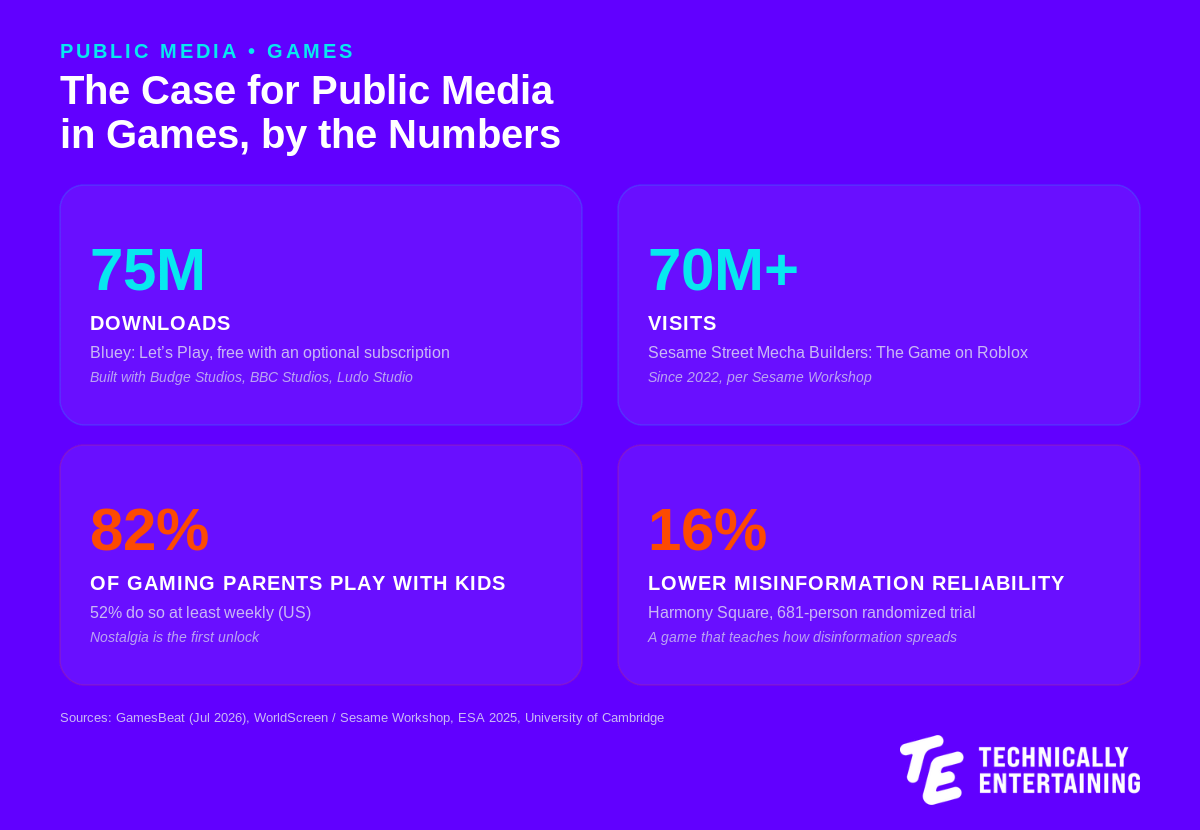
Another competitive advantage is flexibility. Monetization and optimizing for revenue don’t have to be forced and don’t have to sit at the very top of the requirement list. Public broadcasters can stay true to their mission and focus on the players’ needs first to create very compelling, engaging, and useful game experiences that delight players. Where monetization makes sense, it can be an option the player chooses, and the design stays in service of the player. Bluey: Let’s Play shows what this looks like in practice: free to download, with an optional subscription for those who want more.
Public broadcasters already have the IP, the trust, and the nostalgia. What they lack is a games strategy.
Three Game Models Are Already in Play, and None Is Connected
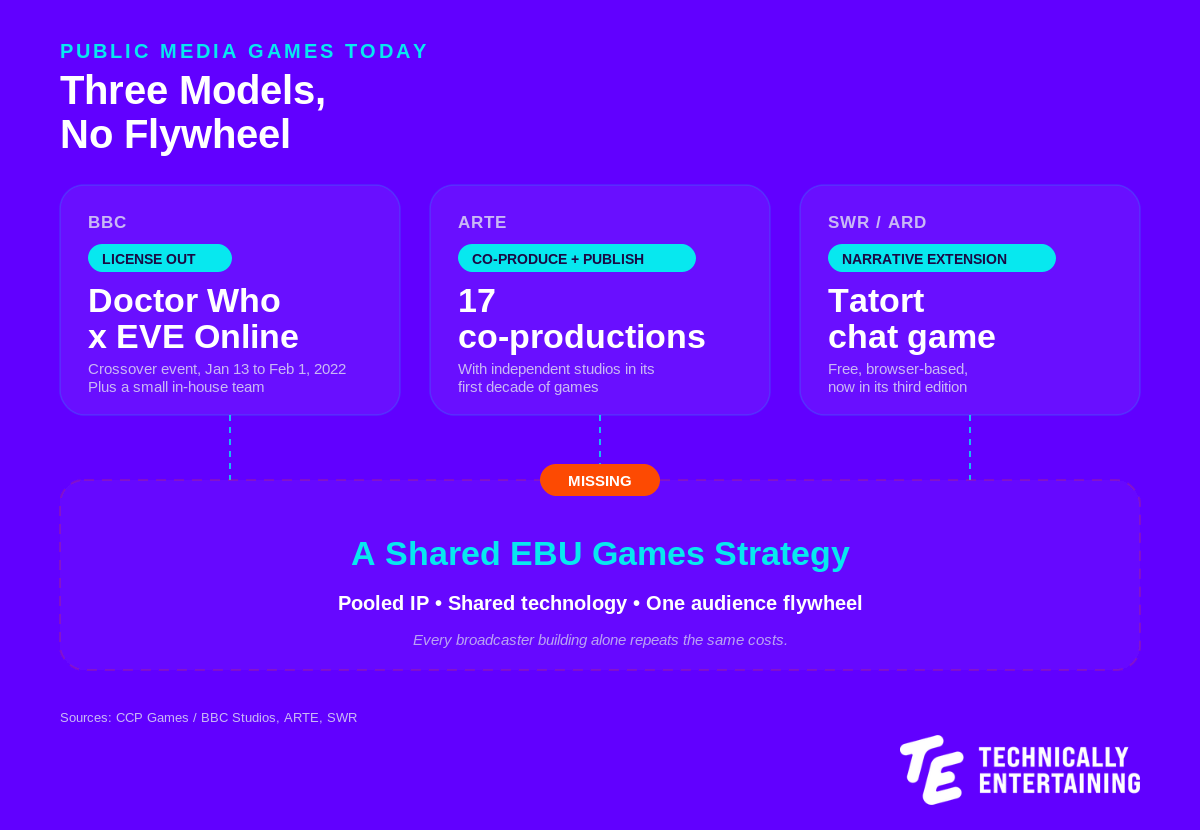
Games for public broadcasters aren’t an entirely new idea. Arte co-produces and publishes games together with independent studios and counts 17 co-productions in its first decade of games. The BBC is known to license its IPs to game developers - for example when Doctor Who joined the renowned EVE Online open world game in a crossover event in 2022, but also houses a small team to make some of its own games. SWR, one of the ARD’s member broadcasters, built a free, browser-based chat game around its crime series Tatort, which is now in its third edition.
Each of these efforts works on its own terms, and from the outside they look scattered. What is missing is a shared strategy that turns them into a network effect, inside a single broadcaster and across the EBU. Yet, the current audience trends and gameplay preferences of key consumer cohorts are offering clear tailwind in the sails of the broadcasters’ gaming efforts. Just to give two examples: in the US, 82% of parents who play video games play with their kids, and 52% do so at least weekly. Millennials, who were the first generation to grow up with games, now have young kids at the age where they start playing games - and the games Millennials first expose their kids to are games they used to play themselves when they were young. That’s why Super Mario, Mario Kart, and Minecraft are so high on kids’ lists. It’s the nostalgia of the parents that oftentimes is the first unlock for children and their gaming journey.
TV consumption follows a very similar pattern - which brings us back to the iconic IP list from before. They clearly serve the thirst for nostalgic experiences, while offering parents the reassurance that they will expose their kids to safe, useful, high quality content. I grew up watching TV shows like Löwenzahn and Die Sendung mit der Maus. My wife loved Siebenstein. Guess what our kids are watching and loving today? You guessed correctly (yes, the occasional Peppa Pig is on the menu as well - nobody’s perfect).
A Shared EBU Kids Hub, Built on Trust and Nostalgia
The timing helps. At Gamescom, Steinmeier and EU Commissioner Henna Virkkunen pledged action on monetization and dark pattern practices, with the Digital Services Act and the forthcoming Digital Fairness Act as the regulatory backbone. A public broadcaster with decades of trust with parents and a player-first design is the safe option families are looking for. In the US, 70% of all parents prefer their children to spend time gaming over social media.
The way to get there is a two-layer strategy: meet kids on the platforms they already use, then bring them home to an owned hub. Peers in the EBU network are already working on the first layer. Yle has a presence on Roblox, VRT built a Eurovision-themed world on Roblox, and Sesame Street launched Neighborhood Adventures on Roblox in October 2025, with a portal to Sesame Street Mecha Builders: The Game, which has passed 70 million visits since 2022.
So here’s just one idea that is true to the essence of public broadcast media that aligns with real consumer needs - a kids gaming hub based on the most iconic kids IP that lets children learn through play alongside all of their - and their parents - favorite characters and storytellers. Bluey: Let’s Play, built together with Budge Studios, has already passed 75 million downloads. Combining Bluey with Sesame Street, Löwenzahn, and Planet Earth? You’ll have an entertainment product that is both educational and fun. No medium can deliver on this better than gaming.
Picture it as a shared EBU kids hub: one destination hosting IP from across member broadcasters, with parent-child co-play modes, learning built into the mechanics, and nostalgia as the unlock. The build model already exists. Bluey: Let’s Play came to life through Budge Studios working with BBC Studios and Ludo Studio. The broadcaster brings IP and trust, and the studio brings craft. Rights differ by property (Sesame Workshop, Ludo Studio, WDR, ZDF), so the hub starts with the properties that are easiest to clear.
Games for Democracy: Where Public Media Has the Edge
Kids are one part of the public service mission. Democracy is the other, and games just became part of that conversation. At the Gamescom Congress in August, Germany’s President Frank-Walter Steinmeier said that games sit at the center of society and are meaningful to democracy, for better or worse, and pointed to research showing that avid gamers have an above-average willingness to engage socially through debates, protests, and petitions.
Previous post relevant to this article

Public broadcasters are built for exactly this. Playable explainers for elections, games that teach how disinformation spreads, and interactive formats that let audiences experience how institutions work are a natural extension of a mission built on independent journalism. Proof that the format works already exists. Harmony Square, developed by University of Cambridge psychologists with the Dutch media agency DROG, puts players in the role of a Chief Disinformation Officer in a ten-minute game. In a randomized controlled trial with 681 participants, it reduced the perceived reliability of misinformation by 16% and the willingness to share it by 11%. In Germany, the Federal Agency for Civic Education (bpb) now curates games for political education for schools and homes. What these projects need is trust and reach, and public broadcasters have both.
This brings me back to efficiency. Public media should be held to it, and the measure has to fit what public media exists to do: reach under-50 audiences, time spent with trusted content, and parent trust. Revenue can be one metric among several, and where it appears it can stay optional for the player. A network-wide strategy is also the efficient route, because every EBU member building separately repeats the same costs. Pooled IP, shared technology, and shared learnings turn a handful of scattered experiments into one flywheel.
Technically Entertaining covers the intersection of gaming, technology, and business strategy. If this changed how you think about public media and games, subscribe today and share it with someone at a broadcaster who is still deciding where to start.