


“The freaks are coming back.”
That’s what two older ladies said to a gaming industry friend and long-time gaming studio executive in 2018 when he attended his first Gamescom in Cologne. Eight years later, and “freaks” from all walks of life showed up at the world’s largest gaming conference again in record numbers.
368,000 visitors from 131 countries.
Over 36,000 trade show visitors, 50% from abroad with more senior management representation than ever before.
1,743 companies from 66 countries exhibited and sold out the entire exhibition space of 233,000 square meters.
624 million digital views accumulated across the show until Saturday night.
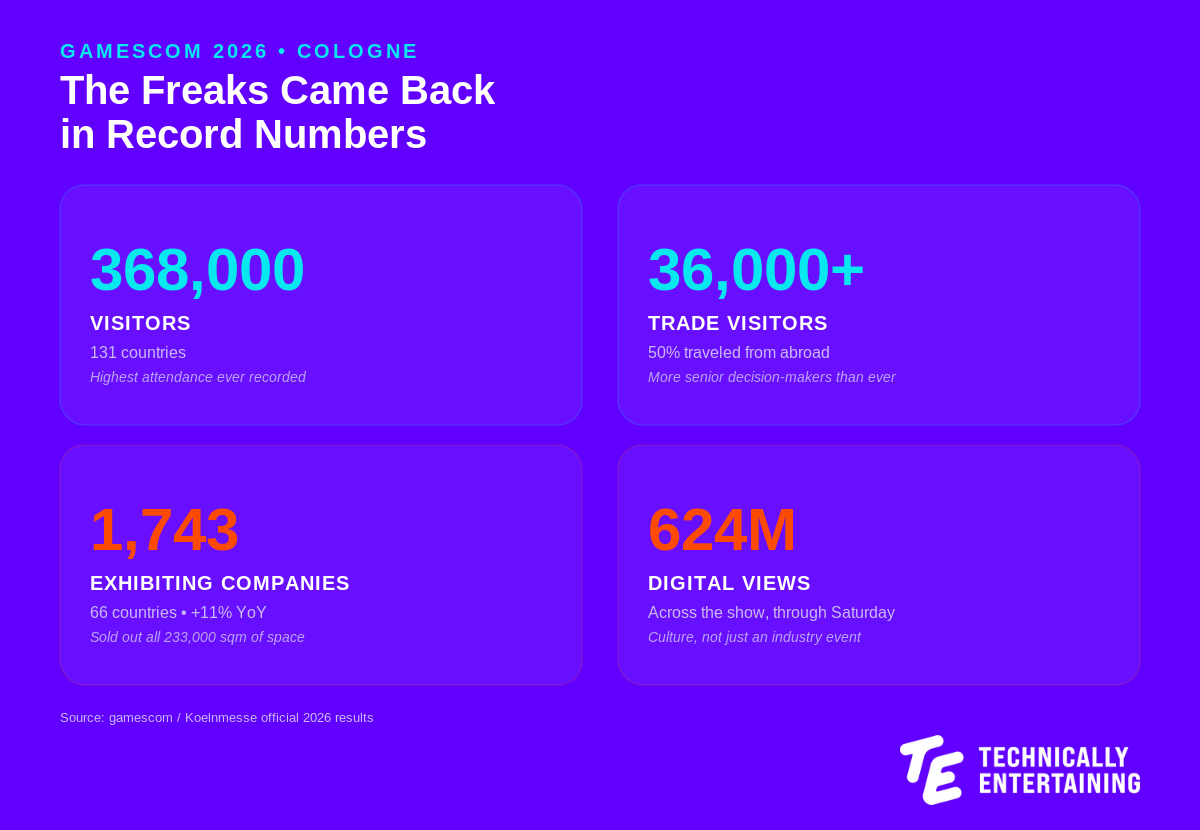
All of these numbers are increases compared to last year. They demonstrate the significant role that video games play culturally across generations as well as economically. Games are serious business and despite this year’s seeming increase in cosplay costumes, games are nowhere near the niche medium that common misconceptions and naysayers still make them out to be.
When politicians like Frank-Walter Steinmeier, the President of Germany, show up at Gamescom to address an audience of 1,100 attendees of the Gamescom Congress and roam the exhibition halls afterwards, it’s as clear of a sign as you can get that games have fully entered the mainstream. Of course, Steinmeier couldn’t help himself but wield a politician’s favorite weapon: the R-word. Regulation. (He and EU Commissioner Henna Virkkunen used the moment to jointly pledge a crackdown on certain monetization and dark pattern practices, a promise already being decried in parts of the industry.)

Yes, games play a crucial role in people’s lives and therefore have a unique responsibility to protect players. Every game developer and publisher that I have worked with and know takes their responsibility very seriously and doing right by players sits at the very top of every list. It’s not perfect and more can be done. Do games pose the same risk as social media usage to, for example, mental health? Not even close. Especially European politicians should first support the growth of this key creative industry before eagerly jumping to putting the handcuffs on (again).
This is why we all should pay closer attention to when the elderly speak up. Gamescom really did bring out the freaks again this year. Some of them were wearing crop tops. Some of them were wearing ties.
To understand the power of games, the magnitude of the opportunity for brands, and where things are headed it pays to take a closer look at one of the biggest and dominant regions in the gaming industry: APAC.
Not only were there more Asian (mostly Chinese) publishers with impressive exhibition booths at Gamescom this year than ever before. APAC also accounts for 49.5% of the industry’s total global revenue. 1.9 billion people play games in the region. The big misconception that games are still niche simply doesn’t hold up. The reality is that the broader gaming population is a highly valuable, mainstream consumer base with significant spending potential that ranges from Gen Alpha to moms to executives.
Looking at the Gamescom exhibitor list, it becomes apparent how broadly appealing and relevant gaming is to non-endemic brands. Red Bull. Airbus. Ferrero. Nestlé. Subway. Vodafone. Porsche. Rheinmetall. From fast moving consumer goods, to fast-food restaurants, to telcos, car manufacturers, and defence companies. The list of companies demonstrating a commitment to gaming is as diverse as the people that play games themselves - and the conversation brands want to have is shifting. Jason Barnes, APAC chief revenue officer at PubMatic, shared his experience in an interview with The Current:
“I speak to buyers every day, instead of saying, ‘Let’s experiment in games,’ they’re saying, ‘Games are part of our omnichannel mix; how do we buy more?’”
One of the brands I spoke with at Gamescom that exemplifies this inevitable shift for brands is luxury fashion house Balenciaga. Balenciaga was one of the first luxury brands to enter gaming - and it is currently arguably the only one still highly active. In its most recent Capital Markets Day, Kering, the global luxury group that owns Balenciaga, Gucci, Bottega Veneta, and more, highlighted Balenciaga’s seven core cultural areas of focus in order to engage and attract consumers: TV series, music, sports, wellness, gaming, innovation, and patrimony. Gaming’s role is to act as a cultural bridge to Gen Z and younger luxury cohorts.
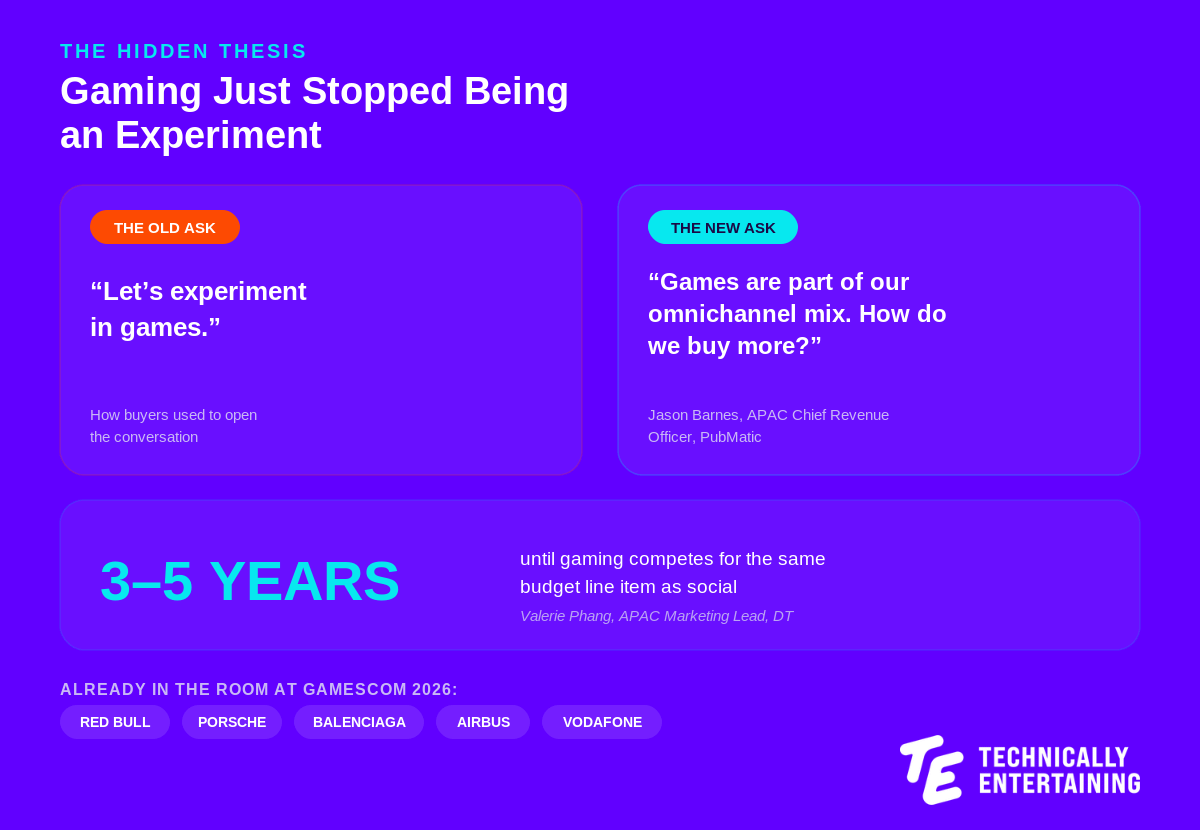
Balenciaga’s strategy is ahead of most brands - but it is the clear sign of what is coming and where brands need to show up to effectively reach consumers. Valerie Phang, APAC marketing lead at DT (formerly Digital Turbine), summarized this neatly when she spoke with The Current. “Gaming will earn its place as a core channel for the same reason mobile did. Attention follows behavior, and consumer behavior is already there. In three to five years, gaming won’t be asking for experimental budget; it’ll be competing for the same line item as social.”
What does this mean if you sit in a marketing, brand, or strategy seat at a company that has not yet made gaming part of its plan?
Gamescom is not a curiosity you check on once a year to see what the latest trends in cosplay attire are. It is the annual proof point that the audience your brand is chasing already lives inside these worlds, in bigger numbers, with bigger wallets, and increasingly, with a seat at the table when Presidents and luxury conglomerates decide where to spend their cultural capital.
Red Bull, Porsche, and Balenciaga did not arrive in Cologne or on Kering’s cultural roadmap by accident. They arrived because the buyers I speak with, and the ones Jason Barnes and Valerie Phang speak with, stopped treating gaming as a line item you experiment with once a quarter. It is becoming the line item you compete for.
The brands still asking whether to test gaming are already behind the brands asking how much more of it they can buy.
Technically Entertaining covers the intersection of gaming, technology, and business strategy. If Gamescom’s numbers changed how seriously you take this industry, subscribe today and share it with a marketing leader who still calls games a niche.