


There is a number sitting inside most brand dashboards right now that is quietly lying to everyone who looks at it. The follower count. The subscriber tally. The reach figure your social team reports in the monthly deck. It looks like an asset. It is a liability dressed up as one, because every single one of those people belongs to someone else.
I’ve spent years working with some of the world’s most recognised brands on their audience and distribution strategies. The single most dangerous misconception I encounter is the belief that building an audience on a platform is the same as owning one. It isn’t. And if the events of the last few years haven’t made that clear, the next few years will.
The follower count is a dependency, owned entirely by someone else, on terms set by someone else. And those terms can change overnight.
“The greatest trick platforms ever pulled was convincing brands that reach was the same as relationship.”
What Your Social Following Actually Is
Let me be direct about what your Instagram following actually is. It is a list of people who, at some point, pressed a button on a platform that doesn’t belong to you. They receive your content at a frequency the platform decides, in a format the platform chooses, delivered to a percentage of them the platform controls. You have zero obligation from the platform to tell you who they are, what they want, or where they go when they leave.
You are borrowing a relationship, on terms set by someone else.
Those terms have changed overnight. Repeatedly. Facebook’s organic reach collapsed from roughly 16% in 2012 to under 6% by 2014, a change that wiped out years of audience-building investment for thousands of brands in a single algorithm update. TikTok’s ban scare in early 2025 was a different kind of wake-up call. For a few days, brands with millions of followers confronted a very simple question: if this platform disappears tomorrow, how do I reach these people? The answer, for almost every brand, was the same. They couldn’t. Because they didn’t have email addresses. They didn’t have phone numbers. They had a follower count, and follower counts are not portable.
This is a structural feature of how these platforms are designed to work. It is not an oversight.
Why the Trap Is Built Into the Business Model
In 2015, technology strategist Ben Thompson published what has become one of the most useful frameworks for understanding how digital platforms accumulate power. He called it Aggregation Theory.
The core argument: in the internet era, the companies that win are the ones that control demand rather than supply. Aggregators (Google, Meta, TikTok, Amazon) win by owning the consumer relationship. Once they have that, suppliers, meaning anyone who needs access to those consumers, have no choice but to come to the platform on the platform’s terms. Over time, aggregators can commoditise and replace those suppliers, because any individual supplier is replaceable. The aggregator is not.
Brands are the suppliers in this framework. Every time you invest in growing an audience on someone else’s platform, you are deepening your dependency on an aggregator with no structural incentive to treat you as a partner.
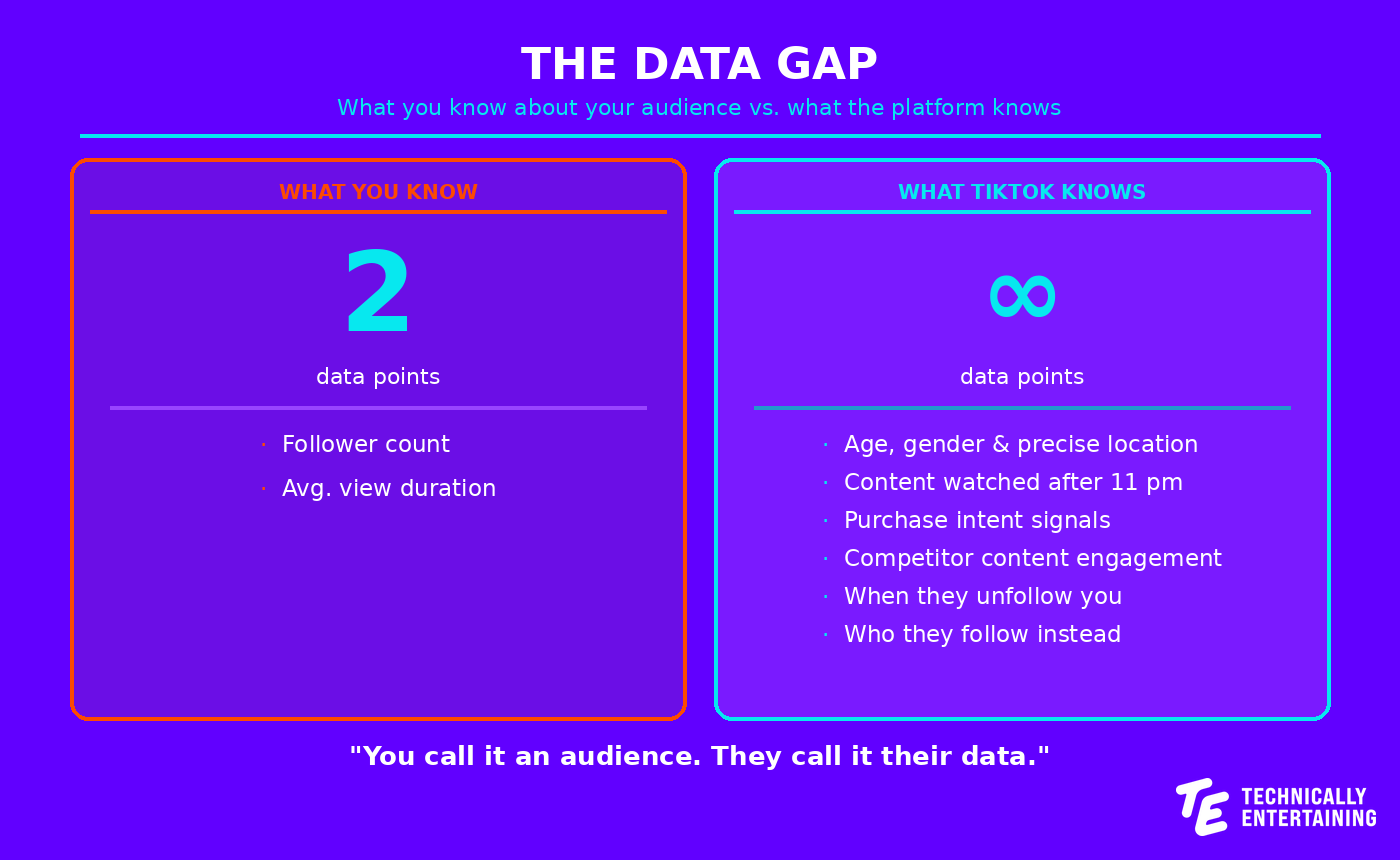
Consider the information asymmetry in practice. TikTok knows which of your followers are 24-year-old women in Manchester who watch beauty content late at night and are in the market for a new moisturiser. They know when those people churn, who they follow instead, what competitor content they engage with. You know your follower count and your average view duration. That gap is not incidental. It is the source of the platform’s entire business model.
Gaming platform Roblox just recently demonstrated this dynamic out in the open. The company announced that starting in 2027, it will begin charging creators a fee for integrating brands into their existing games. This marks a significant shift, as Roblox moves to capture a portion of the revenue from independently negotiated brand partnerships on its platform. It’s effectively another toll brands pay at the toll both (the platform) they have to use if they want to reach a predominantly younger audience. Meanwhile, more and more brands are seriously questioning the tangible return of building $200,000 gaming experiences on Roblox. The platform will charge these additional fees because it can and brands really don’t have anywhere else to go.
The Relationship Was Always Adversarial
The most persistent aspect of this dynamic is that it is disguised as cooperation. Platforms actively court brands. They hold conferences, publish case studies, offer managed service teams. They want your content because it attracts and retains users. They want your ad spend because it funds their business. They need you.
Needing you and sharing power with you are entirely different things. As Thompson noted in his follow-up analysis, suppliers to aggregators face a fundamental structural problem: even when aggregators genuinely depend on them, the aggregator’s control of the consumer interface means suppliers can be played off against each other. There is always another brand willing to create content. There is always another advertiser willing to buy reach.
The platform’s data moat is the product. The incentive for a platform to share meaningful audience data with you is structurally negative. If you understood your audience deeply enough to reach them directly, you would need the platform less. That is precisely why you don’t get that data.
The Measurement Problem Is Getting Worse
What makes this dynamic increasingly urgent is that the platforms’ data advantage is compounding faster than most brands’ ability to respond. As AI-mediated discovery grows through tools like ChatGPT, Perplexity, and Google’s AI Overviews, a new layer of aggregation is forming that is even more opaque than social media.
On Instagram or TikTok, a brand can maintain a presence, publish content, and build a following. In AI-mediated search, there is no profile page. There is no follower count. There is either relevance or invisibility, determined by systems you cannot see and cannot directly influence.
The brands that spent a decade optimising for search, building content libraries and SEO strategies, are watching organic traffic collapse as AI answers replace link clicks. One platform dependency was traded for another, and now that second dependency is being eroded by a third.
The Question Every Brand Needs to Answer Now
I am not arguing that brands should abandon social platforms or stop investing in reach. These channels have genuine value and, for many categories, represent the most efficient way to grow awareness at scale. The error is treating them as a destination rather than a funnel, and confusing rented audience with owned audience.
The question every brand needs to sit with is this: if the three platforms you rely on most changed their algorithm, raised their ad prices by 40%, or disappeared tomorrow, what would you have left? What direct relationships do you own? What data do you hold? Who can you reach without asking someone else’s permission?
Most brands, if they answer honestly, will find the answer unsettling. And that unsettling feeling is worth something. Because the brands figuring this out are not waiting for the next platform shock to motivate them. They are taking structural action now, acquiring the means of distribution itself.
That is what the next piece is about - brands that are buying the doorway to reduce their dependency on these platforms.
Have you done an honest audit of what audience you truly own, versus what you are renting? What did you find? Let me know in the comments.
Technically Entertaining covers business strategy at the intersection of gaming, technology, and entertainment. If this was forwarded to you, subscribe below to get every issue directly.
This is Part One of a three-part series on brand distribution, audience ownership, and the future of the attention economy. Subscribe today to receive the entire series straight to your inbox.