


“Stories need truth to have longevity and last.”
- Halley Gross, Writer on The Last of Us Part 2 and The Last of Us Season 2.
Dear Readers,
The Hollywood and Games Summit in Los Angeles earlier this month made two things very clear. The worlds of entertainment (movies, television) and gaming are converging in real time. At the heart of what future-proof entertainment enterprises will look like will be video games. In pursuit of stretching entertainment IP across screens and media formats to reach and engage as many people as possible, nothing rivals the effectiveness of gaming.
Many firms in Hollywood and far beyond have attempted to succeed at making gaming a core part of their overall strategy, with very mixed results. Make no mistake: making games is incredibly hard. Scaling them might be even harder in today’s market environment.
Look no further than Disney. When I researched Disney’s journey into, and out of, gaming for my book Press Play and threw the events on a 30-year timeline, the effect of visualizing Disney’s oscillation between making its own games internally, shuttering studios, licensing its IP so others could make games with it, and back to making its own games was striking.
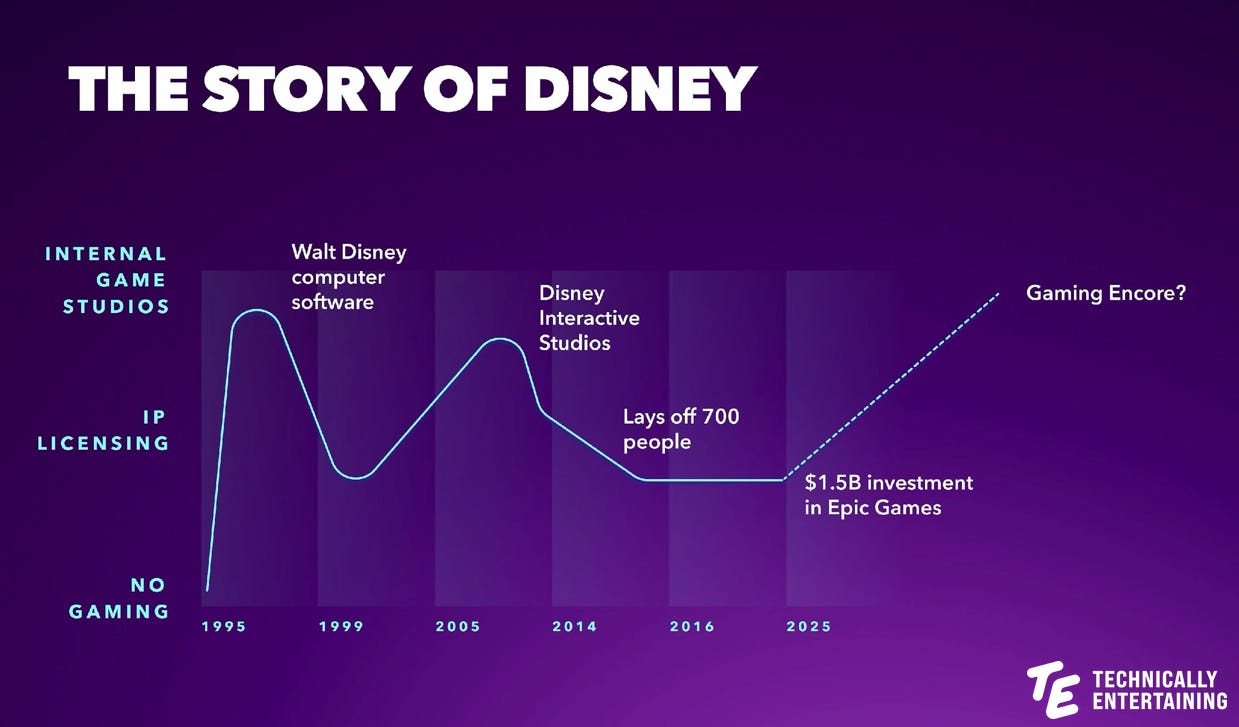
Disney’s relationship with video games looked like a bipolar relationship. On. Off. On. Off. It’s telling that to this day, arguably the best Disney video game ever made wasn’t made by Disney, but by a studio called Second Dinner that licensed Marvel IP to make Marvel Snap. All of this is not to throw shade at Disney. It’s simply this: making games is hard.
Why Hollywood Has No Choice But to Figure Out Gaming
Yet to thrive in the rapidly changing world of entertainment, the incumbents have no choice but to figure out gaming and how it can play a key part in their strategy and journey towards an immersive entertainment and media organization. Netflix, the streaming leader, understood this long ago when cofounder and former CEO Reed Hastings famously stated that his company’s biggest competitor weren’t other streamers, but a game called Fortnite. That was in the beginning of 2019. Fast forward to today and Netflix has already spent billions of dollars on figuring out a gaming offering for its own service.
If the undisputed leader in streaming is proactively investing in gaming, it begs the question if others in this space even have a choice not to.
I don’t think so.
What a Real Gaming Strategy Actually Looks Like
So what does it mean to have a gaming strategy and to make games a core part of your company? I get asked this exact question a lot and I typically point to a conversation I had with Mastercard CMO Raja Rajamannar for my book because he articulated this point in the context for Mastercard in a way that applies to every organization, better than I could have: Gaming is an always-on initiative. It’s 365 days a year, 24/7.
That’s the foundation. Companies can no longer treat their gaming efforts as singular campaigns that are disconnected from each other and in the worst case from the overall company strategy. That’s not how you get tangible results. Gucci is a company that is a living embodiment of what good looks like here. It has structured its organization within the marketing function in a way where dedicated teams are responsible for dedicated channels and executing, monitoring, tweaking, and planning for each channel individually. 365 days. 24/7. Next to teams that manage Gucci’s Instagram, TikTok, and Facebook strategy are teams that manage Gucci’s presence in Fortnite, Roblox, and Zepeto. Gaming within Gucci sees eye to eye with social media.
Now where are the leading examples within the entertainment industry? I’m convinced that one of those is Paramount-Skydance.
Paramount-Skydance’s Organizational Masterstroke
After the merger, the two companies went to work and restructured the organization immediately. One of the most crucial changes the leadership made was how it positioned gaming internally. Paramount Games as a unit now oversees everything: IP licensing and the studios that make their own games internally. But here’s the biggest change compared to how Paramount Games operated prior to the merger within just Paramount: it is no longer a part of the consumer goods business unit and instead its own business unit that lives next to movies and streaming, as a dedicated content pillar.
At first glance, this might not seem like a big deal. But it is. As a part of the consumer goods organization, games were beholden to the end of quarter numbers and treated the same way you’d treat consumer products, as well as run the same way. Need to lift up the end of quarter sales numbers? Run a promotion or throw in a discount. But games are entirely different products than classic consumer products. Kara Bilkiss, SVP Business Development and Licensing at Paramount Games, said it best in her fireside chat with me in LA: “We’re not making and selling backpacks.”
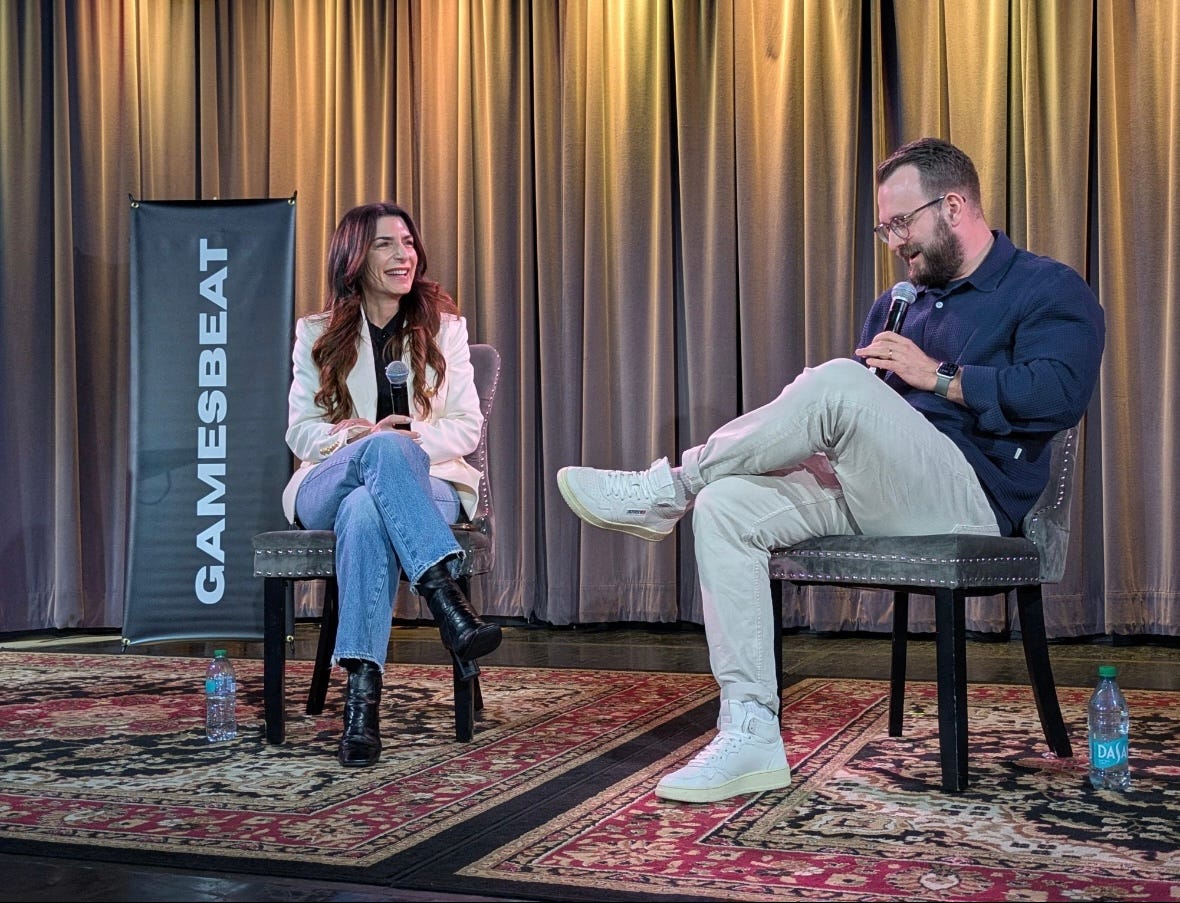
Games are content and media that engage consumers continuously. This organizational move ensures that gaming not only has a seat at the table but places gaming at the very heart of the entire immersive entertainment strategy going forward.
Why Organizational Structure Matters for IP Consistency
Placing games next to movies and TV organizationally also has another critical added benefit that is paramount (pun intended) to successfully stretching any entertainment IP across multiple screens and consumer touchpoints. While games and movies are cousins (meaning they share DNA), they display some important differences. People that play games tend to be more forward leaning and active, participating in the experience and actively shaping it. Film is a more passive experience and the viewer’s engagement is largely driven by the anticipation the audience feels for what may come in the next scene.
This is why companies can’t simply take a successful movie and copy/paste it into a game, or vice versa. Adjustments have to be made to ensure the IP fits the medium and how people engage with it. Having said that, one of the biggest aspects teams that work in this space are desperate to get right each time is this: consistency.
If the IP doesn’t feel consistent across different mediums, it doesn’t stand a chance to become a world that consumers can traverse across different screens and devices. To ensure this consistency, the people involved in these projects need to understand which aspects of the IP drive immersion for the audience, honor those (make sure every representation is maximally authentic), and identify the core tenets of the IP and stay true to them throughout. By putting games next to movies and TV, Paramount-Skydance is giving itself every chance to get this aspect right.
The Warner Bros. Discovery Battle and What Comes Next
It’s clear that Paramount-Skydance is serious about becoming an entertainment company of the future and winning. The ongoing battle for Warner Bros. Discovery is more than enough evidence. In the latest twist in this saga, WBD’s board rejected Paramount-Skydance’s offer as “inadequate” and “inferior” to Netflix’s offer.
Instead of digging into the details of the offer and whether or not WBD’s assessment is correct, I’d want to turn our attention to what Paramount-Skydance could, and maybe should, do if it doesn’t win the fight with Netflix. Because if they’re willing to spend more than $100 billion, it’s safe to assume that the money will be spent elsewhere.
Consolidate streaming downstream. The company needs to increase subscriber numbers in order to be able to compete with the scale of Netflix as well as Disney+. Buying up smaller streamers like MUBI, Starz, or making an offer to Comcast for its streaming service Peacock would bring together smaller services under one roof to establish a competitive subscriber base.
Acquire independent entertainment companies. Yes, Warner Bros. is a storied company and the idea of owning both water towers in Hollywood is romantic. But if it doesn’t pan out, the company should increase its production capabilities for high-end content regardless. A24 comes to mind, the studio behind smash hits like Euphoria, Midsommar, Everything Everywhere All At Once. See-Saw Films is another (they make the fantastic show Slow Horses). There are ways for Paramount-Skydance to achieve the same goal without WBD.
Go BIG on gaming. Yes, WBD has Warner Bros. Games and it has some very good talent and four franchises that have each made $1 billion in lifetime revenue. It is also true that the gaming revenue for WBD declined over the past 24 months and the teams are struggling to deliver another hit. With all due respect, there are stronger gaming assets in the market that potentially fit Paramount-Skydance’s vision even better.
One of these companies is Take-Two Interactive. Owners of Rockstar (who make GTA), Zynga (the mobile games developer and publisher), and many more. Take-Two currently has a market cap of roughly $46 billion. Even if we assume a 50% markup on the current stock price, that would mean a $69 billion offer could land Paramount-Skydance GTA, Words with Friends, Farmville, and incredible publishing skills across all platforms. Especially with respect to GTA, GTA VI coming out in 2026, and the rumors regarding its anticipated UGC elements and creator economy focus (which would pit GTA directly against Fortnite and Roblox), this move would give Paramount-Skydance an open world universe that could become a playground for all of its entertainment IP.
I personally love the idea of this. And at $69 billion, there’s still plenty of cash left over to execute on the above.
The Stakes Are Clear
Paramount-Skydance has already done the hard work internally. They’ve restructured gaming from a consumer products afterthought into a core content pillar. They understand that gaming isn’t a campaign, it’s an always-on strategy that sits alongside movies and streaming as a fundamental part of modern entertainment.
Whether they win Warner Bros. Discovery or pivot to alternatives like Take-Two Interactive, one thing is certain: the companies that figure out how to make gaming a genuine part of their DNA will define the next era of entertainment. Those that don’t will be left wondering why their IP isn’t reaching audiences where they actually spend their time.
The playbook has been rewritten. Now we’ll see who has the courage to follow it.
The holidays are around the corner. We’ll be sure to place the gifts of reviewing the major headlines of 2025 and the predictions for the new year under your Christmas tree. Be sure to subscribe - otherwise Santa won’t know where to find you :)