


Dear Readers,
Disneyland. The Simpsons. K-Pop Demon Hunters. SpongeBob. South Park.
What do all of these have in common? They all integrated in the video game Fortnite in just the last four months.
Fortnite is the premier cultural platform of our time. I was recently asked on a podcast which video games and gaming platforms brands absolutely have to be present in, in 2026, if they want to engage players and consumers.
Everyone’s knee jerk reaction right now is to say Roblox. Yes, Roblox had a great year 2025. But the game or environment a brand chooses to engage in has to be chosen carefully against the following two questions:
Who is the audience I’m trying to engage / what are their values?
Who am I as a brand and what do I stand for?
The platform and game that lets a brand make those two ends meet is the best platform, because it leads to authentic experiences.
So yes, Roblox is having a moment, but the truth is Roblox isn’t a fit for every brand, nor is it smart to focus your gaming efforts on one single platform. Take a look at Mattel. Its SVP Marcus Liassides recently said: The strategy isn’t Roblox. It’s creator.
Or take a look at the NYT: they’re making their own mobile games.
The second part to the question I was asked on the podcast was this: what game and platform do I think will have a breakout year this year?
Here, my answer is a lot pointed and singular: Fortnite.
Yes, Fortnite has been around for a while and it’s certainly not a dark horse nor should it come as a complete surprise that my pick is Fortnite. But why Fortnite will have a massive year this year, now, is really the important aspect to unpack.
Epic Games creator Fortnite has taken deliberate actions to complete a highly technical transition from a singular game to a comprehensive, multi-modal digital platform. From integrating professional tools for content creators, opening itself up to rival game engines, to building direct-to-consumer commerce systems, Epic Games alleviated some of the biggest complaints UGC creators in Fortnite had while making outright savvy business moves. Let’s take a look at each of them.
The Revised Creator Economy: Paying for Real Engagement
The primary driver for Fortnite’s anticipated dominance in 2026 is the radical restructuring of its creator economy. Epic Games has moved beyond a simple affiliate model to a sophisticated engagement-based system that compensates creators based on the value they bring to the ecosystem. This transition is powered by the Unreal Editor for Fortnite (UEFN), a toolset that allows developers to utilize Unreal Engine’s professional capabilities, including advanced rendering, lighting, and VFX, directly within the Fortnite environment.
The 40% Engagement Pool
The engagement payout system distributes 40% of eligible net revenue from Fortnite’s Item Shop and real-money purchases to qualifying island publishers. This “Engagement Pool” is calculated by taking gross revenue and adjusting for platform fees (12% on Epic Games Store, 30% on consoles) and taxes. Epic retains the remaining 60% for ecosystem development, infrastructure, and marketing.
The payout formula, significantly revised on November 1, 2025, now prioritizes high-value engagement metrics. Active playtime tracks total minutes players spend on an island, but only counts engagement from paying players who have made at least one real-money purchase. This prevents exploitation through bots or idle accounts. Island retention rewards creators when players return specifically to their island on subsequent days, not just to Fortnite generally. Playtime surrounding V-Bucks spend provides bonuses to creators whose content is engaged with by players in the week before or after they spend currency, creating a direct link between creator content and ecosystem revenue.
User Acquisition as Growth Catalyst
The most aggressive change for 2026 is the introduction of user acquisition rewards. Epic now rewards developers who bring new or lapsed players (those who haven’t played in six months) into the game. If a creator attracts such a player to their island, they receive 75% of that player’s contributions to the engagement pool for six months. These contributions are derived from the player’s total V-Bucks spending across the entire game, effectively granting creators a significant share of that user’s lifetime value.
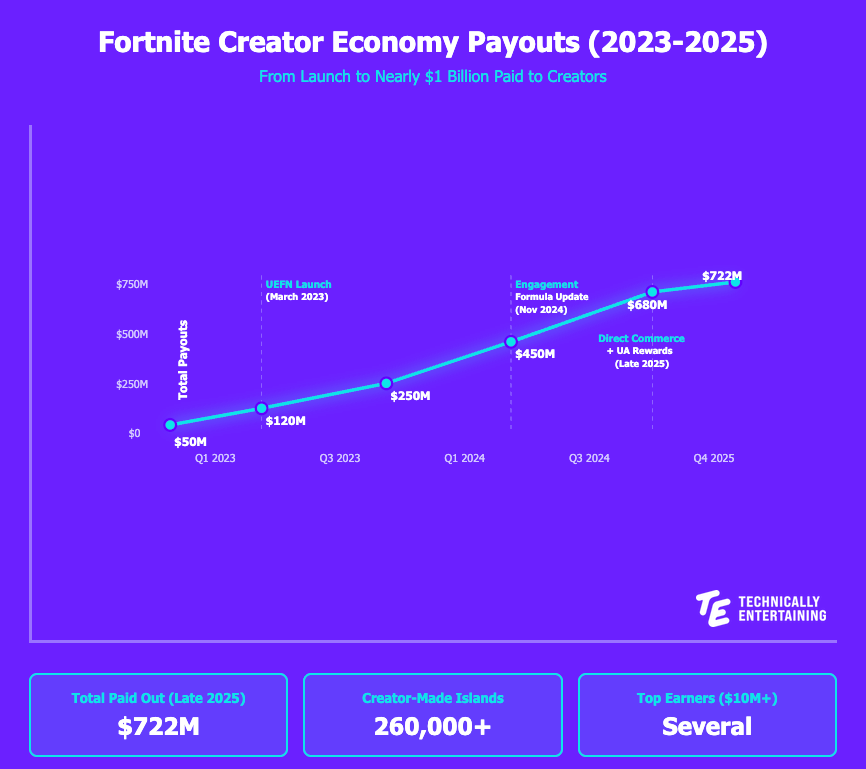
This revised structure has already seen massive success. Since UEFN’s launch, players have spent over 11.2 billion hours across 260,000 creator-made islands, resulting in $722 million paid out to creators by late 2025. Several individual creators have already earned more than $10 million each, proving the Fortnite creator ecosystem can support professional studios and independent developers alike.
Direct Creator Commerce: Building Sustainable Business Models
The introduction of Direct Creator Commerce in late 2025 marks a paradigm shift in how developers monetize content. Previously, creators relied solely on indirect engagement payouts. Now they can sell digital items directly within their islands using V-Bucks, building sustainable business models less dependent on general ecosystem traffic.
The Promotional 100% Revenue Share
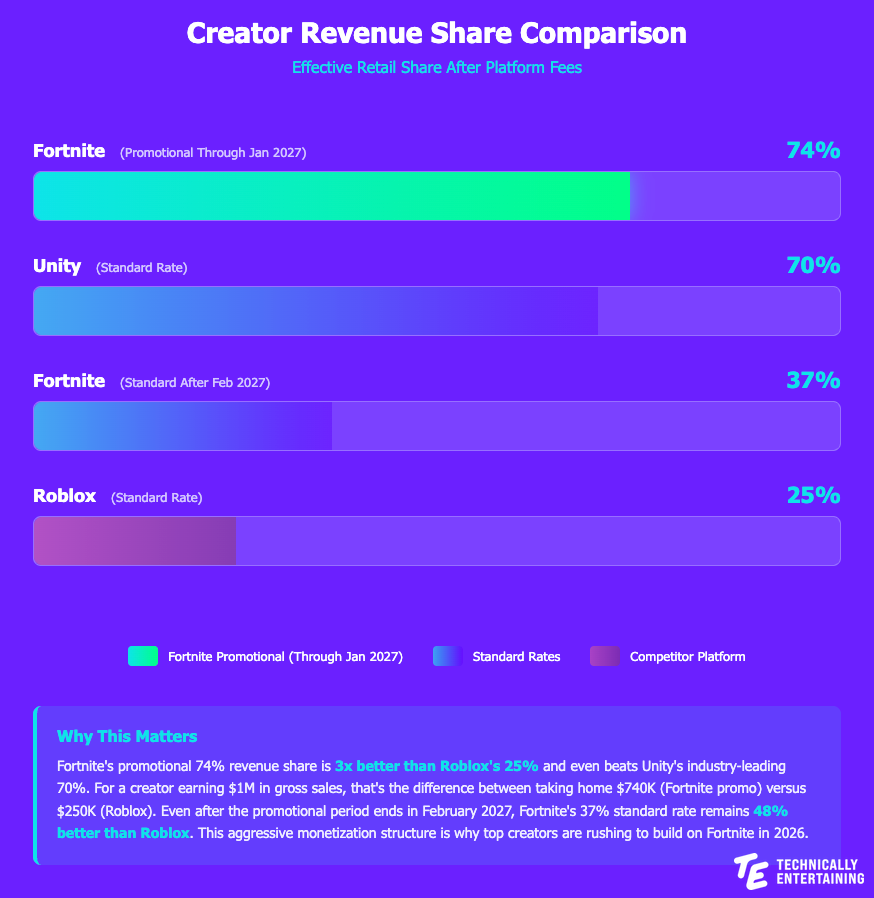
To incentivize rapid adoption, Epic announced a promotional revenue share of 100% of V-Bucks value for all sales made within creator islands through January 31, 2027. After this period, the rate drops to 50%. After accounting for platform fees averaging 26% across devices, the 100% promotional share translates to creators receiving approximately 74% of retail spending. This crushes competitor platforms like Roblox, which typically offers only 25% to developers.
Creators implement these transactions using UEFN and the Verse programming language. Items are defined as “entitlements” with immutable attributes. Prices must be set between 50 and 5,000 V-Bucks in increments of 50.
The regulatory framework is rigorous. Creators cannot sell global Fortnite cosmetics like Outfits or Emotes, as these remain exclusive to the core shop. However, developers can sell gameplay-consequential items like “Boots of Speed” that grant advantages within specific islands. For paid random items (loot boxes), developers must explicitly state percentage chances and use Epic’s APIs to ensure compliance with regional laws and parental controls.
The Strategic Alliance with Unity: Breaking Down Walls
One of the most unexpected developments for Fortnite in 2026 is the landmark partnership with Unity, announced in November 2025. These traditional rivals in the game engine space have aligned to allow developers to publish Unity-built games directly into the Fortnite ecosystem. This move is a strategic attempt to build an open metaverse that prioritizes developer choice over platform-exclusive silos.
Interoperability and Commerce Integration
The partnership goes beyond publishing. Unity is bringing Unreal Engine support to its cross-platform commerce tools, allowing Unreal developers to manage digital catalogs, payment providers, and web shops across PC, mobile, and web. For Unity developers, the benefit is access to Fortnite’s 650 million registered users. By publishing to Fortnite, they participate in the Creator Economy, receiving engagement payouts and conducting in-island sales within their Unity-developed experiences.
This technical bridge allows standalone experiences to exist within the massive Fortnite metaverse, effectively turning Fortnite into a “gamefront,” an interactive interface that can launch other programs. Through this collaboration, Epic Games Founder Tim Sweeney and Unity CEO Matt Bromberg are positioning their companies to lead a future where companies build an open metaverse that is interoperable and fair. This interoperability is expected to drive significant growth in 2026 as high-quality indie and professional titles built in Unity flood the Fortnite Discover tab.
Self-Serve IP Licensing: Democratizing Brand Collaboration
In 2026, the barrier to entry for creators wishing to work with major brands has been virtually eliminated through the IP Partner Licensing Program. This system allows creators to use curated assets from global IPs like LEGO, Teenage Mutant Ninja Turtles, and Netflix’s Squid Game directly within UEFN projects without negotiating individual licensing deals.
The 15% IP Partner Fee Model
The program operates on a fee schedule. When a creator uses a partner template or asset, 15% of their potential engagement payout is automatically diverted to the IP holder as a licensing fee. Creators access these assets through a dedicated “Brand Selection” dropdown in the UEFN Project Browser, allowing them to start building with bespoke templates. To publish, creators simply enroll in the Island Creator Program and sign the IP Partner Licensing Agreement, a streamlined one-click process.
This self-serve model represents a fundamental shift in IP strategy. By allowing the community to build official branded islands, IP holders generate revenue and engagement at scale previously impossible through traditional owned-and-operated world-building. Data from GEEIQ indicates brand integrations on Fortnite grew at an average of 32% quarter-on-quarter since early 2024, far outpacing the 14% growth of owned brand islands. The future of brand activation in Fortnite is decentralization, where brands provide the building blocks for the community to create experiences.
Case Study: The Simpsons Mini-Season
The collaboration with The Simpsons in November 2025 served as a blueprint for high-impact IP rollouts. To quote an Epic Games executive when I asked him about the performance of this collaboration: “It’s done incredibly well for us.”
Rather than a simple cosmetic drop, the event was a month-long mini-season that completely transformed the Fortnite environment, bridging the gap between Chapter 6 and Chapter 7 while maintaining high player engagement during a period that usually sees a seasonal dip.

Map Overhaul and Transmedia Storytelling
The rollout transformed the top-left corner of the Fortnite island into a cel-shaded recreation of Springfield. Iconic locations like Moe’s Tavern, Krusty Burger, and Springfield Nuclear Power Plant were introduced as named locations. The existing Berg gas stations were replaced by Kwik-E-Marts. The aesthetic matched the show’s animation style perfectly.
The event featured a narrative arc where Homer Simpson attempted to use a Zero Point shard to solve his problems, inadvertently causing food rain (supersized donuts and pizzas falling from the sky) and creating a kaiju version of himself. To deepen immersion, Epic released weekly animated shorts both in-game and on Disney+, including “Apocalypse D’Oh” and “The Incredible Bulk,” providing narrative hooks that kept players returning.
The battle pass included Homer, Marge, Flanders, and remixed versions of Fortnite mascots like “Blinky Fishstick” and “Springfielder Peely.” The combination of nostalgia-driven content, new gameplay mechanics, and transmedia storytelling made this one of the most successful collaborations in the game’s history.
Case Study: South Park Born in Chaos Event
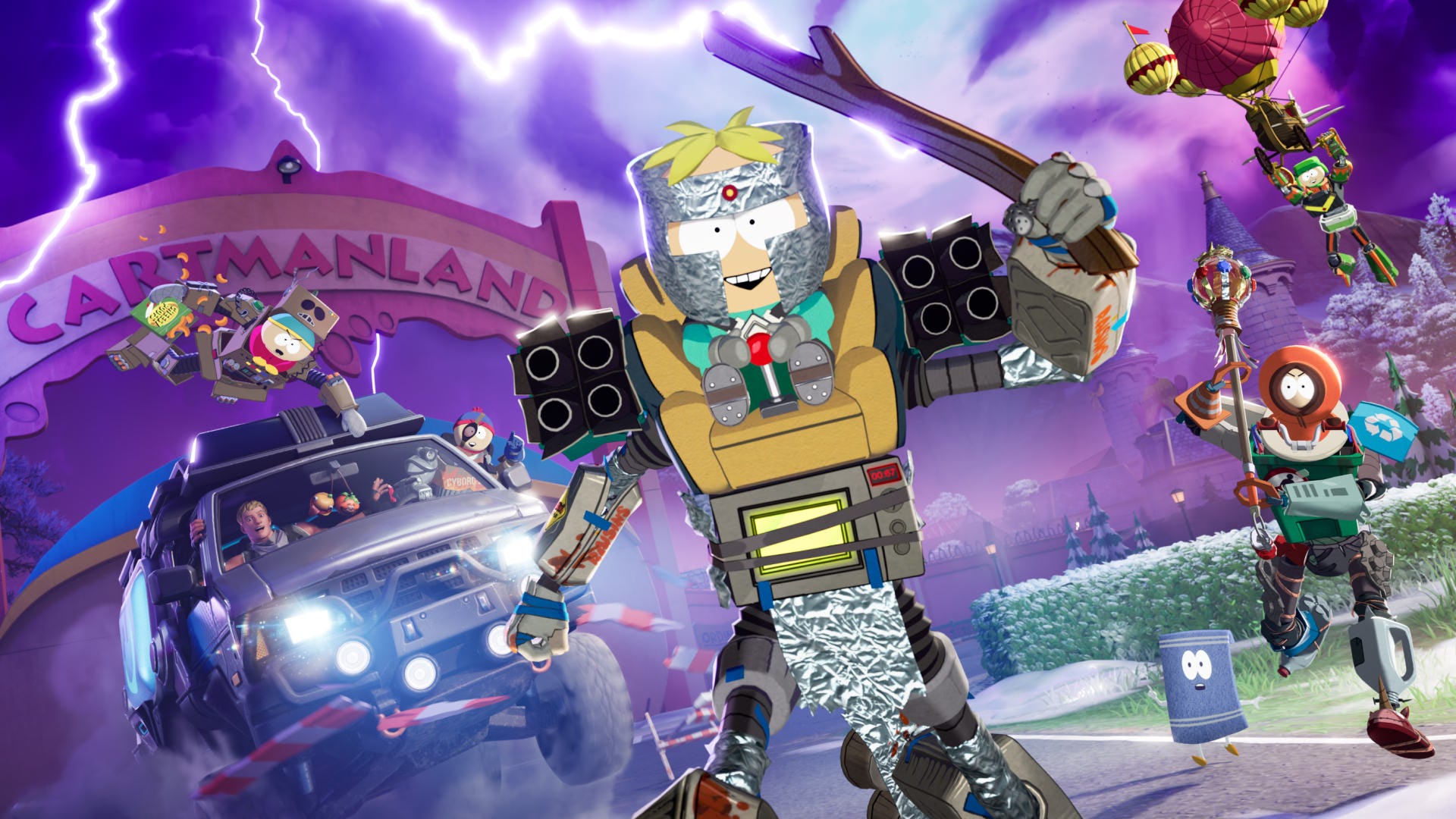
Following The Simpsons, the South Park “Born in Chaos” event (January 9 to February 5, 2026) demonstrated further evolution in how IP integrates into core Battle Royale. This event focused less on map overhaul and more on experimental game modes and high-impact mythic items - and it couldn’t be more timely given the shows absolute cultural dominance given current political events.
Quints Mode and Game-Changing Items
The most significant structural change was the introduction of “Quints,” a five-player squad mode added to standard Battle Royale and Zero Build playlists. This was the first time in Fortnite’s history that five-player teams were supported, fundamentally reshaping match pacing and team strategy.
The event introduced items that directly manipulated core game mechanics. The “Stick of Truth” allowed players to control the Storm’s behavior and location, providing immense tactical advantage. “Kenny’s Respawn Token” granted players an automatic reboot upon death, nodding to the show’s recurring theme of Kenny’s frequent deaths and resurrections.
The event was supported by a free, quest-driven pass. Unlike the standard Battle Pass, rewards like the “Backpack of CRED” could only be earned by completing specific South Park-themed quests, such as riding rides at Cartmanland or eliminating a player after getting knocked. This design ensured the event felt like a focused, interactive experience rather than just a cosmetic sale.
The Disney Partnership: Building a Persistent Universe
The collaboration between Epic Games and Disney, fueled by Disney’s $1.5 billion investment in February 2024, is the most ambitious project in the Fortnite 2026 roadmap. The objective is to build a persistent entertainment universe that interoperates with Fortnite and brings characters from Disney, Pixar, Marvel, Star Wars, and Avatar into a shared space.
Disneyland Game Rush
In November 2025, the first concrete product launched: “Disneyland Game Rush,” a collection of theme park-inspired minigames like a Haunted Mansion treasure hunt and Spider-Man shooting gallery, connected through a hub recreating the feel of walking through Disneyland. What distinguishes this from previous collaborations is its structure as a mostly self-contained space where Disney maintains complete control over its branded corner of the metaverse.
Crucially, this universe is built using Unreal Engine, allowing for high graphical fidelity and seamless transitions between different content areas. While it interoperates with Fortnite, not all Fortnite skins work in the Disney universe to ensure brand safety. This project is Disney’s answer to the metaverse, allowing them to reach hundreds of millions of active Fortnite players without building a separate platform from scratch.
Digital-Physical Integration
A key feature expected in 2026 is convergence of the digital experience with real-world Disney Parks. Reports suggest players may complete challenges in Fortnite that unlock exclusive rewards or experiences during physical park visits, and vice versa. This hybrid model positions the Fortnite x Disney universe as more than just a game. It’s a cross-media ecosystem that merges gaming, media consumption, and real-world hospitality.
Expanding the Sub-Ecosystems: LEGO and Festival
While Battle Royale remains the flagship mode, the success of 2026 is also driven by expansion of sub-ecosystems like LEGO Fortnite and Fortnite Festival. These modes cater to different player niches and ensure Fortnite functions as a comprehensive entertainment platform.
LEGO Fortnite Odyssey
LEGO Fortnite has evolved into “LEGO Fortnite Odyssey,” with the 2026 roadmap focusing on deep progression and survival mechanics. The “Storm Chasers” update introduced the Storm King, a recurring villain whose invasion creates random Storm Dungeons across the map. These dungeons provide high-level puzzles and combat challenges that refresh every 24 hours with new pathways and dangers.
Physical world integration is significant, with five new LEGO Fortnite sets scheduled for 2026, including a 1,963-piece “Rave Cave” and buildable “Kit’s Mech.” These sets strengthen the brand’s presence in physical retail while driving players back to the digital mode.
Fortnite Festival: The Music Distribution Channel
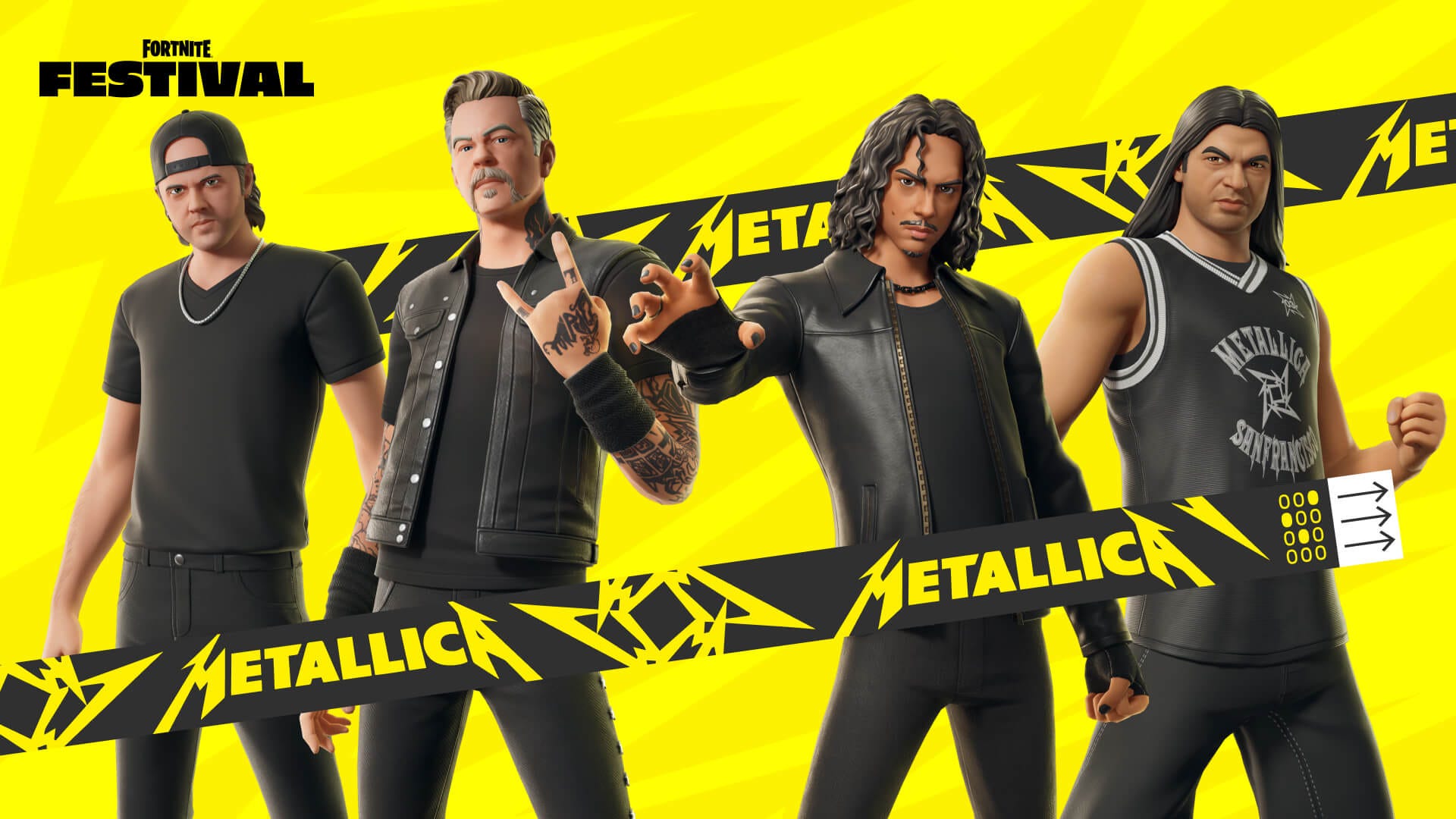
Fortnite Festival, the Rock Band-style mode developed by Harmonix, has committed to long-term support through 2026 and beyond. The mode has already featured The Weeknd, Lady Gaga, and Metallica, and the 2026 roadmap includes highly anticipated Rap, Rock/Metal, and Country seasons. Predictions for 2026 headliners include Kendrick Lamar, Linkin Park, and Chappell Roan.
Technically, the mode is expected to introduce pro vocals and harmony support, turning the game into a karaoke powerhouse that can challenge dedicated music games. With over 285 tracks available by late 2024 and weekly additions of Jam Tracks, Fortnite Festival has become a major distribution channel for the music industry, allowing artists to reach millions of fans through interactive gameplay.
The Platform Has Matured
The headline of this paragraph signifies the monumental shift Fortnite has undertaken: it’s no longer a singular game. It’s a multifaceted institutional platform.
By integrating professional development tools (UEFN), opening the doors to rival engines (Unity), and building direct-to-consumer commerce systems, Epic Games has effectively decentralized the game’s growth. The platform no longer relies solely on Epic’s internal development cycles but is instead propelled by the collective creativity and marketing power of hundreds of thousands of developers and the world’s largest IP holders - with the winds of the cultural Zeitgeist blowing into its sails.
The success of The Simpsons and South Park rollouts demonstrates that Fortnite can serve as a premium distribution channel for narrative and thematic content, while the Disney partnership suggests a future where digital and physical entertainment are seamlessly integrated. With 650 million registered users and a creator economy that has already paid out nearly a billion dollars, Fortnite is not merely existing. It is defining the infrastructure of the next generation of digital experience.
For developers, brands, and players alike, 2026 stands as the year Fortnite matured into a true persistent universe, a game front that serves as the central hub for the global interactive economy. The question is no longer whether brands should be in Fortnite. It’s how quickly they can get there before their competitors do.
What brands do you think will make the biggest splash in Fortnite this year? Let me know in the comments.
I will be speaking at one of Europe’s largest tech and marketing conferences, DLD Munich, this week. In focus: the power of video gaming and how every company can harness the power of play. Subscribe today to get the behind-the-scenes chatter of what top executives of leading brands like Henkel, Adidas, or BMW are saying.