

Why 78% of Brand Activations in Immersive Worlds Live on Roblox or Fortnite, and Why That's a Trap
Five questions every brand leader should ask before adding to the ever-growing pile of brand integrations. Part 1 of a 4-part series on platform concentration in immersive gaming.

A few weeks ago I sat through a panel at the iicon conference where Lisa Willet, Senior Director of Global Strategic Partnerships at Roblox, was on stage with brand leaders from Adidas. At some point in the conversation she said something out loud that should give every brand and marketing leader currently planning a 2026 gaming activation a moment of pause: there are now more than 40 million games on Roblox, and discovery has become so difficult that the platform itself is investing heavily in finding ways to help users surface what’s relevant to them.
Forty million. That’s the room your brand experience is being asked to stand out in.
I bring this up because the question I get asked most often in executive meetings these days is some version of: “Which gaming platform should we be on?” And almost every time, the person asking has already half-decided the answer. Usually it’s Roblox. Sometimes it’s Fortnite. The kneejerk reaction across boardrooms is to default to the two platforms that dominate the headlines.
The data, on the surface, supports that instinct. According to GEEIQ’s Q2 2026 Media & Entertainment Micro Report, 78.4% of all Media & Entertainment brand activations in virtual worlds happen on either Roblox (54.5%) or Fortnite (23.9%). The category itself has grown 79-fold since 2020, from 10 tracked activations to 789 today. And as of 2026, integrations into existing worlds have overtaken brand-owned experiences for the first time, sitting at 58% of the mix.
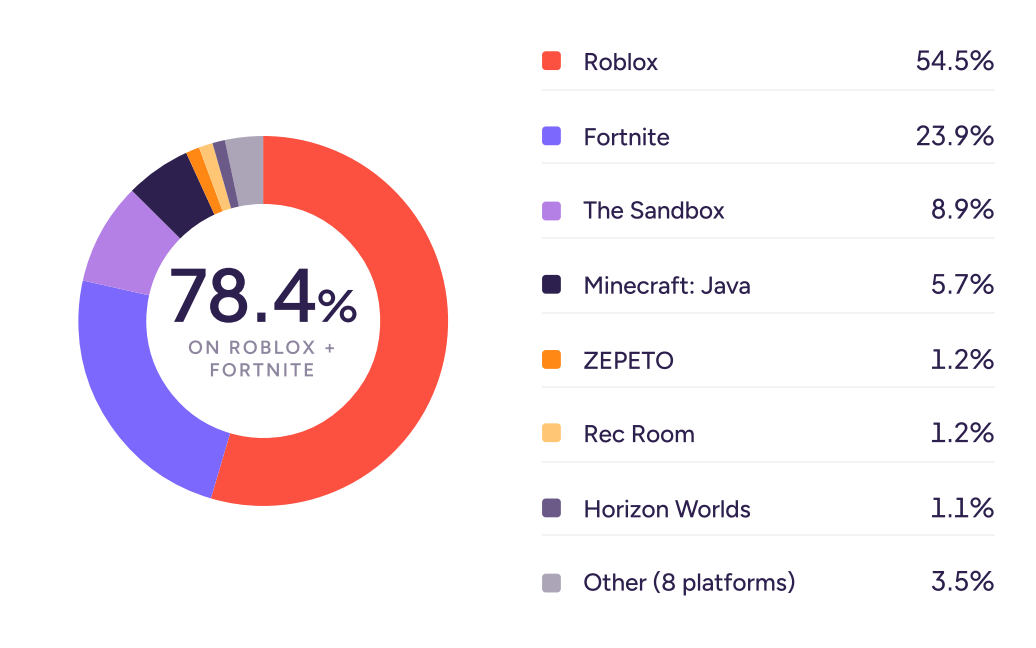
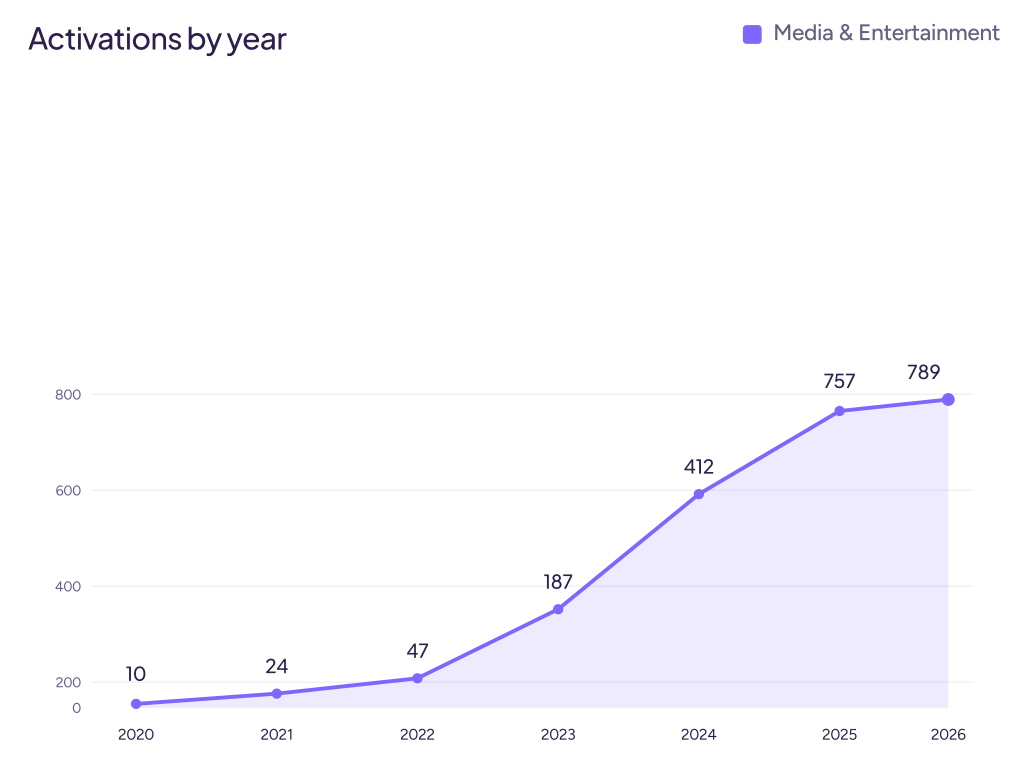
If you’re an executive scanning these charts, the playbook looks obvious. Go where the audience already lives. Plug in.
That playbook is a trap. The honest answer to “which platform should we be on?” is almost never a single platform. It’s a thoughtful, nuanced “it depends.”
This is the first piece in a four-part series on platform concentration in immersive gaming. Over the coming weeks I’ll walk through the 2x2 framework I use with brand leaders to map their options, take a deep dive into Skate as the overlooked alternative now rising up, and close the series with an interview with the General Manager at EA overseeing the Skate franchise. Today’s piece is the foundation: why concentrating your gaming spend in two platforms is more fragile than it looks, and the five questions every brand leader needs to answer before signing the contract.
The Concentration Problem Brands Aren’t Pricing In
The 78.4% number from GEEIQ is the headline you’ve probably already seen circulating in trade decks. What deserves more attention is what’s underneath it.
Six years ago, the category was 90% brand-owned experiences. Brands built their own worlds, hired their own teams, controlled their own roadmaps. Today, 58% of activations are integrations into someone else’s platform. That shift has delivered enormous gains in speed and scale. It has also represented a quiet transfer of leverage, from the brand to the platform owner.
Previously released posts relevant to this story.


Algorithm changes you can’t predict. Revenue share changes you can’t negotiate. Audience composition shifts you can’t control. The same dynamics that have made marketers wary of putting their entire budget on Meta or TikTok are now playing out inside two gaming platforms. The executives I speak with are starting to ask the same questions they asked about social five years ago: what happens when the rules change?
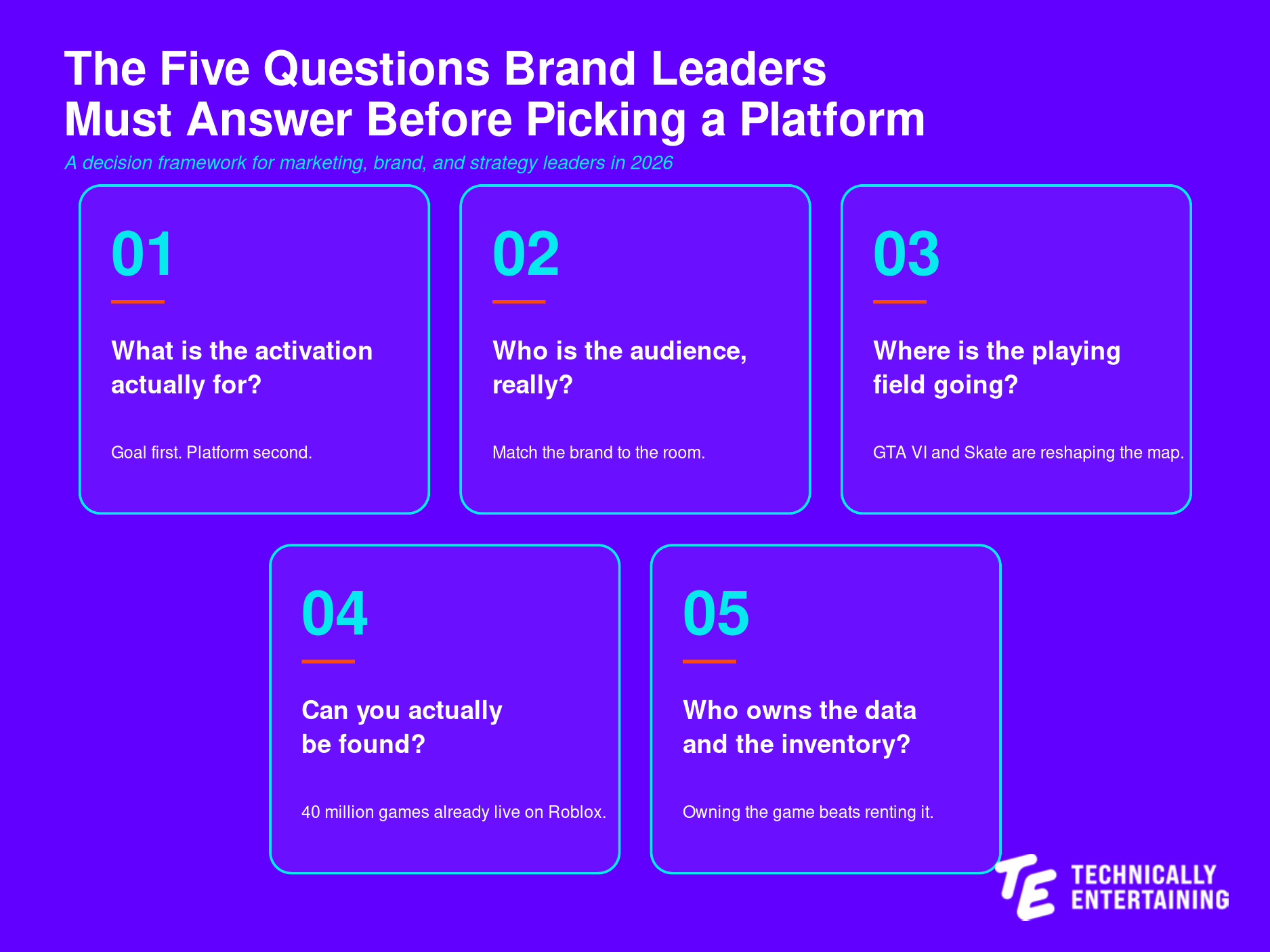
Question One: What Is the Activation Actually For?
Before you pick a platform, get specific about the goal. Are you running a broad brand awareness play with a younger demographic? Then yes, Roblox and Fortnite should be on your list. Roblox in particular still skews younger, and Fortnite gives you cultural relevance across Gen Z and Millennials.
If your goal is to drive real-world commerce with the affluent, core-consumer demographic, the answer changes completely. The average mobile gamer globally is between 36 and 41 years old. That’s where household economic decision-making sits. That’s where credit cards already get pulled out for in-app purchases on a daily basis. Mobile games should be at or near the top of your list, and a Roblox build is almost certainly the wrong place to put your dollars.
The platform follows the goal. Reverse that order and you end up with an activation that looked good in the pitch deck and underperformed in market.
Question Two: Who Is the Audience, Really?
Every platform has its own culture. Roblox is a creator-first ecosystem where teen builders set the pace. Fortnite is a cultural mainline where Travis Scott, The Simpsons, and South Park share the same stage. Mobile games like Royal Match or Coin Master attract a different audience entirely: short play sessions, often on the couch, frequently in the over-35 bracket. Players come to each of these games for different reasons, and they arrive open to different brand messages.
Brands don’t have to be everywhere. They need to be where they can authentically meet their ideal audience. That requires deepening your understanding of player preferences, the dynamics unique to each platform, and how your brand actually fits the room. The best activations I’ve seen come from brand teams that picked one or two platforms with real conviction about why. The weakest come from brand teams that picked the platforms that scored well on a reach chart.
Question Three: Where Is the Playing Field Going?
The map for 2026 looks different from the map for 2025. Two games in particular are about to change the calculus.
Grand Theft Auto VI launches later this year. Given Rockstar’s live operations chops and the franchise’s broad fandom, GTA VI will be an extremely attractive playground for brands. Take-Two CEO Strauss Zelnick has already confirmed on stage that the company has been receiving many requests and offers from brands to integrate. So far, Rockstar has stayed away to avoid “tarnishing” the experience with ads. My read: if these became actual brand integrations with Rockstar holding creative sign-off, rather than ad units, the money becomes too appealing for Take-Two to turn down indefinitely.
EA’s Skate, currently in soft launch, has roughly 2 million monthly active users and is actively experimenting and negotiating with brands. It doesn’t have the scale of Roblox or Fortnite yet, and it doesn’t need to in order to become an attractive alternative for brand spend. Skateboarding culture brings something the larger platforms can’t easily replicate: an authentic subculture with decades of real-world brand history, from Nike SB to Vans to Supreme.
Welevel is another emerging option worth keeping an eye on. The point of all this is not to chase every shiny object. The point is that the platform map for immersive games is genuinely about to expand, and concentrating your spend on two platforms right now means you’re not building the relationships, the data, or the team you’ll need to act when the map shifts under your feet.
Question Four: Can You Actually Be Found?
Back to Lisa Willet’s admission for a second. Forty million games on Roblox. Discovery is broken to the point where the platform itself is investing heavily to fix it. That fact alone should reframe how you think about “scale” on Roblox.
Yes, the platform has hundreds of millions of users. Your brand experience is not competing for their attention against the other 217 brands GEEIQ tracks. It’s competing against 40 million experiences, most of them built by independent creators with stronger native audiences than any brand will ever have. The cost of standing out is going up. The CPM math that justified the build a year ago looks different today.
This is the part most brand briefs underprice. Reach on the platform is a separate question from reach inside the platform.
Question Five: Who Owns the Data and the Inventory?
This is the question I’ve heard more in the last few weeks than in the previous twelve months combined. Brand leaders are increasingly asking: what would it take for us to build our own game, or at least partner in a way where we have full access to the entire world?
Two reasons keep coming up.
First, first-party data. Roblox and Fortnite share information with brands to varying degrees of transparency, and the level of access differs by brand and by deal. Even the most generous platform-side data sharing comes nowhere close to what brands can unlock when they own the entire experience. Owning the customer relationship inside a game means combining gameplay signals with everything you already know from your CRM, your retail footprint, your loyalty program. That’s a fundamentally different asset than a top-line engagement report from a third-party platform.
Second, inventory. For media companies in particular, owning the game means owning a new advertising surface they can monetize with their existing ad partners. Disney, Warner Bros. Discovery, and Paramount have stopped thinking about gaming as a marketing line item. They’re thinking about it as an inventory category. That’s a different conversation, and it leads to different platform choices.
Treat Platform Selection Like Retail Selection
The default to Roblox or Fortnite has a real logic behind it. Both platforms deliver scale, engagement, and a clear unit-economics story. The problem is that brand leaders too often arrive at the answer before they’ve asked the question. Concentration risk, discovery friction, and a static view of the platform map quietly make the decision for them.
The brands that will win the next phase of immersive gaming are the ones treating platform selection the way they treat retail selection. Not every store carries your audience. Not every store fits your brand. Not every store will be open in three years. The same logic applies here.
In the next piece, I’ll walk through the 2x2 matrix I use to map Roblox, Fortnite, GTA VI, and Skate against the two variables that matter most: scale of audience and cultural specificity. The matrix is what turns “it depends” into a decision you can actually defend in the boardroom.
Which platform are you betting on for 2026, and what’s the question that’s pointing you there? Let me know in the comments.
Technically Entertaining is the publication for marketing, brand, and strategy leaders navigating the intersection of gaming, technology, and entertainment. Subscribe to get the rest of this four-part series on platform concentration in immersive gaming, starting with next week’s deep dive into the 2x2 matrix that maps Roblox, Fortnite, GTA VI, and Skate.