


Dear Readers,
I just got off the stage in Zurich at the Innovation Finanzplatz Schweiz Conference 2026 where I gave the keynote to Switzerland’s top 200 bankers on why gaming is essential for financial service providers in the context of modern day consumer touch points and engagement. I’m pretty sure I was the only non-banking person at the entire conference.
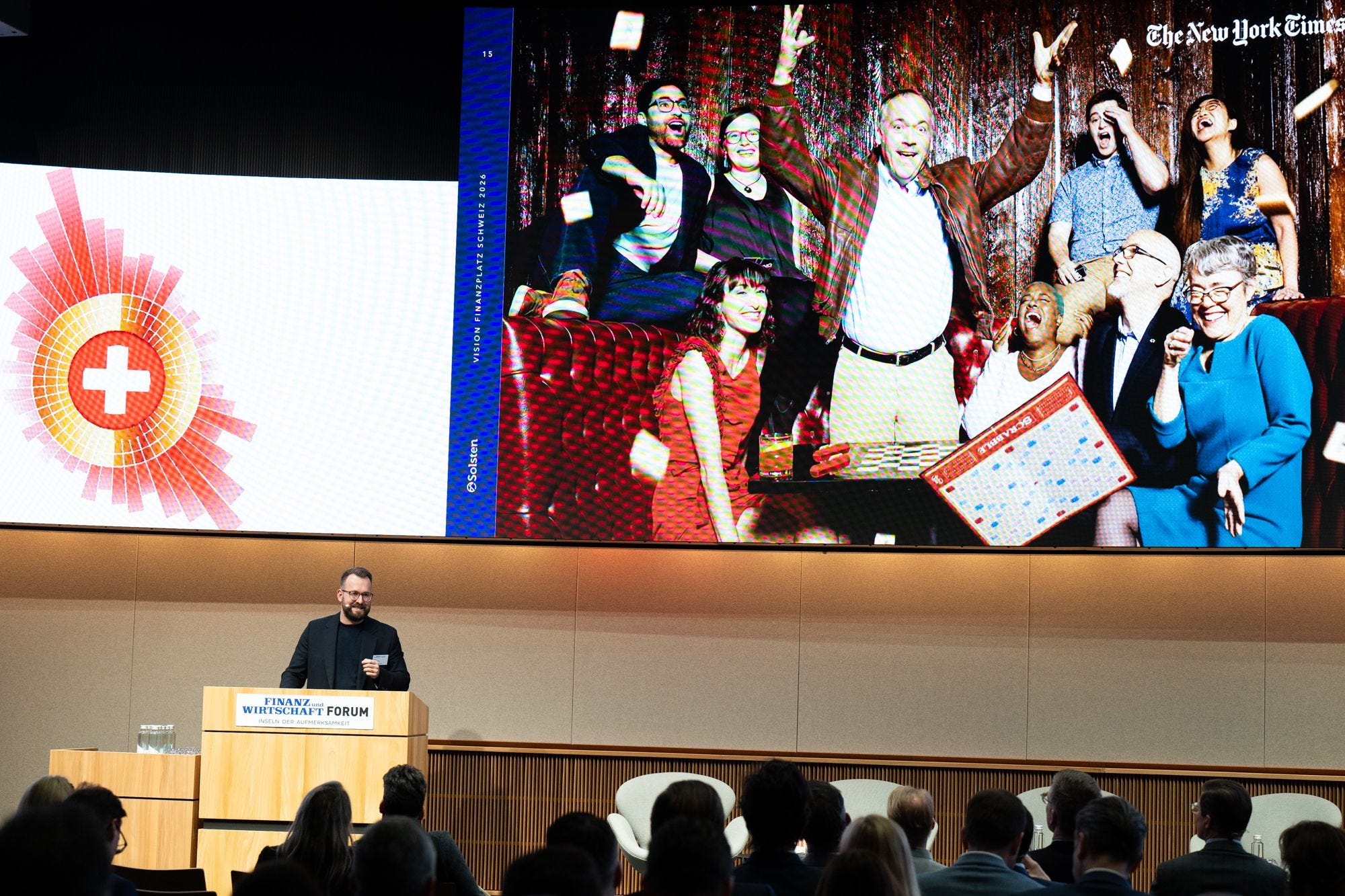
While it’s clear that this industry has some catching up to do, I was positively surprised by both the amount and the vigour of the head-nodding I received from the audience.
Financial institutions face two crucial challenges with respect to engaging their customers. First, the vast majority of their interactions with their customers are purely transactional (you check the balance on your account and you move on), which results in a vast distance between service provider and consumer. Second, younger audiences, the banks’ future customers, don’t go into the city to open a bank account in a physical branch. They don’t just live online, they live in video games predominantly.
Yet, the banking industry has a great example to look up to. Mastercard entered video gaming in 2012 already. When I interviewed Mastercard’s CMO Raja Rajamannar for my book Press Play, the strategic importance of gaming for the company became clear immediately: it’s an always-on initiative that sits right next to all other channels in terms of importance.
I’m confident we’ll see more financial service providers take the leap and adopt gaming in different ways. Fintech darling Revolut is already rumored to be looking into acquisitions in the gaming space to unlock customer acquisition for them.
There’ll undoubtedly be a steep learning curve ahead of them, which brings us to this week’s post.
The Numbers Don’t Lie: Brands Are Retreating
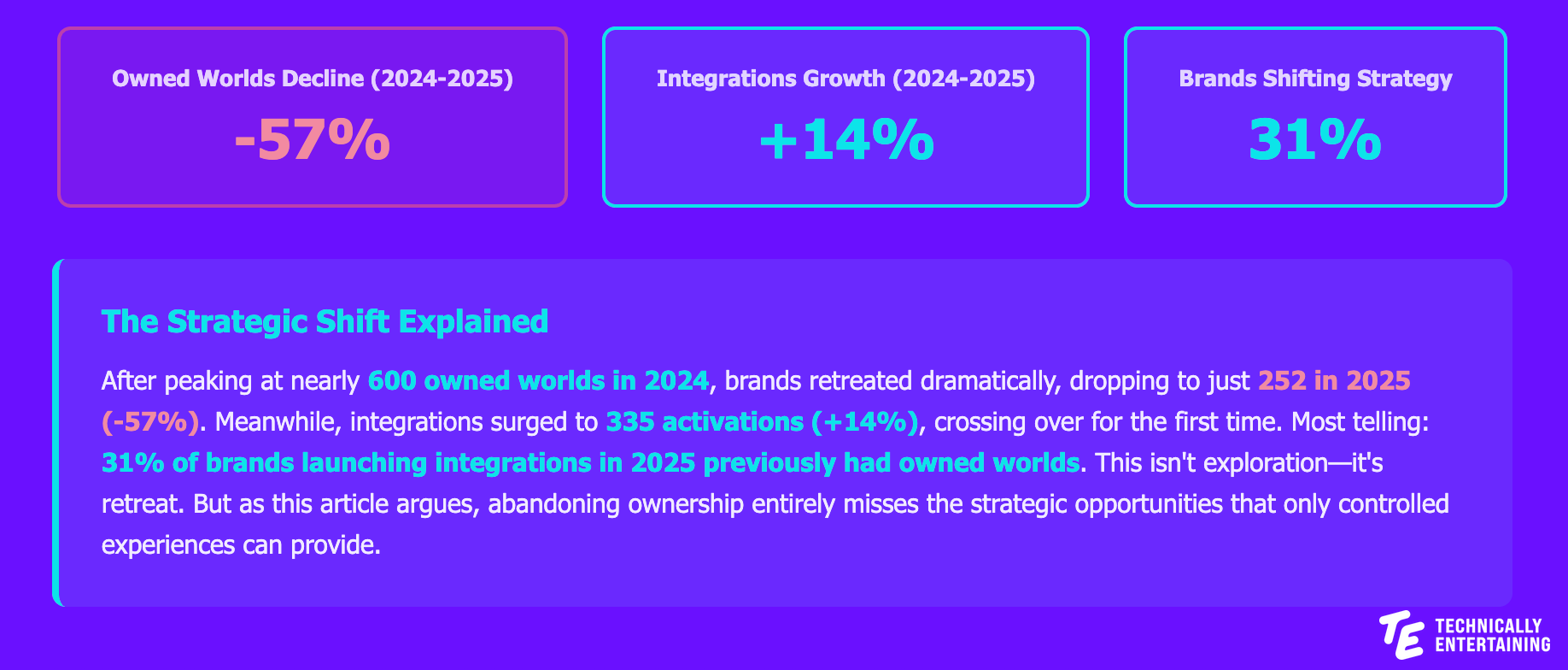
According to GEEIQ’s upcoming State of Brands in Virtual Worlds 2026 report, something remarkable happened in 2025. For the first time ever, the total number of brand integrations inside experiences on Roblox, Fortnite and other user-generated content platforms exceeded the number of active brand-owned worlds. Between January and December of last year, brands launched 335 integrations and just 252 owned worlds, marking a 57% year-over-year decrease in brand-owned worlds and a 14% increase in integrations.
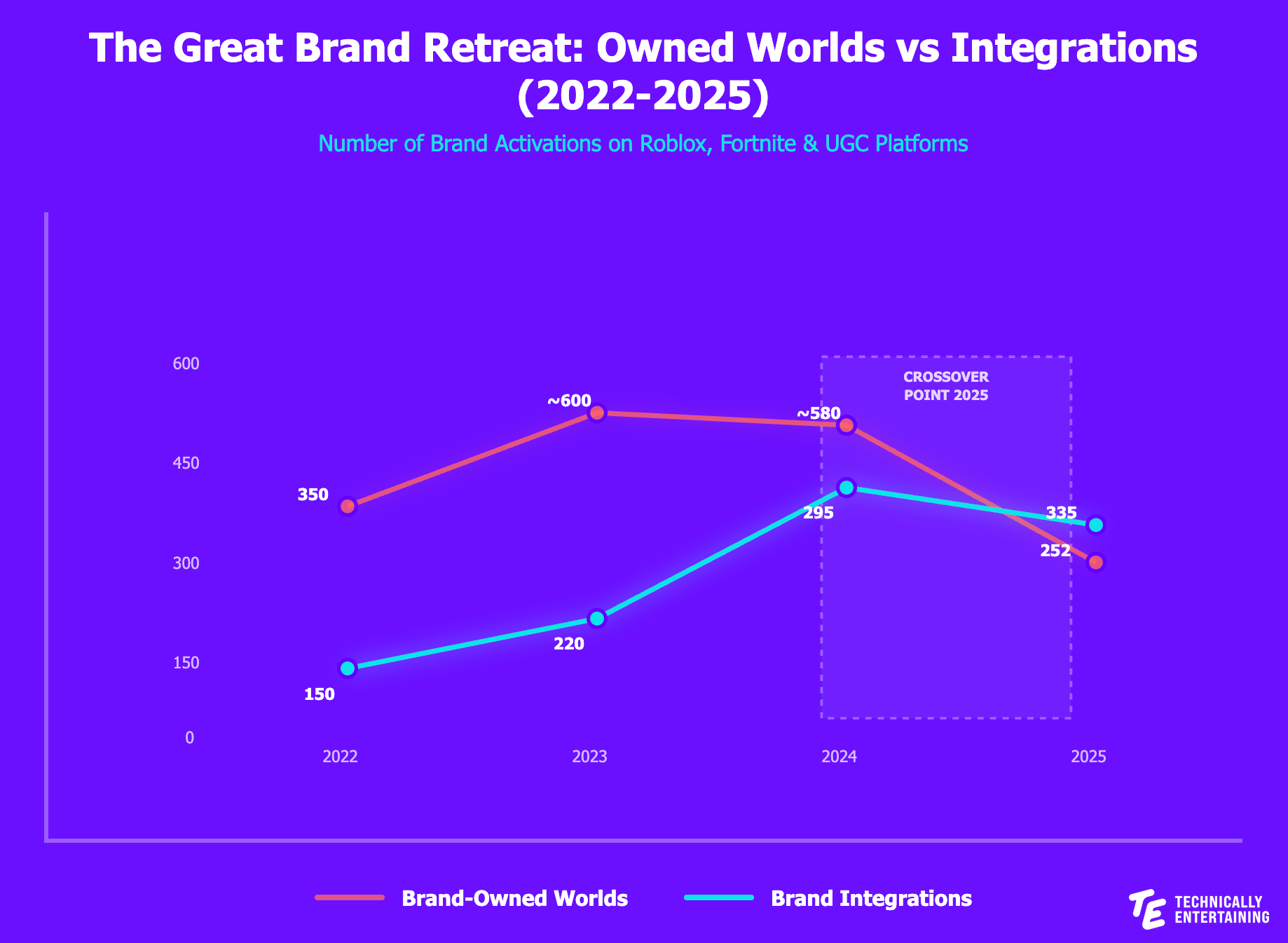
This isn’t just new brands choosing a different path. It’s an active retreat. GEEIQ found that 31% of brands that launched an integration in 2025 had previously built a brand-owned experience. They tried ownership. They’re walking away from it.
GEEIQ CEO Charles Hambro frames this as a structural change:
“Brands that entered virtual worlds 2-4 years ago went in for hype, and it was still novel to have branded worlds, regardless of how much it cost to build and maintain one. Over time, the novelty wore off, it became harder to build an audience from the ground up without significant marketing budgets to amplify it, and ultimately, brands needed more tangible results they could measure to justify this investment.”
He’s right, but the story is more complicated than brands simply getting smarter. This shift reveals both hard truths about gaming and dangerous misconceptions that could leave brands worse off than before.
Why the Shift Is Happening: The Hard Truths
The Elephant in the Room: Making Games Is Brutally Hard
Let’s start with the obvious reality too many CMOs ignored when they greenlit their first Roblox world. Making games is hard. Not marketing-campaign-hard. Actually, genuinely, technically difficult in ways that most consumer brands have zero competency in.
Look at Disney. One of the best storytelling companies on the planet. Thirty years of attempts to crack gaming. Billions invested. Studios opened, shuttered, reopened. And to this day, the most successful Disney game based on Disney IP wasn’t made by Disney. It was made by a third-party developer called Second Dinner, for which Disney merely licensed its Marvel characters to create Marvel Snap.
If Disney struggles this much with gaming, what chance does a CPG brand or fashion label have building a game from scratch, maintaining it, and consistently seeing great results? The answer is borderline delusional confidence mixed with fundamental misunderstanding of what game development requires.
The Metrics Aren’t There, Part 1: Measurement Solutions Are Still Makeshift
Even if you somehow build a decent game or world, justifying the investment to your CFO becomes the next impossible task. According to brand executives I’ve spoken with privately, measurement and tracking solutions on platforms like Roblox and Fortnite have improved but still feel makeshift and cobbled together.
To justify the increased costs that operating live games requires, platforms need transparent and reliable measurement across the entire funnel. CMOs need to demonstrate ROI to finance departments. When the tools to do that are underwhelming, the business case for owned worlds collapses.
The Metrics Aren’t There, Part 2: The Numbers Were Just Bad
And assuming sufficient tracking was in place, maybe the metrics were just bad. Engagement tapered off quickly. Retention was low. After a quick brand awareness spike, there was no sustained impact.
A key reason: brands make it about themselves. You have to make it about the players and their experience. Always start with the audience and their needs. Make sure your brand values deliver against those user needs in a way that’s natural to the gaming environment you’re entering.
That’s the recipe for authentic experiences. If you don’t do that, the metrics won’t be there. And when the metrics aren’t there, the CFO pulls the plug.
Ramping Up: Harder to Scale From Scratch
Though it’s easier to attract players on platforms like Roblox or Fortnite compared to launching a new mobile game, building an audience from zero remains a massive challenge. The clear benefit to integrating with an existing game is that the audience is already there. Distribution and reaching critical mass become dramatically easier.
When Universal Pictures’ “How to Train Your Dragon” Roblox experience became the most-visited persistent branded world in 2025 by over 30 million visits, it proved something important. Entertainment IP with existing fandom can succeed with owned worlds. But for brands without that built-in audience? Integration starts looking a lot more attractive.
The Dangers of Overcorrecting: Why Integrations Aren’t Perfect
The conventional wisdom around this shift gets dangerous. Yes, integrations solve real problems. But treating them as the default strategy for all brands creates new pitfalls that CMOs need to understand.
Treating Games as Just Another Advertising Channel
The easiest trap: pick an existing world, slap your brand logo on it, report brand awareness lift, call it a day. It’s the easy way to tick the box on your gaming initiative.
But brands that treat games as simply another advertising channel miss out on all the downstream revenue potential games offer. Commerce integration. Loyalty programs. Data capture. Community building. Direct customer relationships. These opportunities exist when you control the experience. They disappear when you’re just buying a billboard inside someone else’s world.
Losing Creative Control: You Can’t Shape What You Don’t Own
When you build a new game or world, you can craft it exactly to what you want it to be. You control the narrative, the mechanics, the user journey, the data architecture, everything. When you integrate with an existing game, you have to live with the design confines of what exists and operate within that.
This matters more than most CMOs realize. Your brand might have specific storytelling needs. Your product might require specific mechanics to demonstrate properly. Your compliance team might have requirements about data collection. In an owned world, you accommodate all of this. In an integration, you’re at the mercy of the host experience.
The Authenticity Paradox: Choose Carefully or Fail Quietly
Picking the right game or world for your brand is incredibly hard. GEEIQ’s data shows brands are making the shift to integrations, but it doesn’t show whether those integrations are performing well. Based on conversations with developers and brand strategists, many aren’t.
Here’s the problem: brands aren’t doing the hard work of understanding their audience beyond “we want to engage young people.” That’s not strategy. That’s lazy. Picking the right game where your target audience is overwhelmingly present, where your brand values align naturally with the game’s themes, where your integration adds genuine value to players’ experience, that’s the work.
“With integrations being the new standard, brands should try to work closely with creators or at least ensure they’re included in the conversations early on. They’re not just a distribution channel, but they need to be a core part of the infrastructure. They are the experts on their own platforms, they know what their players like and what they don’t.”
That’s the key. But how many brands are actually doing this versus treating creators as just another vendor?
What Smart Brands Should Actually Do
The GEEIQ data doesn’t reveal that integrations are better than owned worlds. It reveals that most brands executed owned worlds poorly, and integrations offer a less risky way to stay in the game while learning.
The brands that will actually win in gaming over the next five years won’t be the ones blindly following the integration trend. They’ll be the ones that understand when to own and when to integrate based on their specific objectives, capabilities, and audience.
Own when you have entertainment IP with existing fandom, need full creative control, can commit to always-on operations, need proprietary data and direct customer relationships, or are willing to invest in serious user acquisition. Ultimately, I’m convinced more and more brands beyond entertainment IP owners will own their own games and worlds, but it may not be their immediate starting point.
Integrate when you’re entering gaming for the first time, your primary goal is brand awareness and reach, you have limited budget for ongoing operations, you’ve found a game where your target audience is already engaged, or you can genuinely add value to players’ existing experience. There’s a reason why integrating in existing games is the first strategy I recommend in my book: it’s easier to do, faster, cheaper, and most importantly: brands can learn, gain insight, and iterate from there.
The Best Strategy: Do Both Strategically
The most sophisticated brands like Adidas aren’t choosing one or the other. They integrate to learn, experiment, and reach new audiences quickly. They build owned experiences where it makes strategic sense and where they can commit real resources.
Mastercard’s approach is instructive. Raja Rajamannar describes gaming as an always-on initiative that sits next to all other channels. That’s not an integration strategy or an owned-world strategy. That’s gaming-as-infrastructure where different tactics serve different objectives within a cohesive whole.
The Real Learning Curve Ahead
For the financial services providers I spoke to in Zurich, and for any brand looking at gaming strategically, the GEEIQ data should be a warning, not a roadmap.
Don’t build owned worlds just because it’s novel or because your competitor did it. Don’t assume you can build a game without deep gaming expertise. Don’t launch without clear success metrics and infrastructure to measure them.
But also don’t assume integrations are the magic solution. Don’t treat games as just another advertising channel. Don’t skip the hard work of finding authentic fit between your brand and the gaming experience.
The brands that entered gaming 2-4 years ago went in for hype. Many are now retreating. The brands that enter now have the benefit of their expensive lessons. The question is whether they’ll actually learn from them.
The shift from owned worlds to integrations isn’t brands getting smarter. It’s brands getting more cautious. Smart would be understanding that gaming strategy requires the right approach for the right objective at the right time. Nostalgia isn’t strategy. But neither is chasing the latest trend without understanding why the previous one failed.
How is your brand approaching gaming strategy? Let me know in the comments.
Earnings season is in full swing and we have had Take-Two, EA, and Disney all report their latest financials already. Subscribe today to get the latest insights on what’s brewing at the top entertainment companies and how these shifts spill over into other industries.