


Employees are handing in 2-week vacation requests. The US military is offering an extra 4-day vacation for reenlisting into the forces. Basketball star Steven Adams is predicting a significant slow down in performance across the NBA. The Logitech CEO just announced a company-wide day off for 7,000 employees.
All of these have the same cause, and it isn’t a pandemic. It’s a video game: the launch of the highly anticipated Grand Theft Auto VI this Thursday (November 19). The weeks and months leading up to the launch have already dominated the media in and around the gaming and entertainment industries. The launch itself and the weeks after it will undoubtedly surpass that.
GTA VI is widely reported to be the most expensive video game, and piece of entertainment content, ever to be made. It is expected to surpass $3 billion in revenue in the first 4 months post launch alone. But for leaders and decision makers, there is far more to take away from this event than the fact that GTA VI will be a big, wildly successful product launch. Video games are the cultural infrastructure of our time. They offer companies ways to reach and interact with consumers at deep levels of engagement other media channels simply cannot match. 3.7 billion people globally now play video games. Gen Alpha plays video games more than they consume any other media. Millennials that play outnumber any other demographic segment. The gaming industry is projected to reach $214 billion by the end of 2026 - bigger than music, TV, and movies combined. These, and many more, are behind the reasons why a consortium of the sovereign wealth fund PIF of Saudi Arabia, Silver Lake, and Affinity Partners paid $55 billion to take iconic video game publisher Electronic Arts private in the biggest leveraged buyout transaction ever across industries.
The launch of GTA VI demonstrates how much gaming permeates consumer culture and various consumer touch points far beyond the game itself. The game also exemplifies the rich and diverse ways in which other content and consumer culture live inside vast gaming worlds. Leaders across all industries can take away valuable lessons to empower their companies to engage the modern consumer and be culturally relevant through games.
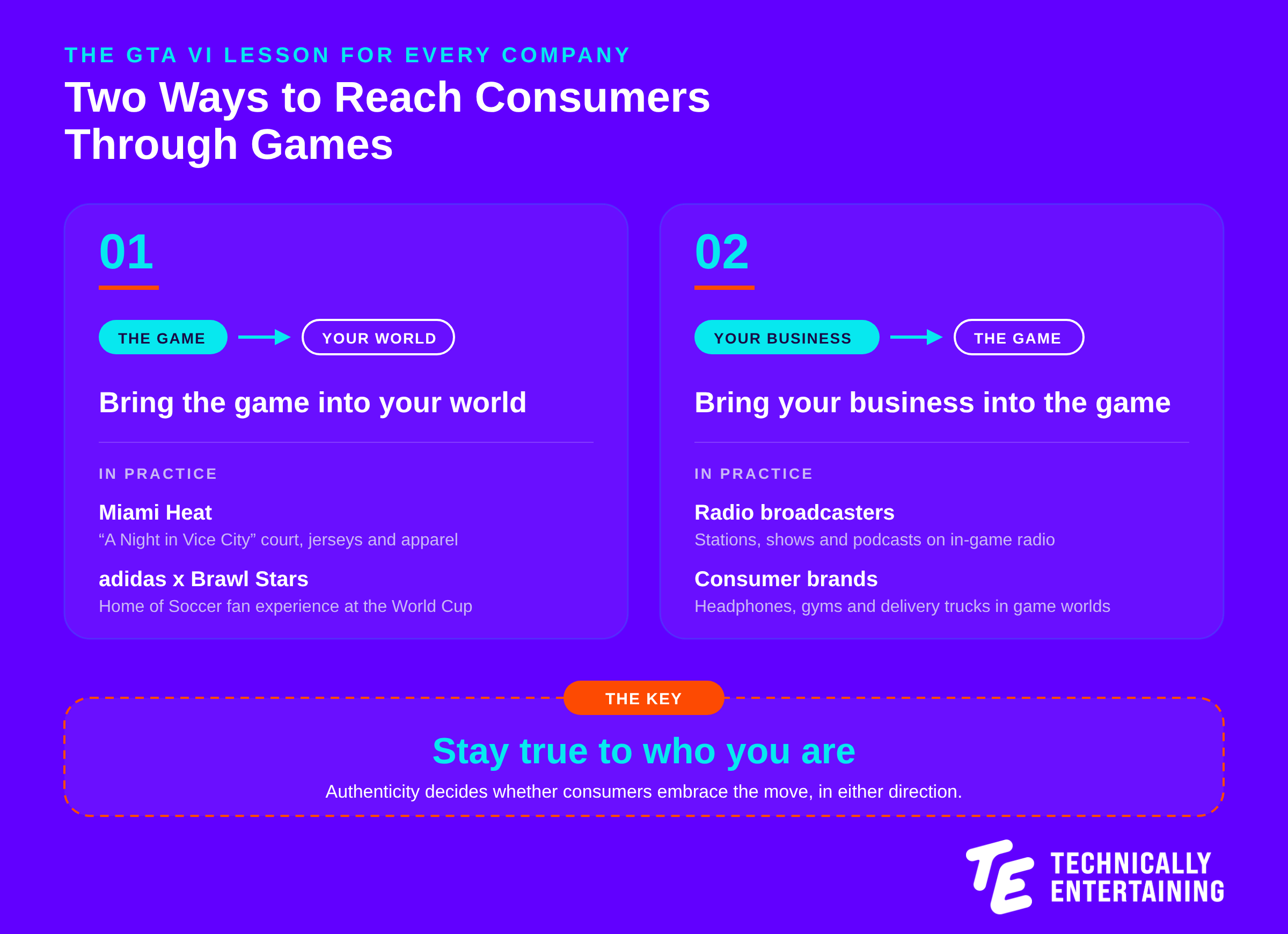
Leading up to GTA VI’s release, I have been fielding questions and calls from executives running food retailers, banks, insurances, and media companies, essentially all boiling down to one thing: how can we benefit from the game’s launch (and games in general) in our own reality? There are two ways to make use of this moment: bring the game into your world, and bring your business into the game. Either way, one element is key to ensure success and embrace by consumers: stay true to who you are.
Bring the Game Into Your World
The game’s first trailer raked in 93 million views in just 24 hours on Youtube, breaking the platform’s record for nonmusic video viewership. The GTA VI extended look feature film on Netflix saw 31.1 million views within the first 4 days of its release. The video-game adaptation The Super Mario Galaxy movie crossed over $1 billion in box office revenue globally, making it the 5th highest grossing movie of 2026. Gaming related streaming content accounted for 8.8 billion hours consumers watched on YouTube in 2025.
In short: games and gaming related content are able to drive massive consumer engagement in other consumer touch points. This is not limited to digital touch points either.
On the night before GTA VI’s release, the NBA team Miami Heat are hosting a special “A Night in Vice City” basketball game against their league rival Milwaukee Bucks. Vice City is the location of GTA VI and it’s heavily inspired by Miami. The game will be played on a custom, one-night-only Vice City themed hardwood court and the Miami Heat will wear a reimagined uniform. Fans have the opportunity to buy the dedicated Court Culture Vice City apparel collection and benefit from unique game night activations. The event is so appealing that sports broadcaster ESPN will even show the game live across the US.
Other brands have previously demonstrated how to successfully leverage video games to drive consumer activation in the real world. During the FIFA World Cup this past summer, apparel giant adidas was integrated into the highly popular mobile game Brawl Stars. But adidas didn’t limit itself and the partnership to staying inside the game. Instead, they connected it to a physical activation during the tournament in Brooklyn, NY. The adidas Home of Soccer served as a live fan experience that brought the video game’s chaotic energy into the real world, allowing fans to engage with the brand and be first to see the Brawl Stars-themed iterations of iconic adidas sneakers.
There’s no limit to the creativity companies can and should use here. But this is where staying true to who you are comes in: the Miami Heat are a basketball team. They’re bringing the video game to the basketball court. Adidas is an apparel brand with a strong footprint in soccer. They brought games to the World Cup. They stayed true to who they are so they could bring gaming into their world in an authentic way.
Staying true to who you are also means being honest about fit. GTA VI is a mature-rated game built around crime and violence, and not every brand can or should be associated with it. That’s fine. GTA VI is the moment, not necessarily the partner. From family-friendly worlds like Roblox to sports games like EA FC, there are games whose audiences and tone fit nearly any brand.
Bring Your Business Into the Game
I gave the opening keynote at the inaugural gaming meet-up of the European Broadcasting Union, the organization whose members are all of the European public broadcasting institutions. The goal was to help leaders see the power of video games and understand how they can leverage games for their own strategy.
After my talk, an executive of the Swedish public radio came up to me and wanted to hear my thoughts on what he and his team could do with radio content.
GTA VI will feature six radio stations. For the first time in the franchise’s history, players can also listen to on-demand podcasts and enjoy their favorite audio content on-foot via headphones the game’s main characters can wear. GTA isn’t the only option. The Fallout series or Cyberpunk 2077 feature in-game radio stations as well, as do many other video games. As a radio broadcaster, this is an authentic and effective way to bring your actual radio station, your shows, and your news, to consumers directly inside their favorite video games. The broadcaster’s product is still the same - the means of distribution are entirely different.
To be clear: GTA VI doesn’t currently allow real brands to enter its world - every brand players come across is fictional. But the game offers a plethora of examples of what’s possible, and of what many other games already allow brands to execute on.
Many video games, and especially larger worlds like GTA VI, offer numerous points of integration that are highly appealing to non-endemic brands. The headphones the game’s main character wears? They could be Sony’s or Bang & Olufsen’s. The in-game gym players can perform real workouts to get in shape? That’s an opportunity for Rogue or Technogym. The delivery truck driver bringing a package to your doorstep? FedEx, DHL, UPS.
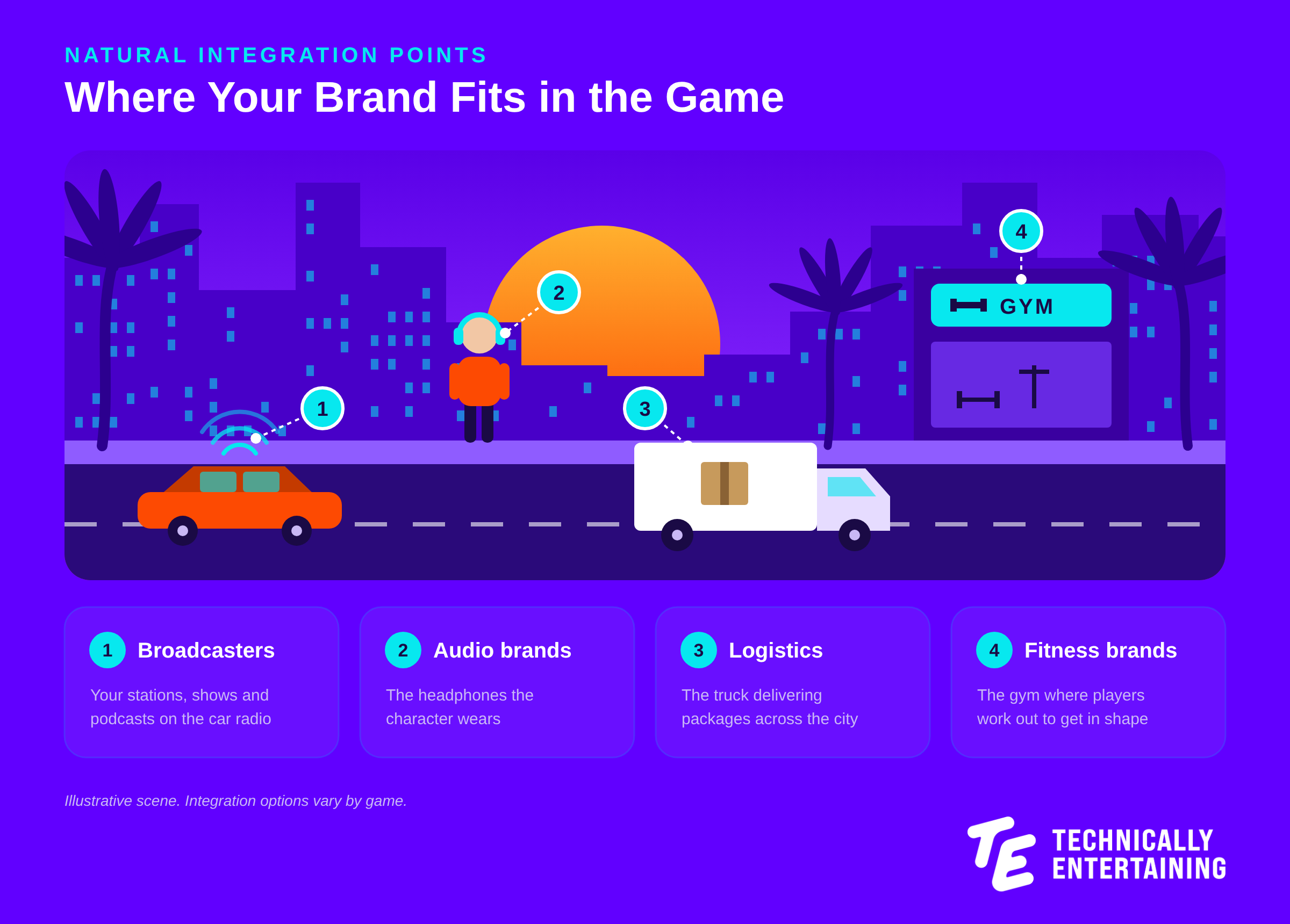
This list goes on. The point is that many brands have natural points of integration inside video games to take their core products - who they already are - directly to consumers in engaging and effective ways. Realizing these opportunities starts with leaders seeing video games for what they are - the cultural infrastructure of our time, where consumer culture is consumed and created.
GTA VI will be the biggest entertainment launch of the year, but it’s not the end point - it’s the clearest signal yet of where consumers already are. For leaders, the question is no longer whether games matter to their business, but how to show up in them. Start by understanding where your consumers actually play, which isn’t always the biggest launch of the year. Then decide which direction fits your company best: bringing the game into your world, bringing your business into the game, or both. Measure what games do better than any other channel - time spent, depth of engagement, and the conversation they spark beyond the game - not just impressions. And above all, stay true to who you are. The companies that win won’t be the ones that chase the hype. They’ll be the ones that bring who they are to where their consumers already play.
Technically Entertaining covers the intersection of gaming, technology, and business strategy. If this post sparked an idea for your own company, subscribe today and share it with a colleague who should be part of that conversation.