


Dear Readers,
Niantic just revealed something that should fundamentally change how every executive thinks about the gaming industry.
The company behind Pokémon Go — the AR game that had 500 million people installing it in 60 days — sold its gaming division to Scopely last year. At the same time, it spun out a new AI company called Niantic Spatial. That company took the 30 billion images Pokémon Go players captured while hunting Pikachus across cities on every continent, and used them to build a world model that can pinpoint a location to within centimeters — without GPS. That model is now being used to help delivery robots navigate the real world.
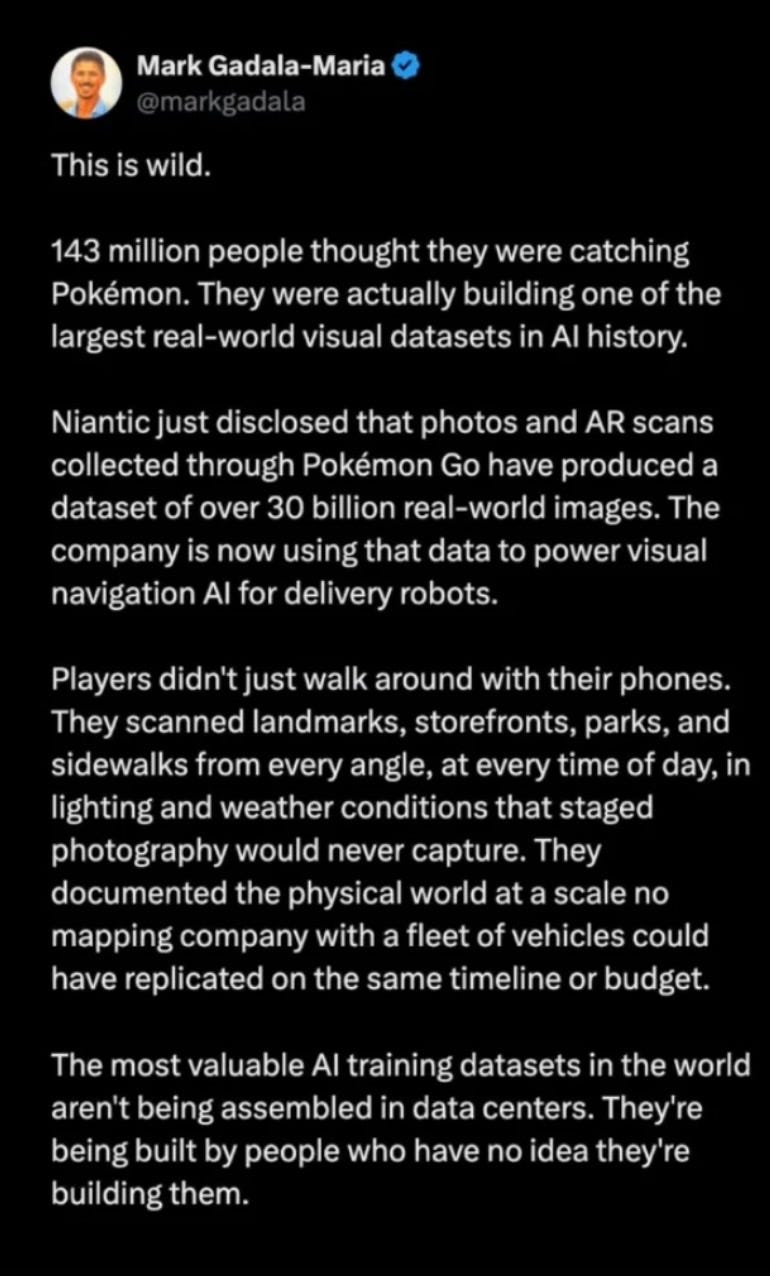
This is not a pivot story. It is a harvest story.
Niantic built a game, deployed hundreds of millions of humans as data collectors, understood the built environment of cities at a scale no mapping company had achieved, and then sold the game when it had extracted what it needed. AppLovin did the same thing on a different axis. It built mobile games to study the relationship between ads, conversion funnels, and player behavior with a granularity no advertising platform could match from the outside. Once that intelligence was baked into its targeting algorithm, it sold the game studios to TripleDot.
To anyone who has spent real time in the gaming industry, this pattern is familiar. Games have always been the place where the hardest problems get solved first — because the stakes are low enough to iterate aggressively and the performance requirements are brutal enough to force real breakthroughs.
The question for decision makers is not whether this has happened before. It has, repeatedly, across hardware, software, behavioral science, and economics. The question is what gaming is building right now that the rest of the world will be running on in five years.
The GPU: Gaming’s Accidental Gift to AI
The most consequential technology transfer in modern history started with a graphics chip.
In 1999, NVIDIA released the GeForce 256, the first GPU specifically designed to handle the mathematical load of rendering 3D game worlds. The architecture was built for parallelism — thousands of small cores performing identical operations simultaneously rather than a few powerful cores doing tasks in sequence. The gaming industry needed this to render realistic environments at playable frame rates. What it created, without knowing it, was the foundational hardware for artificial intelligence.
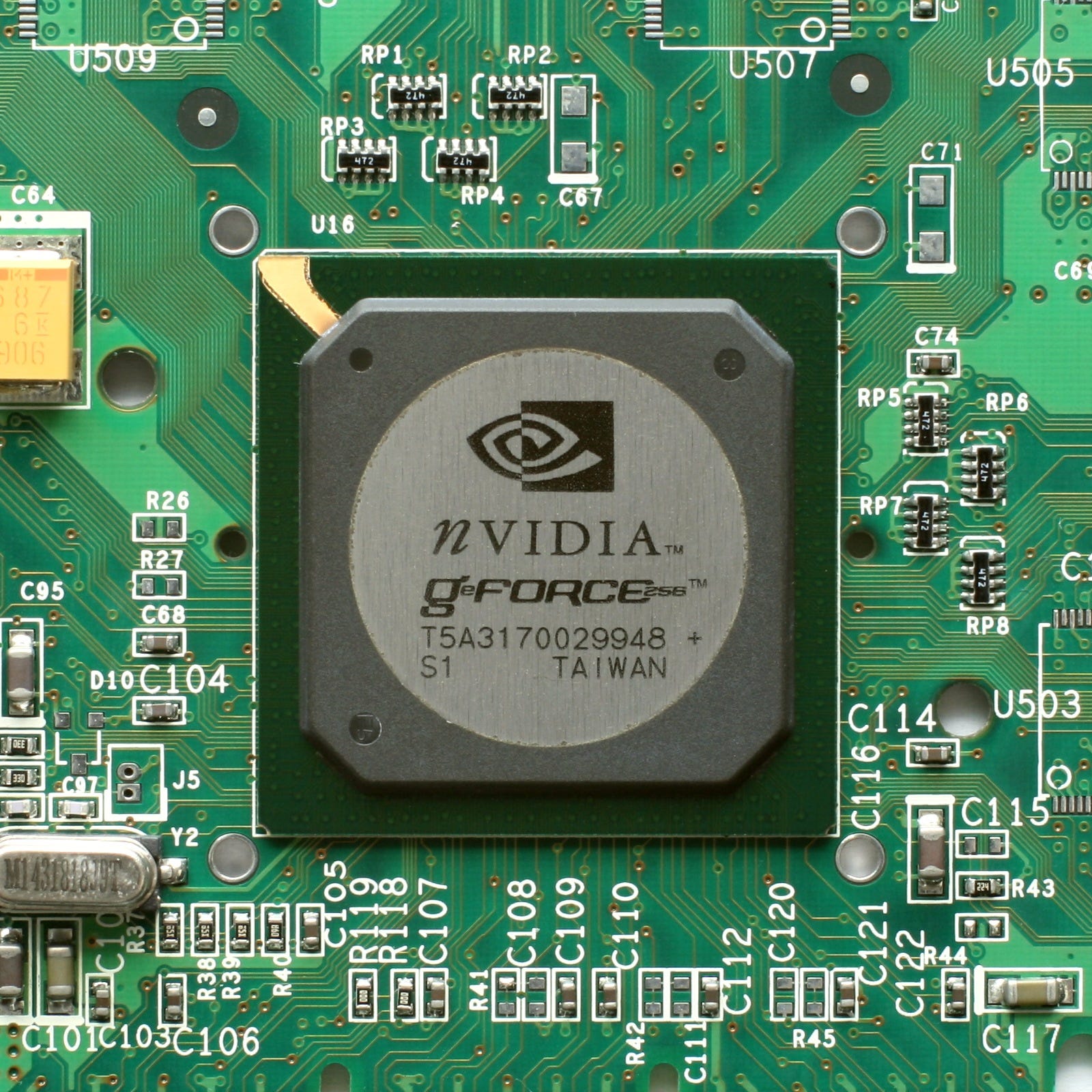
The mathematics of 3D rendering — matrix multiplication, vector calculus — is identical to the mathematics of training neural networks. When researchers ran an image recognition model on two consumer NVIDIA gaming cards in 2012, they crushed every existing benchmark. The hardware that had been running Call of Duty turned out to be more capable of machine learning than the world’s most expensive supercomputers. NVIDIA’s release of CUDA in 2007 had already unlocked GPU programming for non-graphical tasks, but that 2012 result made the strategic reality impossible to ignore.
By 2018, NVIDIA introduced Tensor Cores — originally designed to upscale low-resolution game images using AI — which became the specific hardware architecture needed to train the Transformer models that power every modern large language model. The efficiency gains transformed economics: training runs that would have taken months shrank to days, making the current generative AI wave viable.
Today, GPUs are treated as a sovereign-grade strategic asset. Export restrictions. National stockpiles. Trillion-dollar market valuations. All of it traces back to the requirement that video games look good at sixty frames per second.
Game Engines: The Operating System for the Physical World
Unreal Engine and Unity started as tools for making games. They are now the infrastructure for industries that have nothing to do with games.
The reason is straightforward. Game engines solve extremely hard problems: real-time 3D rendering, physics simulation, lighting, networked state synchronization across thousands of concurrent users. Solving those problems at the performance level games demand creates tools that are simply better than anything a traditional enterprise would build for its own use case.
Film is the most visible example. The Mandalorian and The Batman replaced green screens with massive LED walls driven by Unreal Engine, rendering photorealistic parallax-correct backgrounds in real time. Post-production timelines that previously ran six to twelve months are now concurrent with filming. The virtual production market is growing at nearly 15% annually and is projected to exceed $11 billion by 2034.
Automotive is deeper. BMW and Tesla use game engines to design and prototype the digital dashboards their drivers see every day. More than half of virtual vehicle showrooms run on gaming engines. Aerodynamic simulations, ergonomic walkthroughs, HMI prototyping — all in game engines, all eliminating costly physical models before a single part is manufactured.
The most important application is robotics training. Synthetic data — artificially generated environments where every object, light source, and physical property is labeled and controllable — is now the primary solution to the data gap in physical AI. NVIDIA’s Isaac Sim, built on gaming libraries, allows developers to train robots in procedurally generated environments that simulate rare conditions impossible to capture in the physical world: extreme weather, mechanical edge cases, unusual human behaviors. The technique is called domain randomization. Game developers invented it to create visual variety. Roboticists use it to harden AI against the messiness of reality.
Virtual Economies: The Original Fintech Lab
Before anyone used the word fintech, games were running the world’s most sophisticated digital economies.
World of Warcraft and EVE Online pioneered digital scarcity, virtual currency management, and player-to-player marketplaces in the early 2000s. Game developers became, in effect, digital central bankers — managing inflation and deflation through carefully calibrated faucets (how currency enters the economy) and sinks (how it leaves). The Real Money Trade phenomenon proved that virtual labor could be reliably converted to fiat currency, establishing the foundational thesis that digital assets hold intrinsic value based on the effort required to acquire them.
This is not ancient history. The $1.5 billion creator economy on platforms like Roblox and Fortnite runs on these same mechanics. NFTs, tokenomics, burn mechanisms, decentralized exchanges — each has a direct predecessor in MMORPG design. The Roblox creator economy, Fortnite’s engagement payout pool, the IP Partner Licensing Program — these are all refinements of systems game designers built decades ago because they had no choice but to figure out how digital economies work.
What’s significant is the social dimension. On Discord alone, 41% of digital purchases are now gifted, and 25% of gift buyers are non-players engaging purely through social networks. The economy of game worlds no longer lives inside the game. It has migrated into the broader digital social fabric, taking the mechanics with it.
Behavioral Design: The Science of Human Engagement
The most underestimated technology transfer from gaming is not hardware or software. It is the science of what makes human beings do things.
Game designers spent decades solving the hardest problem in behavioral science: how do you get a person to voluntarily persist through difficulty, return day after day, and find meaning in structured challenge? The frameworks they developed — flow states, self-determination theory, variable reward schedules, social accountability systems — are now deployed across healthcare, education, finance, and enterprise software.
The results are quantifiable. Gamified health protocols have achieved medication compliance rates above 90%, significantly outperforming standard care. Surgeons trained in VR simulation built on game engines demonstrate training confidence improvements of 275% compared to traditional methods. Gamified learning platforms have demonstrated 60% improvements in information retention. Employee retention in organizations using gamified HR systems runs 69% higher.
Duolingo’s streak mechanic. Peloton’s leaderboard. Nike Run Club’s badge system. Apple Watch’s ring closure. These are all game design. The companies that built them understood something the rest of the business world is still catching up to: engagement is not a marketing problem. It is a design problem. And the people who know how to solve design problems at this level are game designers.
Human Understanding: The Psychological Dimension
All of the above — hardware, simulation, economies, behavioral mechanics — depends on one foundational input: understanding what human beings actually want, fear, value, and respond to.
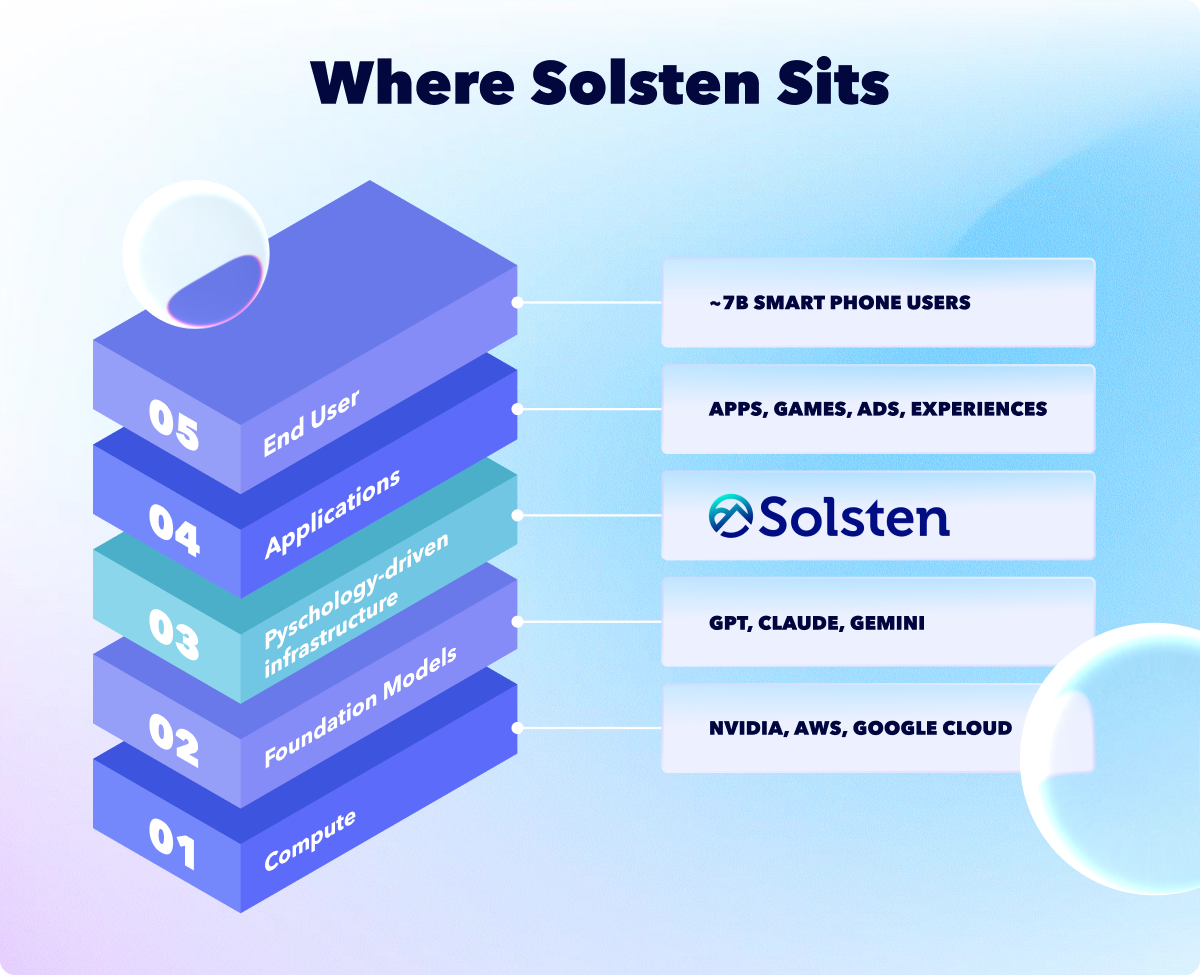
This is where Solsten enters the picture.
Solsten built its proprietary psychological database by doing what no research firm had done before: interfacing directly with real players, in real gaming environments, at scale. Gaming creates uniquely honest conditions for psychological research. Players are not in a survey. They are not performing for a researcher. They are making thousands of micro-decisions under varying conditions of reward, frustration, competition, and collaboration. The behavioral signal is extraordinarily rich - and uncovering the psychology means uncovering the driver behind the behavior.
The result is a dataset that captures the psychological architecture of real human beings — their core motivations, values, and decision-making patterns — with a fidelity that traditional market research cannot approach. Not because the technology is different, but because the environment is. Gaming strips away the social performance layer that distorts every focus group and survey. People reveal who they are when they play.
That psychological database now powers decisions far beyond gaming. Understanding that a consumer is motivated by autonomy rather than status changes everything about how you design a product, price it, market it, and retain the person who bought it. Solsten’s data — built in gaming, applicable everywhere — is the human understanding layer that sits beneath every other technology on this list.
What Decision Makers Need to Understand
The Niantic story is not a curiosity. It is a template.
Gaming has always functioned as the world’s most efficient technology incubator, because the environment demands real solutions at scale. The cost of failure is a bad review. The reward for success is hundreds of millions of engaged users generating data no other industry can produce.
Every foundational technology on this list — GPUs, simulation engines, economic systems, behavioral design, psychological modeling — was built in gaming because gaming was the only environment demanding and tolerant enough to develop it.
The companies that understood this extracted enormous value. The ones that wrote gaming off as entertainment watched the infrastructure of the modern economy get built by people playing video games.
The next wave is being built right now. Spatial computing, physical AI, synthetic data at scale, real-time world models, humanization of AI. All of it is happening first in gaming.
The question is whether you’ll be paying attention this time.
Technically Entertaining covers the intersection of gaming, technology, and business strategy. If this post made you think differently about an industry you thought you understood, subscribe today and share it with someone who needs to hear it.