


Dear Readers,
This week, I had a great conversation with another Dad while we picked up our daughters from the same day care: Nintendo Switch 2 pre-orders. Yes. It’s a thing. We’re both thinking about getting our kids started on video games. He shared some concerns, for very good reasons. Let’s debunk a common misconception: screen time isn’t equal to screen time. Watching TV let alone spending time on social benefit is far worse for your child’s development, specifically the brain, than playing video games. Why? The former are one-directional activities that don’t require your kid to engage with the experience. Video games on the other hand are bi-directional, and hence active experiences. The scientific evidence on this is clear: in general, children that regularly play video games exhibit enhanced cognitive skills specifically related to attention and memory. That does not mean you should hand your child the new Switch and leave them be in their rooms for hours. Like all good things in life, moderation is key as well as what video games kids play. For example, puzzle-solving or action-adventure games tend to be more beneficial than other games.
Plus, there’s the added benefit of a shared experience that kids and parents can bond over together. To this day, I fondly remember all the times my Dad and I were sitting in front of my old PlayStation, playing Fifa match after match after match.
Needless to say that we both preordered the Switch 2 the day after. About 1 million devices were pre-ordered in Japan and in the US they’re sold out as well - Nintendo is 2 devices closer to selling out in Europe as well.
Big Tech gets a big slap on the wrist
In the land of big tech, there’s been another major development. Over the past few weeks, I’ve already written about Alphabet‘s and Meta‘s antitrust trials and that I believe we’ll see a spin of Google‘s ads business and /or Instagram and WhatsApp in the next 12-18 months. OpenAI had already expressed interest in buying Chrome from Google.
This time around, Apple is in the legal crosshairs- and it’s serious.
A judge just took the extraordinary step to hammer Apple for violating an antitrust ruling and turn the entire affair into a criminal matter. This is no joke. Executives are under the suspicion to have lied under oath. Perp walk incoming? It may (unfortunately) be what’s needed to shift behavior here because fines of 500 million bucks are not more than a paper cut for big tech. I’d encourage you to skim the entire court ruling - there are some real gems in there that illustrate the seriousness of this.
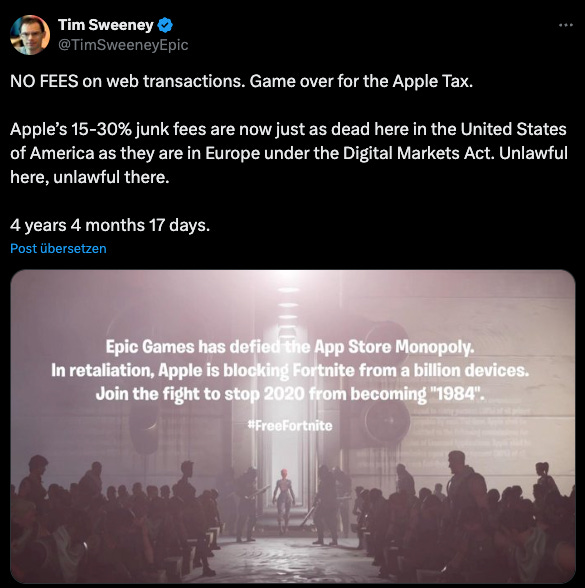
It’s the latest chapter in a necessary fight that Epic Games decided to have on its own behalf, as well as other game developers. Companies like Apple should absolutely be paid for the infrastructure they built and provide. But when companies are stifled and almost forced into using one option only, and give up 30% of every dollar they make - it’s the opposite of competitive markets. It’s the biggest toll booth in history (Google is the other one).
The deconstruction of big tech is happening right before our eyes. We’re witnessing the reshuffling of the entire deck of cards that is the tech industry. Apple, Meta, Google are all on the hook. Who will the big winners be? Shareholders, developers, and consumers. More competition means more value for everyone. If you don’t believe me regarding the significance of this, take it from Tim Sweeney, CEO of what is arguably the most important gaming company in the world: Epic Games.
On to this week‘s story - toys.
The toys and games industry isn’t a place that has been showered with glowing headlines and skyrocketing growth over the past decade. This year, the entire global toys market is expected to reach a market size of roughly $132 billion - a mere 11% increase since 2021. We all remember the headlines about toy retailer Toys ‘R’ Us all too well. In 2017/18, the iconic company went through bankruptcy and shut down all of its stores. It relaunched a selection of stores with a revamped brand a few ago - only to shut down all of stores in 2021 yet again. It’s a story of the decline in brick and mortar retail as much as it was seen as the downfall of good old toys.
Not so fast.
Toys are back. New research suggests that the toy market is about to pop in reach a market size of over $200 billion in 2034, making it pretty much as big as the entire video gaming industry. The research provides a few key drivers behind the forecasted growth.
Factors contributing to this surge include the increasingly popular trend of integrating toys with popular media franchises. These partnerships boost engagement by connecting well-loved characters and stories with physical play, appealing to both children and adult collectors. Technological advancements such as the adoption of AI, AR, and robotics in toy design are set to revolutionize the market, by providing interactive and educational experiences that resonate with modern consumer demands. - Research and Market Trends
In other words: toys, much like a movie IP, are being leveraged across various media touch points as they are being integrated into other physical and digital experiences. This means that the likes of Hasbro, Mattel, or Spin Master can no longer be thought of as toy companies. They’re becoming media and entertainment companies. And if Hasbro’s most recent earnings call is any indication, this evolution is in full swing.
The company beat expectations for the first quarter. Despite a 4% revenue decline in its consumer products business (toys), overall revenue grew by 17%. The main driver: video games with a 46% increase in revenue.
Despite its mixed history with video games, Hasbro has never let off. It oscillated between pure IP licensing and moving video games in-house again - but it seems to have found its stride now by tackling gaming from all of the possible angles. The share of video gaming related revenues over the past 5 years has been climbing steadily, to reach a significant inflection point now in the first quarter.
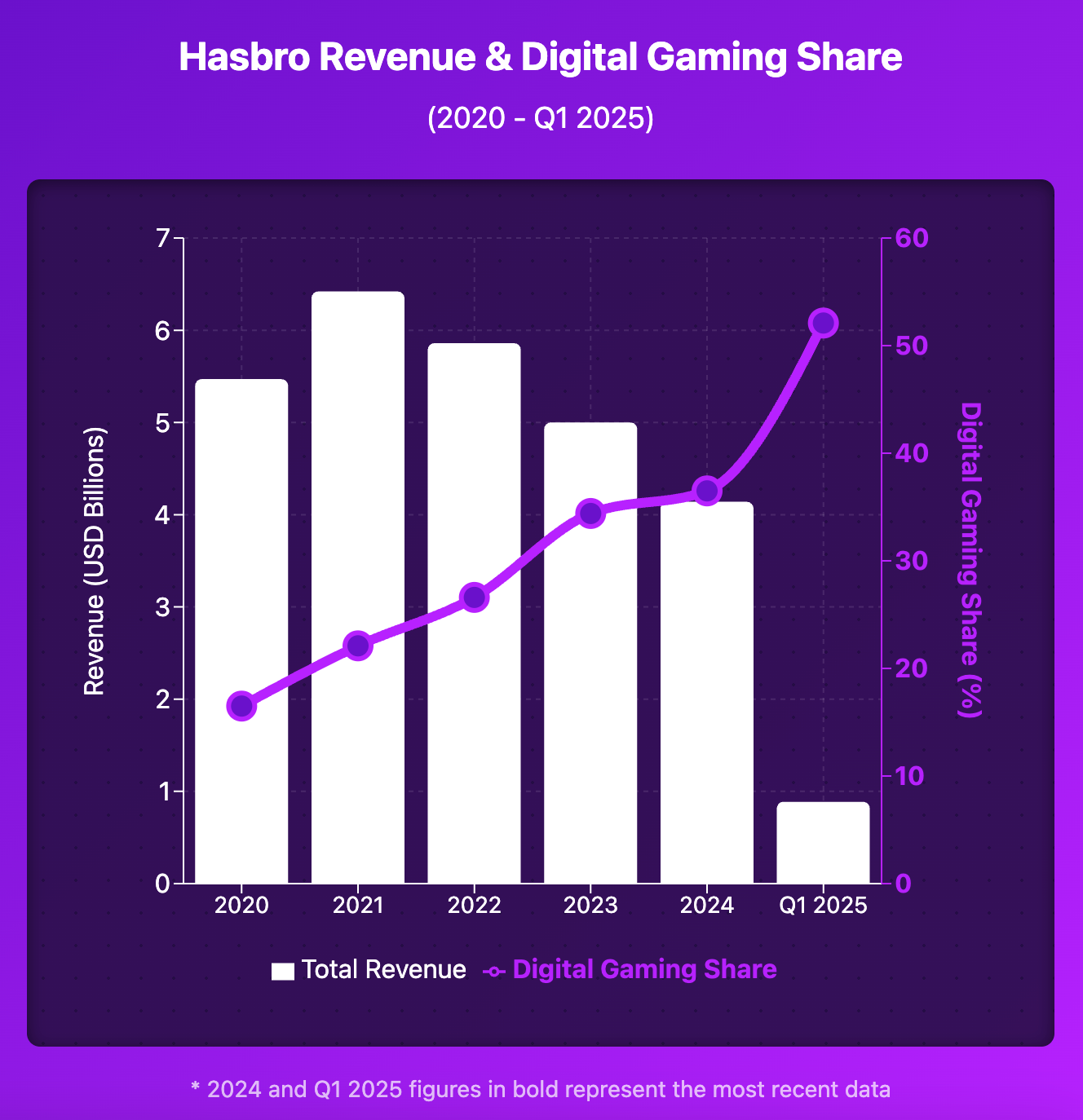
52% of the company’s revenue come from digital gaming. And with the slate of release for the flagship segment Wizards of the Coast, I don’t think that this is a one-off. It represents a larger shift from toy manufactures towards integrated interactive entertainment company.
Hasbro isn’t alone. Companies like Lego, Mattel, Spin Master, Bandai Namco, or Takara Tomy all have digital gaming activities to varying degrees.
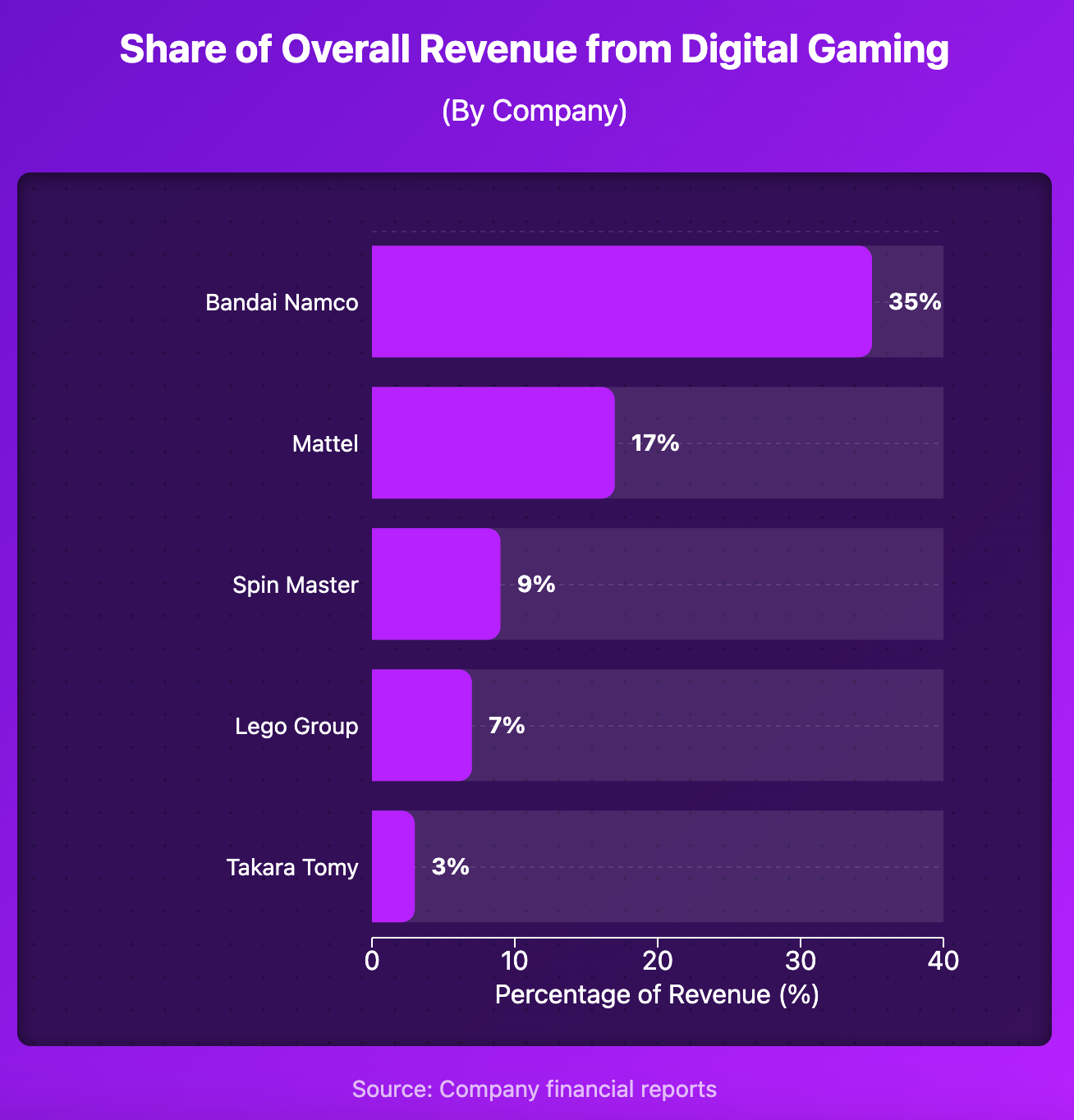
Lego has been investing heavily into digital gaming and I’d expect this number to go up quite a bit as the iconic Danish company looks to solidify and proliferate its legacy into a digital-first world. Spin Master has publicly expressed the goal of reaching a 20% gaming contribution sooner than later. And Takara Tomy has been growing steadily as a company while keeping its digital gaming contribution steady albeit small - they’re poised for a bigger jump.
Hasbro and Company have a massive opportunity given their often iconic IP from their toys. It’s a unique advantage in a world that is continuously shifting towards a transmedia consumer engagement model. To win, it’ll require these companies to outgrow their old toy manufacturer mindset and think like entertainment companies.
Roblox earnings call is on deck. Keep an eye out for updates of the UGC darling and our deep dive into the latest numbers and Roblox’s strategy going forward.