


I bomb atomically, Socrates' philosophies and hypotheses
Can't define how I be droppin' these mockeries
Lyrically perform armed robbery
Flee with the lottery, possibly they spotted me
[...]
The saga continues
Wu-Tang, Wu-Tang
Dear Readers,
Wu-Tang really is forever. The iconic hip-hop band that is currently on its last world tour this week announced that it’s bringing the W back to video gaming. 26 years after the group’s first video game called Wu-Tang: Shaolin Style, the Wu is coming back with a brand new game called Wu-Tang: Rise of the Deceiver. Set to release on PC first before it releases on console, the co-op action RPG game will feature a soundtrack featuring Wu-Tang Clan music and allow players to fight the deceiver in order to rescue the Wu-Tang members and save their home of Shaolin.
What is remarkable and visionary about this isn’t the fact that music artists developed a video game together with a game developer to leverage their brand and IP in a different medium. It’s the fact that this game was originally developed as a tie-in with the upcoming horror film Angel of Dust, made by Wu-Tang Clan members Ghostface Killah and RZA. The entire vision and strategy center on leveraging content across different media touch points - music, gaming, movies - to engage fans and reach consumers. It’s the type of transmedia strategy big companies are desperate to execute on.
“Bringing the story to life through film was just the beginning. Now, with the development of the video game, we are immersing fans even deeper into this supernatural thriller universe. It’s about blending music, storytelling, and interactive experience. I can’t wait for fans to step into the darkness and discover what lies beneath.” - Ghostface Killah
The visionaries are at work once again - and their saga will undoubtedly continue.
A record breaking launch
Another saga that is continuing and breaking records along the way is Nintendo with its newest console Switch 2. It is Nintendo’s fastest selling console ever. While the company’s estimates of being able to sell 15 million units until the end of March 2026 have been deemed conservative by analysts, who project numbers closer to 20 million, the launch has been astonishing.
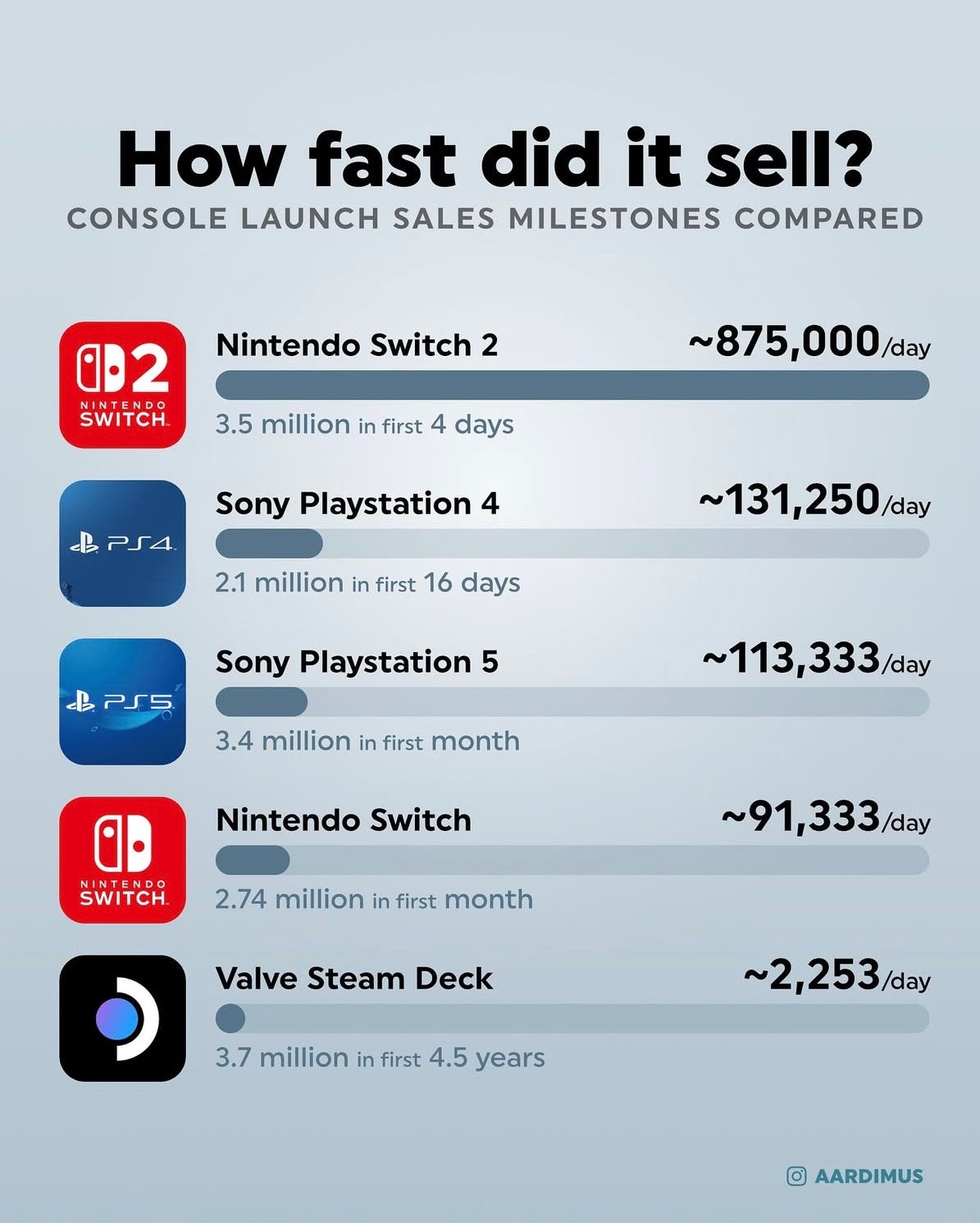
In just the first 4 days post launch, the Switch 2 was sold 3.5 million times globally. That’s already more than the amount of PlayStation 5s Sony was able to sell in the entire first month after launch. Nintendo’s rapid start here means that every minute, just over 600 consoles were sold. Every. Minute.
In parallel, Microsoft Xbox announced a new handheld console that admittedly looks stunning and features great haptics, mirroring the feel of an actual Xbox controller for the console. Some analysts have called it a big threat to the Nintendo Switch 2. I don’t agree with that sentiment for a couple of reasons: First, 75% of all parents co-play video games with their children. That’s the audience Nintendo taps into, which is very different from the target audience for Xbox. So who should be a lot more concerned is Valve with its steam deck. Second, Nintendo is a nostalgic brand with some of the best gaming IPs that will be exclusive for the Switch 2. These two combined put Nintendo in a different league.
That was - uhm - underwhelming
Apple has announced a ton of updates during its WWDC on Monday across its suite of products and services mostly focused on the software side of the company. The company also announced its much anticipated new gaming app. Called Games, the new app essentially is just an aggregator for all the games stored on your iPhone. You can access your downloaded games, your Apple Arcade, go to the games section in the App Store, as well as see what your friends are playing, compare scores, and invite them to play with you via the Play Together tab in the app.
Overall, it feels like a slightly better version of its predecessor Game Center that falls short of the actual potential Apple has on hand with games. As I discussed in a previous post, I was hoping for a much deeper tie-in with the entertainment content on Apple TV+ (see above - Apple should take note from the Wu-Tang Clan) to develop mobile games exclusively for the iPhone based on the streaming service’s IP library. We may still get to this place eventually, but for now the biggest potential upside especially for game developers is the built-in social proof from the visibility into what your friends are playing. This can definitely be fleshed out a lot more, but it’s going into a direction many game developers have been pushing both Apple and Google into by wanting to see social proof, friend lists, and recommendations on the respective app stores.
The split - finally
The writing has been on the wall forever on this one. Warner Bros Discovery (WBD) has finally announced that it’s splitting into two companies. By separating its traditional cable TV business (declining - think CNN) from its streaming and studio business (growing - think HBO). The goal is to grow the future-fit streaming and studios business without being dragged down by the declining networks business.
WBD is following Comcast’s footsteps in a move that essentially unwinds the 2022 merger of WarnerMedia and Discovery. Post split, both companies are set to be traded publicly, but the rumor mill is swirling that a lot more consolidation in the media industry is on the horizon - including deals where the majority of declining cable TV assets are combined in one company akin to a bad bank scenario, where ruthless cost cutting will drive up the profitability to allow investors to realize sizeable returns while revenues continue to decline year-over-year.
Ready for a big check?
In an attempt to reduce headcount, Google is offering buyouts to employees across the company, specifically in its knowledge and information unit (which includes the search, ads, and commerce divisions), central engineering, marketing, research, and communications. Teams that are not being offered such buyouts? Anyone and anything related to AI.
Reducing headcount via buyouts to avoid the backlash of abrupt layoffs is certainly a reason here. But there’s more to this than meets the eye. Google’s AI Overview feature at the top of Google Search is already significantly impacting organic traffic to other websites, and it will ultimately impact Google’s current core business that is search. As of today, it still contributes 56% of Google’s entire revenue, but it’s showing much lower growth rates than YouTube and the company’s cloud business. The threat from AI to search as we know it is real.
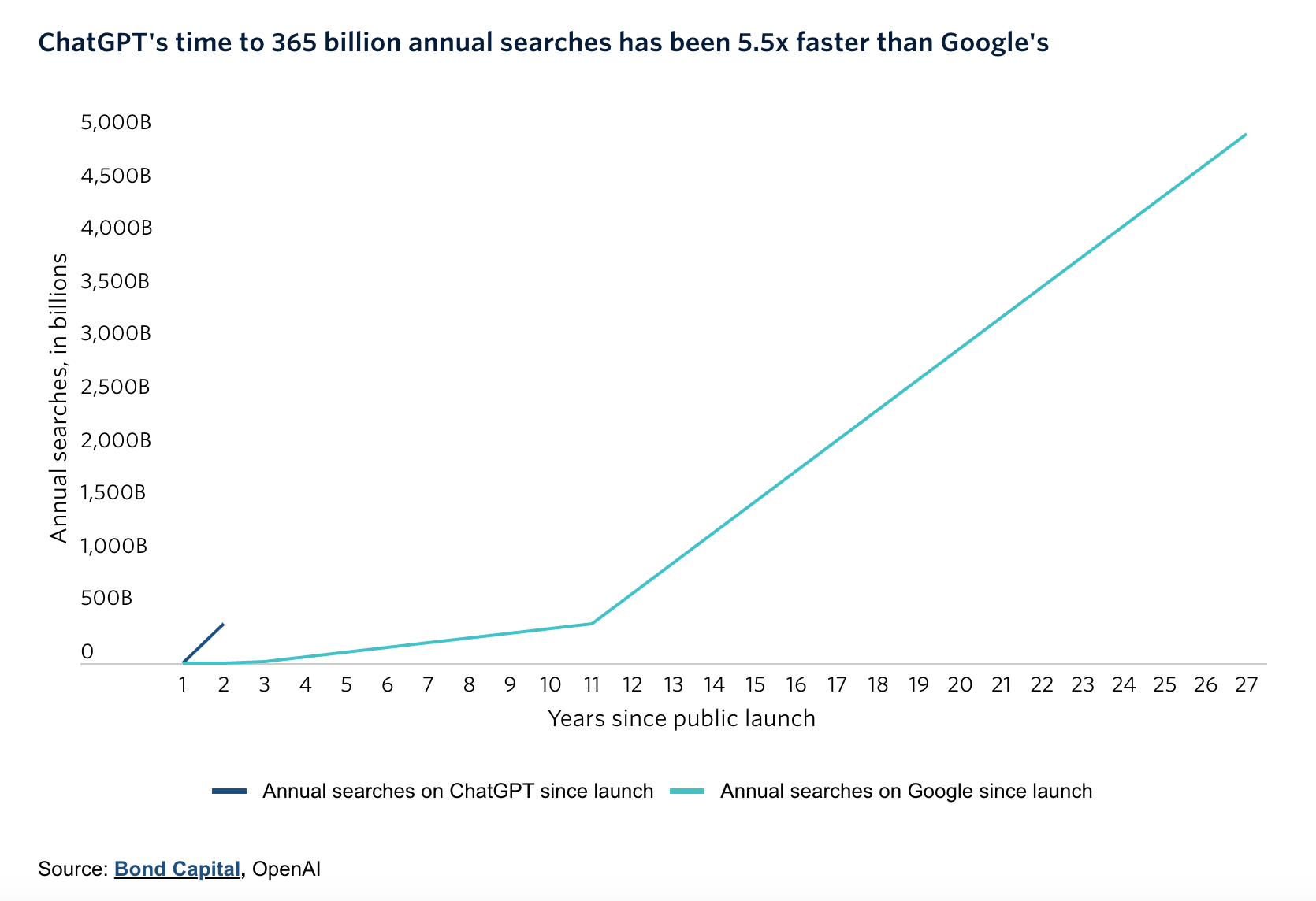
ChatGPT's time to 365 billion annual searches has been 5.5x faster than Google's. On top of that, there’s the looming breakup scenario hovering over Google that could see the company divest its ads business and/or Chrome - maybe even more. Given that, these buyouts feel more like tightening the belt in preparation of spinning out entire operations.
Hollywood fights back
Entertainment rivals Disney and Universal have teamed up to file a joint lawsuit against AI image generation startup Midjourney. The core complaint? That Midjourney ripped off key characters from Disney’s and Universal’s entertainment IPs when generating images without any consent or licensing agreement in place. These are some of my favorite quotes and depictions of Midjourney from the lawsuit.
Midjourney is…
“the quintessential copyright free-rider”
“a bottomless pit of plagiarism”
“a virtual vending machine” for “endless unauthorized copies”
Add this lawsuit to the ongoing slate of lawsuits from artists, record labels, entertainment companies, and news organizations against AI companies for scraping their content illegally.
I like this. Yes, IP laws put up barriers for AI companies to scale and create friction and hurdles. But for the people and organizations that create new and novel content, IP laws are often the only protection they have. Without that in place, many artists and creators would lose the incentive to create at all - which also can’t be in the interest of AI solutions that constantly seek new data to feed into their models to improve their capabilities. Aside from that, whoever creates something should own that. OpenAI didn’t like it when Chinese rival DeepSeek seemed to have copied its LLMs either.
We should expect to see a lot more of this and companies punching back on both sides.
Protect ya neck.
The world of AI and content is spinning faster and faster. To make sure you stay on top of the most relevant developments, we’ll dive into the world of GenAI and specifically how to ensure that the content these models produce is actually made with the consumer in mind. Please subscribe and share Technically Entertaining with one friend today.