


A media executive shared a chart on LinkedIn this week with a clean message. US attention is capped at about 25 hours a week, it has drifted down since 2018, and gaming has grown more slowly than social media and YouTube. His conclusion: to keep growing, games will have to look more like social media.
The chart is real. The conclusion deserves a challenge, and the strongest reason has little to do with gaming.
Over the past decades, boardrooms have developed an idolatry of attention. Nearly every marketing playbook now looks the same, and executives obsess over attention as if it were the metric that drives business outcomes. Attention without an action that follows is a vanity metric. If a consumer commits nothing to memory and does nothing later, the attention bought nothing. Even worse, attention can trigger actions a brand never wanted.
A Flat Pool of 25 Hours
The chart comes from a16z and draws on BCG data on US active media consumption. Weekly hours slipped from 26.2 in 2018 to 25.3 in 2025, a decline of 0.5% a year. Social media grew fastest at 6.6% a year and YouTube at 7.8%. Gaming grew 2.1%. On growth rates, the media executive is right.
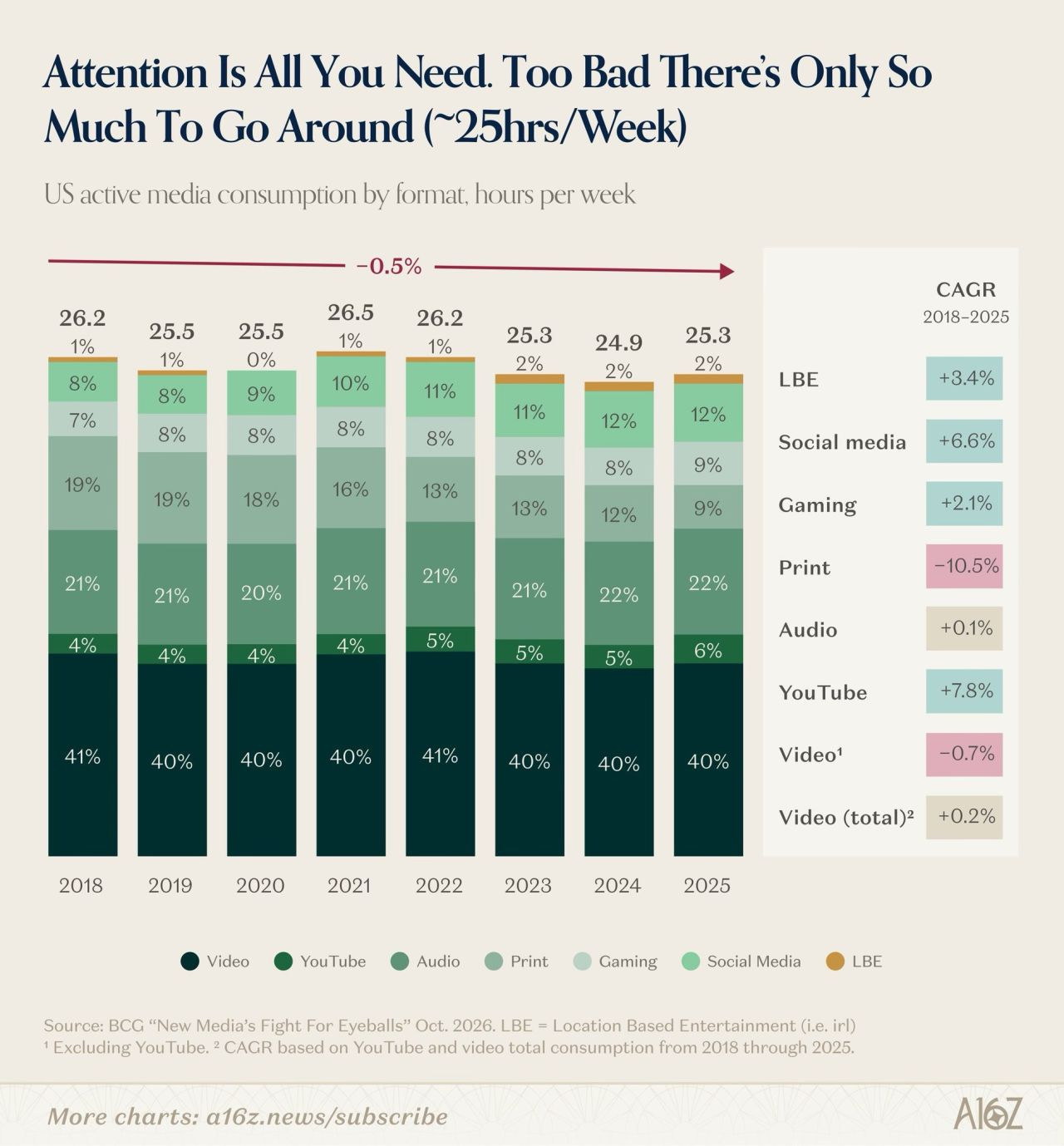
But take a look at share of the pool and the picture changes. Gaming moved from 7% to 9% of active time. YouTube moved from 4% to 6%, and social media from 8% to 12%. The biggest loser was print, which fell from 19% to 9%. Gaming gained share in a flat pool without turning into a feed.
The pool deserves one more piece of context. BCG’s own 2026 report puts total US media time at 91.4 hours a week, of which only about 28% is focused attention. Most of what gets logged as media time is background, and mostly noise.
For years the answer to growth was more minutes: more reach, more impressions, more watch time. In a flat pool, every minute gained is a minute taken from someone else, and winning it gets more expensive each year. With the pool of minutes fixed, a company’s job is to deliver as much value to consumers as it can within the minutes it already has, and to capture its share of that value in return.
In a fixed pool of minutes, growth comes from the value created per minute.
How Attention Became a Currency
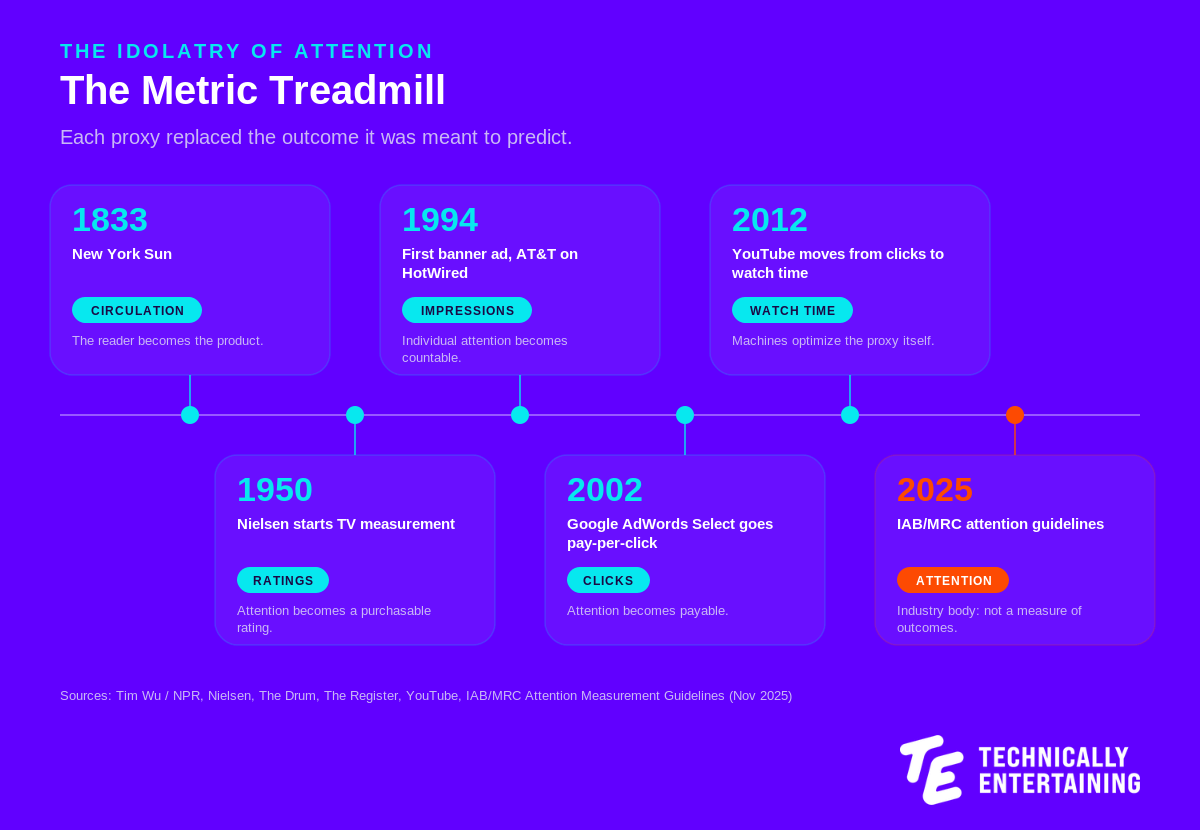
Nobody set out to build an idolatry. It grew one proxy at a time, and each proxy replaced the outcome it was supposed to predict.
It began in 1833, when the New York Sun launched at one penny and funded itself with advertising instead of subscriptions. The reader became the product. Tim Wu, who wrote the history of this business, called the Sun the first paper to run entirely on the harvesting of human attention. Radio and television turned that harvest into ratings, and Nielsen began measuring TV in 1950.
The turning point came on October 27, 1994, when AT&T ran the first banner ad on HotWired. For the first time, an individual’s attention could be counted in real time, and impressions and clicks became KPIs. In 2002, Google moved AdWords to per-click pricing, and attention became payable. By 2012, machines were optimizing the proxy itself. YouTube moved its recommendations from clicks to watch time, and Google’s own researchers later wrote that ranking on click-through rate often promotes deceptive videos.
Every fix to a gamed metric produced a deeper metric. The latest in the line is the attention second.
When Attention Backfires
In April 2023, Bud Light ran a sponsored post with influencer Dylan Mulvaney. The attention was enormous, and so was the reaction. In the four weeks ending May 28, Modelo Especial overtook Bud Light with $333 million in sales against $297 million, a 23% fall for Bud Light and its first loss of the top US spot in about 22 years. In the week ending May 20, volume was down 29.5% and revenue down 25.7%. Anheuser-Busch InBev lost about $27 billion in market value between March 31 and the end of May, although not all of that traces to the controversy. Whatever your view of the debate, the business lesson holds. A brand that buys attention without planning for the action it triggers does not control the outcome.
Cracker Barrel followed a similar path in August 2025. A new logo drew heavy attention, the company reversed it later that month, and traffic fell 8% after the change with shares down as much as 12% during the backlash.
Attention can also arrive with an action built in. Coinbase’s 2022 Super Bowl ad showed a floating QR code offering $15 in free bitcoin. It drew more than 20 million hits in a minute, crashed the site, and moved the app from #124 to #2 on the US App Store, according to Sensor Tower. Coinbase never published signup figures, so the commercial result remains unproven. The design principle holds. The ad told viewers exactly what to do next.
The Industry Is Saying It Too
I raised this with Joseph Cox, Director of Neuromarketing, Analytics and Strategy at Merkle / Dentsu, at DMEXCO in Cologne. We talked about how brands approach consumer attention, and he described it as one of the biggest risks in marketing strategy right now. I agree. The issue is systemic, and brands need to rethink their approach urgently.
The measurement industry’s own bodies point the same way. The IAB and MRC attention measurement guidelines of November 2025 say attention “should not be considered or used as a measure of outcomes.” The ARF’s third validation study in June 2026 tested four live national campaigns and found no simple one-to-one relationship between attention and upper-funnel lift. The ANA’s 2023 programmatic study found that only 36 cents of each dollar entering a DSP effectively reaches the consumer.
What does drive outcomes is meaning. The IPA’s database of 996 campaigns found that emotional campaigns delivered very large profit effects in 43% of cases at three years or more, against 23% for rational ones.
Attention Matters. It Is Just Not Enough.
None of this makes attention worthless. A Havas and Lumen study of about 9,000 campaigns found that attention and brand outcomes correlate, with the strongest effect on preference and purchase. The attention data is modelled by Lumen, a vendor, so treat it as directional. Karen Nelson-Field’s research adds that the effect depends on the brand. Passive attention was the strongest predictor for big brands, and active attention for small ones.
Attention is an input. Memory and action are the outcomes, and the budget belongs to the outcomes.
Why Humans Still Matter When Machines Fill the Feed
Bots made up 53% of web traffic in 2025, according to Thales, up from 51% the year before. Graphite estimates that roughly half of new English-language web articles are primarily AI-written. Impressions measure less human interest every year.
AI agents add a second layer. McKinsey estimates agents could orchestrate $900 billion to $1 trillion of US B2C retail revenue by 2030. Early research shows agents respond to position, ratings, and platform endorsements, and one study found they penalize “sponsored” tags. Agent checkout is still early, and OpenAI scaled back its Instant Checkout in March 2026 on weak adoption, so treat this as direction, not fact.
Humans still respond to other humans. Edelman’s 2025 brand trust research found that 84% trust friends and family and 80% trust “customers like me” for accurate brand information. NIQ’s neuroscience study of AI-generated ads found weaker memory activation even when the ads were high quality, and viewers called them annoying, boring, and confusing.
My view: as synthetic supply scales, verified human actions become the scarce signal for people and agents alike. Purchases, reviews, repeat play, and community are the currency a brand cannot fake.
Games Deliver Engagement Beyond Attention
This is where gaming holds a structural advantage over every other medium. A game cannot proceed without the player. Every minute involves decisions, memory of the rules, progress, and often other people. That is engagement, and it asks far more of a person than attention does.
The evidence that engagement turns into action is growing, although most of it is brand- or vendor-reported. Lunchables packs carrying a Roblox QR code outsold packs without one by 22% in sales velocity, per Kraft Heinz’s award entry. Starbucks’ virtual cafes on Roblox in Asia Pacific drove about 75,000 coupon redemptions. Hilton’s Roblox experience with Paris Hilton produced 27,300 Hilton Honors sign-ups. Duolingo has turned gamification into a business, with 58.7 million daily active users and 12.7 million paid subscribers in the second quarter of 2026.
Games are not immune to the flat pool. Roblox reported 29 billion hours engaged in the second quarter of 2026, up 5% year on year, with 123 million daily active users, up 10%. Both measures have fallen for three quarters in a row from a Q3 2025 peak of 40 billion hours and 152 million daily users. If the largest game platform in the world cannot count on more minutes, the case for depth per minute gets stronger.
BCG’s revenue-per-hour data shows what that depth is worth. Gaming earns $0.70 per consumer hour, social media $0.69, and video $0.39. The figure measures what companies capture, not what consumers receive, and it still shows how differently a minute can be monetized.
So I disagree with the advice to make games look more like social media. Games win with agency, progression, and play with friends. They should lean into those strengths harder, recognize content trends, and combine what only games can deliver with the habits consumers already have.
One warning applies. Nearly all of the action data above is vendor-run. Games need independent, outcome-based measurement, or the industry will build the same trap around its own metrics.
Beyond Games: The Engagement Test
Games are not the only place meaning and action meet. I scored six media on three criteria: user agency, closed-loop measurement, and human connection.
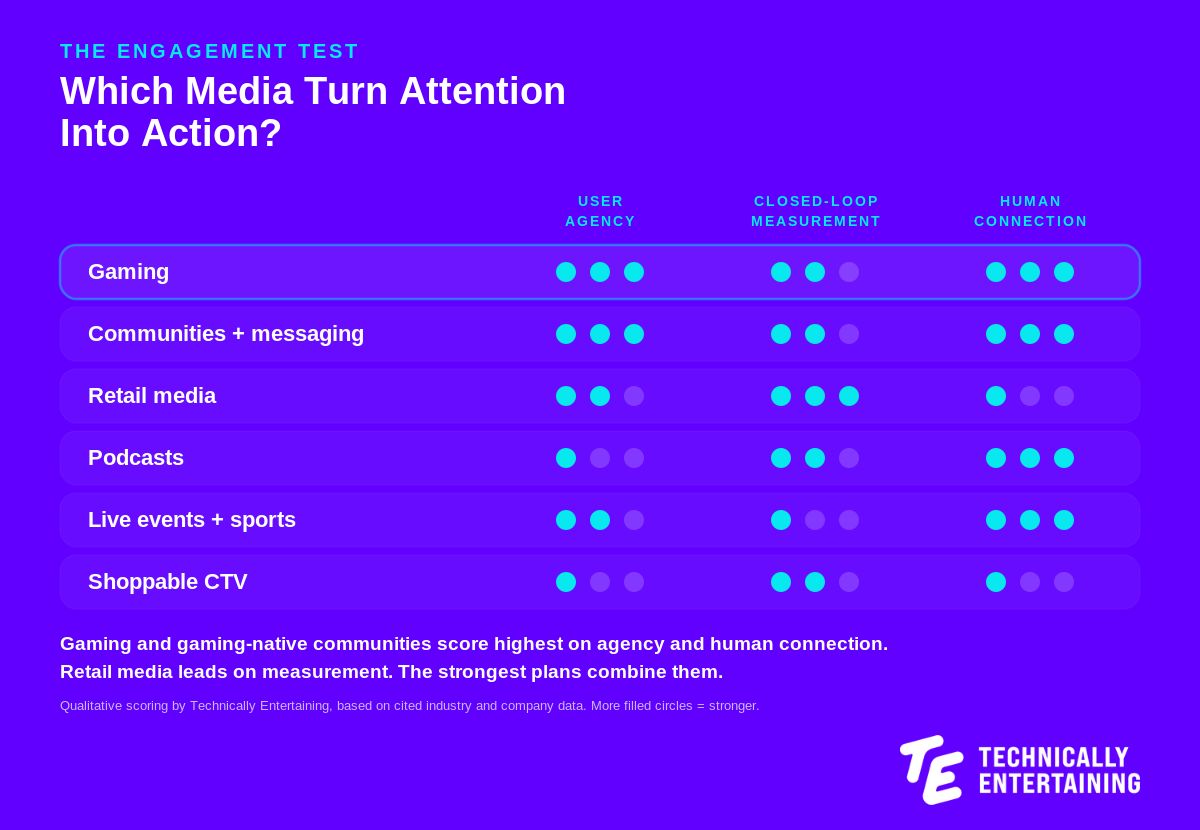
Gaming and gaming-native communities such as Discord score highest on agency and connection. Retail media leads on measurement, although only 53% of CMOs believe retail media networks measure incrementality reliably. Podcasts carry trust, with Edison Research finding that 76% of weekly podcast consumers took action after a podcast ad. Live sports struggle with proof, as 76% of marketers find sports ROI hard to determine. No medium wins every column, and the strongest plans combine them.
A Scorecard for the Boardroom
So what should executives do now? To start, replace the question “How many people looked?” with the following three questions:
Will they remember it?
What will they do because of it?
Do we have a relationship with them afterward?
Attention is the admission fee. The pool is not growing, and neither is consumer patience. The companies that win will treat every minute they earn as a chance to create value and capture their share of it.
Technically Entertaining covers the intersection of gaming, technology, and business strategy. If this changed how you think about attention, subscribe today and share it with the person in your building still asking for more reach.