


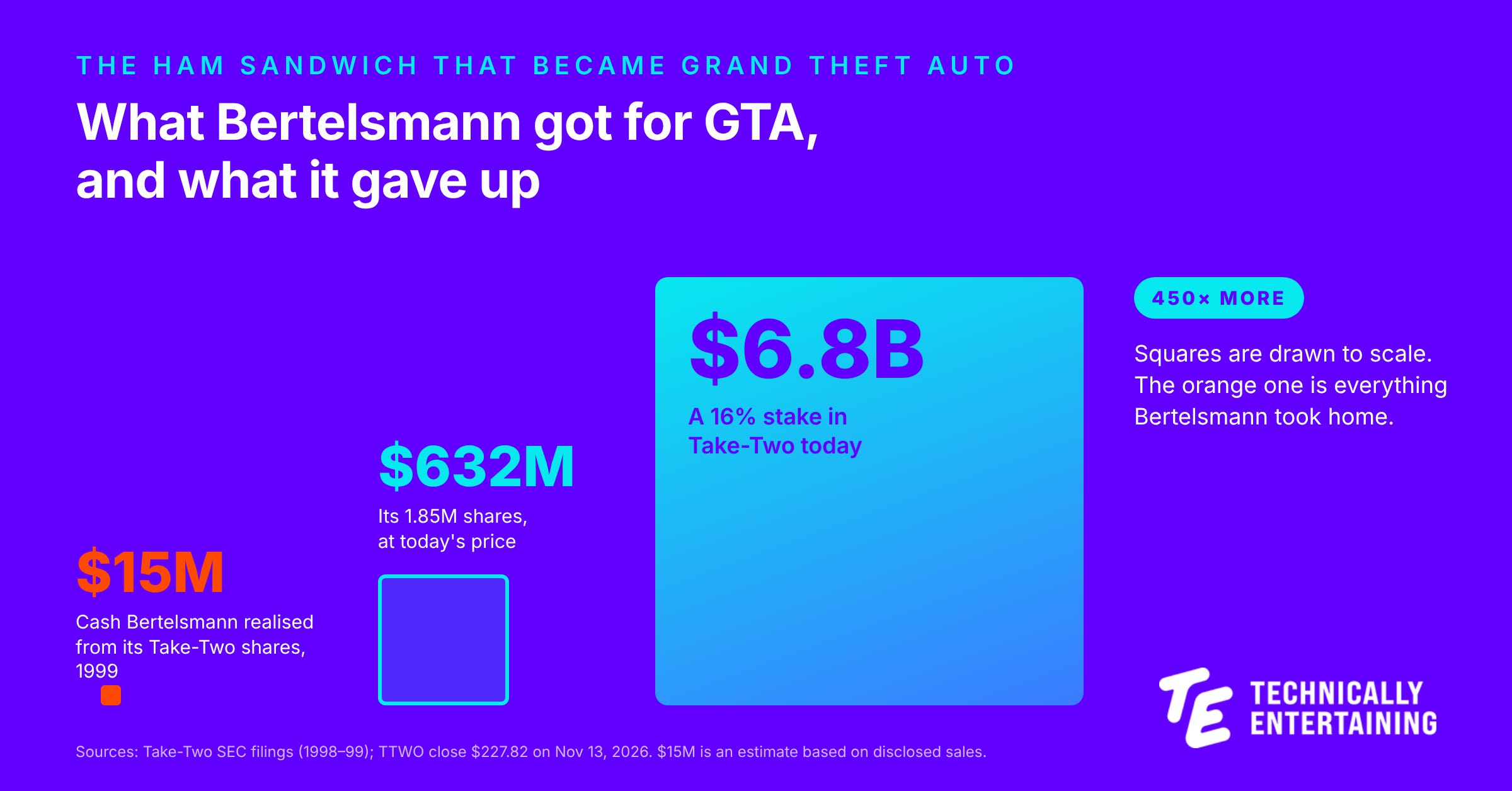
If you’re having a bad day today, remember that you could be Thomas Middelhoff. Twenty-eight years ago, the German media giant Bertelsmann owned the rights to Grand Theft Auto, and Middelhoff, then one of its most powerful executives, pushed to sell them. Since the release of GTA V in 2013 alone, the franchise has generated more than $10.5 billion in revenue. Bertelsmann walked away with roughly $15 million.
Here’s the twist that makes this story worth telling. The executive who fought hardest to keep GTA inside Bertelsmann is the same person who will launch GTA VI tomorrow. His name is Strauss Zelnick, and he is the Chairman and CEO of Take-Two Interactive.
The most expensive decisions in business are often made quietly, when a company labels an asset “non-core” and sells it before it understands what it owns. GTA is the most extreme example I know of, and the timing of GTA VI makes it the right moment to unpack it.
Strauss Zelnick Saw Games Coming Before Hollywood Did
In 1993, Strauss Zelnick had the job most entertainment executives spend their whole careers chasing. He was President and COO of 20th Century Fox, running the studio’s worldwide film production and distribution. He was in his mid-thirties.
Even then, he was paying close attention to where the entertainment business was heading. Video games were still a niche hobby for teenagers in the eyes of Hollywood. Zelnick saw something else. As he later told LEADERS magazine, games looked like “the next big entertainment business.”
So he did something almost nobody in his position would do. “I left Fox voluntarily, which no one ever does, to move to Silicon Valley, take a 95% pay cut and become the pre-revenue CEO of a little tiny video-game company called Crystal Dynamics in 1993,” Zelnick said in a recent Bloomberg interview with David Rubenstein.
Think about that. A 95% pay cut. A company with no revenue. A medium that the rest of his industry considered a toy. The only thing Zelnick had going for him was conviction, and the willingness to act on it years before his peers.
He built Crystal Dynamics to early success, and in 1995 Bertelsmann recruited him back into big entertainment as President and CEO of BMG Entertainment North America, home to RCA, Arista and a roster of the biggest music acts in the world. Zelnick brought his conviction about games with him. According to Music Business Worldwide, he and executive J Moses persuaded BMG’s owners to back BMG Interactive, the company’s video game division. Moses ran BMG Interactive from 1993 to 1996 and, as Take-Two’s own proxy statement puts it, “green-lighted” a portfolio of 11 games, including the original Grand Theft Auto.
Sam Houser and the Record Label Model for Games
The other person who matters here started in BMG’s post room. Sam Houser joined the company in 1990, moved into the interactive division in 1994, and by 1996 was Head of Development at BMG Interactive in the UK. Music Business Worldwide describes his gift as “A&R’ing” video games: spotting titles that would sell big and signing them the way a label signs an artist.
That mindset is the hidden thread of this whole story. Bertelsmann had assembled, almost by accident, everything a modern games powerhouse needs. It had an executive at the top who believed in the medium, a publishing team with an ear for hits, and a provocative new game from a small studio in Dundee called DMA Design. In late 1997, BMG Interactive published that game. It was called Grand Theft Auto.
How Bertelsmann Sold Grand Theft Auto in 1998
Grand Theft Auto sold well in Europe and immediately sparked a fierce debate about violence in games. For Bertelsmann’s leadership in Gütersloh, the whole interactive division looked like a distraction. The company concluded that BMG Interactive lacked the scale and strategic importance of its core music business, and it put the division up for sale.
Zelnick fought it. “I couldn’t have protested more but, at the end of the day, I had a boss,” he told Music Business Worldwide, naming Thomas Middelhoff as the executive who forced the divestiture.
The buyer was a scrappy New York publisher founded five years earlier by Ryan Brant, who had started the company at 21. On March 12, 1998, Take-Two Interactive announced it would acquire substantially all of BMG Interactive’s assets, and the deal closed on March 25. Mark Seremet, who co-founded Take-Two with Brant, recently looked back on the acquisition in a LinkedIn post. One of the greatest franchises in entertainment history, he wrote, had landed in their hands for what Brant would have called a “ham sandwich.”
The ham sandwich had a precise price. According to Take-Two’s 8-K filing, Take-Two paid with 1,850,000 shares of newly created convertible preferred stock, which gave BMG about 15.8% of Take-Two. The press valued the deal at $14.2 million. Take-Two’s own annual report booked the shares at just $9.5 million.
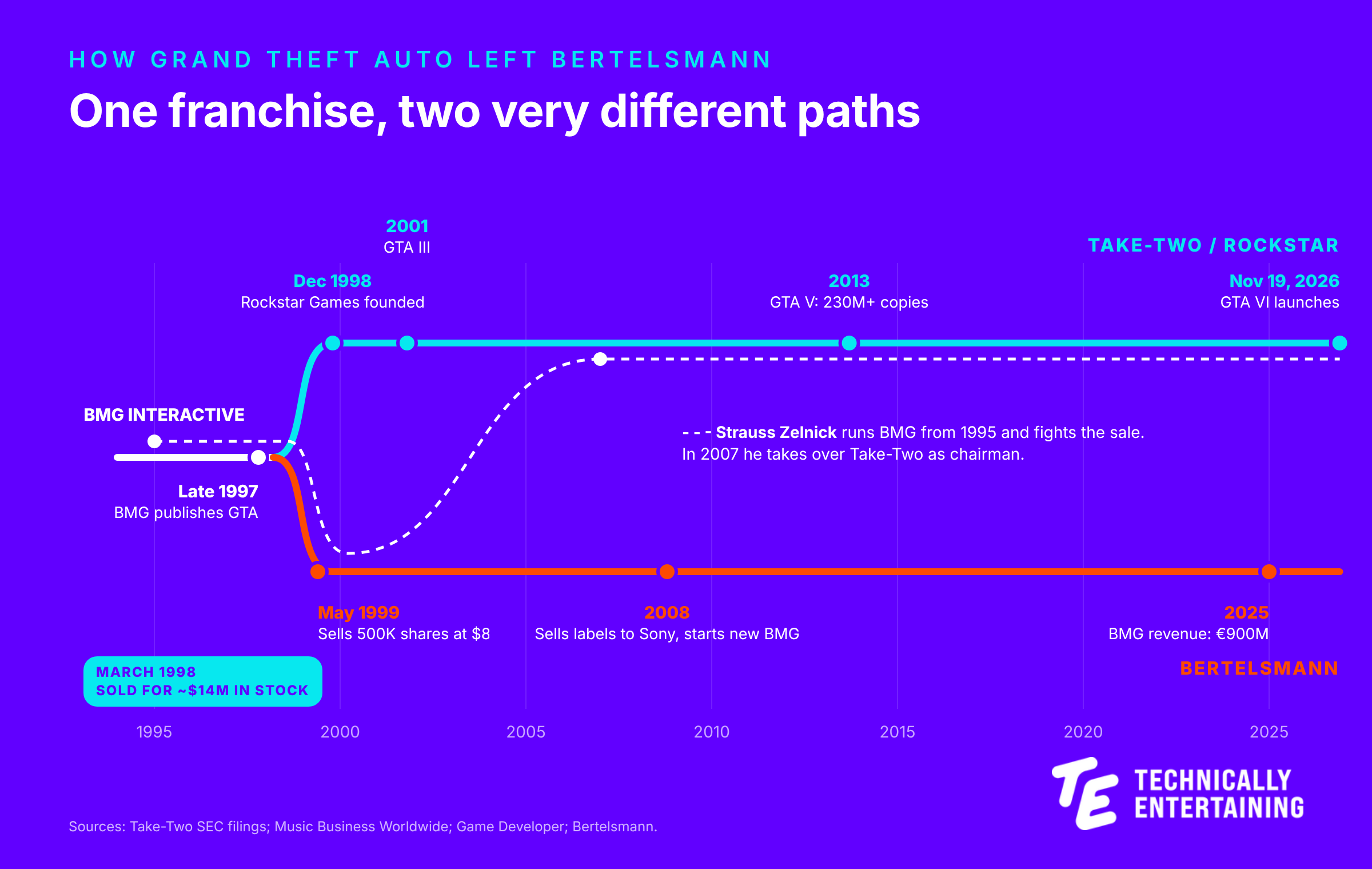
For that, Take-Two received the worldwide rights to Grand Theft Auto, a catalog of other titles, European distribution operations and, most importantly, the people. Sam Houser, his brother Dan Houser, Jamie King and Terry Donovan moved to New York. In December 1998, they founded Rockstar Games as Take-Two’s premium publishing label, built on the assets Take-Two had bought from BMG. In 1999, Take-Two also acquired DMA Design, the studio behind GTA, which later became Rockstar North.
What followed is entertainment history. GTA III arrived in 2001 and turned the series into a cultural phenomenon. GTA V launched in 2013 and has sold more than 230 million copies across three console generations. And in 2007, Strauss Zelnick came back into the story. His firm led a shareholder takeover of Take-Two, and he became Chairman that year and CEO in 2011. The executive who could not stop Bertelsmann from selling GTA ended up running the company that bought it.
What Selling GTA Cost Bertelsmann
Here is the part that surprised me most when I went through the old SEC filings. Bertelsmann did keep a stake in GTA’s future. The Take-Two shares it received were exactly that. It just sold them far too early.
The preferred shares converted into common stock in August 1998. On May 11, 1999, BMG sold 500,000 Take-Two shares at $8.00 each, for $4 million. A month later it filed its last ownership report, showing 1.35 million shares, or 6% of the company. After that, Bertelsmann disappears from Take-Two’s shareholder record. If the remaining shares sold at a similar price, Bertelsmann’s total haul from Grand Theft Auto came to roughly $15 million.
Now run the numbers on what that stake would be worth today. After Take-Two’s 3-for-2 stock split in 2005, BMG’s original 1.85 million shares would be 2.775 million shares. At Take-Two’s closing price of $227.82 on November 13, that is about $632 million. Had Bertelsmann kept its 16% ownership through the years, that stake would be worth about $6.8 billion at today’s market cap of roughly $42.6 billion.
The revenue picture is even starker. Take-Two posted $6.72 billion in net bookings in its fiscal year 2026 and has guided to $8.0 to $8.2 billion for fiscal 2027, the year GTA VI launches. A 16% share of fiscal 2026 alone would be worth about $1.08 billion a year.
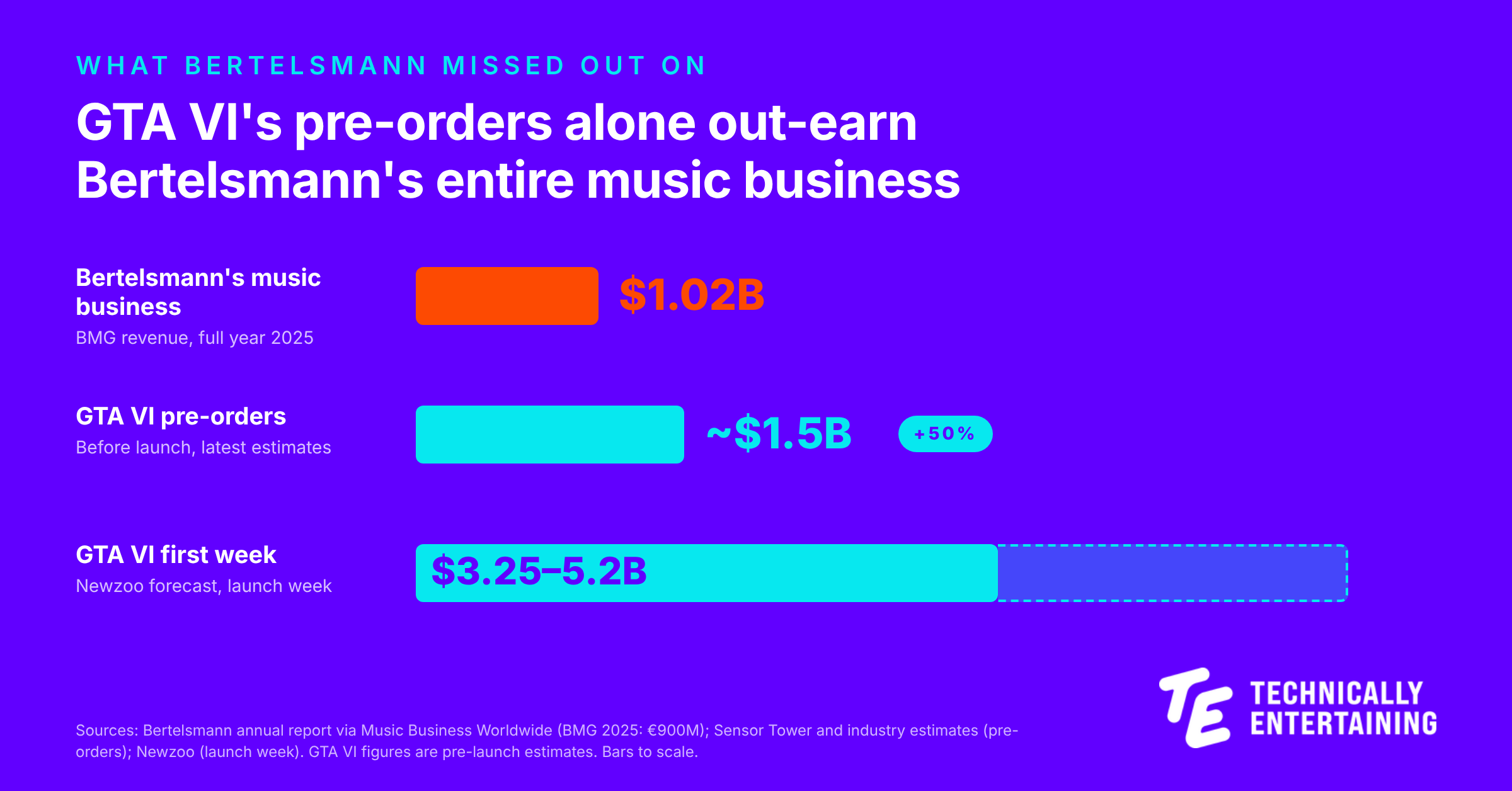
Compare that to Bertelsmann’s music business today. BMG, the music rights company Bertelsmann built after selling its record labels to Sony in 2008, generated €900 million, or about $1.02 billion, in revenue in 2025. The latest estimates put GTA VI’s pre-order revenue at roughly $1.5 billion, before anyone has played a single minute of the game. Sensor Tower’s digital tracking alone has GTA VI past $1 billion and 10.3 million pre-orders. Newzoo projects the game will earn between $3.25 billion and $5.2 billion in its first week.
GTA VI’s pre-orders alone bring in about 50% more than Bertelsmann’s entire music business makes in a year, and its first week could earn three to five times BMG’s annual revenue.
The industry context makes the miss even more painful. Bertelsmann sold its games division to protect its music business. In 2025, global games spending reached $201.6 billion, according to Newzoo. The entire global music industry sits at roughly $31 billion.
McDonald’s and Chipotle: The Same Decision in Fast Food
If you think this only happens in entertainment, look at what McDonald’s did with Chipotle in the very same year.
In 1998, McDonald’s made its first investment in Chipotle Mexican Grill, a burrito chain founded by chef Steve Ells that had 16 restaurants, all in Colorado. Over the following years McDonald’s put around $340 million into the company and ended up owning about 90% of it. Its capital fueled Chipotle’s expansion to more than 500 locations.
Then, in 2003, McDonald’s decided to focus its management resources on revitalizing the McDonald’s brand and to eliminate projects that did not directly affect the experience of McDonald’s customers. Chipotle had become “non-core.” McDonald’s took it public in January 2006 and completed its exit through a tax-free share exchange that closed on October 12, 2006. Its gross proceeds came to about $1.1 billion.
On paper, that was a good trade. McDonald’s roughly tripled its money. But Chipotle kept growing. It reported $11.9 billion in revenue for 2025 and runs more than 4,000 restaurants. Its market capitalization sits at about $43.5 billion. A 90% stake would be worth roughly $39 billion today.
The parallels to GTA are striking. Both deals started in 1998. In both cases the parent company owned a fast-growing asset run by a founder or creative team with a distinct vision. Steve Ells famously resisted McDonald’s push for drive-throughs and breakfast, much like the Houser brothers built Rockstar with a culture all its own. And in both cases, the parent sold in the name of focus.
The difference is in degree. McDonald’s tripled its investment. Bertelsmann sold a franchise that has since generated well over $10 billion for about $15 million.
Three Leadership Lessons From the GTA Sale
It’s easy to mock Bertelsmann with the benefit of hindsight. Nobody in 1998 could have predicted GTA V. But the decision itself followed a pattern I see in boardrooms all the time, and it holds three lessons for any executive deciding what to keep and what to sell.
First: “non-core” describes your portfolio today, and markets move faster than portfolios. Bertelsmann measured BMG Interactive against its music business and found it small. The better question would have been how big the games market could become and what role the company wanted to play in it. Zelnick asked that question in 1993, and it cost him 95% of his salary. Before you divest, judge the asset against the growth of its own market.
Second: the people are the asset. Take-Two bought a game, a catalog and some distribution operations. What it really acquired was Sam Houser, Dan Houser and a team that knew how to find and build hits. McDonald’s had the same thing in Steve Ells. When you sell a business with a strong creative leader, you are selling that leader’s next ten years of ideas, and your buyer knows it.
Third: if you sell, keep a seat at the table. Bertelsmann’s 16% stake in Take-Two was a built-in hedge against being wrong. It sold half a million shares within 14 months and appears to have exited fully soon after. Holding on would have turned one of the worst divestitures in media history into a respectable return. Structure your exits so that you share in the upside if the market proves you wrong.
Tomorrow, millions of players will start GTA VI. Strauss Zelnick will be watching the numbers come in, 33 years after he took a 95% pay cut to bet on games. Somewhere in Gütersloh, someone may be doing the math on that ham sandwich.
Technically Entertaining covers business strategy at the intersection of gaming, technology and entertainment, for the decision-makers shaping what comes next. The executives who understand gaming’s strategic value today are the ones setting the agenda tomorrow. Join them.