


Where should we start?
If you have been in a room with CMOs and brand leaders in the past 12 months, or you are amongst those leaders yourself, the chances that someone around the table asked this question are 100%.
The context: new media strategy. Specifically gaming and where the brand should play, what games to seek out, and how to build video games themselves. Despite the overwhelming evidence when it comes to pretty much any audience statistic that demonstrates that video games are THE channel for modern-day consumer engagement, execution is riddled with question marks and uncertainty.
Where should we start?
It’s the moment where the meeting’s atmosphere shifts from excitement and enthusiasm to hesitation with a dash of burden and a hint of worry. It’s the toxic cocktail that causes most great adventures in business to tap out and leaders decide to move it down the priority list.
The example of Unilever illustrates just how costly this decision for a brand can be. In conversation for my book Press Play, Luis di Como, the former VP of Global Media at Unilever and in charge of the company’s global gaming efforts from its earliest days onward, tells the story of how Unilever was ahead of the curve - and then waited a full decade to get back into gaming. A partnership with Electronic Arts in 2012 brought the Unilever brand Dove with its famous shampoo into The Sims Social game, after which Unilever made the call that would cause them to lose their advantage.
“The space was important, but it needed too much ramp-up time for us internally. It has always been on our road map, but we simply didn’t have access to the skills and capabilities needed to be successful.”
- Luis di Como, frm. VP Global Media Unilever
Source: Press Play - Why Every Company Needs a Gaming Strategy
Access to the necessary skills and capabilities. What held Unilever back is, in my experience, still the number one reason why brands hesitate to jump into gaming (close second: measurement and attribution of ROI). It’s the root cause for the question expressed in every one of those fateful meetings. If you lack the tools and capabilities, it’s hard to assess where to start - and how.
A few important things have changed since the days when Unilever had to make their call on video gaming. First, more people in the workforce who grew up playing video games have moved up the corporate ladder and are entering leadership roles. This brings a much-needed familiarity of gaming as a medium into the fold. Second, technological progress is making games a lot more accessible - both from an integration and a building point of view. For brands, this is a critical shift that significantly reduces the skills gap. Instead of having to rely on specialized game development and engineering talent, platforms, tools, and providers are making it easier and easier for everyone to build great games.
Unity and Unreal, Together on One Stage in Seoul
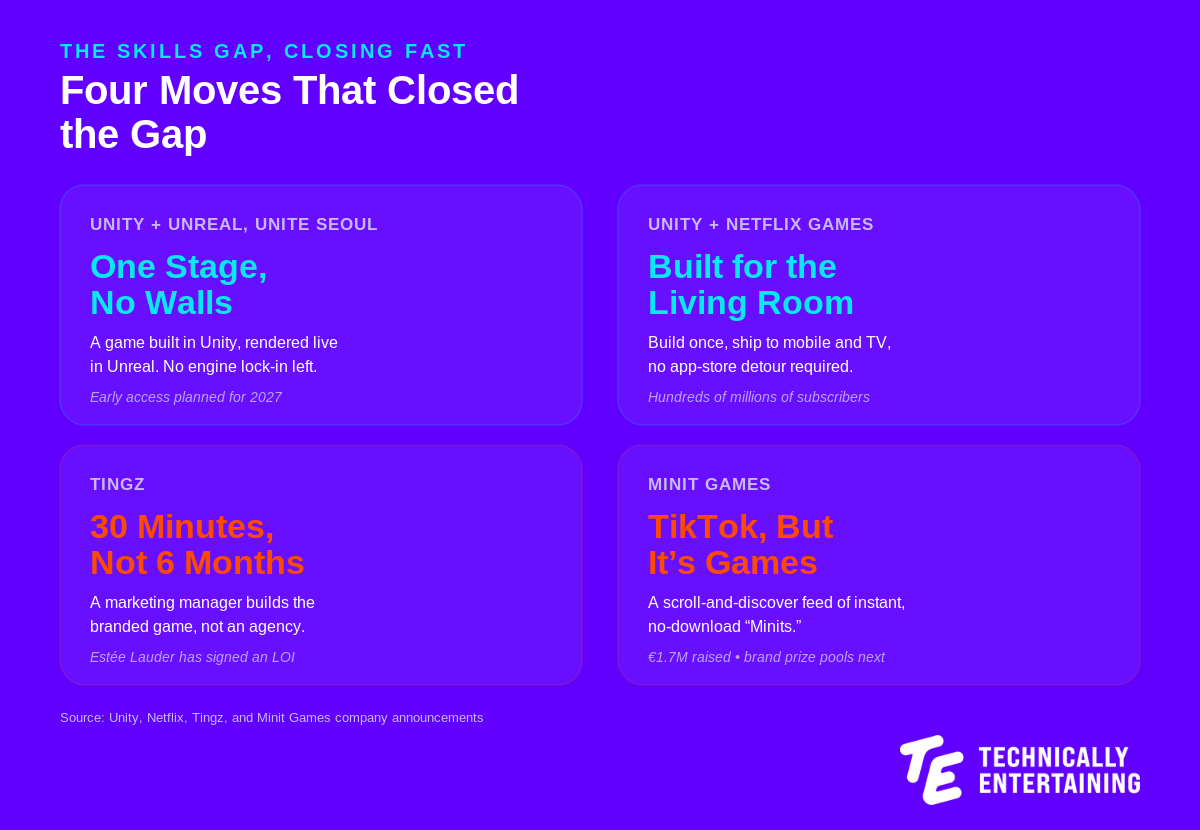
At Unite Seoul in July 2026, Unity announced Unity 7, its biggest platform update in years: faster iteration through selective code reloading, real-time global illumination without baking, and a free CLI and MCP server that let external AI tools plug directly into the engine. The moment that mattered most for brands, though, came during a live demo of Unity’s partnership with Epic Games. Unity showed a game simulated entirely in its own engine, rendered in real time inside Unreal Engine, with synchronized physics, lighting, and input. As Unity’s James Stone put it on stage: “What you’re seeing here is a game simulated in Unity, rendered with Unreal. Now, that’s not video streamed, no smoke and mirrors. This is all real-time.” Early access is planned for 2027.
Why this matters for brands: the two engines that split the industry between them are actively removing the walls between their ecosystems. A brand no longer has to bet its gaming investment on picking the “right” engine or the agency locked into one. The tools brands rely on to build and distribute a branded game are starting to work across both, which lowers the risk of committing to a gaming strategy in the first place. It also offers brands the much needed flexibility in shaping gaming experiences that allow their customers to seamlessly travel between touch points.
Unity and Netflix, Built for the Living Room
Unity also announced dedicated engine support for Netflix Games, giving developers the ability to build once and ship across mobile and TV, optimized for Netflix’s cloud gaming infrastructure. The goal is to shorten the distance between browsing Netflix and actually playing something inside it. Several existing Netflix titles were already built on Unity, and the new dedicated support is designed to make that path the default rather than the exception.
Previous article relevant to this story

Why this matters for brands: Netflix already reaches hundreds of millions of subscribers who open the app expecting quality entertainment, not a separate app-store detour. A brand that builds a lightweight, Unity-based game for Netflix’s platform gets distribution to that audience without asking anyone to leave the couch or download anything new. The fact that Netflix offers games tremendous reach as a platform was just recently demonstrated by the launch trailer / movie for the upcoming Grand Theft Auto VI eclipsing over 31 million views within 4 days of its release and claiming the number 1 spot in many of Netflix’s core markets.
Tingz, Turning a Brief Into a Playable Ad in 30 Minutes
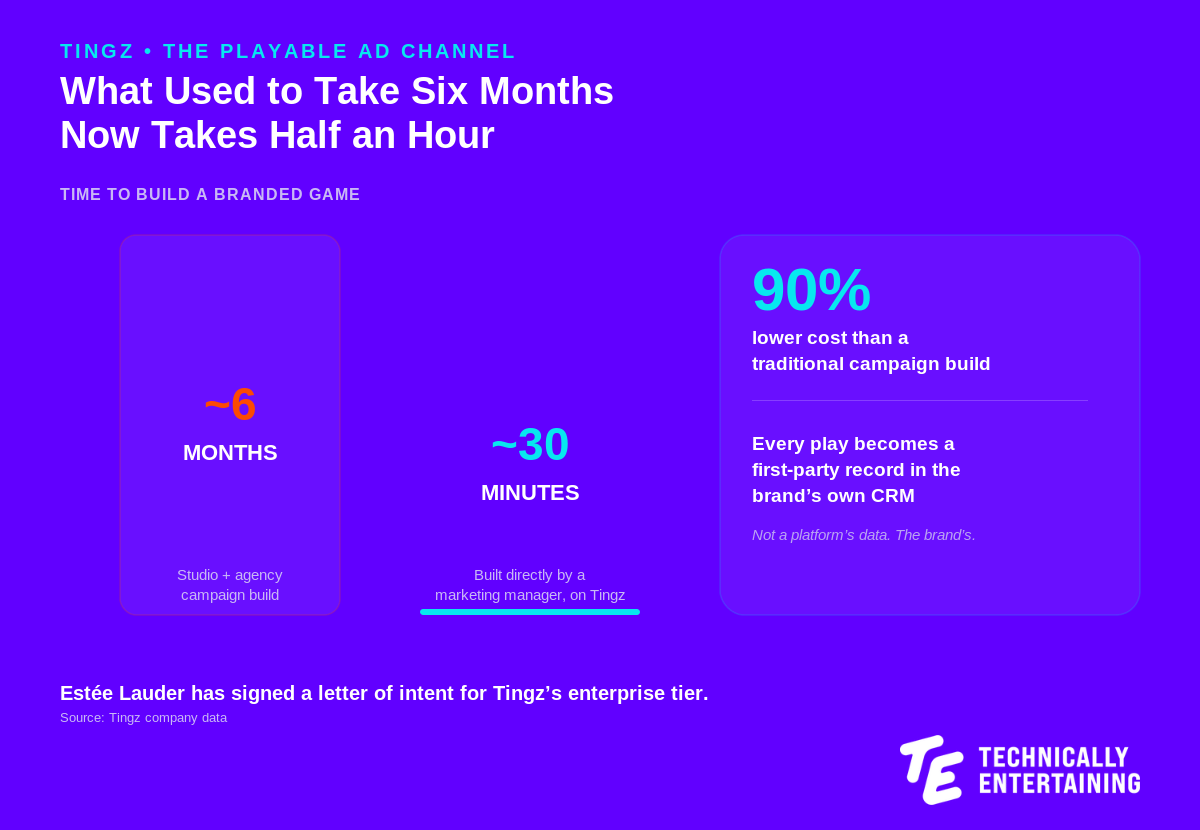
Tingz builds custom branded games for consumer brands and rights holders, designed and delivered end to end on its own AI production pipeline rather than commissioned out to a studio and an agency. A build takes days. The industry standard for a studio-and-agency campaign is three to six months, at many times the cost. The data belongs to the brand: play produces first-party behavioural data, and where a brand wants identified players, the game captures consented records straight into their own CRM.
The company comes out of two careers pointed at the same problem from opposite ends. Co-founder and CEO Julia Muszynski spent more than a decade in brand marketing, at adidas and then at Google, where she ran some of the largest brand accounts in sport, beauty and FMCG, and watched them pay more every year for attention people were actively trying to skip. Her co-founder Andreas Schemm spent his on the other side of it, building two companies before this one, one in gaming and one in AI. Games are the format people choose. Tingz is the two of them making that format buildable on a marketing timeline, and the first titles are in production now.
Why this matters for brands: the math is the real story here. A branded game that used to require two agencies and half a year now takes days and a fraction of the budget, low enough that testing gaming as a channel no longer requires a full campaign commitment to justify, and brands are already commissioning them on that basis.
Minit Games, Betting on the TikTok-ification of Play
Minit Games has raised €1.7 million to build a short-form gaming platform: a feed of instantly playable HTML5 games that need no per-game download or install, borrowing the scroll-and-discover mechanics that made short-form video unavoidable. The individual games are tied together in a platform-wide meta layer, so the motivators that make games sticky, like progression, competition and achievements, carry across the whole feed and from session to session.
Now in global open beta (you can join here), Minit Games is deliberately an open platform that accepts games built in any professional engine or AI tool, and it is growing its creator base through on-platform game jams with prize pools. For brands, the business model is a playable-ad network native to the feed: brands and publishers bring their own playables and buy targeted placement by audience and country. On top of that, Minit Games plans to give brands a direct way into the creator community by funding prize pools for creator challenges, tournaments, and branded events built on the feed.
Why this matters for brands: this is the closest thing gaming has to TikTok's creator economy right now. A brand doesn't need to build an audience from zero. It shows up inside a feed people are already scrolling, with exactly the kind of short, shareable, interactive content brands have spent a decade trying to manufacture on social platforms.
The Excuse Is Gone
Every one of these four moves points at the same shift. Unity and Unreal are opening their walls to each other. Unity is wiring itself directly into Netflix’s living room platform. Tingz is turning a sentence into a playable ad. Minit Games is building a TikTok-style feed for games. The skills and capabilities gap that Luis di Como described as the reason Unilever waited a decade is being dismantled by the tool providers themselves, not by brands finally hiring enough engineers.
That doesn’t mean the “where should we start” question disappears. It means the honest answer to it just got a lot shorter. Brands no longer need a five-year gaming roadmap and a bespoke studio relationship to get a foot in the door. They need a clear-eyed view of which of these platforms fits their audience, and a willingness to test something small before the next CMO meeting turns into another round of hesitation.
Technically Entertaining covers the intersection of gaming, technology, and business strategy. If this changed how you think about your brand’s next move in gaming, subscribe today and share it with the person in your building still asking where to start.