


Last week, I was on a call with the Chief Digital Officer of one of Europe’s most respected news publishers. His remit is to build out the entire digital business. That includes the mobile news app, but it also includes a slate of brand-new content verticals. The three verticals on his agenda right now: podcasts, cooking, and gaming.
When I asked him about the strategy behind the gaming offering, how he plans to build it, position it, and grow it, his answer was disarmingly simple:
“It’s easy. We’ll just copy what The New York Times is doing.”
I have heard that exact answer more times than I can count over the past 18 months. In executive workshops, on stage at industry conferences, in private investor meetings. Always the same sentence. Sometimes with a knowing smile.
The New York Times has become the default reference point for gaming strategy in the news and media industry, and for good reason. Since acquiring Wordle in January 2022 for a reported low seven figures, the company has stitched together a games portfolio that now drives billions of plays per year and shows up repeatedly in earnings calls as a key contributor to subscriber growth, bundle conversion, and engagement. NYT Games has done what every publisher dreams of doing: turn casual readers into daily habits and daily habits into paid subscriptions.
So copying The New York Times sounds like a safe bet. It is the opposite of safe. It is one of the most dangerous strategic moves a media executive can make in 2026.
Why Copying The New York Times Gaming Playbook Is a Strategic Trap
There are two structural reasons the “just copy the NYT” mindset breaks down at the foundation.
First, copying a competitor’s playbook is the fastest route to commoditization. The single most important premise of any successful games offering is authenticity. The portfolio has to stay true to the brand and be grounded in the publisher’s unique audience. Copying what others are doing is the direct contradiction of that premise. It produces sameness, and sameness erases the differentiation that gaming is supposed to create in the first place.
Second, every piece of content a news organization creates has to be grounded in the audience first. When you copy someone else’s playbook, you inherit their assumptions about their readership without ever questioning whether those assumptions apply to yours. What converts a Times reader in Manhattan into a paying subscriber may have nothing to do with what your readers in Munich, Madrid, or Manchester want from your brand. The execution can look identical and the outcome can be wildly different.
The proof is already on the table. Walk through the gaming offerings of major newspapers and magazines around the world today and you will find the same default product on the homepage over and over again: a crossword puzzle. The Washington Post, Die Zeit, Bild, The Guardian, Le Monde. Every major publisher’s first move into games has been to ship a crossword and call it a strategy.
Crosswords have a real heritage in print journalism. They are connected to newspapers the way pickles are connected to a good cheeseburger. Pickles, however, do not all taste the same. There are dozens of other ingredients that make a cheeseburger great. If every publisher serves the same pickle, the entire category tastes identical to the consumer. The differentiation collapses the moment everyone shows up with the same recipe.
How Bloomberg Uses Games as a Subscription Funnel
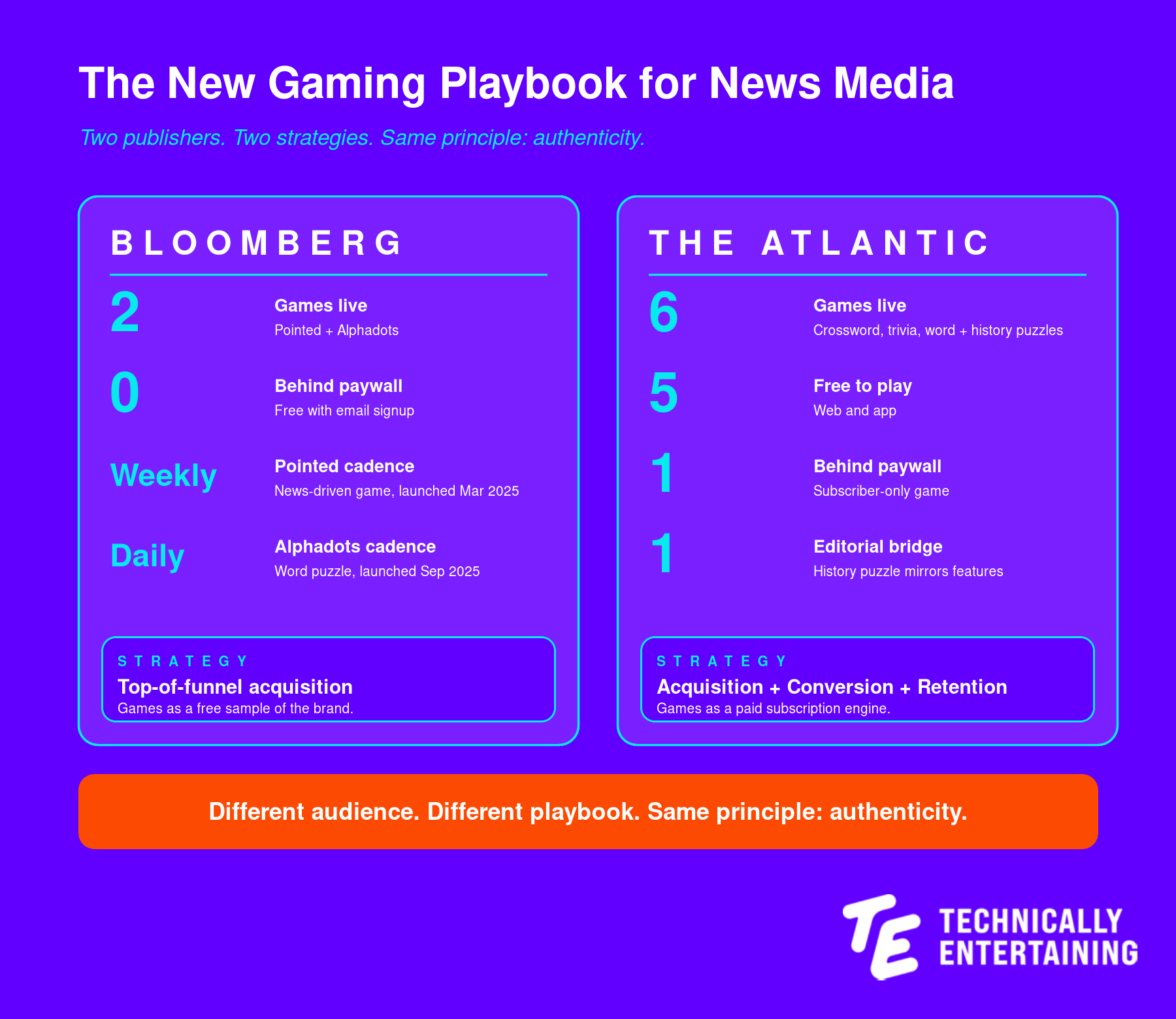
Two publishers are demonstrating what a differentiated, audience-first games strategy actually looks like in practice: Bloomberg and The Atlantic. Both are building out gaming offerings. Both are following different playbooks. Both are getting real traction.
Bloomberg currently has two games live inside its “Explore” content section:
Pointed, a weekly news game for risk-takers, launched in March 2025 and grounded in current events and the news cycle.
Alphadots, a daily word puzzle, launched in September 2025.
The two games are presented as standalone products in the Explore section. There is no bundled, branded games destination yet. To play either of them, users only have to register with an email address and create a free account. No subscription required.
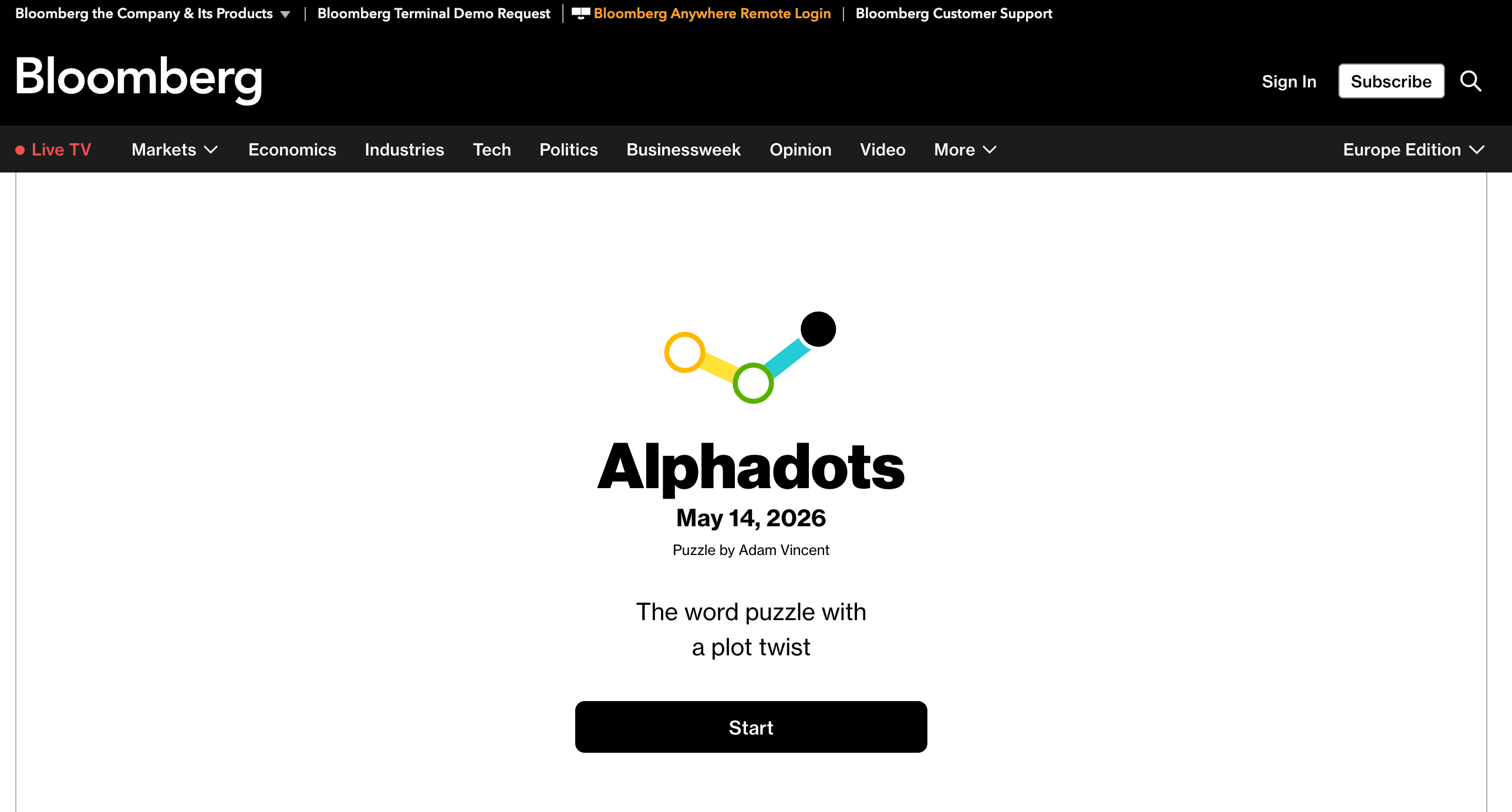
The strategic intent is clear. Bloomberg is using games as a top-of-funnel acquisition engine for its broader digital subscription business. The hook is the game. The conversion target is the subscription. The bet is on cross-pollination: a user who comes in for Pointed gets exposed to Bloomberg’s terminal-grade journalism, market data, opinion content, and over time the habit forms. The games themselves pull from the same editorial DNA as the rest of the publication. Current events. Markets. The news cycle. The game is a free sample of what the Bloomberg brand actually stands for.
This is the part most publishers miss. Bloomberg has resisted the temptation to build games as a separate entertainment product bolted onto the side of the newsroom. The games are an extension of the journalism. They reinforce the brand promise of being deeply plugged into the news and the markets. That is what makes the funnel work.
How The Atlantic Built a Six-Game Portfolio That Mirrors Its Editorial DNA
The Atlantic is one step further down the learning curve. The publication has scaled to six games in a remarkably short window. The lineup includes the expected crossword, but it also includes trivia, word games, and a daily puzzle game that uncovers historical facts tied to a specific date in the year.
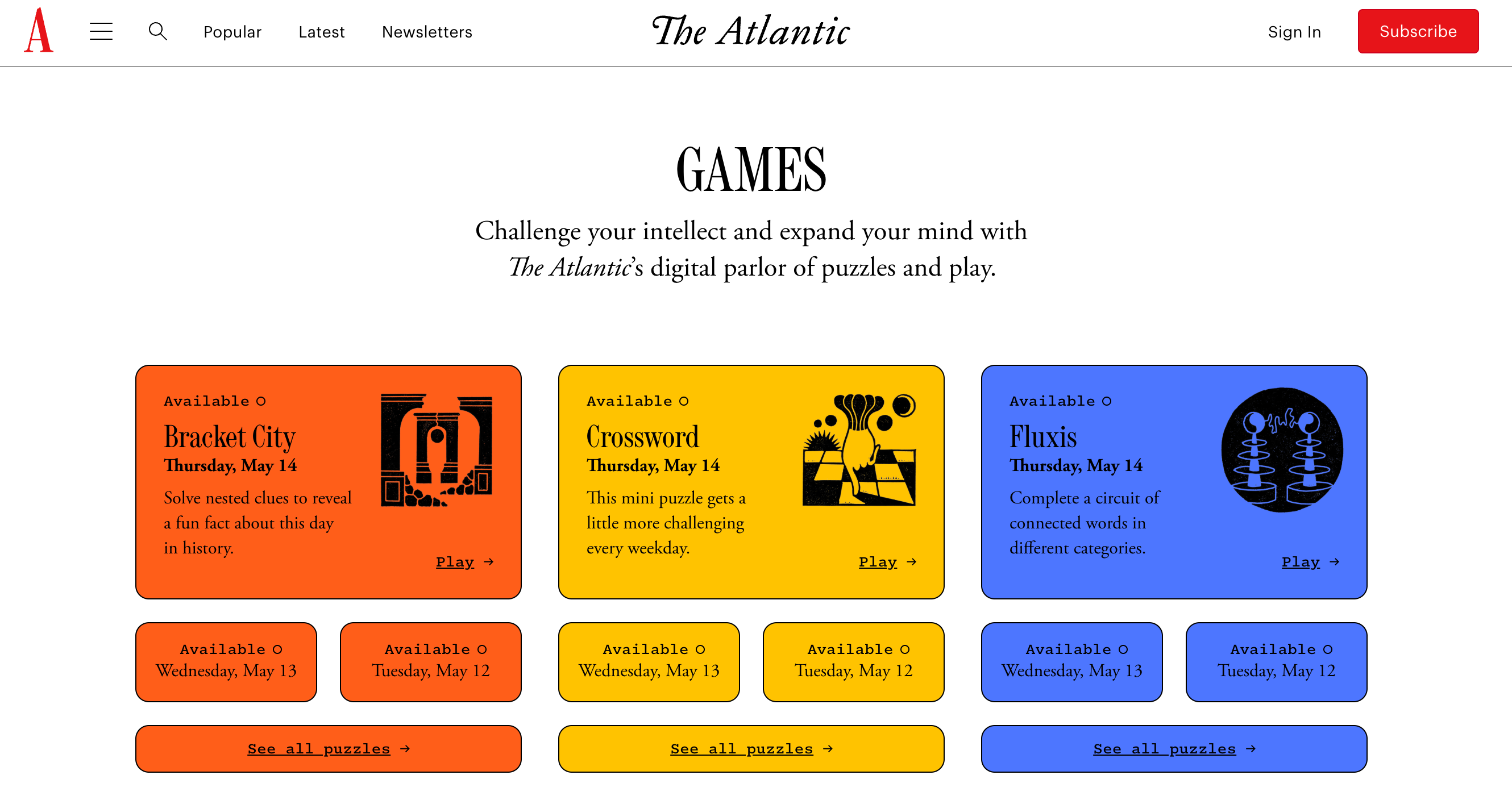
What makes this portfolio interesting is the mix. Yes, there is a crossword. There is also a trivia game directly connected to recent Atlantic stories and reporting. There is a history-driven puzzle that authentically mirrors The Atlantic’s editorial approach of going deeper into any given topic and pulling in historical context. The history game feels like a playable version of an Atlantic feature, and that is exactly the point.
Five of the six games are free to play directly on the website and inside the app. One game sits fully behind the subscription paywall. That single design choice tells you everything about where The Atlantic sits in its learning journey.
Games are still primarily an acquisition funnel: a reason for new users to come in, sign up, and come back weekly. The paywalled game signals something more advanced. It suggests The Atlantic has early internal evidence that games drive measurable conversion from free user to paid subscriber, and that they materially contribute to subscriber retention and stickiness once a user is in. The New York Times has been signaling exactly that pattern in its quarterly results for two years. The Atlantic is now building on that learning with its own audience and its own editorial voice.
The Real Business Case for Games in News and Media
Step back from the specific products for a moment. The high-level appeal of games for news and media organizations is obvious if you understand consumer behavior.
Games provide a reason to come back daily. They fit naturally into the routines consumers already have: checking emails, reading the news, looking at the stock market, playing a game over morning coffee. The behavioral hook is the same one the morning paper used to own.
Games also extend session time. They increase the number of touchpoints per user per week. They create habit loops that are measurable and predictable. They generate first-party engagement data that can inform editorial, advertising, and product decisions across the company. They are one of the few content formats that holds up against TikTok and Instagram for daily share of mind. Every major news publisher should have a games strategy on the executive agenda right now.
The mistake is never in having a strategy. The mistake is in the execution.
What News and Media Executives Should Build Instead
If you are sitting in the Chief Digital Officer chair, the Chief Product Officer chair, or the CEO chair of a news or media business in 2026, the right question is “what do my readers want that I can authentically and uniquely deliver in game form?”
For a general-interest newspaper, a high-quality crossword or sudoku may genuinely be the most authentic answer. The format and the audience match. That is a defensible choice.
For a sports publication, the most authentic answer is almost certainly a fantasy or manager-style game. Readers come for standings, trades, and matchups. The game has to feel like an extension of that obsession.
For a fashion magazine, the most authentic answer lives closer to a styling game, an interior design challenge, or a daily aesthetic puzzle.
For a financial publication like Bloomberg, the most authentic answer is a market-aware news game like Pointed.
For an ideas-driven publication like The Atlantic, the most authentic answer is a history-driven puzzle game tied to the editorial worldview.
The pattern is consistent across every category. The best games offering for any publisher is the one that reflects what the publication uniquely stands for and what its specific audience deeply cares about. The Times did not become great at games by copying anyone. It built its games strategy around the cultural authority and crossword heritage of the Times brand. Copying The New York Times means copying a strategy that was designed around someone else’s audience.
The Bottom Line for News and Media Executives
The next three years will separate the publishers who win at games from the publishers who built tribute acts. The category is already crowding with crossword clones from every major newsroom in North America and Europe. The early winners will be the publishers who treat games the way the best of them treat editorial: as an authentic, distinctive expression of what the brand does best, in service of an audience that is uniquely theirs.
Bloomberg and The Atlantic are showing the playbook in real time. They are asking the right question first and shipping the answer second. That sequence is the entire game.
If your gaming strategy starts with a screenshot of the NYT homepage, the call you should make next week is the one that brings your audience research, your editorial leadership, and your product team into the same room. Then ask one question: what would our readers find irresistible that nobody else can build?
The answer to that question is your games strategy.
What do you think? Are publishers in your market building authentic, audience-first games offerings, or is the crossword playbook winning by default? Let me know in the comments.
Technically Entertaining is a Substack publication on the business of gaming, technology, and entertainment for marketing, brand, and strategy leaders. If this piece was useful to you, subscribe for weekly analysis.