


Dear Readers,
AdWeek in New York took place last week. It’s the most important annual event for the marketing and advertising industry aside from Cannes Lions (which is also more about seeing and being seen). A senior executive from a large investment firm, who was in attendance, messaged me to share his main observation from AdWeek: there was a lot of gaming content. A lot of gaming content.
“We’re working together to really try and lift the profile of gaming.”
- Advertising Week global president Ruth Mortimer.
It’s about time. When I visited AdWeek’s London event at the beginning of this year, there were only two talks about gaming across multiple days of content - a pathetic representation of an industry that is bigger than TV, film, and music combined.
Brands and organizations are slowly waking up to the fact that gaming is the best place to effectively engage consumers in the 21st century. Industry events and conferences are following suit. We could take this as one more signal that there’s a tidal shift brewing when it comes to the allocation of marketing and advertising dollars - which brings us to a new section of Technically Entertaining that you love so much.
Today, we’re introducing TE’s chart of the week. In a world where all of us are burdened with more information than we can reasonably digest and AI slop that is making it harder and harder to tell reality from fiction, we’ll be following a simple principle: less is more. Rather than simply providing you with more information, the chart of the week zeros in on one key message and insight that is important for you in your company or job. One quality insight that highlights where the world of business, tech, and entertainment is headed.
It’s hard to imagine a time before social media and the internet were as big as they are today. But that time existed - and there’s a lot to learn from history for business leaders and marketers in order to anticipate the next wave of change that is building up before our very eyes.
Without further ado, let’s take a look at our inaugural TE chart of the week.
The mounting tidal shift of global advertising spend
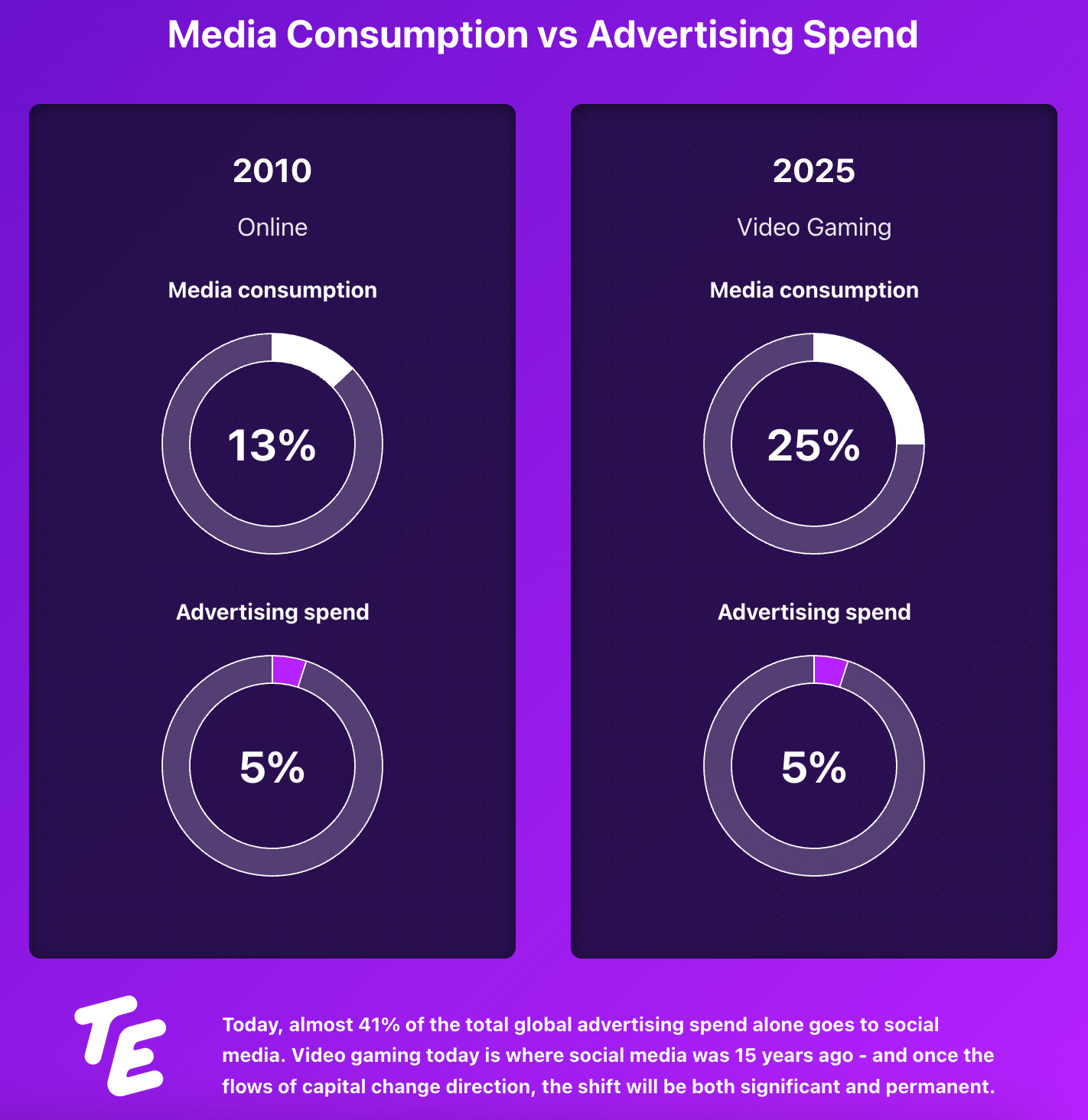
Here’s what’s behind it.
2010 - Online media consumption is starting to take over, but advertising spend lags behind
Just 15 years ago, consumers spent about 13% of their time allocated to media consumption online.
That’s 32 hours per month spent online consuming media content (US households).
The average person spent over eight hours a day consuming media for a monthly total of just over 240 hours (globally).
In just the next 4 years, the time consumers spent consuming media via the internet would increase by almost 84%.
Yet, the share of global advertising spend devoted to the internet in 2010 was only 5% ($26 billion versus the global advertising market size of $503 billion).
2025 - Gaming is starting to dominate media consumption, but advertising spend (for now) lags behind
Consumers spend roughly 25% of their media consumption on games and game-related content.
Gaming is consumed by all demographic consumer cohorts with the average of players coming in at 41 years.
Especially young audience gravitate towards games with Gen Z spending on average over 12 hours per week on video games (more than on traditional TV)
Combined with Gen Alpha, some research shows that young audiences spend more time playing games than on all social media channels combined
Despite all this evidence of the appeal of video games for consumers, the gaming industry only sees about 5% of the total global advertising spend
Your key insight
Today, video gaming is almost exactly where the internet and social media were 15 years ago - dominate consumer attention, but brands and companies haven’t shifted their advertising dollars over to this fairly new, uncharted, but growing medium yet.
But just as social media eventually took over and became the dominant channel for brands to advertise in, gaming will see the same influx of capital - which will be enormous. Consider this: social media’s share today of the global advertising market is nearly 41%. That’s almost $480 billion brands spend on social media every year.
What you should do to prepare yourself now
The leaders that are staying ahead of the curve are taking a few very specific actions to bring themselves and their organizations up to speed on video gaming, what it is, and how it may add value to their business.
Four-Step Action Plan
Build up your knowledge base quickly - My book Press Play has become the go-to-resource for decision makers wanting to understand gaming and how to enter the space. Joost van Dreunen’s book One Up is another valuable read.
Stay up to date on current events - subscribe to newsletters such as Morning Brew or GamesBeat. IGN, The Verge as well as Bloomberg and the Wall Street Journal all frequently report on gaming and its bigger strategic implications. SuperJoost Substack is another great resource - and obviously this very Substack you’re reading right now (so if you haven’t subscribed yet, now is a good time).
Explore the right data - in order to wrap your head around the gaming industry and what other companies are doing in this space already, you’ll need access to the right data to help color in what works, what doesn’t, and why. GEEIQ is a good resource for immersive gaming platforms like Roblox and Fortnite. Creator Games is a terrific partner for those platforms as well, especially if you want to get involved with specific games on Roblox. Aldora tracks what brands are doing and how effectively across gaming environments. And Elaris equips you instantly with the right audience insights to ensure a) you understand what your target audience cares about, b) you know what games they’re playing and would like to play, and c) how you show up authentically in these environments.
Educate your leadership team and wider organization - share the above resources with the wider group. The next best step is to bring an expert in and run a tailored strategy session or workshop with you to start crystallizing the opportunity. I have run sessions like these for financial institutions, consumer goods brands, professional service firms, telcos, as well as non-profits - so feel free to reach out here anytime to see how I might be able to help.
From there, you’d start to scope a pilot project as well as assemble your initial SWAT team to get things going - but let’s not get ahead of ourselves here.
In Sum
Brands shift their advertising dollars slowly. But once the tide turns and the floodgates open, the influx of capital into gaming will be substantial and the shift will persist for years, if not decades.
The smartest leaders are proactively exploring how their companies can leverage video gaming to reach and engage consumers. They are experimenting now so that they can apply their learnings and scale their efforts before the flows of capital are reversed and every company enters the space.
When that happens, they’ll be far ahead.
Netflix and Amazon Prime are pushing more deeply into video games by bringing games directly to its streaming subscribers. Next week, I’ll be attending Google Playtime, Google’s flagship mobile gaming industry event that brings together executives from across the gaming industry to dissect the latest trends and insights. Be sure to subscribe and share Technically Entertaining with your friends to get new posts straight to your inbox.