


Dear Readers,
The summer vacation period is slowly coming to an end - at least that’s what it feels like on my side. In preparation for my keynote at the Gamescom Congress next week, the world’s largest video gaming conference that takes place in Cologne, managing my calendar amid the influx of sudden meeting requests has felt like playing Tetris on Pro mode for days on end.
I worry that if any meetings now shift or get cancelled, I will be buried underneath my collapsing Jenga meeting tower - 34 degrees Celsius summer heat and working in the attic certainly don’t help. But I digress…
If you’re in Cologne next week, swing by our session on Thursday and say hi - details below.
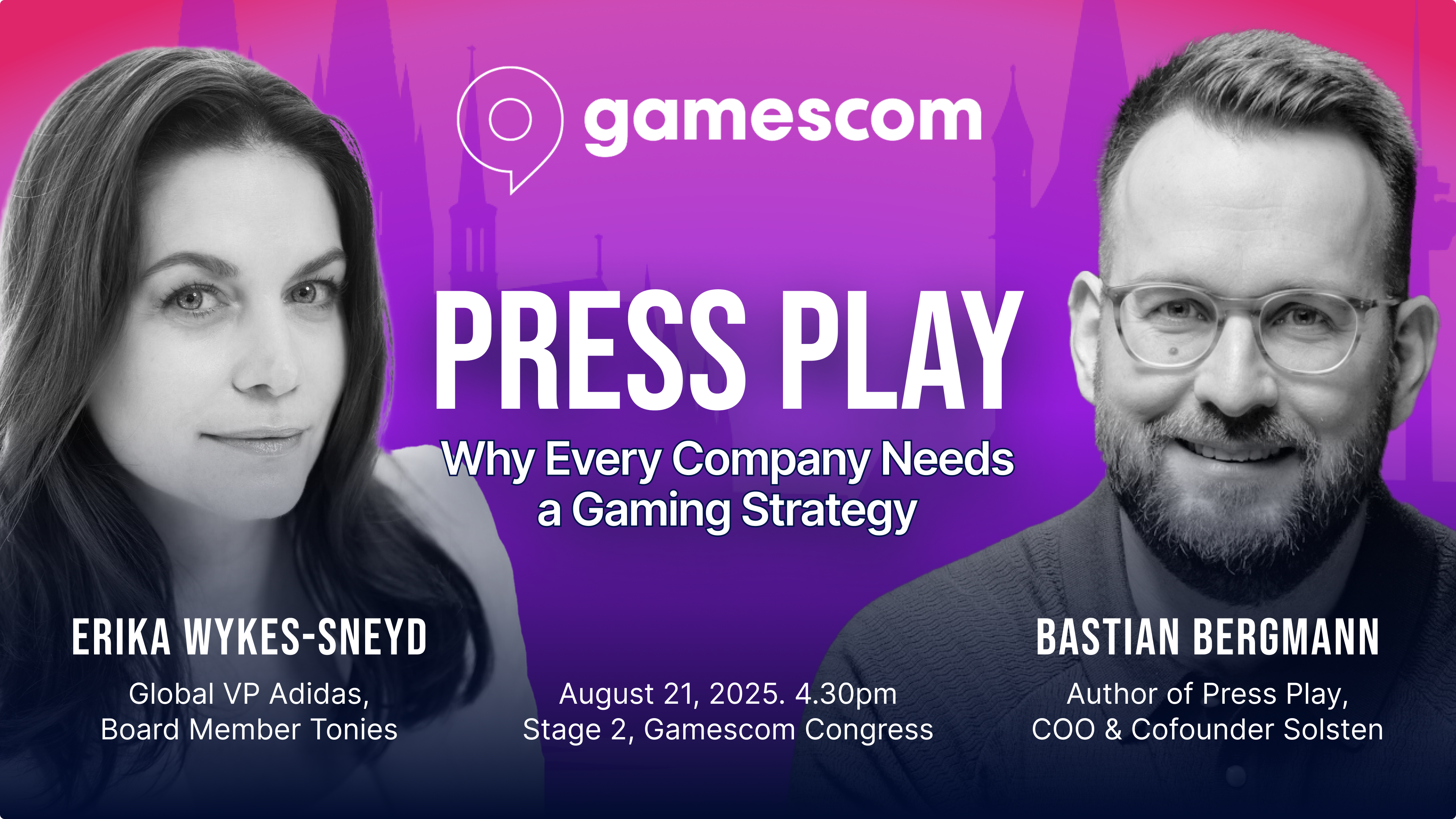
In getting my talk for Gamescom about my upcoming book Press Play ready, my mind kept going back to a quote I heard from a CMO of a large consumer goods brand last week. When I asked about why her company wasn’t more actively positioning and integrating its brand in the video gaming space yet, she said the following:
“For now, we look at video games as glorified digital billboards.”
While consumers certainly spend way more time watching, engaging with and in, as well as spending money on and in video games compared to anything they could (and can’t do) with billboards, the grain of truth in her statement is this: for brands to fully dive headfirst into the opportunity that video games present with respect to engaging consumers, the return on investment of how a company’s gaming initiatives translate directly to tangible improvements on the company’s top and bottom line needs to be measurable.
The power of games
The evidence
For now, it’s obvious to everyone that brands can increase brand awareness and activation, as well as engagement through video games:
Young audience spend more time on gaming environments than on all social media channels combined
86% of consumers who purchased a virtual item inside of a video game also purchased the corresponding physical item
The most viewed content on TikTok is gaming content, with 3 trillion views in 2022 - meaning games are the engagement driver and social media is the distributor
Branded experienced in Roblox see an almost 600x longer engagement than your average social media post
Ads placed exposed to users within a gaming context achieve much higher brand recall - 50-60% compared to 30-40% recall rates of social media, online, or display ads
Younger audiences are 2.3x more likely to recommend products they’ve seen in games.
SUPERPRETZEL’s execution of a in-game advertising strategy is a great example of this:
Uplift in brand interest: 29pt
Uplift in brand image: 22pt
Uplift in purchase intent: 23pt
Uplift in actual revenue: unclear.
The disconnect
That’s the billboard analogy - you drive by one and you become aware of Dove’s new shampoo and think you should try it out. You may even go to Amazon.com to buy it right then, or stop at the next store to grab it. In either event, Dove won’t know that it happened as a result of you seeing the billboard. They can’t do the math around how many dollars in revenue they got back as a result of spending a certain amount of dollars on getting that billboard up.
With games, it’s largely (for now) the same. Brands being active in games without a doubt drives revenue - the challenge is connecting those dots so the math becomes simple and reallocating marketing budgets from traditional marketing channels like SEO towards video gaming becomes a no-brainer.
The opportunity
Right now, the reality of this disconnect is perfectly encapsulated by the distribution of global advertising dollars:
Gaming: $39 billion
Everything else: $733 billion
Here’s a sneak peek at a visual from my Gamescom keynote presentation.
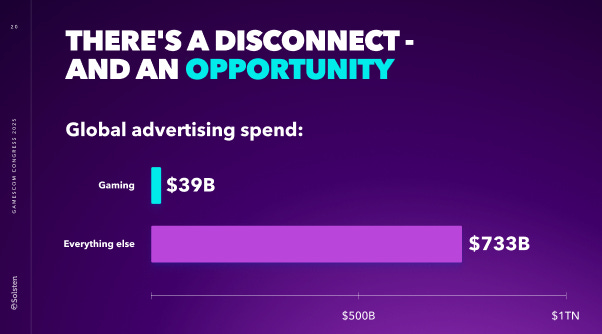
This means that games see about 5% of the global advertising spend despite attracting 3.4 billion people, holding attention longer, driving super engagement, and triggering real-life purchases - because the measurability of the tangible top-line impact isn’t fully there.
This is the massive opportunity for video gaming as an industry, and for brands and gaming publishers alike although for different reasons.
The case for brands to act now
The opportunity is already here - gaming offers access to 3.4 billion consumers
First-mover advantage - early exposure will yield sustained brand awareness advantages over followers into the space
Iteration is key - the journey towards a perfectly executed strategy will be iterative and the sooner brands jump in, the faster they learn what works and what doesn’t
Structure follows strategy - implementing organizational changes to support a functioning gaming strategy takes time
The case for game publishers to be brand-ready
Ensure audience alignment - invest deeply in the understanding of the audiences across your portfolio of games and identify the best fit for a given brand
Provide measurement and attribution tools - invest in the technical setup to measure and attribute the impact of in-game brand events and activations in terms of hard $$$ for the brand
Setup dedicated brand teams - key account teams that provide a white glove service to brands and guide them every step of the way from planning to execution and tracking of the project and the partnership as a whole
Make it easy - as much as possible, things need to be turn-key and work seamlessly without much overhead
I’ll explore this opportunity and what brands and publishers alike can do in greater detail in my talk.
But the main takeaway is this: the moment brands are able to more reliable measure and attribute the impact on their businesses to their gaming efforts, a large chunk of the $733 billion currently allocated to all other channels will start flowing towards gaming - ushering in the next phase of hyper growth for the gaming industry.
This week, I was on the I Wish I Knew podcast hosted by Joe Hirsch. We dove into my new book Press Play and why gaming is a big opportunity for any company. Joe’s tagline of the podcast is “sharing a big idea in about the time it takes to enjoy a cup of coffee”. Hope you like it.