


There is an assumption baked into most conversations about brand strategy that I want to challenge directly. It goes like this: you can reach millions of people, or you can know them deeply. Pick one. Scale is broadcast. Intimacy is boutique. In any meaningful sense, the two do not coexist.
Gaming is destroying this assumption in real time.
That’s the opportunity. But there’s a version of the gaming opportunity that brands keep misreading, and I’ve watched some very smart marketing leaders spend very significant budgets on it. Getting this right requires understanding not just why gaming works, but exactly where the current conventional approach breaks down.
Gaming offers something no other medium has ever managed: genuine intimacy at scale. But only if you build it the right way.
What Gaming Does That No Other Medium Can
Start with a question that sounds simple but isn’t: what is the difference between watching a Travis Scott concert and attending one?
In April 2020, 12.3 million people were simultaneously inside Fortnite for his Astronomical event, a Guinness World Record for the largest music concert in a video game. Across all five time-zone-staggered showings, 45.8 million players experienced it. By any traditional media metric, this is a broadcast event. The numbers dwarf most television audiences for live music.
Ask anyone who was there, inside the game rather than watching a stream, and they will describe it the way they describe being somewhere, not watching something. They had a squad. They had a position in the world. When the sky turned inside out and Scott’s giant avatar moved through the landscape, they were moving too. The camera was not fixed. The perspective was theirs.
This is the quality that makes gaming categorically different as a brand medium: it places people in a state of play, and in a state of play, human beings are cognitively and emotionally present in a way that passive consumption cannot replicate. The neuroscience is well-established. Play engages agency, identity, and reward circuits simultaneously. When a brand enters a gaming environment, it becomes part of the world the player is inhabiting.
That is why the Travis Scott event felt intimate despite its scale. That is why Balenciaga’s Fortnite collection launch generated genuine fashion press, not gaming press. That is why Nike’s in-game sneakers are coveted rather than ignored. The brand arrives as something you wear, use, or experience in a context of self-expression and identity. The interaction is personal, mediated by play, even when millions of others are doing the same thing simultaneously.
Scale and intimacy are not a trade-off in gaming. They are features of the same architecture.
Why the Default Approach Is Failing Brands
Here is where I need to be direct, because I think the current standard approach to gaming is producing cautionary tales rather than competitive advantages.
The most common first move for an enterprise brand entering gaming right now is to build an experience on Roblox. I understand why. Roblox has a young, engaged audience, the barrier to entry is relatively low, the press coverage of brand activations is reliable, and it feels like being in the right place at the right time. For some objectives, it makes sense.
But I have spoken directly with a marketing leader at a global beauty brand who told me something that every CMO considering this path should hear. They spent $200,000 on a Roblox integration. When it launched, they received virtually no data from Roblox on who engaged with it, how they engaged, where they came from, or what happened next. Some brand awareness metrics moved. Beyond that, the learnings were nearly zero. The investment, in terms of actionable intelligence about their audience, returned almost nothing.
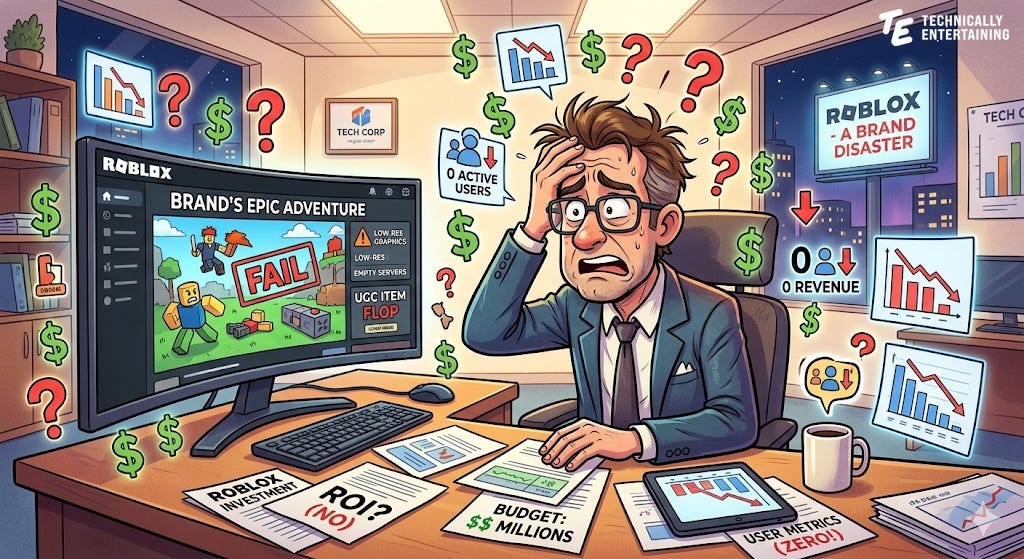
This is structural, not an execution failure. As Digiday has reported extensively, the lack of third-party measurement on Roblox has been a persistent and growing problem for advertisers, with agency executives finding it increasingly difficult to convince new brands to invest without independent verification of results. Roblox offers first-party data from its own ad server, but there is no Nielsen, no Comscore, no external validation of what the platform claims about your outcomes.
The aggregation trap I described in Part One of this series applies inside gaming too. Roblox needs brands to make its platform feel culturally alive and commercially credible. Sharing meaningful audience data with those brands would reduce their platform dependency. So it doesn’t. The incentives are identical to every other platform aggregator, even if the medium is different.
In case you missed it - Parts One and Two in this series


The beauty brand’s $200,000 bought them a presence. It did not buy them knowledge. And without knowledge, there is no compounding value, no ability to reach those players again, no understanding of who they were, no data to inform the next decision.
What Sega Understands About This Problem
I recently spoke with an executive at Sega, the company behind one of gaming’s most enduring cultural properties: Sonic the Hedgehog. Sonic commands genuine love across generations, an IP with the kind of authentic resonance that most brands spend decades and enormous budgets trying to manufacture.
And yet, from a distribution standpoint, Sega faces a version of the same trap that every brand building on third-party platforms faces. Their games live on PlayStation, Xbox, Nintendo Switch, and Steam. Their relationship with fans is mediated by platform holders who set the terms of discovery, pricing, and access. The IP is exceptional. The ownership of the audience relationship is not.
“IP without distribution is a rented asset. You can build something genuinely beloved and still find yourself dependent on someone else’s willingness to let you reach the people who love it.”
This is the paradox the gaming industry itself is grappling with. It illuminates exactly the right question for any brand operating in this space: what does it mean to own a relationship with your audience, and what are you actually building toward if you don’t?
A Portfolio Framework That Actually Works
Based on my work advising enterprise brands on gaming strategy, here is the framework I believe produces the best outcomes. It is deliberately a portfolio approach, not a single bet.
The first move is to experiment on third-party platforms including Roblox, but with clear-eyed expectations and a data strategy built into the commercial agreement before you sign anything. Negotiate what data you will receive, in what format, and with what frequency. If a platform will not commit to meaningful data sharing in the contract, that tells you something important about the nature of the relationship you are entering. This is not necessarily a reason to walk away, but it is a reason to calibrate your investment accordingly and to be honest internally about what success looks like when learning is structurally constrained.
The second move, and this is where most enterprise brands are significantly underinvesting, is to partner with established mobile game publishers who already have the audience you want to reach. Mobile gaming reaches more people than console and PC combined. Unlike Roblox or Fortnite, a partnership with a mobile game publisher can be structured as a commercial deal where data access is a negotiable term. You are agreeing to terms, not accepting platform defaults. That distinction is significant. It means you can require, as a condition of the partnership, that you receive player data that makes the investment meaningful: purchase intent signals, cohort behaviour, retention patterns. The kind of intelligence that tells you whether your brand changed anything, not just whether people saw it.
The third move is the most strategically important, and the one that most directly addresses the aggregation problem: use your own brand and IP to build games or gamified content for the audiences you already reach. This is a call to stop treating games as someone else’s medium and start treating your brand as the platform. If you have an existing direct audience through email, through loyalty programmes, through owned communities, you have the foundation for a gaming experience that you control, that generates data you own, and that deepens relationships with people already invested in your brand. The intimacy is real because the relationship pre-exists the game. The data is yours because you built the environment.
This is the thread connecting back to the broader series argument. The brands that escape the aggregation trap are not necessarily the ones with the biggest budgets. They are the ones that recognise their existing owned audience as the most valuable starting point, and invest in deepening those relationships through experiences that cannot be intermediated by anyone else.
The Standard Every Brand Should Hold Itself To
Gaming represents one powerful expression of something more fundamental: the shift from renting attention to building relationships. The brands that understand gaming understand this instinctively, because gaming makes it impossible to hide behind impression counts and reach metrics. Either the player is engaged, actively, willingly, on their own terms, or they are not.
That standard: genuine, chosen engagement from an audience that knows what it is doing when it shows up, is the standard every brand should hold its entire distribution strategy to. In games. In everything.
The platform trap is real. The acquisition playbook, as I described in Part Two, is available at various scales to anyone willing to think structurally about distribution. The intimacy at scale that gaming demonstrates is achievable. But only if you build it the right way, own the data that comes from it, and resist the temptation to confuse a presence on someone else’s platform for a relationship of your own.
Are you applying the same scrutiny to your gaming investments that you would apply to any other major marketing commitment? What would your data tell you if you asked? Let me know in the comments.
Technically Entertaining covers business strategy at the intersection of gaming, technology, and entertainment. This is Part Three of a three-part series on brand distribution, audience ownership, and the future of the attention economy. If this was forwarded to you, subscribe below to get every future issue directly.