


I couldn’t believe what I was hearing.
At a recent industry event, a brand executive shared with me the advice they had just received from a partner at a major marketing agency, the partner who oversees gaming activations for the firm’s brand clients. The advice was delivered with the confidence of a person who gets paid to know better. “Just integrate your brand in existing games, ideally Roblox or Fortnite.”
That is the playbook being sold to brand leaders in 2026. It is also exactly the playbook I argued against in the opener of this series.

So this week I want to give you the framework I actually use to map the landscape.
I’ll introduce you to the 2x2 matrix (yes, I know, but we can mock them all we want. 2x2s work!) every brand leader that evaluates gaming opportunities for his brand has to know. A 2x2 matrix gives a distinct and clear picture regarding a key decision to make on typically the two most critical decision parameters, which become the axes. The axes I’ll use here: audience scale and cultural specificity. Scale captures how many people you can reach. Specificity captures how coherent the gaming platform’s cultural identity is, and therefore how clearly your brand either belongs there or doesn’t.
These two axes pull against each other, and the tension is the point. Scale exerts a genericizing gravity. The larger a platform’s audience, the harder it becomes to hold a distinct point of view, because a point of view always excludes someone. Mass platforms drift toward the lowest common denominator. The vertical axis measures which platforms surrendered to that pull and which resisted it. GTA VI is the proof that resistance is possible: a franchise with enormous reach that never sanded down its edges.
I lay these four games on the matrix: Roblox, Fortnite, Grand Theft Auto VI, and Skate. There are other games that can be mapped on this matrix. The point is not to be complete. The point is to prevent leaders from simply taking their brand to Roblox - into one quadrant - when other and potentially better suited options exist.
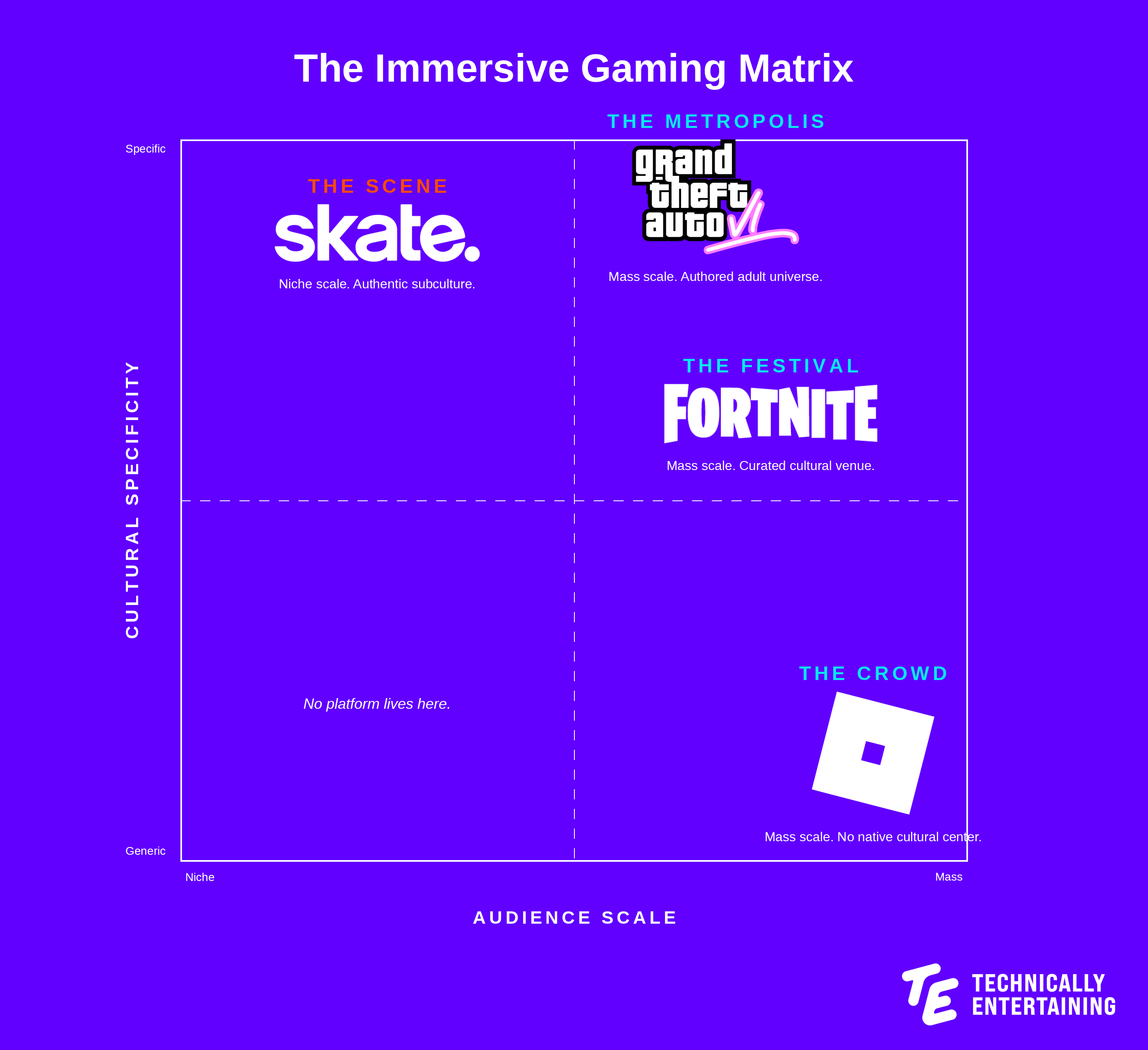
The biggest strategic mistake I see brand teams make is defaulting into one quadrant when their brand belongs in another.
Roblox: The Crowd
Roblox is the undisputed scale leader in immersive gaming. Hundreds of millions of monthly users, the destination GEEIQ tracks as the home of 54.5% of all Media & Entertainment activations in virtual worlds, and the deepest creator ecosystem in the category by a wide margin.
What Roblox does not have, and what most brand decks underplay, is a defining cultural identity. The platform’s strength is its lack of one. Roblox is a substrate. More than 40 million games live on it (a figure Lisa Willet, Senior Director of Global Strategic Partnerships at Roblox, acknowledged publicly at the iicon conference earlier this year), and the dominant aesthetic shifts by experience. That openness lets a Vans skate park, a Nike training center, and a Walmart shopping mall coexist on the same platform. It also makes brand activations on Roblox feel interchangeable to anyone who isn’t already inside the build.
Visually, Roblox lives in blocky, low-polygon, primary-color territory. The aesthetic is intentionally simple and accessible to younger players, and it carries the same limitation everywhere it goes. A luxury watch, a premium fashion house, or any brand that depends on visual sophistication to signal value will struggle to read as itself inside Roblox. The brands that look right here are those whose identity already aligns with playful, toy-like aesthetics: LEGO, Hot Wheels, family entertainment, fast-casual food.
Roblox itself signals the limitation through its developer economics. In 2025, the platform rolled out a payout structure that pays developers up to 42% more on revenue generated by U.S. players aged 18 and older, an explicit move to seed mature, 17+ rated content on a platform whose base audience and aesthetic skew young. A platform with its own cultural center wouldn’t need to subsidize one. The Crowd skews young by default, and Roblox is paying developers extra to engineer older-skewing cultural pockets inside it. For brand teams, the read is that adult-skewing or culturally specific positioning on Roblox lives inside the niche corners the platform is paying developers to build. The base aesthetic still defaults to the broad, young, and generic territory that defines the Crowd.
This is the bottom-right of the matrix: mass scale, low cultural specificity. A crowd delivers reach, foot traffic, and discovery. What it cannot lend you is cultural authority. The right brand fit is awareness plays and creator collaborations. The wrong fit is anything that needs cultural weight to land.
Fortnite: The Festival
Fortnite has 650 million registered users and a cultural relevance that punches above its absolute scale. The reason is structural. Epic has spent the last three years curating Fortnite into a cultural venue through high-profile IP integrations: Travis Scott, The Simpsons, South Park, K-Pop Demon Hunters, the Star Wars events, and the deepening Disney partnership that followed Disney’s $1.5 billion investment in Epic Games in February 2024.
That curation gives Fortnite something Roblox doesn’t have: an actual cultural identity, even if much of it is borrowed. Fortnite is a festival. The headline acts are booked, the lineup rotates, and audiences arrive for the moment as much as the venue. Brands plugging into it benefit from Epic’s curatorial filter.
The trade-off is that Fortnite’s culture is largely defined by the IP Epic has already chosen to integrate. Your brand activation borrows the cultural relevance Epic has assembled. The platform sets the terms, and your brand operates inside its frame. Epic’s UEFN framework also constrains creative latitude in ways Roblox doesn’t (though it has made positive improvements in this area).
Visually, Fortnite is stylized cartoony-realism: vibrant, cinematic, with a polish that sits between Roblox’s blockiness and console-grade photorealism. The art direction is flexible enough to absorb animated, live-action, and musical IP without breaking its own visual identity. The fit weakens for brands that need either gritty realism or restrained premium polish. Fortnite events look like Fortnite, regardless of what’s plugged into them.
This is the middle-right of the matrix: mass scale, medium-to-high cultural specificity. The right brand fit is brands with strong cultural IP that want amplification through Epic’s network.
Grand Theft Auto VI: The Metropolis
Take-Two CEO Strauss Zelnick just days ago confirmed the date: GTA VI launches later this year, November 19, and lands in the top-right of the matrix the moment it opens to players. The franchise has sold more than 425 million copies in its lifetime and built one of the most coherent universes in entertainment: satirical Americana, hip-hop and pop-culture saturation, and a fanbase that has spent two decades inside the Rockstar tone.
That tone is the asset. GTA VI is a metropolis, a place dense enough to hold millions of people and still feel unmistakably like itself. GTA’s radio stations have parodied brand culture since the original release. The map is built around branded storefronts, billboards, and product references that the audience reads as part of the world, the same way they read the in-game satire. The fanbase expects brand presence and accepts it on Rockstar’s terms.
The catch is that Rockstar has historically refused real brand integrations. In a recent Variety interview at the iicon conference, Take-Two CEO Strauss Zelnick confirmed that GTA VI will not feature real brand names, explaining:
“It’s a fictional world and everything in it is fictional. So we’re not even at risk of doing brand partnerships because all the brands are made up.”
From the same stage, Zelnick acknowledged the company has received many requests from brands eager to integrate, even as Rockstar holds the line.
My read remains the one I made in the opener: if these become true integrations with Rockstar holding creative sign-off, the economics will eventually become too compelling for Take-Two to leave on the table.
Visually, GTA VI is photorealistic, gritty, satirical, and unmistakably mature. The franchise’s art direction lives in the lineage of cinematic crime drama crossed with American satire, now rendered with top-tier console fidelity. The aesthetic fits adult lifestyle brands, automotive, spirits, fashion (especially streetwear), and premium audio in ways that no other immersive game on this matrix can match.
This is also where GTA VI’s M-rating becomes a strategic asset rather than a constraint. Roblox and Fortnite have to maintain audience appropriateness for younger players, which limits the kind of brand content that can land authentically. GTA VI carries no such constraint. The platform IS the 18+ audience, which makes it the only immersive game on this matrix where adult-targeted brand content (R-rated humor, mature lifestyle, beer and spirits, fashion brands with edgier creative) can show up without compromise. For brands whose actual audience skews adult, that is rare oxygen.
This is the top-right of the matrix: mass scale, very high cultural specificity, with a uniquely adult audience profile. Built-in audience, curated entry, high ceiling for the brands that earn it.
Skate: The Scene
Skate occupies the quadrant no other platform on this matrix can reach. EA’s Skate launched into free-to-play early access on September 16, 2025. The game crossed 15 million players in under three weeks, passed 23 million players by the end of 2025, and is currently maintaining 750,000+ daily active users. That’s still a fraction of Roblox or Fortnite’s scale, but a fast-moving fraction with an audience the larger platforms can’t reach.
That smaller scale is the entire strategic point. Skateboarding reads as a niche only if you count participants. It is really a cultural nucleus, with concentric rings radiating outward into streetwear, music, fashion, art, and film. A brand entering the skate scene reaches far more than skaters. It taps a culture that has shaped youth identity and adjacent industries for fifty years, punching well above its participation numbers the whole time. That radiating quality is why the Scene holds value despite the smaller raw audience.
The Scene also carries the most developed brand-association language in action sports. Nike SB, Vans, Supreme, Thrasher, Independent Trucks, Element, Spitfire. These brands ARE the language of skateboarding. They built it from the inside, sponsoring riders before anyone called it influencer marketing. New entrants who don’t speak that language get rejected by the audience. New entrants who do speak it get adopted with a fluency that Roblox and Fortnite activations rarely achieve.
Visually, Skate’s language is realistic with edge: motion-graphic energy, urban grit, the camera angles and color grading of a real skate documentary. The art direction is already aligned with the visual codes that Vans, Nike SB, Supreme, and Thrasher have used in their marketing for decades, which means brands that fit those codes get cultural read for free. The misfit is corporate, B2B, polished-luxury, or anything that signals visual restraint. Skate doesn’t look restrained, and that is the point.
The Nike collaboration already present in the game’s early access is the early proof point. I’ll go deeper on that, the broader brand opportunity, and the conversations EA is having with brand partners in next week’s deep dive.
This is the top-left of the matrix: niche scale, very high cultural specificity. The quadrant most brand decks skip past, and the one most likely to deliver disproportionate cultural credibility.
What the Matrix Actually Tells You
The matrix is a trade-space, not a leaderboard. Each quadrant rewards a different strategic intent. The Crowd rewards low-cost reach experiments and Gen Alpha exposure. The Festival rewards brands with strong cultural IP that want amplification through Epic’s network. The Metropolis rewards adult-focused brands, and those patient enough to earn a place in Rockstar’s world. The Scene rewards brands with authentic claim to a subculture.
The empty bottom-left quadrant, niche scale with low cultural specificity, is correctly empty. Almost no brand should aim there.
The brand teams making the strongest gaming decisions in 2026 treat this as a portfolio question. They place a smaller bet in the Scene because that is where their core audience already lives, and run a broader awareness play in the Festival because that is where their next demographic will discover them. They resist defaulting the entire budget to the Crowd just because Roblox tops the activation-count chart in last year’s report.
The question to bring back to your team this quarter is which quadrant best matches what you are trying to do, and whether your current strategy is biased toward the right one.
Next week: the Skate deep dive. Specifically, why skateboarding culture is uniquely attractive to brands, what Nike’s early integration is telling us about the platform’s brand potential, and the conversations EA is having with brand partners that haven’t made it into the trade press yet.
Which quadrant does your brand actually belong in, and which quadrant is your current activation strategy biased toward? Let me know in the comments.
Technically Entertaining is the publication for marketing, brand, and strategy leaders navigating the intersection of gaming, technology, and entertainment. Subscribe to get next week’s deep dive into Skate, plus the closing interview with the General Manager at EA overseeing the franchise.