


Dear Readers,
The AI industry has a problem, and it’s not the one you think. It’s not hallucinations, safety concerns, or regulatory pressure. It’s hunger. An insatiable, relentless hunger for data that grows exponentially with each model improvement. And that hunger is about to trigger a wave of acquisitions that will make the tech M&A boom of the 2010s look quaint by comparison.
Case in point: OpenAI is reportedly in discussions to acquire Pinterest. While the exact terms haven’t been disclosed, with Pinterest’s current market cap hovering around $17 billion, a deal with the typical acquisition premium would likely land somewhere in the $25-26 billion range. For context, OpenAI is reportedly preparing for an IPO that could value the company at over $1 trillion. The math might seem asymmetrical, but for a company pursuing trillion-dollar ambitions, spending 2.5% of your valuation to acquire a critical data asset is a no-brainer. Plus: Pinterest seems to be ripe for the picking. Over the past five years, its stock is down 62%.
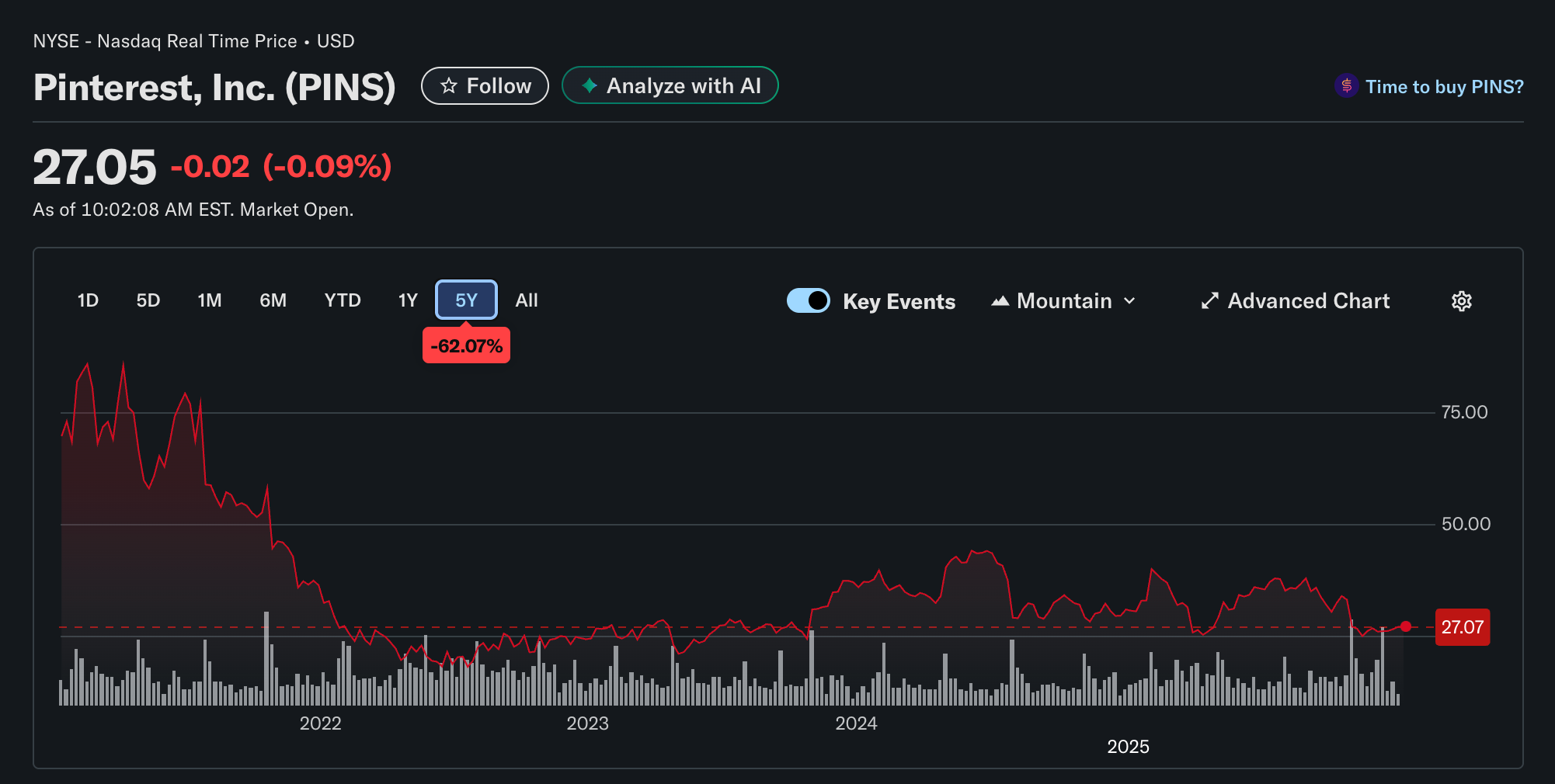
Yes, the stock was likely inflated during Covid. But just to compare. In the same period, Meta’s stock is up 141%. The comparison is even more staggering when looking at the stock performance across the stocks’ lifetime:
Pinterest: up by 14%.
Meta: up by 1,444%.
But here’s what matters more than the price tag: OpenAI knows Pinterest isn’t just a collection of recipe boards and home décor inspiration. It’s a treasure trove of visual intent data that represents the holy grail for AI companies racing to dominate e-commerce, advertising, and the next generation of search. More importantly, it’s data that OpenAI currently doesn’t have access to. And in the AI arms race of 2026, the companies that control the most diverse, highest-quality datasets will be the ones left standing.
Why Pinterest Makes Perfect Sense for OpenAI
OpenAI needs visual data at scale. ChatGPT and its suite of tools have conquered text. GPT-4 and its successors can write, reason, code, and analyze with stunning proficiency. But visual understanding, especially the kind that translates into commercial action, remains a frontier that OpenAI hasn’t fully cracked.
Enter Pinterest, a platform built entirely on visual discovery and purchase intent. The company hosts billions of pins across millions of boards, serving over 553 million monthly active users as of late 2024. Every single pin represents a moment of consumer intent. Someone looking for a specific style of furniture. Another person planning their wedding. A third researching their next vacation destination. This isn’t passive scrolling like Instagram or TikTok. Pinterest users are actively searching, curating, and signaling what they want to buy, create, or experience.
For Sora, OpenAI’s text-to-video model, Pinterest’s visual corpus offers something money can’t easily buy: contextual understanding of how real people think about and organize visual concepts. It’s one thing to generate a video of “a modern kitchen.” It’s another entirely to understand the dozens of different aesthetic subcategories that Pinterest users have organically created around modern kitchen design, complete with color palettes, material preferences, and lifestyle contexts.
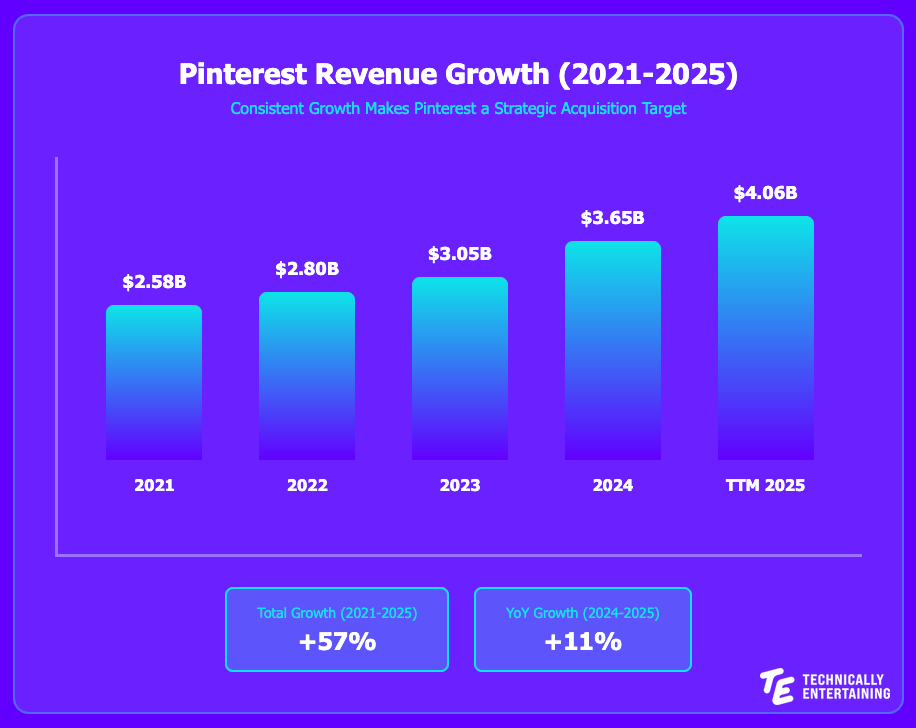
But the visual data is only half the story. Pinterest has something even more valuable: a functioning e-commerce engine and advertising platform that generated over $4 billion in revenue in the twelve months ending September 2025, up from $3.65 billion in 2024. The company has shown consistent growth, climbing from $2.58 billion in 2021 to its current run rate. OpenAI has made no secret of its ambitions to bring shopping directly into ChatGPT. The company has experimented with product recommendations and affiliate partnerships, but building a full-fledged commerce and advertising business from scratch would take years.
Pinterest gives OpenAI a shortcut. A proven platform with existing advertiser relationships, conversion tracking, and most critically, user behavior data that connects visual inspiration directly to purchase decisions. Imagine ChatGPT not just recommending products but understanding the aesthetic journey that leads someone from “I need new living room furniture” to clicking “buy now” on a specific velvet couch.
The social networking component shouldn’t be overlooked either. Pinterest’s 553 million monthly active users have explicitly opted into a platform about discovery and curation, with particularly strong growth in international markets outside North America. OpenAI could transform ChatGPT from a tool you use in isolation to a social experience where you can share AI-generated content, collaborate on projects, and discover what others are creating.
The Data Gaps That Keep AI CEOs Up at Night
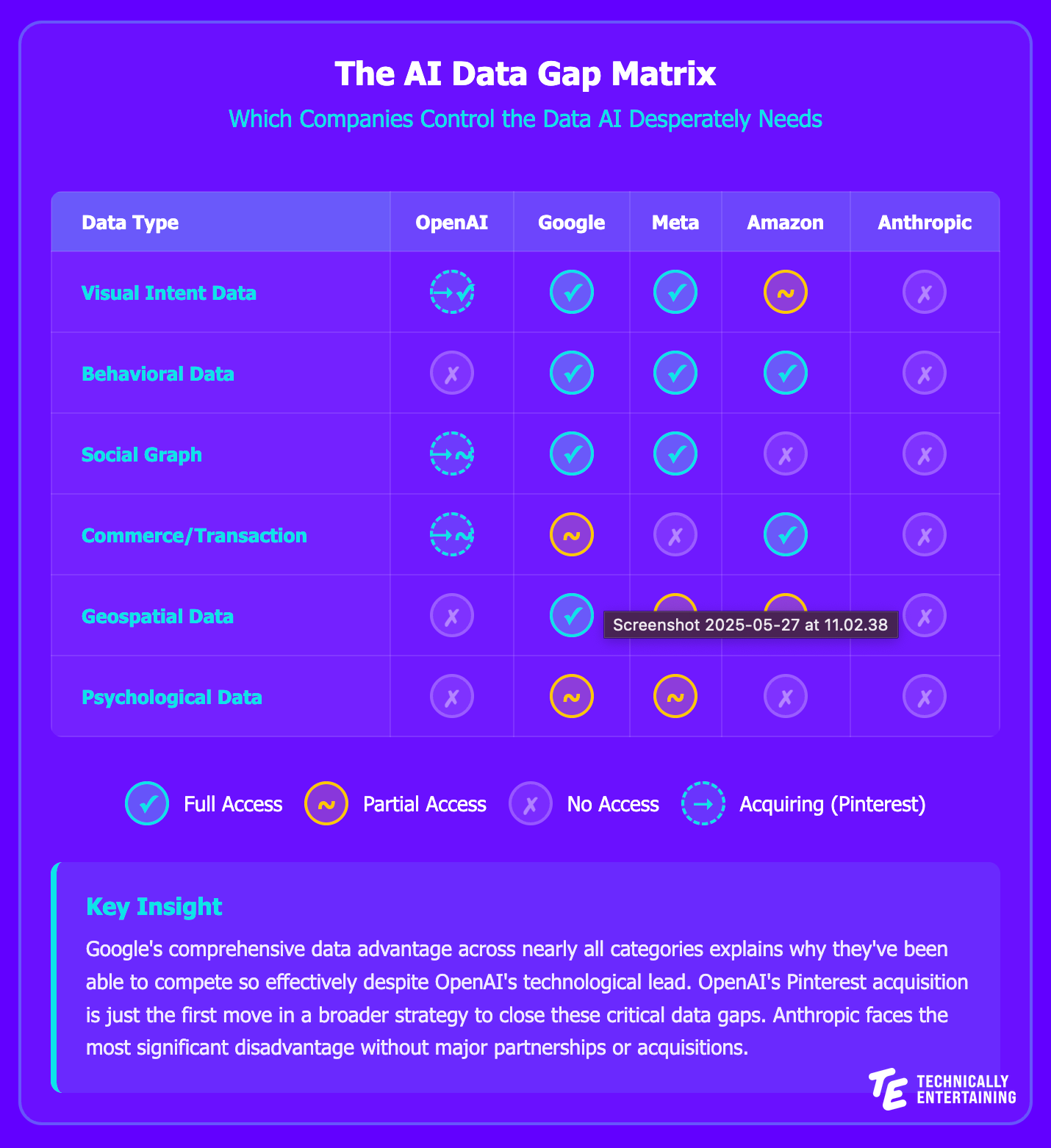
Pinterest represents one category of data that LLMs desperately need. But step back and look at the broader landscape, and you’ll see massive gaps in what these models can access. These gaps represent billions, potentially trillions, of dollars in untapped business opportunities.
Real-Time Behavioral Data Across Apps and Devices
LLMs today are trained on static datasets. Web scrapes, books, academic papers, licensed content. What they don’t have is the behavioral exhaust that accumulates every time you open an app, click a link, or hover over a product before scrolling past.
Google has this data. Meta has this data. Apple has this data. The AI companies largely don’t. And this behavioral data is the key to understanding not just what people say they want but what they actually do. This is a big reason why OpenAI is getting into the web browser space. Expect AI companies to pursue partnerships or acquisitions with mobile analytics platforms, app developers, and potentially even device manufacturers. The goal is closing the loop between language understanding and actual human behavior in digital environments.
Social Graph and Relationship Context
Current LLMs understand language but struggle with social context and relationships. They can’t easily grasp that the way you talk to your boss is different from how you talk to your best friend, or that your recommendation for a restaurant should factor in who you’re dining with and what the occasion is.
Social networks have spent two decades building graphs that map human relationships, contexts, and social norms. This relationship data is extraordinarily valuable for AI applications in communication, collaboration, and personalization. An AI that understands your social graph doesn’t just help you draft an email, it helps you navigate the complex social dynamics of workplace communication or friend group planning.
Pinterest gives OpenAI a lightweight social graph focused on taste and aesthetic preferences. But don’t be surprised if we see more aggressive moves toward companies with richer relationship data. Discord, with its community-centric model, would be fascinating for any AI company looking to understand how people collaborate and communicate in groups.
Commerce Intent and Transaction Data
AI companies want to power the next generation of shopping, but they’re missing actual transaction data. They can recommend products based on descriptions and reviews, but they don’t know what people actually buy, what they return, what they buy together, or how their purchase behavior changes over time.
E-commerce platforms like Amazon, Shopify, and payment processors like Stripe sit on this data. OpenAI’s Pinterest acquisition addresses part of this by capturing pre-purchase intent, the research and inspiration phase. But the post-purchase data remains largely out of reach. Expect partnerships between AI companies and e-commerce platforms to accelerate.
Geospatial and Physical World Data
LLMs excel in digital spaces but struggle with physical world reasoning. They can describe how to get from point A to point B, but they don’t have the rich geospatial data that makes that direction useful in real-world contexts.
Companies like Google (Maps), Uber, and spatial computing companies like Niantic that have built detailed maps of the physical world through user-generated gameplay data have enormous value. This data becomes even more critical as AI moves from purely digital interactions to powering robots, autonomous vehicles, and augmented reality experiences.
A maybe surprising highly valuable data source for geospatial and world data? Video games. OpenAI offered $500 million to acquire gaming company Medal including its data asset of video gaming data.
Geolocation data is the key to relevancy in advertising and product recommendations. An AI that knows you’re currently in Manhattan rather than rural Montana can surface completely different suggestions. More importantly, geolocation enables proactive assistance. Your AI doesn’t wait for you to ask about dinner options, it knows you’re near a neighborhood you’ve never explored and suggests places you’d love based on your preferences and current location. This transforms AI from reactive to anticipatory.
Psychological and Psychographic Data
Here’s the data category that most people aren’t talking about yet, but will define the next generation of AI personalization: psychological profiles and psychographic data. Current AI systems understand what you do, but they struggle with why you do it.
This is changing rapidly. The global behavior analytics market was valued at $1.1 billion in 2024 and is projected to reach $10.8 billion by 2032. Companies are building what industry experts call “behavioral AI” by coding behavioral science directly into their systems. Organizations like Mind Friend are scaling human expertise through AI by connecting with over 500 licensed psychologists, psychiatrists, and neuroscientists to create what they describe as “behavioral infrastructure.” Solsten has built a large database comprised of medical-grade psychological profiles connected to consumer affinities and preferences.
The implications for AI companies are profound. Psychological data unlocks true personalization in ways that behavioral data alone cannot achieve. Understanding that someone is risk-averse versus thrill-seeking, or motivated by social validation versus personal achievement transforms how an AI can communicate, recommend, and persuade.
For social graphs, psychological data adds a critical dimension. It’s not just knowing who you’re connected to, it’s understanding the psychological dynamics of those relationships. For advertising and commerce, psychological intelligence is the difference between showing someone a product and knowing exactly how to frame that product to drive conversion.
Early adopters like Clarity AI are already processing hundreds of thousands of data points daily to detect behavioral patterns. Companies like IBM and Adobe are investing heavily in behavioral analytics, recognizing that understanding human psychology is as important as understanding human behavior.
The challenge is data access. Unlike behavioral data that can be observed through clicks and scrolls, psychological data requires more sophisticated collection methods. Expect AI companies to pursue partnerships with mental health platforms, personality assessment tools, and companies that sit on rich psychographic datasets.
The Business Models Data Unlocks
Each of these data categories doesn’t just make models smarter. They unlock entirely new business models that transform AI from a utility into a platform.
Native Commerce in Conversational Interfaces
With the right visual intent data and commerce infrastructure, ChatGPT doesn’t just answer questions, it becomes a shopping destination. You describe what you’re looking for, the AI understands your aesthetic preferences, and it can complete the transaction without you ever leaving the chat.
The market opportunity here is staggering. Global e-commerce is valued at approximately $29-31 trillion as of 2024, with projections showing it could exceed $80 trillion by 2030. If conversational commerce captures even 1-2% of that market over the next five years, we’re talking about a $800 billion to $1.6 trillion opportunity.
Advertising That Understands True Intent
Current digital advertising relies on proxies for intent. Keywords you searched, pages you visited, content you engaged with. But with rich behavioral data, social graphs, and commerce history, AI companies can build advertising platforms that understand intent at a level that makes current targeting look primitive.
Imagine ads that don’t just target demographics or interests but understand exactly where you are in a decision-making process, what barriers are preventing you from converting, and what specific message would be most likely to drive action. Pinterest’s advertising business already does a version of this in the visual discovery space. Scale that across all of ChatGPT’s interactions and you have an advertising platform that could challenge the established players.
Subscription Services Powered by Proprietary Data Access
AI companies are already charging for access to more powerful models. But what if the real premium isn’t model capability but data access? A ChatGPT Pro subscription that gives you AI assistance with deep integration into your social graph, commerce history, and behavioral patterns becomes significantly more valuable than a basic chatbot.
This is why enterprise AI is exploding. Companies will pay enormous sums for AI that understands their specific data, workflows, and business context. The consumer version of this is an AI that knows you deeply, and that level of personalization requires data that goes far beyond what you type into a chat box.
What Comes Next
The OpenAI-Pinterest deal, if it closes, won’t be the last major AI acquisition of 2026. It will be the opening salvo in a data land grab that reshapes the technology landscape. Every major AI company is looking at their data gaps and making acquisition lists.
Google already has substantial data advantages through Search, Maps, YouTube, and Android. That’s why they’ve been able to compete so effectively. Their data advantage is enormous.
Anthropic, despite making Claude increasingly competitive on capability, faces a data disadvantage that will eventually limit growth unless they pursue partnerships or acquisitions. Meta has social graph and behavioral data but lacks the commerce intent that OpenAI is pursuing. Amazon has commerce data but needs better social and visual understanding.
The next 18 months will be defined by which companies successfully acquire the data they need to unlock new business models. And just like the platform wars of the 2010s, the winners won’t necessarily be the companies with the best technology. They’ll be the companies with the best data.
OpenAI understands this. That’s why they’re pursuing Pinterest. It’s not just an acquisition. It’s a statement about what it takes to win in the next phase of AI development. Data isn’t the new oil. It’s the new oxygen. And the companies that can’t breathe deeply enough won’t survive.
What’s your take? Which company should AI players acquire next? Let me know in the comments below.
2026 is off to a hot start. This week, beloved TV show South Park is launching in the video game Fortnite. It’s one of the biggest entertainment collaborations this year - with big implications for the entertainment and gaming industries as well as the cultural Zeitgeist. Subscribe below to join the conversation.