


Dear Readers,
The World Economic Forum in Davos last week delivered one of the most remarkable gatherings of the world’s elite and most powerful in decades. The stakes were so high that even Elon Musk, who for years has openly defied and mocked the event in the Swiss Alps, made a last minute appearance to do a fireside chat with BlackRock CEO Larry Fink.
Amid all the geopolitical tensions and tantrums, Canada’s Prime Minister Mark Carney delivered a speech for the ages. What many didn’t notice was that the former banker delivered one of the soundest pieces of business advice.
“Nostalgia isn’t a strategy.”
Carney referred to the evolving relationships within the Western alliance and that reminiscing about, maybe even clinging to, the past partnership with the US isn’t going to be helpful going forward. It’s not a strategy. The tides have turned. Which means new strategies need to be crafted and deployed.
Carney might as well have been talking about two of the culturally most important industries, entertainment and gaming, when he uttered those five words. The deadly cocktail of reaching backwards, hoping to hold on to the comfort of the past and the known, mixed with a few ounces of Clayton Christensen’s Innovator’s Dilemma, where even some of the best companies fail to adapt to disruptive technologies only to be disrupted themselves, is on full display across the Hollywood and video gaming landscape.
Hollywood’s Streaming Denial: Blaming Netflix for Their Own Complacency
Hollywood is so concerned with condemning Netflix and blaming its own demise on the streaming giant that executives are forgetting to take a hard look in the mirror. Netflix only happened because Hollywood’s giants didn’t do it first. Classic Innovator’s Dilemma and complacency. Why change what’s working well (for us)?
They’re now paying the price. The writing has been on the wall for a long time. Hollywood execs will claim that Netflix killed the movie theater experience. Netflix didn’t do any of that. Consumer behavior changed.
Movie theater attendance in the U.S. over the past five years has experienced a volatile, slow recovery from pandemic-era shutdowns, remaining significantly below pre-2019 historical norms. While 2025 showed a strong, younger-skewing audience, overall admissions for 2025 are estimated at 780 million, a slight decrease of 4.9% from 2024 and still well below the over 1.2 billion tickets sold in 2019.
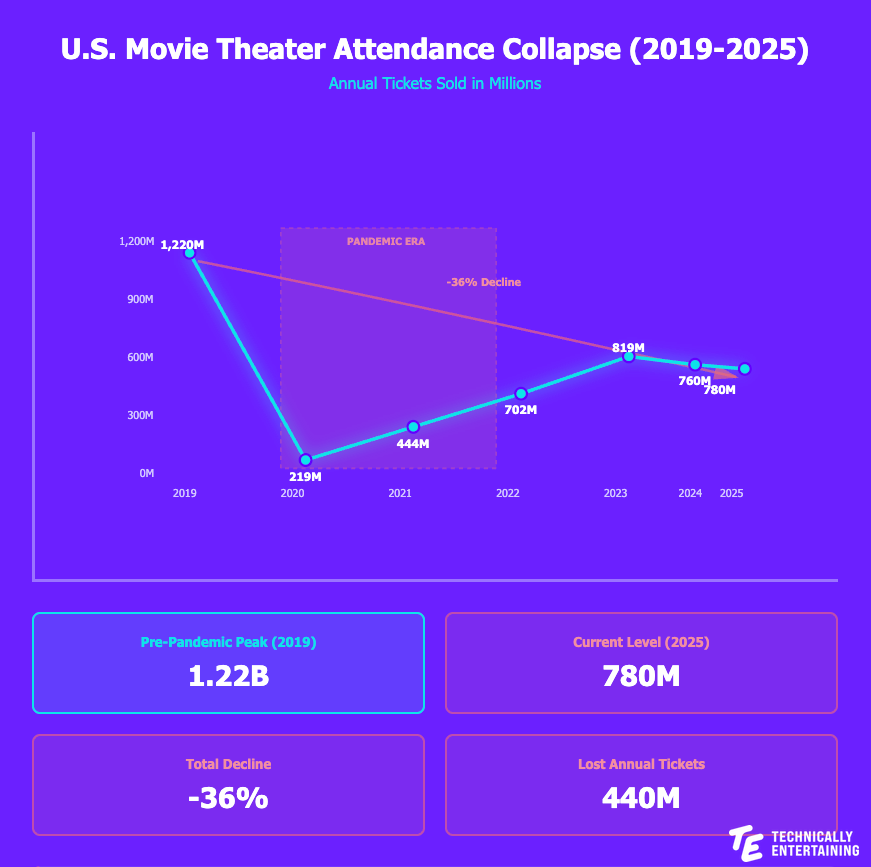
The trend is unmistakable. Theater attendance has been cut nearly in half since 2019, and it’s not recovering. Yet Hollywood executives continue to operate as if 2019 is coming back. It’s not. Consumers have fundamentally changed how they want to consume entertainment. They want flexibility. They want to watch on their schedule, on their devices, in their homes. The theatrical window isn’t sacred anymore. It’s a relic that still has its occasional moment.
The incumbents were simply too complacent to see what was going on and acknowledge a fundamental shift in their industry that would impact their precious business model. They chose nostalgia over reinvention.
Hollywood’s Next Nostalgia Moment: Artificial Intelligence
Now, Hollywood is facing its next nostalgia moment: AI. The use of AI will impact Hollywood production across the board. Sound, storytelling, visual effects, post-production. The list goes on.
The response from the industry? Lawsuits, strikes, and defensive posturing. The Writers Guild and Screen Actors Guild fought hard in 2023 negotiations to restrict AI use. Studios are being sued for training models on copyrighted content. Executives are publicly dismissing AI as a fad that will never replace human creativity.
But here’s the reality: AI is already embedded in Hollywood production pipelines. Visual effects houses are using AI for rotoscoping, color grading, and asset generation. Music supervisors are using AI to generate placeholder scores. Post-production teams are using AI to clean audio and speed up editing workflows. The question isn’t whether AI will be used. It’s who will control it and benefit from it.
Yes, there are real risks here and we need to make sure we protect IP, respect copyright and trademarks, and work with the talent that is there to allow them to level up and do a better job than before using AI, rather than aim for outright replacing people. Yes, there will be impact and it will likely be significant.
But looking to the past and desperately trying to preserve what once was, hoping the imminent change will subside, is naive at best and a terrible strategy that will doom your company at worst. The studios that figure out how to integrate AI responsibly, how to augment human creativity rather than replace it, and how to use AI to reduce costs without sacrificing quality will be the ones that survive. The ones clinging to 20th century production models will be the next Blockbuster Video.
Gaming’s Creative Purity Myth: When Art Meets Market Reality
Gaming purists like to shout it from the rooftops that games are an art form and if commercial interests become too dominant, it’s no longer a real video game and almost outright evil. I’ve been subject to a few messages claiming that I don’t understand gaming because I see the shift towards brands coming into this space in order to reach and engage new audiences and advocate for embracing this shift.
Let me be clear: games are absolutely an art form. But art doesn’t pay the bills. And if your studio can’t keep the lights on and you can’t feed your family, then what are you doing?
What has worked 20-30 years ago to make a game successful is no longer working and hasn’t for the past decade. Some of the most prominent and iconic game designers of the industry, like Raph Koster, start new game projects thinking about the business model first. Not because they don’t care about the art. Because they understand that sustainable art requires sustainable business.
The romantic notion that “if you build a great game, players will come” died in the 2010s. That worked 30 years ago when there were hundreds of games released per year. Now there are tens of thousands. The App Store alone sees over 1,000 new game releases every single day. Quality is table stakes. Discovery is the actual challenge.
The AI Paradox: Easier to Build, Harder to Win
The gaming industry is experiencing a profound paradox driven by AI. Production has never been easier. Standing out has never been harder.
AI has democratized game development and creative production, enabling any studio to generate code, mechanics, and assets at AAA speed. Small teams can now produce what would have taken large studios months to create. The result: more games reaching market faster, flooding acquisition channels with creative variations and shifting the bottleneck from production capability to marketing excellence.
The data in AppsFlyer’s latest report tells the story. In 2025, we saw a 10% paid install share increase year-over-year while ad impressions surged 20%, revealing AI’s dual impact on gaming channels. Total gaming user acquisition spend hit $25 billion in 2025, with roughly 50% flowing into the U.S. alone. However, U.S. budgets actually dropped 5% year-over-year as high costs and competition made incremental scale harder to justify. Meanwhile, spend increased 29% in Turkey and 19% in India.
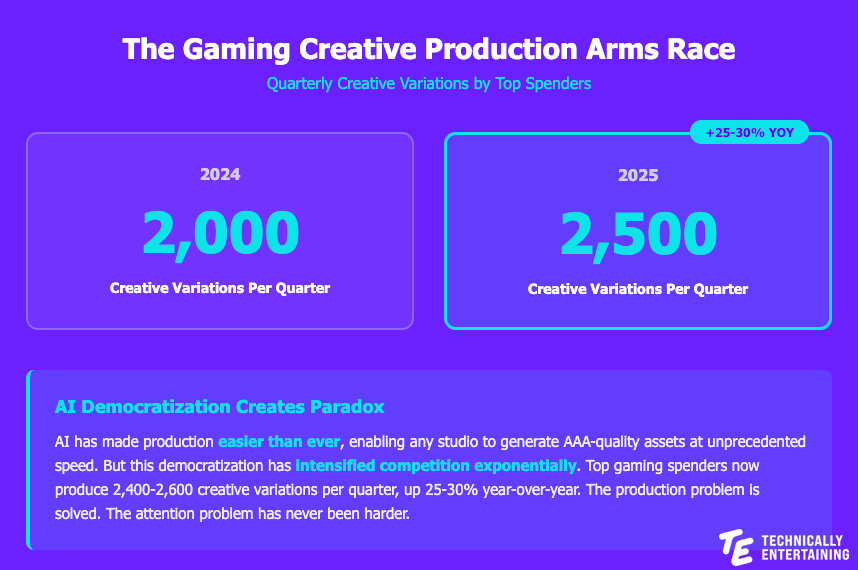
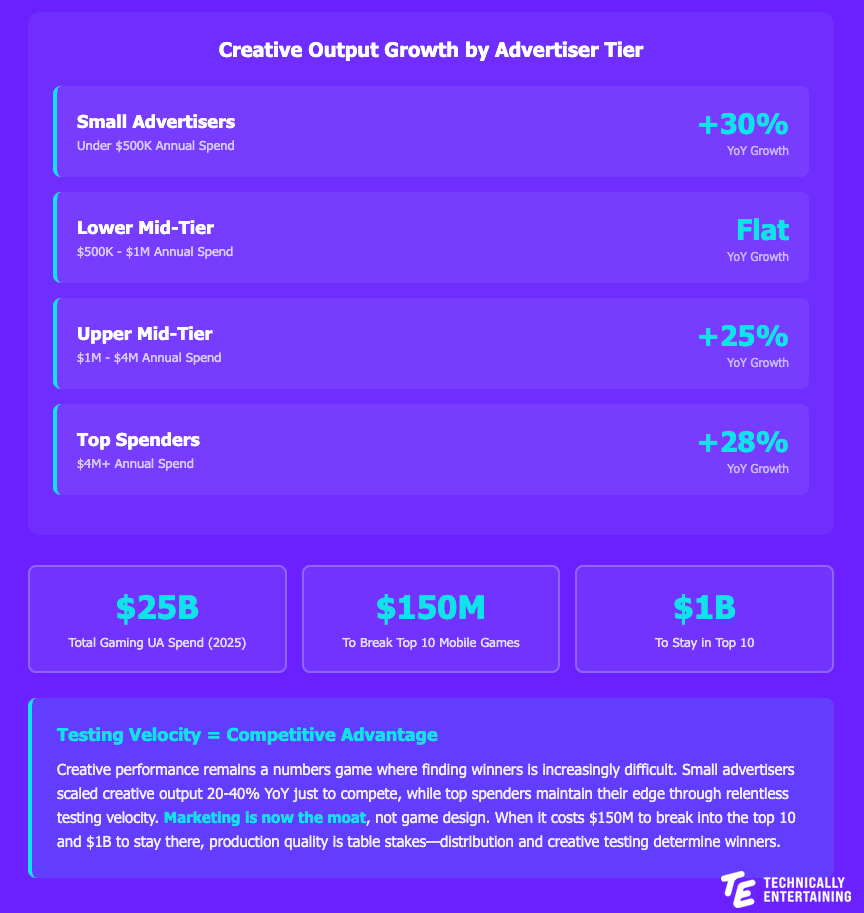
The creative production arms race is intensifying. Top gaming spenders now produce 2,400 to 2,600 creative variations per quarter, up 25-30% year-over-year. Creative performance remains a numbers game where finding winners is increasingly difficult. Smaller advertisers (under $500K annual spend) scaled output 20-40% year-over-year just to compete. Lower mid-tier advertisers ($0.5M to $1M) showed flat or declining volume, while upper mid-tier ($1M to $4M) maintained scale like top spenders. Testing velocity now determines competitive advantage.
The market is also polarizing geographically. 66% of iOS in-app purchase revenue comes from Western countries, while emerging markets drive in-app advertising growth. Western countries dominate IAP with 55% on Android and 66% on iOS, with the U.S. alone commanding 45% of iOS spend. Emerging markets show rapid IAA expansion, with Turkey rising 25% across all genres. The split highlights market polarization between high-spending Western IAP hubs and ad-supported growth markets.
The Real Bottleneck: Marketing Is Now the Competitive Moat
The paradox is clear. AI makes it easier to build and create, but exponentially harder to stand out. The production problem is largely solved, but the attention problem has intensified. Gaming as an industry has quickly matured and marketing is now a true competitive advantage.
An internal analysis by Boston Consulting Group revealed that it takes roughly $150 million in user acquisition spend to break into the top 10 mobile games on the app stores and roughly $1 billion in forward-looking spend to stay there.
Read that again. $150 million just to get in. $1 billion to stay. This isn’t a creative problem. It’s a capital problem. And it’s why indie developers building “pure” games without monetization strategies or marketing budgets are increasingly irrelevant in the mobile market.
The gaming purists who rail against brands entering gaming spaces are fundamentally misunderstanding what’s happening. Brands aren’t corrupting gaming. They’re becoming essential partners for studios that need distribution and marketing firepower. When it costs $150 million to break into the top charts, partnering with a brand that brings its own audience, marketing budget, and IP recognition isn’t selling out. It’s survival.
What Strategy Actually Looks Like
So what does strategy look like in entertainment and gaming when nostalgia is off the table?
For Hollywood: Embrace AI as a production tool, not a threat. Invest in training talent to use AI to augment their work. Build workflows that use AI to reduce costs on routine tasks so budgets can focus on creative excellence. Stop pretending theatrical windows are sacred and build distribution models around how audiences actually consume content. Partner with platforms instead of fighting them.
For Gaming: Accept that marketing is now the moat and build accordingly. Think about business models from day one, not as an afterthought. Embrace brand partnerships as distribution channels. Use AI to scale creative production and testing velocity. Understand that being in the top 10 requires capital and infrastructure, not just great gameplay.
For Both: Stop looking backward. The markets have fundamentally changed. Consumer behavior has fundamentally changed. Technology has fundamentally changed. The companies that win won’t be the ones preserving the past. They’ll be the ones bold enough to build for the future that’s already here.
The Choice Is Clear
Mark Carney’s five words apply far beyond geopolitics. They apply to every industry facing disruption. Nostalgia isn’t strategy. It’s the opposite of strategy. It’s the comfortable delusion that if we just hold on long enough, things will go back to how they were.
Hollywood isn’t going back to 1.2 billion theatrical admissions.
Gaming isn’t going back to a world where great gameplay alone guarantees success.
AI isn’t going away.
Consumer behavior isn’t reverting.
The choice is simple. Adapt or die. Build for the future or cling to the past. The companies choosing nostalgia are writing their own obituaries. The ones choosing strategy are writing the next chapter of their industries.
Which side of history will you be on?
What’s your take? Is nostalgia holding back your industry? Are you witnessing complacency in your company? Let me know in the comments.
Gain valuable insight into strategies the most successful companies are deploying across the entertainment and gaming space, as well as understand their playbooks to navigate the changes driven by AI and evolving consumer behavior. Subscribe to Technically Entertaining today. Make sounder decisions for your business tomorrow.