


Dear Readers,
Netflix reported another stellar quarter. According to Netflix’s Q3 2025 earnings, revenue rose 17% to $11.51 billion, driven by membership growth, pricing adjustments, and increased ad revenue. Net income hit $2.55 billion, or $5.87 per share, up from $2.36 billion a year prior. The company is projecting $45.1 billion in full-year revenue—a 16% jump from 2024.
By traditional streaming metrics, Netflix is crushing it. Wall Street loves the numbers. Analysts call it the “runaway winner” of the streaming wars.
But here’s what everyone’s missing: Netflix isn’t competing against Disney+, Paramount+, or Apple TV+. Those battles are already won. Netflix is fighting an existential war against YouTube—and it’s losing on the metric that matters most: content volume and increasingly, content quality.
The rumors circulating through Hollywood are clear: Netflix is actively hunting for IP acquisitions to bolster its content catalog. This makes perfect strategic sense. In streaming, IP is the only sustainable competitive advantage.
But Netflix faces a problem that no amount of acquisition spending can solve: YouTube’s content generation flywheel is accelerating while Netflix’s production model is approaching its economic limits.
Netflix’s recently announced partnership with Spotify to bring video podcasting to its platform isn’t about podcasting. It’s about embracing user-generated content economics before YouTube makes Netflix’s $18 billion content budget look quaint and unsustainable.
The Real Streaming War: Netflix vs YouTube
When analysts discuss the “streaming wars,” they compare Netflix, Disney+, Max, and Paramount+. By those metrics, Netflix dominates. But this ignores the elephant in the room: YouTube.
According to YouTube’s official statistics, the platform has over 2.7 billion monthly active users watching over 1 billion hours daily. Alphabet’s Q4 2024 earnings show YouTube generated $43 billion in advertising revenue in 2024—larger than Netflix’s entire business.
Here’s the content volume comparison that should terrify Netflix - our TE chart of the week:
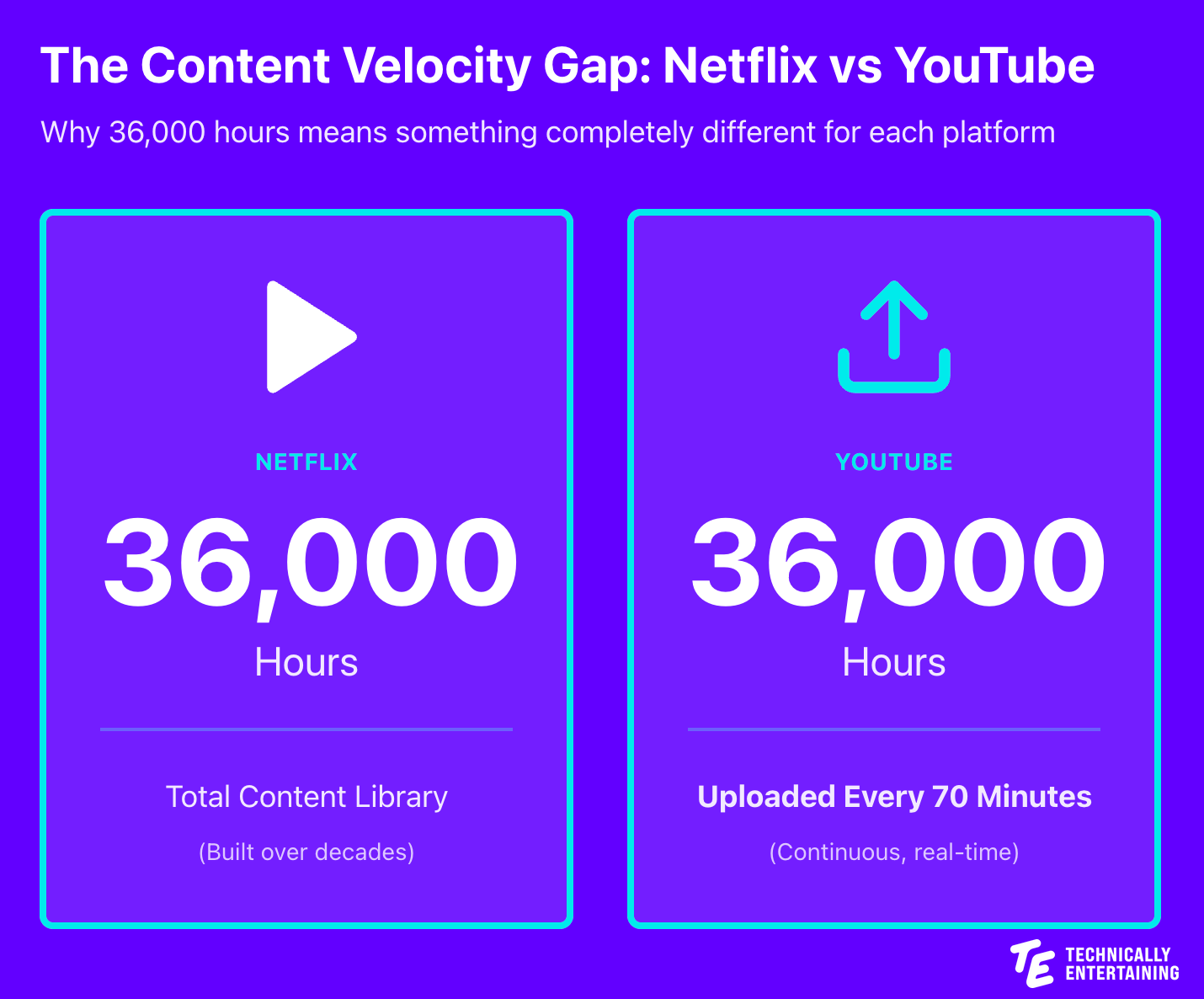
Netflix’s entire catalog: approximately 36,000 hours of content YouTube: 36,000 hours of new content uploaded every 70 minutes
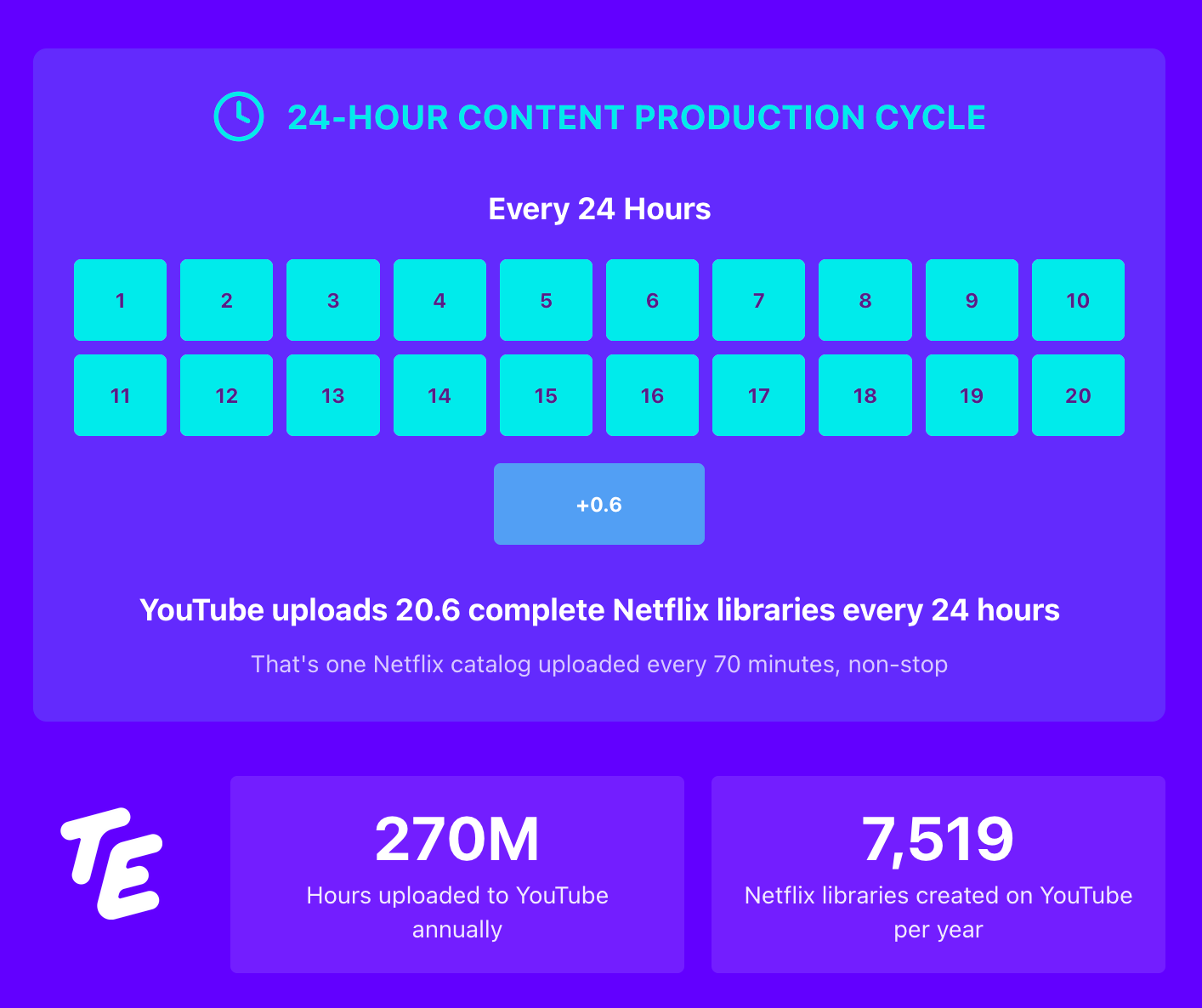
YouTube adds the equivalent of Netflix’s entire library roughly every 12 hours. That’s 7,519 times more content than Netflix produces annually—over 270 million hours of new content every year.
In other words: YouTube adds 20.6 times a full Netflix content library - every 24 hours.
Netflix’s defense has always been quality over quantity. YouTube had endless content, but Netflix had prestige. That advantage is disappearing fast.
The Quality Gap is Closing Fast
YouTube’s content quality has been steadily improving for years, but generative AI is about to accelerate that improvement exponentially. With tools like Google’s Veo 3 video generation model that now includes expanded creative controls including native sound and extended videos, and Gemini’s multimodal capabilities, the marginal cost of producing high-quality video content is approaching zero.
Netflix currently spends approximately $18 billion annually on content production according to their 2024 annual report. YouTube creators, armed with increasingly sophisticated AI tools, are producing content that competes directly with traditional streaming quality—at a fraction of the cost.
MrBeast’s production budgets now regularly exceed $2-3 million per video, rivaling many Netflix series on a per-hour basis. Yet MrBeast’s videos generate more views than most Netflix originals, with his Squid Game recreation garnering over 600 million views.
The economics are brutal for Netflix: if YouTube is outproducing them by a factor of 7,519x and the quality gap is narrowing, Netflix’s production model becomes economically unsustainable. They’re spending $18 billion to compete against an infinite content library whose quality improves daily.
Netflix has two strategic options: dramatically lower production costs while maintaining engagement, or find entirely new content models that don’t depend on expensive Hollywood production.
They’re pursuing both.
Gaming: The First Pillar of Defense
Netflix’s gaming strategy is more sophisticated than most analysts realize. According to Netflix’s gaming announcements, the company isn’t just adding mobile games—they’re transforming how games integrate with streaming.
Netflix recently launched games playable directly on TVs using smartphones as controllers. This includes party games like Squid Game: Unleashed and Netflix Party Games, designed for group play on the main screen.
Industry analysts have criticized this approach, arguing that Netflix’s audience wants high-quality, AAA games based on popular IPs like Stranger Things, not casual party games. That couldn’t be further from the truth.
Using Elaris, the premier audience intelligence tool that uses psychological AI to decode audience motivations and preferences, we found reliable data that clearly backs up Netflix’s strategy.
The core Netflix audience is expressive, socially driven, and loves trendy, emotionally engaging entertainment. Elaris proposed three game concepts that align perfectly with Netflix’s actual audience psychology:
“Binge Detectives,” a cooperative episodic mystery game where players solve cases together
“Trendsetters’ Showdown,” a competitive party game with customization that lets players express their style
“Your Story, Your Squad,” a branching narrative game with multiplayer choices that puts social decision-making at the center.
Here’s a link to a video recording showing the process to getting to these insights using Elaris (it took less than 3mins).
Netflix understood something the analysts missed: their audience doesn’t want to grind through 80-hour RPGs—they want social experiences that create connection and conversation, exactly what party games deliver.
The strategic logic is clear: gaming delivers sustained engagement that passive viewing cannot match. While the average Netflix viewing session lasts 30-45 minutes, successful games keep players engaged for hours. Gaming also creates opportunities for interactive storytelling and franchise extension that traditional streaming lacks.
But gaming alone won’t solve Netflix’s content volume problem. Games can be expensive to develop and Netflix’s gaming efforts remain modest compared to their streaming content spend. They need a content model that combines low production costs with high engagement—ideally leveraging user-generated content economics.
Enter video podcasting.
User-Generated Content: The Second Pillar
Netflix’s partnership with Spotify, first announced in January 2025, brings select video podcasts to Netflix’s platform. Initially featuring shows like The Joe Rogan Experience, Call Her Daddy, and other top Spotify video podcasts, this partnership represents Netflix’s first major embrace of user-generated content. Now, the streaming giant has doubled down on its partnership with the Swedish music streaming company to bring select video podcasts currently produced by Spotify Studios and The Ringer, such as The Bill Simmons Podcast, The Dave Chang Show, or Serial Killers to Netflix.
Here’s why this matters more than the headline suggests:
Production Economics
A typical Netflix original series costs $5-8 million per episode according to Variety’s production cost analysis. A successful podcast costs $50,000-200,000 per episode to produce—roughly 2-4% of traditional streaming content costs.
Engagement Metrics
According to Edison Research’s Podcast Consumer Report 2024, weekly podcast listeners average 8 hours and 17 minutes of listening time per week. The 18-49 demographic—Netflix’s core audience—consumes even more, with 62% listening to podcasts weekly.
Content Velocity
Top podcasters release multiple episodes weekly with minimal production lag. Joe Rogan releases 3-5 episodes per week. Traditional Netflix series release entire seasons at once, then face 1-2 year gaps between seasons.
The partnership with Spotify gives Netflix access to content that’s produced continuously, costs a fraction of traditional production, and engages Netflix’s core demographic more frequently than traditional streaming content.
The Real Strategy: Competing on Economics, Not Just Quality
Netflix’s dual strategy of gaming and podcasting isn’t about diversification—it’s about fundamentally changing the economics of content engagement.
Traditional Netflix content model:
High production costs ($18B annually)
Limited content velocity (new seasons take years)
Passive consumption (viewers watch then churn)
Declining marginal returns on content spend
Emerging Netflix content model:
Lower production costs (gaming + podcasting)
Continuous content velocity (games updated constantly, podcasts weekly)
Active engagement (games) and habitual consumption (podcasts)
Better retention economics through sustained engagement
By adding gaming and user-generated video content, Netflix is building a content portfolio that competes with YouTube’s economics while maintaining the quality curation that differentiates them from the YouTube firehose.
The Spotify partnership is particularly strategic because it tests user-generated content without the moderation nightmares that come with open platforms. Spotify has already curated and moderated these podcasts—Netflix just needs to integrate them into their interface and recommendation algorithms.
What This Means for the Streaming Wars
If Netflix successfully integrates lower-cost, higher-velocity content formats like gaming and podcasting, they create a sustainable competitive advantage against YouTube that doesn’t depend on outspending them on traditional content.
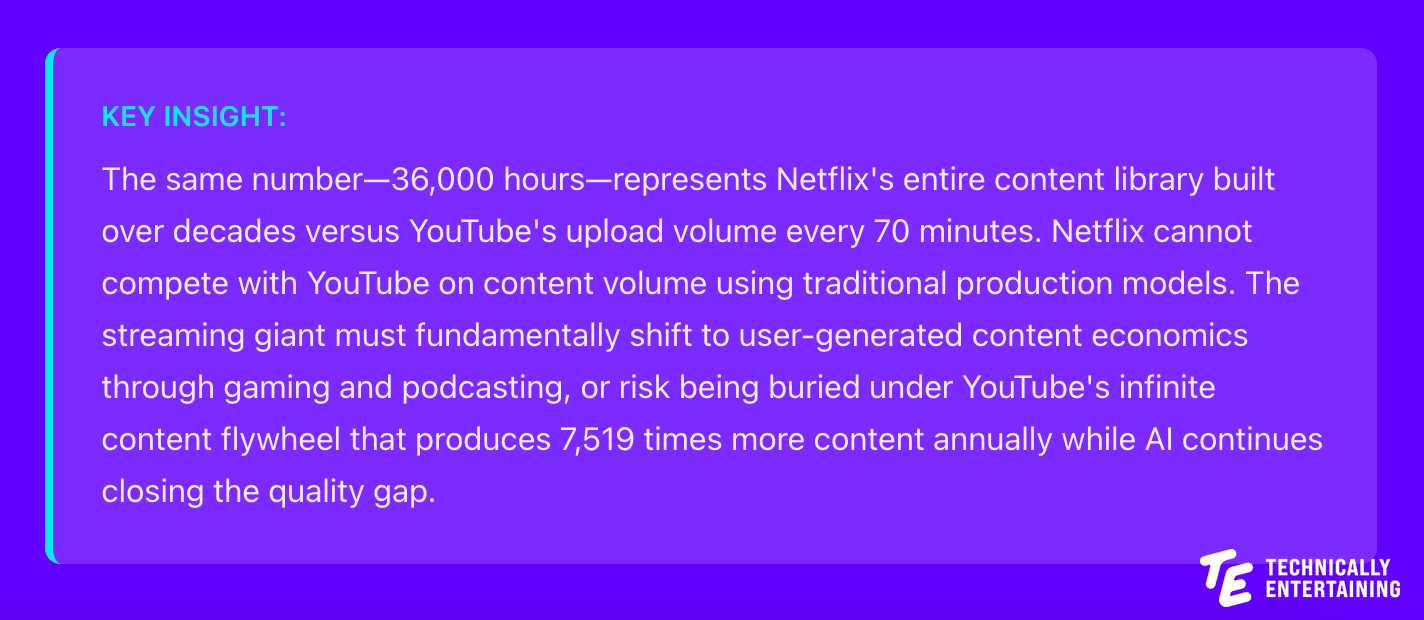
The strategy acknowledges a hard truth: Netflix cannot compete with YouTube on content volume using traditional production models. But they can compete on curated experience, quality filtering, and integrated user experience—if they embrace user-generated content economics.
This is why the Spotify partnership matters more than it appears. It’s not about podcasting—it’s about proving Netflix can integrate user-generated content successfully. If this works, expect Netflix to expand aggressively into other UGC formats: creator-led documentary series, reality content, educational programming, and eventually, fully open creator platforms.
The streaming war isn’t Netflix vs Disney+ or Netflix vs Max. It’s Netflix vs YouTube, and Netflix is finally fighting on the right battlefield: content economics rather than content volume.
The Inevitable Evolution
Netflix’s evolution toward user-generated content and gaming isn’t a pivot—it’s survival strategy. As generative AI continues lowering content production costs and YouTube’s quality continues improving, the traditional Hollywood production model that built Netflix becomes an expensive liability.
The companies that win the next decade of streaming will be those that master the economics of sustained engagement rather than the spectacle of expensive one-time viewing. Netflix is betting that curated user-generated content combined with interactive gaming can deliver the engagement levels that traditional streaming cannot—at a cost structure that YouTube’s scale can’t overwhelm.
The partnership with Spotify is the opening move in this transformation. The question isn’t whether Netflix will embrace user-generated content more broadly—it’s how quickly they can do it before YouTube’s quality catches up to their curation advantage.
The streaming wars aren’t over. They’re just being fought on entirely different terms than anyone expected.
Netflix’s strategic evolution will reshape the streaming industry’s competitive dynamics. Subscribe to Technically Entertaining for ongoing analysis of how the battle between traditional streaming and user-generated platforms unfolds.
Hey, great read as always. Your analysis of the YouTube flywheel and Netflix's economic limits feals incredibly sharp, especially with AI changing content paradigmes.