


Dear Readers,
July 6th is quickly approaching. Other than our American friends BBQing it up that weekend in celebration of Independence Day, what else is going on you ask? July 6th is the deadline for the merger between Skydance Media and Paramount Interactive to be completed.
Right now, that deal is still in limbo. Between visits in the Oval Office from billionaire and Oracle founder Larry Ellison, who’s son David is leading Skydance and trying to get this deal done, and Paramount trying to make a lawsuit with the Trump administration and Paramount’s cable network CBS go away, it’s all a big mess. It’s not unlikely that the July 6th deadline will get extended. But the longer this takes, the more the uncertainty eats away at the morale of the employees as well as the potential value of Paramount. The company has a lot going for it in terms of its vast content library and IP - but it needs to press forward and take this content into the future of entertainment that is already here.
One aspect of that is pressing down on video games. Paramount has a smaller internal games team that post-merger should be grown to also develop games based on the Skydance IP (Mission Impossible, Fountain of Youth, Transformers, Jack Ryan, Reacher). Right now, Paramount is actively looking to enhance its capabilities to license its IPs like Yellowstone or SpongeBob to game developers. As I’ve argued before, the newly formed company should make video games a core part of its strategy alongside streaming, where it has the upside to compete for spots 4-6 behind YouTube, Netflix, and Disney+ in the global streaming ranking.
And this is the second aspect when it comes to streaming: time is of the essence. While the two companies are still trying to get a deal done, the established players are making moves to further strengthen their position and crowd out the competition even more.
While Paramount and Skydance are trying to join forces, Warner Bros Discovery is separating the dying from the thriving business, Netflix is making deals to bring live television (yes, you read that right) into its service in a bid to become the ultimate aggregator of TV content.
On to this week’s story.
Netflix is becoming the aggregator
Netflix is TV - and TV is Netflix. Ted Sarandos, Netflix’s CEO, has never been shy about expressing his desire and vision for the streaming giant. Now, in a deal that could open the floodgates across media in other countries, Netflix struck an agreement with TF1, the largest TV network in France, to distribute its live content directly to Netflix subscribers. This is the equivalent of US network NBCUniversal distributing its content directly via Netflix.
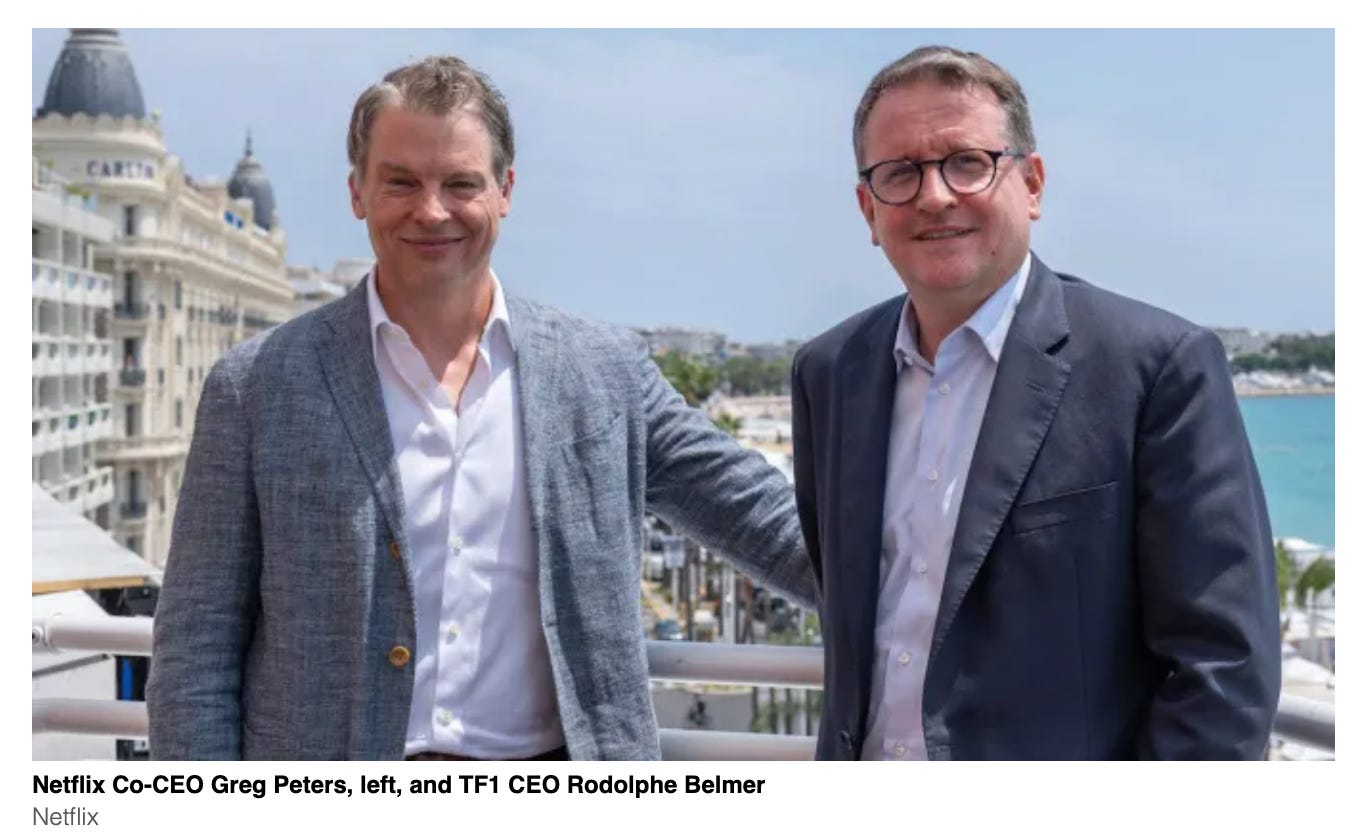
Against the backdrop of the coastline of the South of France at Cannes Lions, executives announced the unexpected deal that will see 30,000 hours of programming across TF1’s five largest broadcasting channels be available on Netflix on-demand to French subscribers.
Industry experts and analysts are predicting that this is only the beginning and that more of these types of deals are bound to happen. They make sense for both sides.
Streaming has limitations to its scalability
On the one hand, you have streaming services like Netflix, Amazon Prime, Hulu, Disney+, HBO Max, and of course YouTube all wrestling with the same challenge - there’s a limit to the scalability of their business if their offering is based entirely behind a premium tier, meaning a paid-subscription service. In other words: there’s a limited number of people that can and are willing to spend $20 per month on one, and likely multiple, subscription services. This is why pretty much all streamers now offer a subscription tier that is priced lower but includes ads - it gives them scalability across a broader pool of people (if that already feels a bit like the TV model to you, you’re not wrong).
In addition, they need more and more content to ensure people are satisfied staying behind their walls and not cancel their subscription and wander off to another service. With that comes a challenge of the media consumption subscribers are exhibiting: binge watching, the practice of watching multiple episodes of a television programme in rapid succession per the Cambridge Dictionary (aren’t we fancy today?), is great for shorter periods of extreme engagement on the platform. But: what happens when you have plowed through the ten episodes of the newly released season 4 of The Bear (available on Disney+ today) in a couple of days? Engagement breaks off. It’s challenging to keep people engaged, and keep them paying. Even the best in the business, YouTube, per estimates, lost 500,000 subscribers in the first quarter.
Binge-watching isn’t the only habit
The solution to that is obviously more good content, but also live content that guides people from binge watching to regular viewing. This is where the linear schedule of TV comes in. I still remember as a kid the times when my parents would sit down with me to watch the movie that started at 8.15pm. You were there on time, because that’s when it aired. This habit is still engrained in slightly older audiences, which streamers like Netflix see a growth opportunity in. Linear content that is in line with this audience’s media consumption habits becomes the gateway to the broader offering Netflix and others have - so they can learn how to binge watch too.
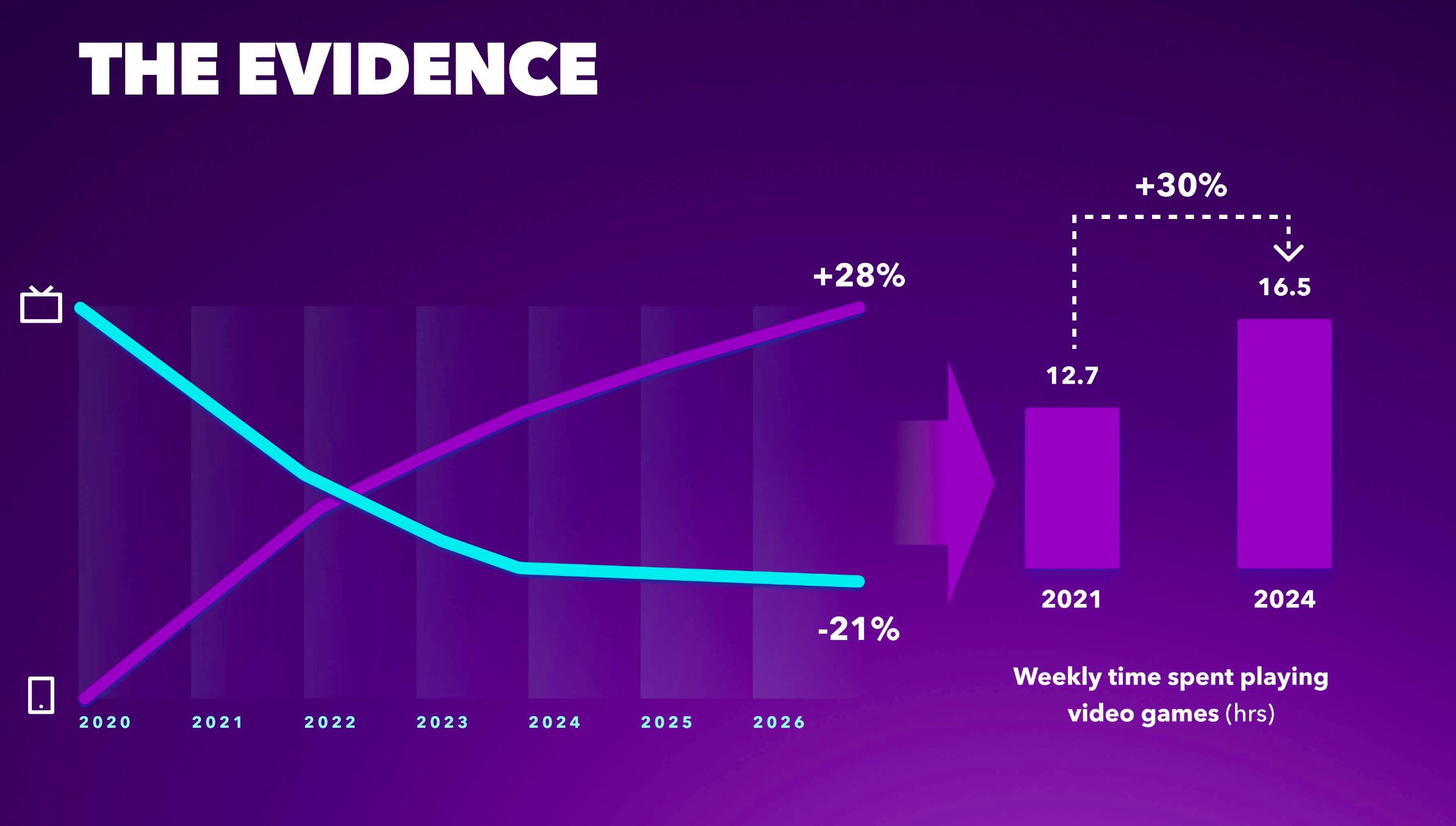
Now on the other hand, you have the cable network and old-school TV like TF1. Why does this make sense to them? Well, it’s quite simple: because traditional TV is dying. Its overall share of media consumption has been declining steadily since 2014 while digital media has been on the opposite trajectory. In the US, 35% of adults have cancelled their cable TV subscriptions already. So while their current business model still brings in cash and attracts a wide enough audience, it’s very clearly on the way out - which is why Comcast and Warner Bros Discovery are spinning out this part of their businesses into separate companies.
Access to superior distribution
These content deals with streamers give TV networks access to a superior distribution model as well as an audience they have trouble reaching on their own. They’re able to extend the reach, and life, of their programming and make additional revenue from it.
I believe that this is the area where traditional media companies can play offense and win in this dramatically changed media environment. They have the local expertise on a country and even regional level of what moves audiences. If they can streamline their operations (which is why we’ll see more mergers of cable TV networks) and hence bring down their cost of producing content, and lean into developing great programming for local audiences, there’ll be plenty of appetite from the streaming giants to license and pay for this content. Case in point: in 2022, Netflix reported 10 million subscribers in France. TF1 currently reaches 58 million people.
The media landscape will continue to change, no doubt. No doubt but these deals are a win for the old and the new guard, while also demonstrating that even the mightiest entertainment companies like Netflix face challenges they can’t solve on their own.
What else
Microsoft announced that supposedly significant layoffs are on the horizon for its gaming division Xbox. While the details and the magnitude of the cuts are expected to become public as early as next week, this would mark the fourth round of layoffs at Xbox in the past 18 months. Just a couple of years ago, Microsoft spent close to $68 billion on acquiring games publisher Activision Blizzard in what is the company’s biggest acquisition ever. With the challenges at Xbox and the ever-increasing focus on AI, it puts into question Microsoft’s commitment to gaming - which we’ll do a deep dive on in next week’s post.
In a leaked pitch deck, Spotify’s ambition of going head to head with YouTube by bringing more video content onto its platform became blatantly obvious. Extending its music library via podcasting was Spotify’s first push, but as audiences are consuming more and more video content, the Swedish streaming giant is offering YouTube creators serious cash to bring its videos over to Spotify.
The launch of my new book called Press Play - Why Every Company Needs a Gaming Strategy is getting closer. It’s already available on Amazon for pre-order and it will hit physical and virtual shelves on September 9th. The early reviews are great and if you’re keen to learn more about video gaming and how companies like Chipotle, Peloton, or the NYT leverage the power of games to engage consumers globally, consider placing a pre-order for yourself today - I appreciate the support!