


Dear Readers,
The events of the World Economic Forum in Davos are dominating the news headlines and social media feeds this week. If you haven’t been fortunate enough to be invited to the event in the Swiss Alps (or be able to purchase a ticket that goes for $150,000 to $500,000), there’s no way you have been able to escape the onslaught of content the event has generated.
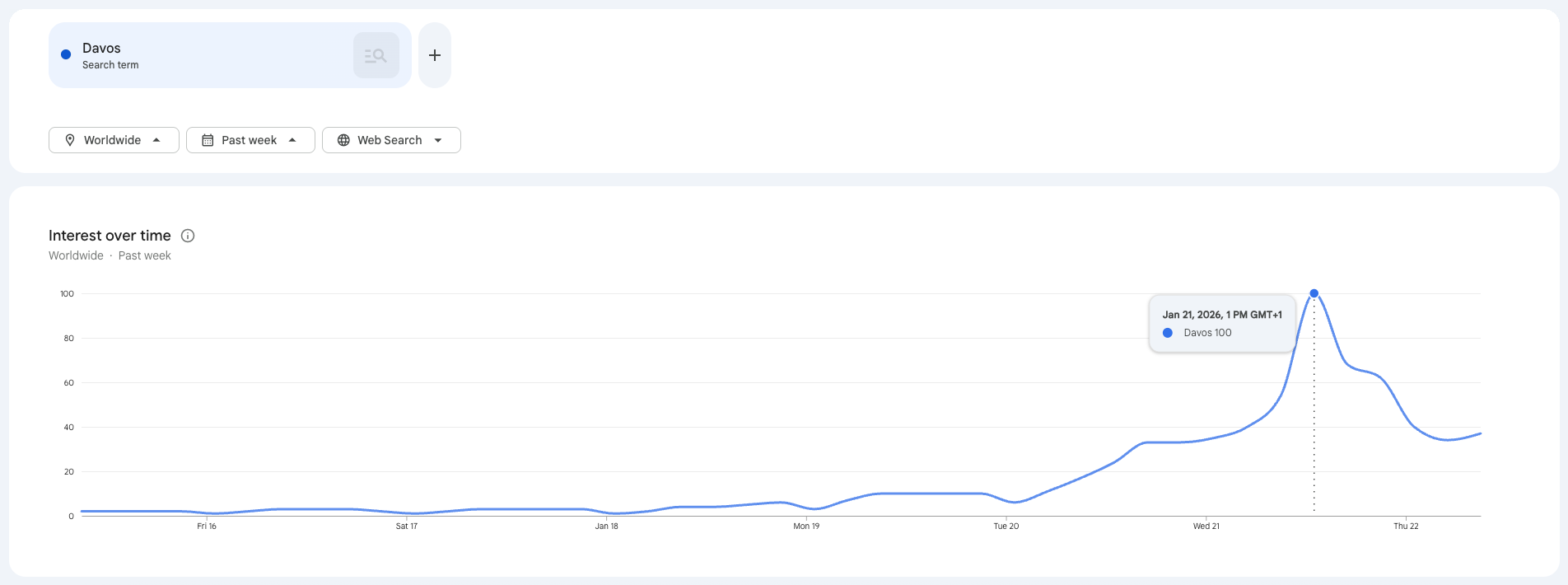
Google search volumes for Davos peaked yesterday. Anything related to President Trump or Canada’s Prime Minister Mark Carney (who gave a speech for the ages, but that’s another post) is top of mind for people online.
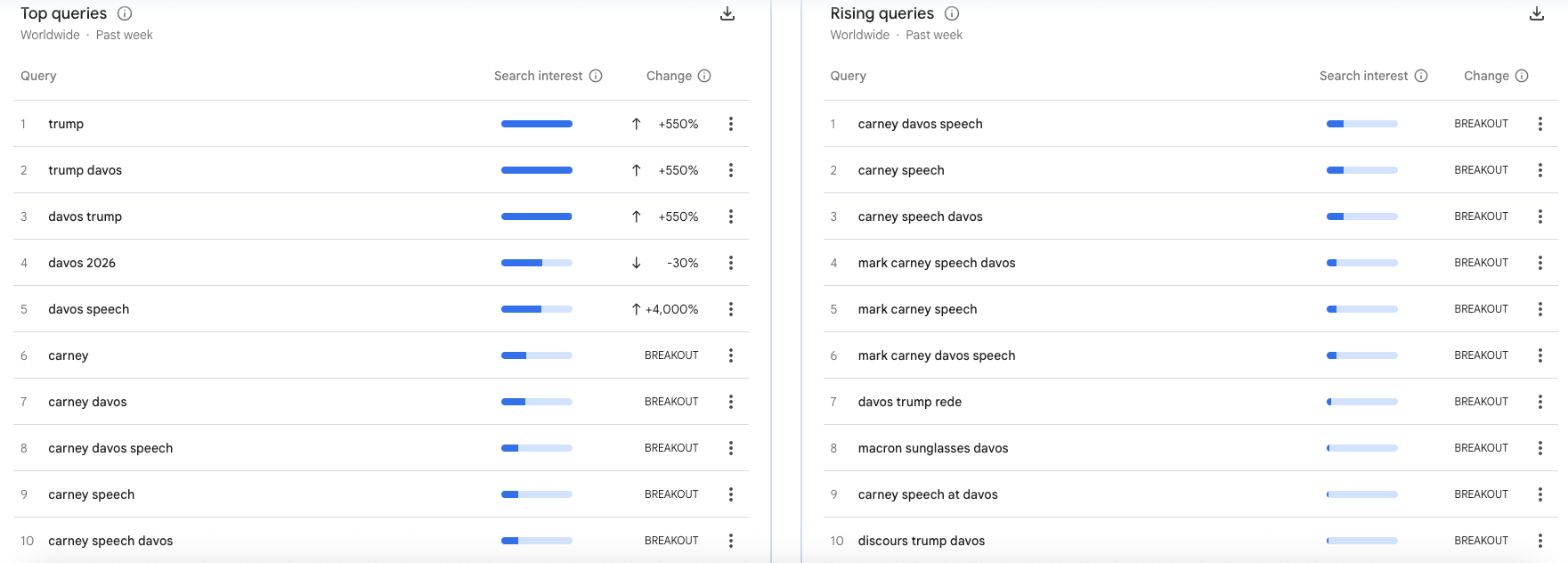
Carney’s speech is racking up millions of views on YouTube. And then there’s French President Emmanuel Macron and his aviator sunglasses.

What a time to be alive. It’s been an absolute feast for social media content. One thing that all of the videos and images have in common as we are consuming them is this:
We’re holding our phones vertically.
Which brings us back to technology and entertainment, the real reason why you’re reading Technically Entertaining, and an update streaming behemoth Netflix announced during its earnings call this week that may seem benign, but it is actually a pretty big deal.
Netflix Is Going Vertical
First, Netflix delivered strong financial results. Fourth quarter revenue of $12.05 billion exceeded Wall Street estimates of $11.96 billion, representing approximately 18% growth compared to Q4 of last year. Full year revenue came in at $45.2 billion, representing 16% growth. Netflix projects 2026 revenues between $50.7 billion to $51.7 billion (growth of 12-14%) with 325 million subscribers worldwide.
But aside from these impressive numbers, another announcement regarding the user experience of its mobile app deserves attention, because it signals the strategic direction Netflix is pursuing and what it views its real competition to be.
The Vertical Revolution: Why This Matters
Netflix is fundamentally redesigning its mobile app experience around vertical video. Not as an experiment. As the primary interface for mobile users going forward. This is a seismic shift that acknowledges a truth the industry has been dancing around: horizontal, lean-back viewing is losing the battle for attention to vertical, scroll-through consumption.
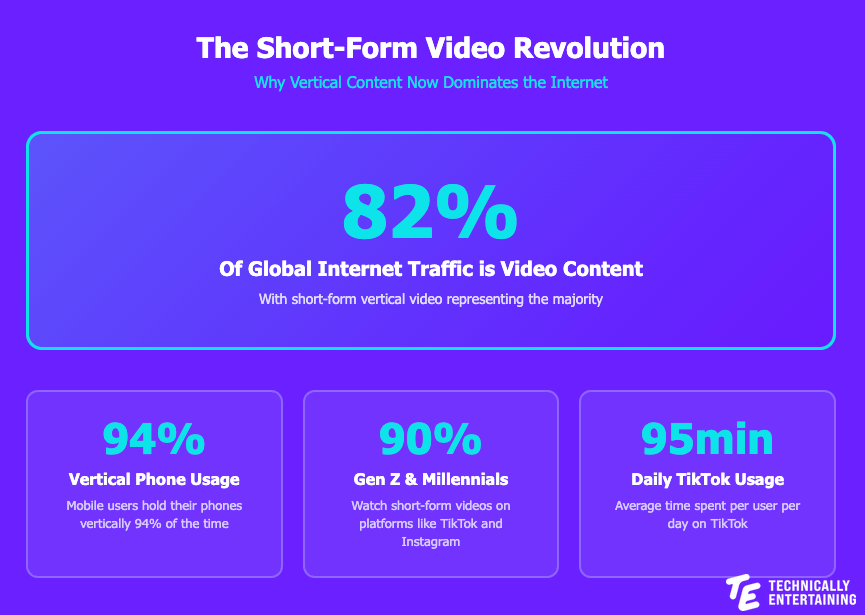
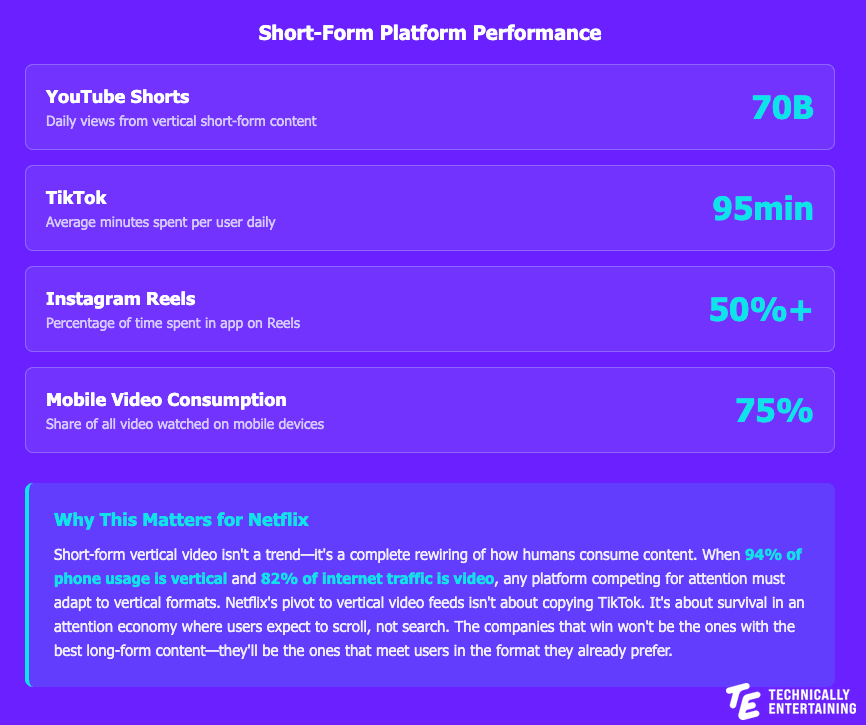
The data makes this undeniable. Short-form vertical video now accounts for over 82% of global internet traffic. TikTok users spend an average of 95 minutes per day on the platform, almost entirely in vertical format. Over 90% of Gen Z and Millennials consume video content on mobile devices, and when they do, they hold their phones vertically 94% of the time.
Netflix co-CEO Greg Peters acknowledged this reality during the earnings call:
“Netflix had already been featuring a vertical video feed in the mobile experience for the past several months, which includes clips of Netflix shows and movies. That will likely soon include other new content types, including video podcasts, which began streaming on the platform in January. You can imagine us bringing more clips based on new content types, like video podcasts, which Ted [Sarandos] mentioned that we’re adding to the general service. We’ll bring the sort of appropriate components of that into that vertical video feed.”
Read that carefully. “More clips based on new content types” isn’t about making Stranger Things easier to discover. It’s about transforming Netflix from a destination for 45-minute episodes into a feed of consumable moments that keep you scrolling.
This Is Netflix’s Admission: YouTube Won
Let’s be clear about what this vertical pivot really means. It’s Netflix’s clearest admission yet that YouTube, not Disney+ or HBO Max, is its most dangerous competitor. And YouTube is absolutely dominating.
YouTube now commands over 1 billion hours of watch time per day on TV screens alone. On mobile, YouTube Shorts generates 70 billion daily views. The platform has over 2.5 billion monthly active users. For context, Netflix’s 325 million subscribers watched approximately 500 million hours per day in 2024. YouTube is moving more than double Netflix’s total viewing volume.
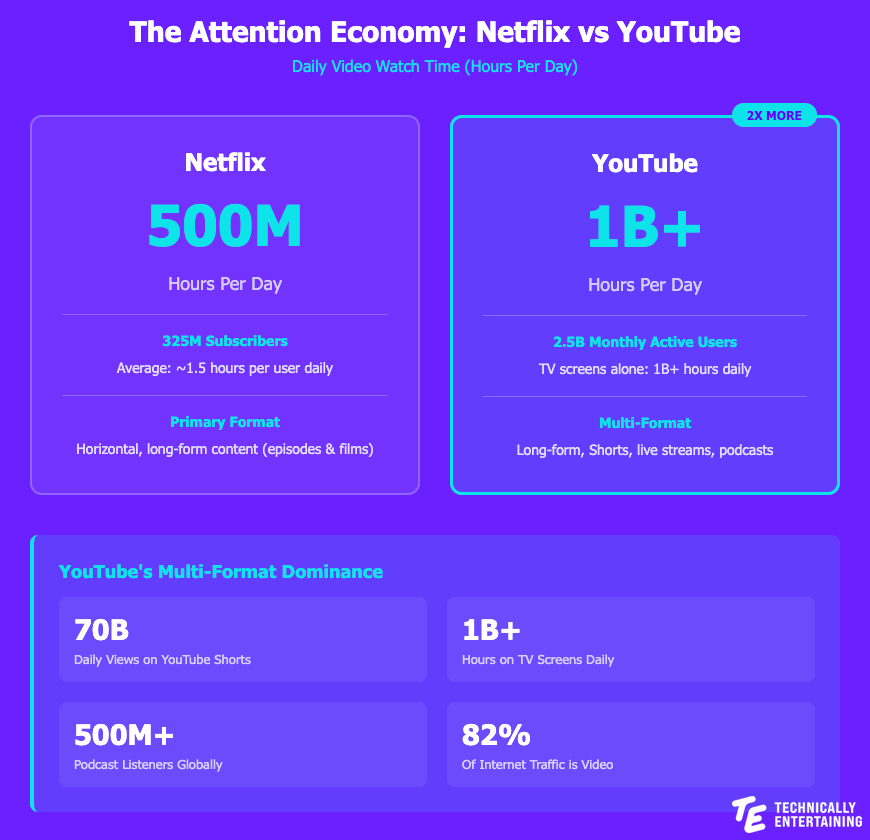
But YouTube doesn’t just have scale. It has variety. Long-form documentaries, 10-minute explainers, 60-second Shorts, live streams, video podcasts. YouTube has trained users to expect everything in one place. And YouTube is leaning on content creators, which results in dramatically cheaper means of production of this content variety.
Ted Sarandos, Netflix’s co-CEO, basically said this out loud:
“Amazon owns MGM, Apple is competing for Emmys and Oscars and Instagram is coming next. YouTube has just surpassed BBC in monthly average audience. We compete for people’s attention across an even wider set of options that include streaming, broadcast, cable, gaming, social media, big tech, video platforms.”
Notice what he listed: gaming, social media, big tech, video platforms. Netflix isn’t competing with other streaming services anymore. It’s competing with the entire attention economy.
The Three Pillars Netflix Is Building Toward
The vertical video shift enables three strategic content pillars Netflix needs to stay relevant.
Short-Form Video
Netflix has been experimenting with “Fast Laughs,” a TikTok-style vertical feed of comedy clips. That’s expanding. The vertical video feed will include clips from across Netflix’s library, algorithmically surfaced based on viewing history and trends.
Why does this matter? Discoverability is Netflix’s Achilles heel. Despite billions spent on content, most subscribers watch a tiny fraction of the catalog. Vertical video clips solve this by turning passive browsing into active engagement. You scroll, watch a 30-second clip, get hooked, click through to the full episode.
More importantly, short-form video keeps users in the app when they don’t have 45 minutes for a full episode. It captures the 5-minute window waiting for coffee, the 10-minute commute, the mindless scroll before bed. That’s time Netflix currently loses to TikTok, Instagram, and YouTube Shorts.
Video Podcasts
Netflix launched video podcasts in January 2026, starting with high-profile shows from Spotify. This wasn’t a courtesy to audio creators. It was a strategic land grab. Podcasts represent over 500 million listeners globally, and video podcasts specifically have exploded. Joe Rogan’s show generates over 200 million downloads per month, with the video version on YouTube driving the majority of engagement.
The vertical video feed gives Netflix a native way to surface podcast clips. A 2-minute highlight from a 90-minute conversation, optimized for vertical viewing, drives users to the full episode. This is the same playbook YouTube has used to dominate podcast distribution.
But here’s the bigger play: video podcasts are cheap to produce relative to scripted content, they generate consistent engagement, and they create parasocial relationships that keep subscribers loyal. If Netflix becomes a legitimate podcast destination, it diversifies beyond expensive scripted series and gives users a reason to open the app daily, not just when a new season drops.
Gaming
Netflix has been investing heavily in gaming since 2021, with over 100 titles now available. Engagement has been decent but there’s a lot of room for improvement, largely because gaming within a video streaming app feels incongruous. But vertical video changes the equation.
Imagine scrolling through a vertical feed and seeing a 15-second gameplay clip from a Netflix game. You tap, you’re instantly in a playable demo. No separate download, no friction. Just scroll, tap, play. This is how mobile gaming actually works in 2026.
Netflix’s gaming strategy has struggled because it tried to position games as standalone experiences. The introduction of games can be played directly from the app on your TV is a step in the right direction. Vertical video lets Netflix further position games as content, just another thing you might scroll past and engage with. If Netflix can crack mobile gaming distribution through vertical feeds, it opens up a multi-billion dollar revenue stream that doesn’t rely on subscription growth.
The Real Strategic Bet: Becoming a Super App
What Netflix is really building toward is a super app for attention. Not in the WeChat sense, but where one app serves multiple content consumption needs throughout the day.
Right now, Netflix is a destination. You open it when you want to watch a show. The rest of the day, you’re on YouTube, TikTok, Instagram, Spotify, and mobile games. Netflix’s vertical video strategy is about collapsing those use cases into one feed. Short clips for the scroll. Full episodes for the lean-back. Podcasts for the commute. Games for the waiting room - it’s the entertainment center for our lives.
This is the only way Netflix justifies its valuation in a world where subscriber growth is slowing. You can’t grow subscribers forever. But you can grow time spent per subscriber. And time spent is what really matters. More time means more pricing power, more advertising inventory (for the ad-supported tier), and more opportunities to keep users from churning.
The vertical video feed is the interface that makes this possible. It’s the discovery engine that surfaces content you didn’t know you wanted. It’s the funnel that moves you between content types seamlessly.
What Comes Next
Netflix’s vertical video pivot won’t happen overnight. The interface will roll out gradually, the content mix will evolve, and user behavior will take time to shift. But make no mistake: this is the future Netflix is betting on. A future where the line between streaming service, social media platform, and content feed disappears entirely.
The question is whether Netflix can execute this transition while maintaining its core product. The risk is alienating subscribers who came for prestige TV and now find themselves scrolling through clips. The opportunity is capturing billions of micro-moments that currently go to competitors.
One thing is certain: Netflix’s leadership understands what many legacy media companies still don’t. The battle for attention isn’t about having the best shows anymore. It’s about being where attention already lives. And in 2026, attention lives in games and on social media. On mobile devices, that means vertical feeds.
How do you feel about Netflix’s vertical video shift? Is this the future of streaming or a desperate pivot? Let me know in the comments.
Companies across all industries are waking up to the fact that consumer engagement has dramatically shifted and that the old playbooks no longer work. From media companies, banks, hospitality providers, consumer goods, to governments. Gaming and gamified experiences are the number one gateway to modern day consumers. Technically Entertaining is dedicated to decoding this shift for you and your organization. Join like-minded leaders and subscribe today.