

Netflix’s gaming ambitions are dead.
This is what the majority of industry pundits have concluded following the announced closures of game developers Night School Studio (the acclaimed Oxenfree studio, which had just released the horror game Unhinged) and Moonloot.
A shift in strategy is a company’s admission that they failed - at least that’s the tune people on the outside are playing. Add to that the fact that Netflix’s arguably most successful video game endeavour was the launch of the 26-minute long movie/trailer for the soon-to-be-released Grand Theft Auto VI (more on that below) and the picture gets even fuzzier. Wired tried to cut through the noise and make sense of it all with the conveniently clickbaity article titled “Netflix failed at Video Games. Now It’s Trying to Promote Them.”
The headline and takeaway of the article are both reductive and misleading. Building out an entirely new business unit as aggressively as Netflix did is a challenge for any company. Maybe the initial strategy didn’t yield outsized results (yet), but that doesn’t mean they failed nor that they are simply shifting to promoting games instead. Business strategy and management thinker Peter Drucker made a version of this point decades ago in his writing on strategy and self-renewal, collected in The Essential Drucker:
"Energy will be used up in defending yesterday. No one will have the time, resources or will to work on exploiting today, let alone to work on making tomorrow."
- Peter Drucker.
Due to the GTA VI extended look’s success on Netflix, gaming industry analysts are concluding that the only viable thing for Netflix is to outright acquire Take-Two Interactive, owner and publisher of the GTA franchise and its creator Rockstar Games.
Based on a dinner conversation I had at Gamescom a month ago with one of Netflix’s top executives, I see a different picture emerging for Netflix’s gaming future. I believe most analysts and pundits are getting it wrong.
The Appetite Nobody’s Talking About
What came up at that table was appetite, but a very specific kind. Netflix is actively looking to buy studios, particularly smaller teams that, armed with AI, can iterate, build, and ship fast, using Netflix’s own IP as the foundation. The profile Netflix wants is small, cheap to run, and built for the format Netflix has already told the market it’s building for: casual, social, the kind of game two people play together on a couch while a show sits paused on the same screen.
That target lines up with everything Netflix has done publicly this year. Co-CEO Greg Peters has organized the games business around four priorities: kids’ games, party and puzzle titles, mainstream games built on Netflix IP, and cloud delivery through the TV app. Netflix Playground, its kids’ gaming push, has tripled its daily players since launch. That reads like a company that figured out which games its audience actually wants, and following through consistently in areas of the business where the setup doesn’t line up with the thesis and customer needs - event if that means closing studios.
Calling this failing is a failure to see what is really going on. Rather than defending the past, Netflix decided to exert its energy and resources on the future and on what kind of gaming company it wants to be. I’m convinced Take-Two doesn’t fit the picture.
Netflix Already Had Bigger, Cheaper Deals on the Table and Walked Away From Both.
Here’s the part the “just buy Take-Two” argument keeps skipping. Netflix has had two real chances to own AAA game studios outright in the past year, and it passed on both.
The first was Electronic Arts. Netflix reportedly explored acquiring the publisher before EA instead took a $55 billion offer to go private, backed by an investment group tied to Saudi Arabia’s Public Investment Fund. The second, and far larger, was Warner Bros. Discovery. Netflix agreed in December 2025 to acquire WBD’s studio and streaming assets for $82.7 billion, a deal that would have handed it four established game studios (Rocksteady, NetherRealm, TT Games, and Avalanche Software) along with everything else. Then Paramount Skydance came back with a higher offer, and in February 2026, Netflix walked away. Co-CEOs Ted Sarandos and Greg Peters said matching it was simply “no longer financially attractive.”
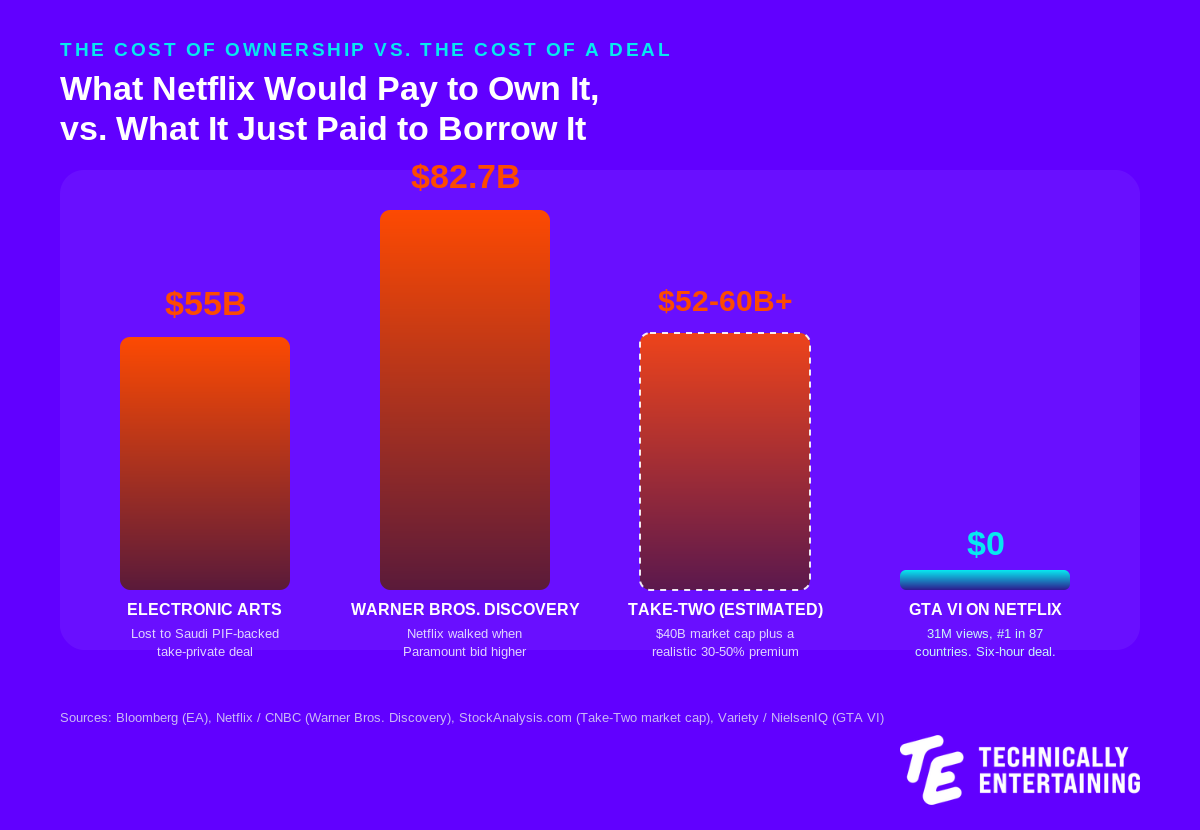
This is fiscal discipline at its best. Netflix was prepared to spend $82.7 billion and take on four AAA studios almost as an afterthought. Peters had already said the games business “didn’t attribute any value to that from the get-go because they’re relatively minor.” When the price crept past what Netflix considered rational, it walked from the whole deal rather than stretch. That kind of capital discipline tells you plenty about what Netflix would do facing a takeover premium on Take-Two’s roughly $40 billion market cap, even if that includes a blockbuster franchise like GTA and a stellar mobile publishing powerhouse like Zynga.
The Numbers That Already Prove the Point
The GTA VI extended look is the best evidence Netflix has that it doesn’t need to own Rockstar to benefit from Rockstar. The 26-minute preview, filmed entirely on a base PS5, drew 31.1 million Netflix views in four days and topped the charts in 87 of 93 tracked countries. Sensor Tower measured a 35% hour-over-hour spike in Netflix usage during the premiere, a roughly 50% jump in mobile app users compared with Netflix’s 12-week average at that time slot, a 125% increase in web traffic, and a 24% rise in US app downloads.
The halo effect reached all the way into hardware retail. NielsenIQ recorded UK PS5 sales up 33% and Xbox Series X|S sales up 34% in the week following the reveal, a sharp reversal for a market that had been down 14.4% year-over-year through late July. Take-Two’s own stock moved too, up roughly 2.3% the day after the reveal, though the reaction stayed fairly contained given the scale of the viewership numbers. Trailer buzz and enterprise value are not the same thing.
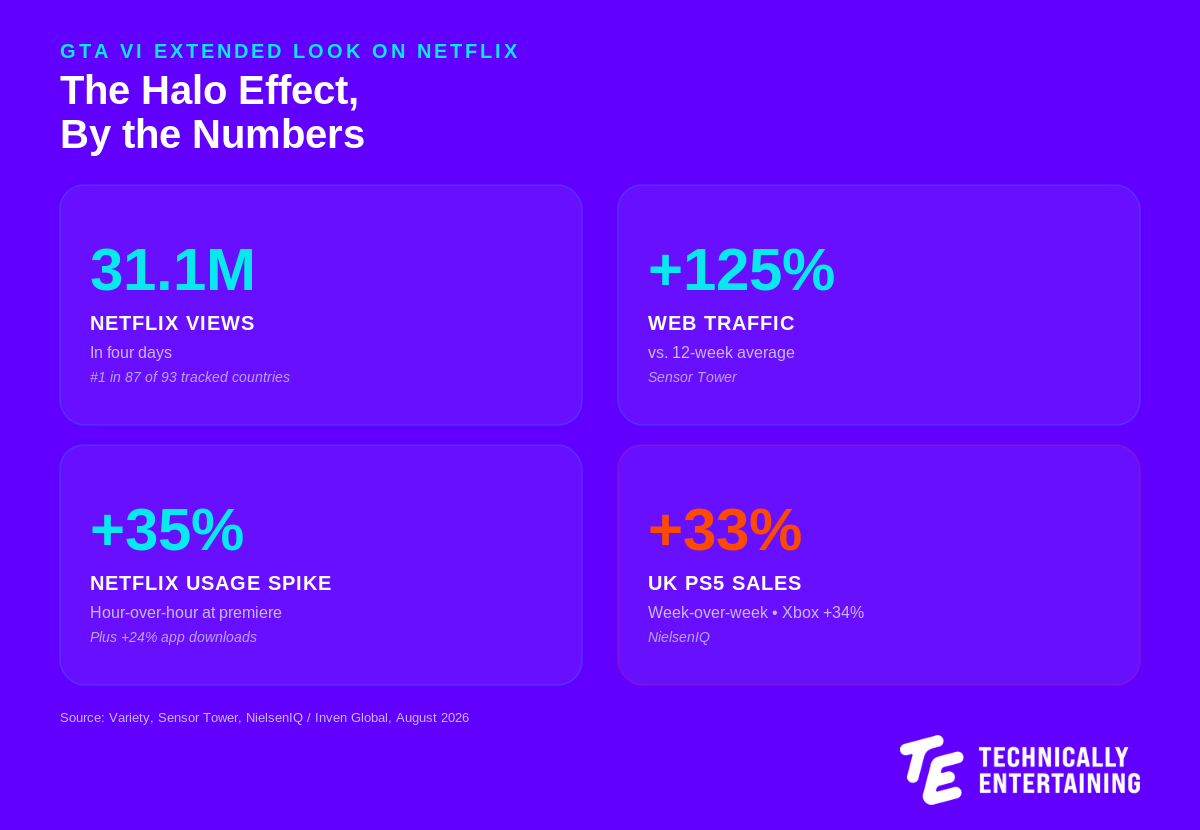
All of that came from a six-hour exclusivity window and a licensing arrangement. Nobody at Netflix had to buy Rockstar Games, take on GTA VI’s balance sheet risk, or absorb Take-Two’s entire back catalog to get 31 million views and a console sales spike. They got the distribution benefit that ownership would provide, at a fraction of the cost of owning the company.
Take-Two Isn’t For Sale, and It Wouldn’t Be Cheap If It Were
Take-Two’s own leadership has already answered the acquisition question directly. CEO Strauss Zelnick told CNBC that Take-Two is “not interested in selling to anyone at the moment,” and made the case for the company’s independence himself:
“I think if anyone deserves to be an independent company, we do.”
- Strauss Zelnick, CEO Take-Two Interactive.
He’s not wrong on the numbers. Take-Two is the largest pure-play public company left in gaming, expects more than $8 billion in revenue this year, and heads into GTA VI’s November 19 launch with 27 of 28 analysts rating the stock a buy.
A public company with that growth profile, a management team on record refusing to sell, and a market cap already sitting around $40 billion doesn’t come at a discount. Realistic takeover premiums in entertainment and media run somewhere between 30% and 50%. That puts a serious Take-Two acquisition somewhere north of $52 billion, on top of a seller who has already said no. Netflix just showed exactly what it does when a price like that starts looking unreasonable, with a deal twice that size. It walks.
The Better Deal Is Already Sitting in Netflix’s Own Playbook
Netflix already has a working template for exactly the outcome it wants from GTA, and it doesn’t involve owning Take-Two.
Arcane, built with Riot Games without Netflix ever owning Riot, became one of the most acclaimed animated series Netflix has ever released. It’s worth being honest about the economics here too. Riot reportedly spent around $250 million producing it and, according to Bloomberg, didn’t fully recoup that investment directly from the show itself. Even a disappointing outcome on a $250 million licensing bet is a rounding error next to a $50 billion-plus acquisition. Netflix has run the same playbook since with Devil May Cry, and has a Splinter Cell anime from the writer of John Wick in production. Each of these deals gave Netflix a hit adaptation and a stronger claim on that franchise’s audience, with none of the balance sheet exposure of owning the studio behind it.
Apply that model to Take-Two and the shape of a real deal becomes obvious. A first-look or output agreement giving Netflix the rights to adapt GTA, Red Dead Redemption, or NBA 2K into series and film, paired with the kind of marketing scale it just demonstrated with the extended look, gets Netflix its transmedia ambitions and gets Take-Two Netflix’s distribution muscle for GTA VI’s launch window. Take-Two keeps its independence, its stock, and its studio. Netflix gets first dibs on turning its biggest franchise into television and film. Nobody has to write a $50 billion check to get there.
What This Means for Brand and Media Leaders
If you sit in a media, brand, or content strategy seat and you’ve been watching this story purely as an M&A question, you’re watching the wrong story. The real signal is that the distribution deal is becoming the default structure for pairing a media platform with a gaming franchise. Netflix just showed what a single marketing window can do to console sales, app usage, and audience attention. That structure is available to any brand willing to negotiate the right partnership, not just to whoever can write the biggest check.
The pundits calling for an acquisition are asking the wrong question. The real question isn’t whether Netflix can afford Take-Two. It’s why anyone would pay ownership prices for what a distribution deal already delivers.
Technically Entertaining covers the intersection of gaming, technology, and business strategy. If this changed how you read the Netflix and Take-Two headlines, subscribe today and share it with someone still predicting an acquisition.