


When the global pandemic hit, no one really liked being in lock down but game developers and publishers. The gaming industry was already on a tear leading up to the events of 2020 and 2021. But like the Greek mythology figure Icarus, everyone that believed the only way forward was up flew a little too close to the sun, burned their wings - and came crashing down. Layoffs, killed game projects, big flops, and dried up venture capital pipelines dominated the headlines in 2022 and 2023.
I just returned from Cologne, having spent the entire week at Gamescom, the industry's biggest annual event. 335,000 visitors means it’s still the largest gaming trade show in the world and the 2024 instalment is the biggest one since the pandemic. 32,000 trade visitors is a record number for people in gaming and beyond, wanting to do business between Kölsch, the Dom, and chocolate. The opening night recorded 40 million views - double the all time high from the year before. Dare I say it feels a bit like a phoenix rising from the ashes?
Alright alright, enough of the Greek mythology. Let’s get to the details of what this means for gaming, but entertainment and business more broadly (though have you ever listened to Stephen Fry telling Ancient Greek stories in the podcast series Mythos?! Anyway…). Here are five big themes from Gamescom 2024.
The heart rate is stabilizing, and the focus is on longevity.
While there are still some studios that are struggling to keep things going and are looking at making further cuts, the majority of players are on the up. Developers and publishers alike are actively hiring, investing in new projects, as well as taking a more long term look at the next 5-10 years of their most prized assets: well known IPs and franchises that have shown success and have access to an established audience. Taking bigger bets is becoming a hotter topic again, with a critical caveat. Consistently mentioned in every conversation I had were the words “external validation” and “data informed”. Executives expressed the need to rigorously test and validate any new ideas before committing serious budgets to any project. As one person put it:
“There are very few, if no, companies in the industry who can simply roll the dice on a 300M dollar game and simply wait for it to flop, expecting to continue as if nothing happened.”
Sounds very sensible (why was that different before? Asking for a friend).
Venture capital is starting to flow again - well, sort of.
The funding market is slowly ticking up again, but the bar to convince financial investors remains high. Especially on the content side, investors remain wary of taking on the risks of a new bet (see above: rolling the dice) and are looking for validation (again: see above) as much and as early as possible. The days of great founding teams being able to point to their track record and receive a written check to fund their journey seem like a distant memory at this point. Teams that are able to bring in a strategic investor in their fundraising process have an easier time to convince the financial investor. The strategic investor signals expertise, so their commitment is read as a sign of, you called it, external validation. There are a couple of juggernaut funding rounds in the vicinity of 100-250M dollars for pre revenue games in the making, so be on the lookout for more updates over the next few weeks.
The times they are changing.
There’s a profound shift in the App Store ecosystem brewing. Epic Games launched its mobile app store in the European Union for iOS (Apple is still blocking access to Fortnite and the app store outside of the EU) and worldwide for Android. Epic has moved quickly to onboard the mobile gaming publishing powerhouse to increase the content pipeline for consumers. Meanwhile, YouTube is positioning itself more as a platform for discoverability for mobile games via influencers in its own right, almost adjacent to Google’s very own Play Store. It’s not hard to imagine being able to install your next mobile game directly from a YouTube video you just watched about that exact game, without having to actually navigate to the Play Store. For now, YouTube is still Google (or more precisely Alphabet), but with the recent antitrust rulings it’s good to keep an eye on this one. If Google is indeed broken up at some point, YouTube would instantly become a veritable competitor to the established storefronts.
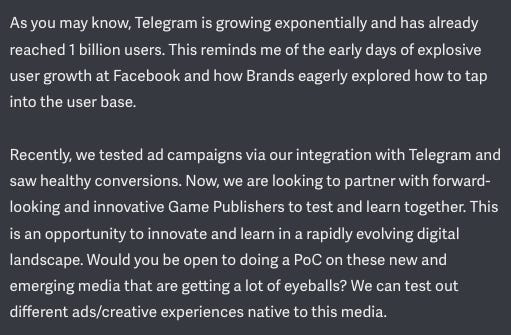
Then there’s Telegram, whose sales rep has followed up three times with me since Gamescom (below is a screenshot of the email in my inbox), boasting about their 1bn users and how Telegram is becoming the new platform for games. That was before their CEO was arrested in France over the weekend for alleged fraud and misconduct by users - not the best business card to acquire new business.
It’s too early to tell where all of this will lead, but one thing is clear: more competition is great for consumers. It means more optionality, which almost always drives down cost. Another beneficiary: developers. The exact timing is tbd, but the days of 30% fees paid to app stores for any transaction inside of a game (or app for that matter) you built are numbered.
Meet the “new” kids on the block.
More than a third of all of my meetings at Gamescom were with executives from companies whose business is not to make games. Volkswagen, Porsche, Mercedes, Adidas, Formula E, Balenciaga - what do all of them have in common? They are looking to understand and reach gamers. Why? 3.4 billion people play games, and all of these people are general consumers of all of those, and more, brands. Some of these brands have been more active than others in gaming. One of the conclusions that all of them have come to: Slapping a logo on a team for esports doesn’t provide actual ROI. And when really slow moving organizations like the ARD in Germany (the pendant to the BBC in the UK) are prioritizing making and co-developing games to supplement their news business, you know that play is serious business and a must-have strategic consideration for any company.
Especially interesting in the context of the growth of games and their convergence with more and more consumer touch points is the role of the car - so much so that we will explore the automobile as the potential dominant consumer touch point of the next decade and what role entertainment has to play in a future post. If you don’t want to miss it, make sure you hit subscribe.
All roads will lead to the same place - the customer.
Another term that seemed to echo through the Gamescom venue and the various crowded hotel lobbies was “transmedia”. The question to ponder is the following: In 10 years, will every IP launch with a transmedia strategy, delivering content based on that IP across multiple touch points from the get go to cater to varying consumer needs? So rather than launching the Last of Us game and then years later follow through on a TV series, is the true unlock for the future of entertainment to think of IP and its applicability to the plethora of consumer touch points from day one, and engaging consumers across their entire journey right out the gate?
This topic is in its early days, but it sits at the top of the agenda for all entertainment companies and brands alike. The convergence of games with other forms of media, as illustrated by the recently announced anthology series Secret Level, offers glimpses of where the entire space may be headed. The rate at which companies are setting up transmedia strategy teams is an indication of how seriously this shift is taken.
Reason enough for us to dive deeper into this in a dedicated post soon to come (if you haven’t hit subscribe before, now you really need to - but enough of the shameless self promotion).
Stay tuned - and thank you for reading.