


Dear Readers,
I’ve been an avid user of the messaging app Signal for more than six years. In that time, I’ve never been added to a group chat that I shouldn’t have been a part of, or that shared highly sensitive information with me. Looking at what’s going on in the US right now, with Secretary of Defense Pete Hegseth leading the race of incompetence, maybe my turn is just around the corner.
On a lighter note, it’s good to see people and companies clap back at the whirlwind of insanity launched by the Broligarchs in Mar-a-Lago - and when official company accounts on social media start to punch back, you know how fed up everyone is.
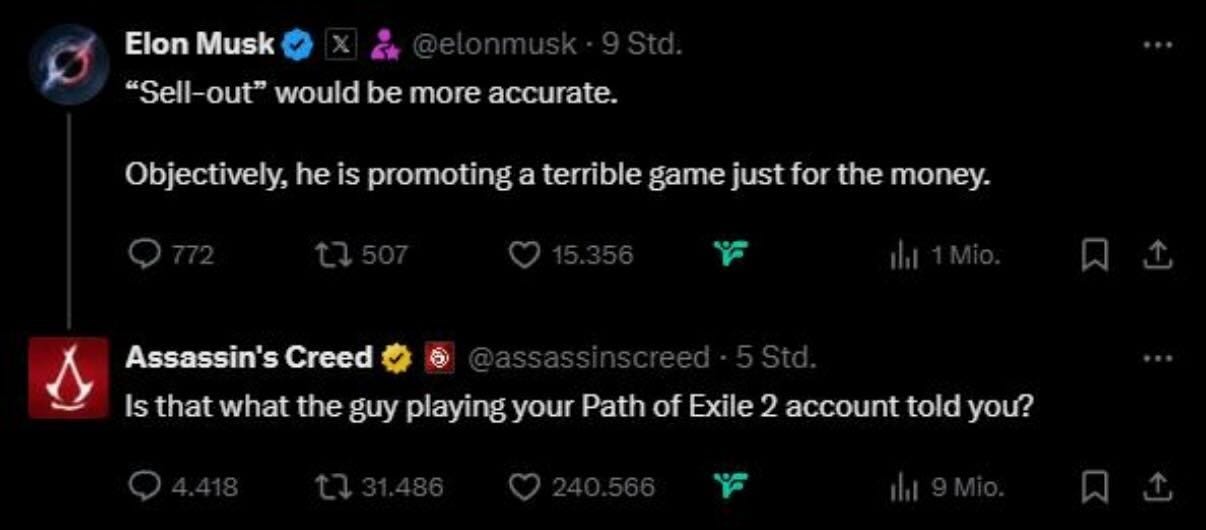
You gotta love gaming for its zero BS tolerance. Ubisoft 1 - Elon 0.
On to this week’s topic.
Last week, Apple was ordered by EU courts to open up to competitors. The landmark ruling details plans to open up its iPhone and iPad operating systems to work better with competing technologies. This includes better interoperability with non Apple wireless devices as well as the ability to develop apps similar to Apple’s AirDrop using the company’s wireless technology, and more. Google also received another slap on the wrist for still not being compliant with the Digital Markets Act (DMA), and Brussels found that Google is “failing to let app developers steer users to cheaper options outside its Google Play Store app marketplace.”
Both companies’ app stores are under heavy scrutiny, and I believe that sooner than later the EU will force Apple and Google to allow third-party app stores onto their devices and/or rule to see both companies divest and spin out their app store businesses from their other businesses.
The key argument both companies keep making against this are the following: (1) this change would introduce more fraud in the ecosystem, (2) pose more risk to consumers, and (3) ultimately that they built the underlying infrastructure and get to decide what runs on it. Points 1 and 2 can be solved and controlled for quite easily through technology and imposing safety and quality standards for any third-party store and what they offer to consumers. With respect to (3), they should absolutely be compensated for what they have built and still provide.
But consumers and companies have a right to have options. The way the mobile ecosystem currently works is similar to a high speed highway with toll booths every kilometer along the way - and you have no choice but to drive on this one highway. What we need are alternative routes that maybe take a little longer to drive on, but might be more scenic - in any case, the tools would be lower. Competition is good - it always tends to increase the economic value at hand and the prosperity of the parties involved. The ultimate winner: you and I, the consumer.
Here’s why you, as the consumer, should care.
This would lead to easier discovery or new better content, products, and services. Why? Because with lower costs in the advertising networks and on these platforms, new companies that are building new games or are making new apps need less marketing budget to be seen and to acquire their initial set of users to get some early traction. The cold start problem is what’s literally killing companies right now and why the “new” content feels more like “more of the same”. With this change, we’re encouraging competition by making room for new companies and apps to emerge. The consumer can discover novel experiences more easily. Meanwhile, Apple and Google are forced to step up their game to provide better experiences to developers and customers alike (ask any mobile developer and they’ll tell you how fed up they are with Google Play Store and the lack of innovation over the years), in turn making their own services better which allows them to increase their revenues. Everybody wins.
Why isn’t this happening already?
Apple, Google, Meta, AppLovin, and others have no interest in achieving greater efficiency in their networks, at least not more than to be slightly better than their competitors and to further increase their own margins. Their incentive is not to become low cost and let developers participate in the cost reduction. The overall advertising market is expected to reach a record high $798.7 billion this year. About $430-$450 billion of that are forecasted to represent the mobile advertising spend - a near 11% increase compared to 2024. The market keeps growing and developers and brands have no other choice but to go through the gatekeepers. The average return on ad spend in mobile is about 10%, meaning that in order to achieve 50 million in revenue, companies spend about 45 million on mobile advertising. So why would the advertising gatekeepers shoot their own cash cow?
The answer is quite simple: to proactively protect your market leading position through innovation. It’s a tale as old as time. At some point, a new alternative will come around. It’s called the Innovator’s dilemma.
Look no further than Google. Its cash cow has been, and still is, Search. Yet, for the first time since 2015, Google Search’s market share has dropped below 90%. The likely culprit? AI Agents, LLMs, and new ways of searching for information. You can bet even the internet giant on 1600 Amphitheatre Parkway in Mountain View is concerned about this development.
How can we shake things up?
There’s a number of things that could happen, and many of them I can’t even see coming. But there are also some fairly obvious moves that would also be highly effective at breaking Apple’s and Google’s dominance and inject growth through competition into the ecosystem:
Epic Games’ own mobile store - The company is well on its way and is fighting Apple in courts about this. This would be a great start, especially considering that mobile gaming accounts for almost half of all the mobile advertising spend and is a lucrative business for Apple and Google alike due to the sheer amount of in-app purchases, of which they take a further cut.
A spin-off of YouTube - this one is my personal favorite and I think regulators focusing on Google Chrome and Search over monopoly powers is a good start, but it’s not the most effective lever to pull. Spinning of YouTube over antitrust concerns as a legal case has a lot of legs and it would create a viable competitor overnight. You could easily see YouTube videos and shows include a link to instantly download whatever app is being talked about or promoted - directly from YouTube. Through the comments section, social proof is already built in, which is something both App Stores severely lack and developers are asking for. Spinning out YouTube into its own publicly traded company also presents an incredible opportunity to create shareholder value - based on YouTube’s revenue of roughly $40 billion, a valuation north of $450 billion is likely.
Web traffic to mobile - web traffic is inherently cheaper than mobile traffic. Companies like Trade Desk have historically been focused on web traffic and advertising there. If there was a way to identify a likely mobile user any company might be targeting through web traffic signals, and then convert that person into a mobile download - you have created a second funnel into the mobile ecosystem at much lower cost.
New content discovery model - this is another personal favorite of mine: flipping the entire content discovery model on its head via targeted early stage communities to create traction for new content. Being able to engage highly curated communities of users with new content would address the cold start problem and give new experiences an instant baseline of engaged users. This demonstrates traction and offers Apple and Google an incentive to recommend these apps and games to additional people. The biggest unlock here is the following: more than 80% of all organic traffic on the app stores goes to the top 20 games. Why? Because Apple and Google can confidently forecast strong revenues from another Monology Go player versus a player of a brand new game. It’s a race to the bottom for new and emerging content. AI Agents as well as companies like Fandom and Discord all have a big opportunity. I talked with executives of Fandom and Discord at GDC last week and entering the advertising space is high on the agenda for both companies. Discord’s IPO also appears to be the real deal this time, so we may see action on this front sooner than later.
We expect to hear from the EU courts on Apple’s ruling early next week. It is clear that change is needed - the question is how soon this will happen and how much the current administration in the White House shields Big Tech from legislative scrutiny.
I’ll be attending AdWeek in London next week. The agenda is packed with talks about the future of marketing and advertising, including personalization of content, sports, and entertainment. Make sure you subscribe to get the most important headlines straight to your inbox.