


Dear Readers,
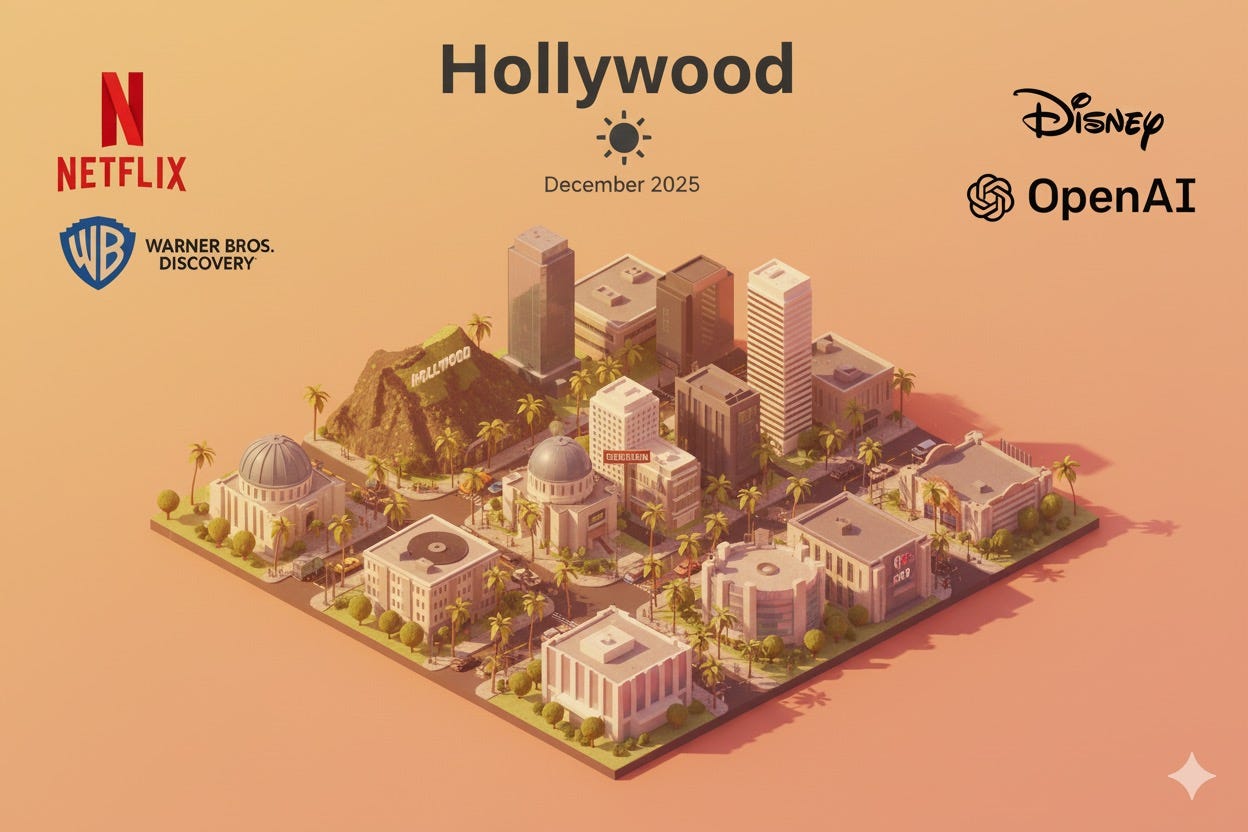
I was in Los Angeles last week for GamesBeat’s Hollywood and Games Summit 2025 when the worlds of AI, entertainment, and games collided in real time.
In the midst of the ongoing battle for Warner Bros. Discovery between Netflix and Paramount-Skydance, a senior executive at one of the bidding parties shared his sentiment with me over lunch:
“If someone’s willing to spend $100 billion and they’re not getting WBD, they’re going to buy something else.”
Consolidation in the entertainment industry will continue. The makeup of Hollywood will change forever.
Two hours before that lunch, news broke that Disney would invest $1 billion into ChatGPT maker OpenAI. As part of the deal, Disney will license 200 of its iconic characters and IP for OpenAI’s Sora service, allowing users to create their own content using Disney IP. I was in an Uber driving down Melrose Avenue when the news flashed across my phone screen. I needed to read it twice, but it became clear immediately that Disney CEO Bob Iger was simply one step ahead of everyone else in and around Hollywood.
The Unimaginable Just Happened
For the longest time, a move like this for anyone in Hollywood was simply unimaginable. IP had to be protected at all costs. It needed to stay inside a walled garden, as tightly controlled and managed as possible. The idea of licensing IP to end users and letting them have at it seemed insane.
Yet here we are. Disney’s move is a clear signal to the rest of Hollywood: IPs are coming to whatever screen you want them to be on. This shift is happening and we won’t prevent it from happening. So we might as well get out in front of it and actively participate in the shift and shape it, rather than chase it.
The fine print in the deal terms with OpenAI reveals this strategy. The deal doesn’t only protect Disney’s IP rights. Disney automatically and immediately receives ownership of any work or output based on their IP that users create using Sora, without having to negotiate with, chase, or sue creators. Evan Shapiro has hands down the most succinct analysis of the deal terms.
Disney formally ushered in a new era in Hollywood, its relationship with tech companies, and what this means for the business of entertainment. The rest of Hollywood still looks up to Disney and a move like this just legitimized it for every other IP owner. Just think about what principle executives at Paramount, owners of a $1 billion IP in SpongeBob in their own right, still operate by: “SpongeBob won’t do anything Mickey Mouse wouldn’t do.”
Mickey Mouse just opened Pandora’s Box.
Hollywood Meets Gaming: The Convergence Accelerates
At the Hollywood and Games Summit itself, the convergence of entertainment and video games took center stage. Across pretty much all talks and panel discussions, executives from Hasbro, Tencent, Capcom, HBO, and Bad Robot shared their insights on how entertainment IPs are becoming games and how games are becoming entertainment IPs, focusing on two of the four core gaming strategies I outline in my book Press Play: integrating your brand/IP with existing games and building new games using your brand/IP.
Two of the most insightful sessions featured Marcus Liassides, SVP Global Head of Digital at Mattel and Kara Bilkiss, SVP Business Development and Licensing at Paramount Games. While I was fortunate enough to have the conversation on stage with Kara Bilkiss, digging into Paramount-Skydance’s gaming strategy and the ripple effect of new owner David Ellison being a self-proclaimed gamer (there were too many relevant insights in this conversation, so we’ll dig into these in a separate post - be sure to subscribe below to not miss it), the former saw Mattel executive Liassides shed light on Mattel’s learnings at the forefront of UGC in games.
Mattel’s UGC Strategy: Five Key Insights
UGC as a promotional anchor. UGC will be a part of the promotion of big screen film or TV releases to generate momentum and engagement with the audience. On the back of the successful launch of the Barbie movie, from which Mattel made roughly $1.5 billion, the iconic superhero He-Man will hit theatres in 2026. Expect this movie to have a significant UGC footprint in Roblox and other gaming environments, though Liassides was quick to point out that UGC isn’t a panacea and not every media has to have a UGC component.
The strategy is “creator” not “Roblox.” While Mattel so far has been leaning heavily towards Roblox and Fortnite as the go-to platforms for their IP, the overall strategy is clearly platform-agnostic and in general leans heavily into creator environments and user-generated content. Right now, Mattel appears to be in experimentation mode and is looking to bring more brands like Uno and Hot Wheels into these worlds. Liassides emphasized the importance of this strategy for Mattel:
“We would have never conceived games like Grow a Garden, but if we can put our brands into the hands of creators, they can create something with that.”
Audiences in the spotlight. While Mattel has been focused on younger audiences for now, they clearly want to age up and let older audiences create too. A critical part of the discussion centered on audience overlap and questions regarding which audience is core to an IP (the core fanbase), who’s adjacent, who’s net new, who will never play a game even when paired with the IP, and how different entertainment formats based on the same IP can be used to stretch the IP’s overall value and reach, tapping into previously untapped audiences. Tools like Elaris offer incredible insight and guidance around this to shape the IP strategy appropriately against the different audiences that are within scope. You can learn more about this using the He-Man IP and its movie release June next year as an example in this excellent blog post.
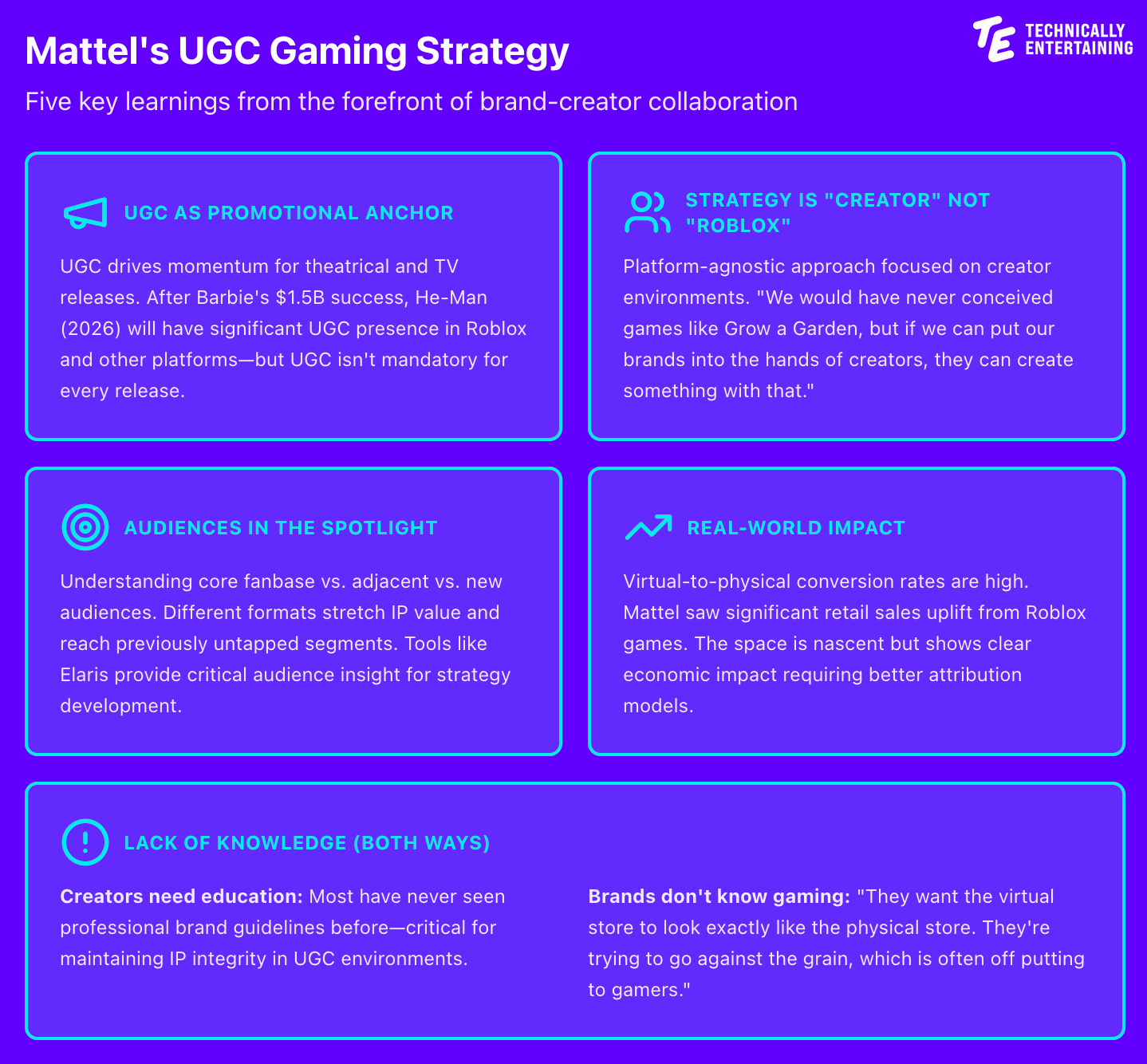
Real-world impact. Mattel had commissioned research that confirmed a key insight I shared in my book Press Play: the virtual-to-physical conversion rate for players making a purchase in a game and then proceeding to make the identical purchase for the physical item is high. Mattel saw a significant uplift in retail sales from its Roblox game, but overall this space is nascent and needs a lot more science to inform the necessary attribution models.
Lack of knowledge. This goes both ways. On the one hand, creators need more education regarding the guidelines that come with using a specific IP as most of the creators have never seen professional brand guidelines before, a crucial aspect that Overwolf and its CMO Shahar Sorek emphasized. He also called out the second side of the equation that caused me to start writing my book almost four years ago and that is still the biggest roadblock in getting brands to shift their budgets towards gaming:
“Brands don’t know gaming. They want the virtual store in the game to look exactly like the physical store. They’re trying to go against the grain, which is often off putting to gamers.”
That’s when these experiences are perceived as inauthentic, which often causes more harm than not having integrated with a game in the first place.
The New Hollywood Playbook
All of the events in and around Los Angeles demonstrated one thing very clearly. The world of entertainment will never be the same again and what used to define Hollywood and its players at its very core will look radically different in 2026 and beyond.
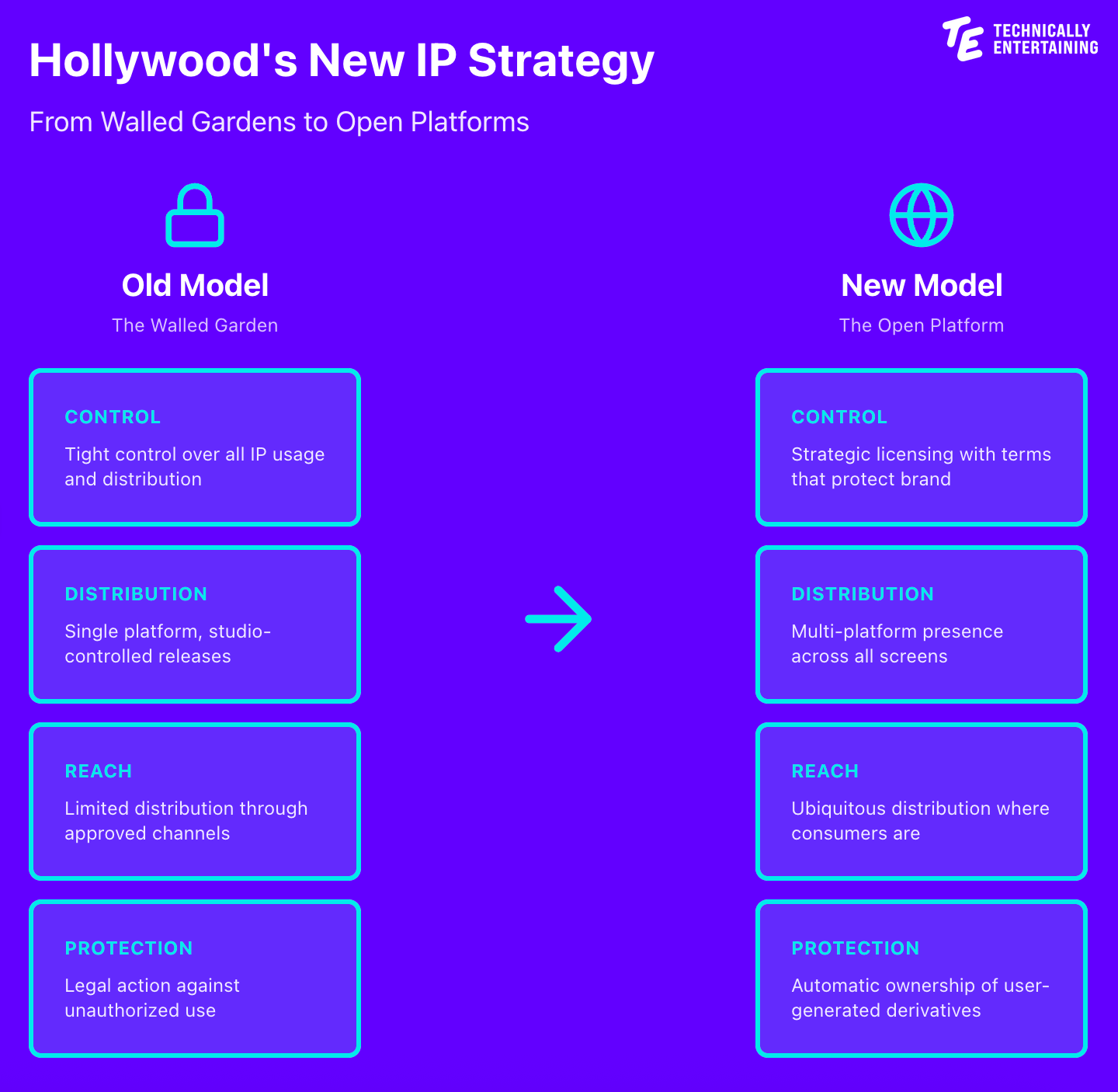
It’s no longer about being able to produce and release great entertainment content. That has become table stakes. The new competitive advantage is the ability to integrate technology into your content stack, and leverage video games as well as AI to shape your IP to all the different media formats and screens that exist in order to accomplish one overarching goal.
To meet consumers where they are.
The year is winding down but we aren’t slowing down one bit. Paramount-Skydance’s gaming strategy, the major headlines of 2025, predictions for 2026, and musings on AI and the data we’re training intelligence on. Be sure to subscribe below and spread the word with your friends and colleagues you know would enjoy Technically Entertaining.