


Dear Readers,
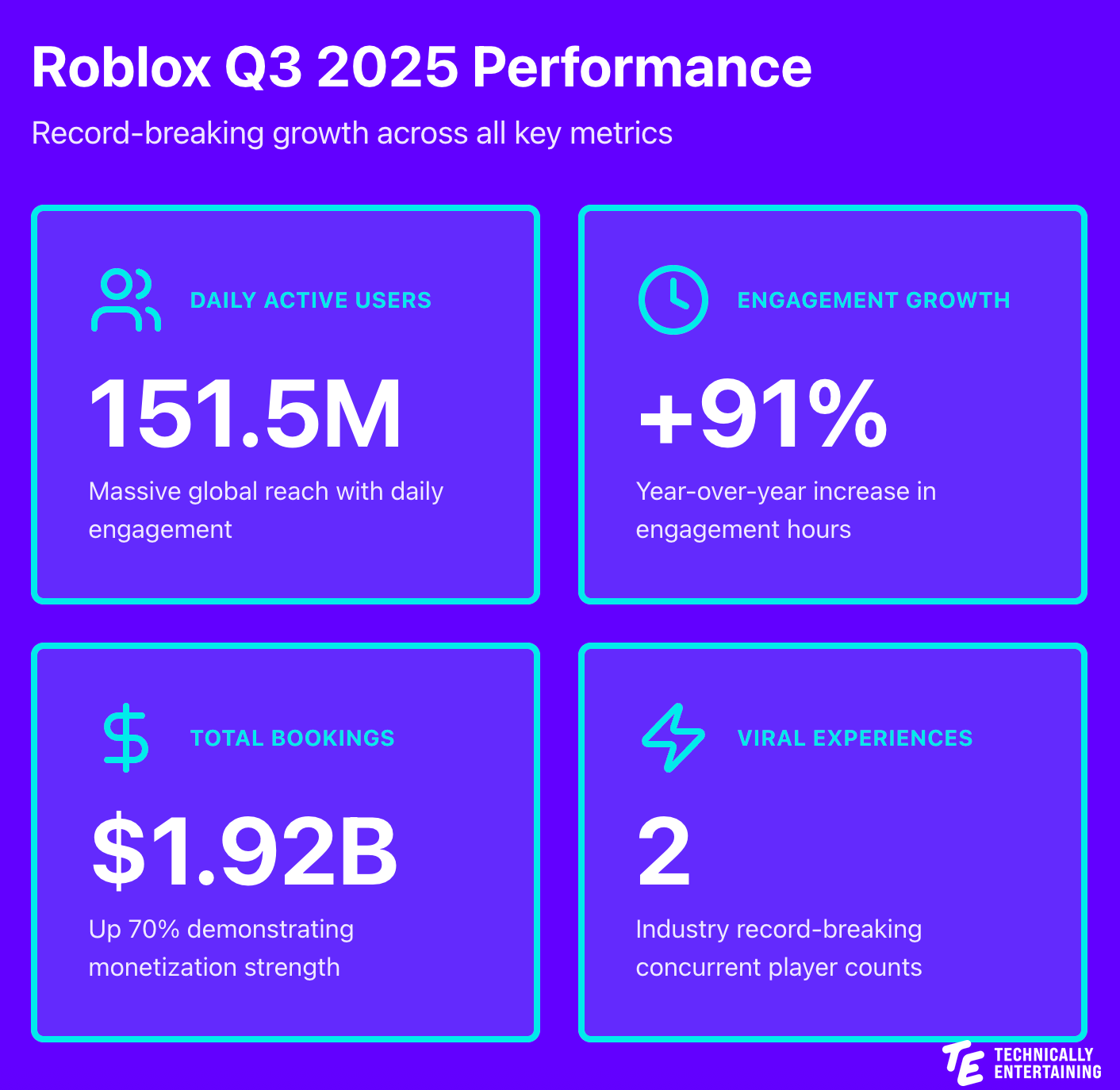
Roblox reported Q3 2025 earnings last week that should have every Hollywood executive paying attention. Revenue jumped 48% to $1.36 billion, bookings surged 70% to $1.92 billion, and daily active users hit 151.5 million. Most tellingly, engagement hours skyrocketed 91% year-over-year.
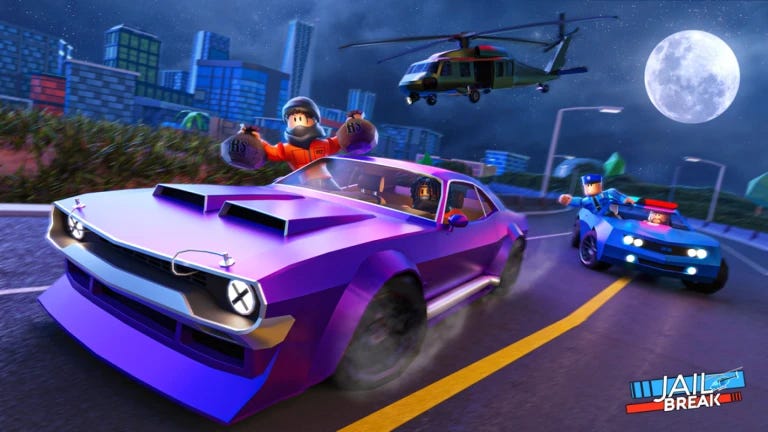
But the real headline came days later: Wind Sun Sky announced they’re adapting Jailbreak, one of Roblox’s most popular experiences with over 7.6 billion gameplays, into an animated feature film titled “Jailbreak: Rising City.” This isn’t a one-off project—it’s positioned as the potential start of a franchise including an animated series and shorts.
This is the moment Hollywood’s relationship with Roblox fundamentally shifts. While earnings calls buried the success of viral experiences like “Grow a Garden” and “Steal a Brainrot”—each setting industry records for concurrent players—the Jailbreak announcement proves that Roblox isn’t just a gaming platform. It’s Hollywood’s new IP factory, and the studios that recognize this first will have an enormous competitive advantage.
The Traditional IP Development Model is Broken
Hollywood’s IP development process is expensive, slow, and increasingly ineffective. According to The Hollywood Reporter’s production cost analysis, the average studio film costs $65 million to produce, with another $35 million in marketing. Big-budget tentpoles routinely exceed $200 million in production costs alone.
The development timeline is even more brutal. From concept to screen typically takes 3-5 years for feature films and 2-3 years for television series. Studios invest millions in script development, pilots, test screenings, and market research trying to predict what audiences will want years in the future.
The failure rate is catastrophic. Parrot Analytics’ Content Valuation Report 2024 shows that 67% of original scripted series fail to recoup their production costs through initial release windows. For films, Box Office Mojo’s analysis indicates that only about 20% of theatrical releases achieve profitability when accounting for full production and marketing costs.
Studios are essentially making expensive bets based on limited market research, hoping that audiences in 3-5 years will care about concepts developed today. It’s a model built for a different era, and it’s failing spectacularly.
Roblox: 151.5 Million Daily Focus Group Participants
Now consider Roblox’s model. The platform hosts over 70 million creator-developed experiences according to Roblox’s 2024 investor presentation. These experiences compete for attention from 151.5 million daily active users who collectively spent 91% more engagement hours in Q3 2025 than the previous year.
Every single one of those 70+ million experiences is a hypothesis about what entertains people. The ones that succeed do so because they’ve organically captured genuine consumer interest. There’s no studio executive greenlighting projects based on gut instinct or committee consensus—just pure market validation through user behavior.
When “Grow a Garden” and “Steal a Brainrot” set industry records for concurrent players, they proved something that Hollywood can only dream of: millions of people voluntarily choosing to engage with these entertainment concepts simultaneously, sustaining that engagement over time, and spreading those experiences through organic word-of-mouth.
The economics are transformational. While Hollywood spends $65+ million developing a film that might flop, Roblox creators develop experiences for thousands or tens of thousands of dollars. The platform’s engagement metrics provide real-time feedback about what’s working, allowing rapid iteration and improvement. Successful concepts generate revenue through Roblox’s economy while proving their entertainment value.
The Gaming-to-Hollywood Pipeline That Already Works
Hollywood is finally recognizing games as viable IP sources, but they’re approaching it backwards. Studios are licensing established game franchises—The Last of Us, Fallout, The Super Mario Bros. Movie—that already have decades of consumer validation and built-in audiences.
These adaptations work because the entertainment value has been proven through years of player engagement. The Last of Us generated over 20 million players across its franchise. Fallout has sold over 35 million units across multiple titles. Super Mario is one of the most recognized characters globally.
But this approach has limitations. Studios are licensing IP after it’s already proven, meaning they’re paying premium prices for established franchises. They’re also competing against other studios for the same limited pool of proven gaming IP.
The success metrics are impressive when executed well. HBO’s The Last of Us averaged 32 million viewers per episode in its first season according to Warner Bros Discovery’s reporting. Amazon’s Fallout reached 65 million viewers in its first 16 days per Amazon MGM Studios. The Super Mario Bros. Movie generated $1.36 billion at the global box office.
But here’s what Hollywood misses: by the time they’re licensing these franchises, the IP discovery and validation has already happened. They’re paying for proven concepts rather than discovering them early.
The Jailbreak Proof Point: 7.6 Billion Gameplays Can’t Be Wrong
The Jailbreak announcement isn’t just another game-to-film adaptation—it’s validation of the thesis that Roblox experiences represent pre-tested entertainment franchises.
Consider what 7.6 billion gameplays actually means. That’s not passive views or algorithmic impressions—that’s 7.6 billion times someone actively chose to engage with this specific entertainment experience. For context, the entire Marvel Cinematic Universe has sold approximately 2 billion tickets across all theatrical releases combined.
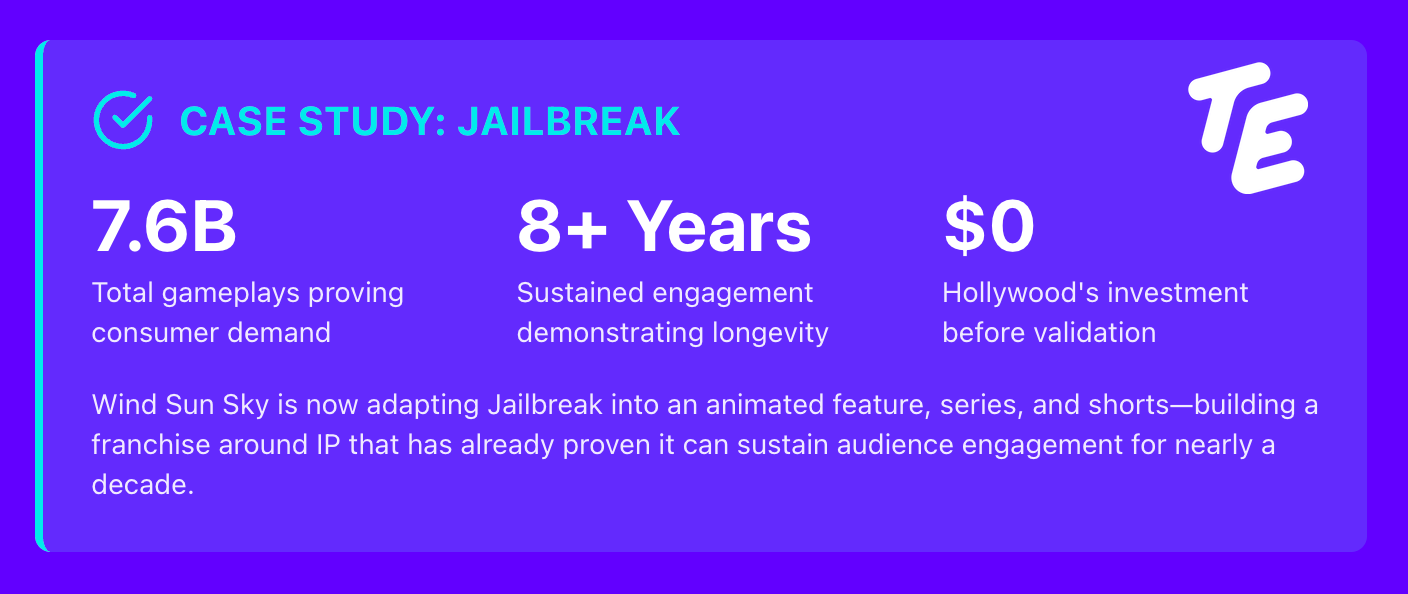
Jailbreak has generated more active engagement than the entire MCU, and it did so organically through Roblox’s platform without marketing budgets or theatrical distribution. The experience has been live since 2017, meaning it has sustained player interest for over eight years—longer than most Hollywood franchises maintain cultural relevance.
Wind Sun Sky’s decision to develop “Jailbreak: Rising City” as an animated feature with franchise potential (including series and shorts) demonstrates sophisticated understanding of the opportunity. They’re not just making a one-off film—they’re building a transmedia franchise around IP that has already proven it can sustain audience engagement for years.
This is the model Hollywood should be following at scale: identify Roblox experiences with billions of gameplays, partner with creators, and develop franchise ecosystems around concepts that have already passed the most rigorous market validation test possible.
Why Roblox is Different: Real-Time IP Discovery
Roblox represents something fundamentally different from traditional gaming IP. Rather than licensing an established franchise like Mario or Fallout, studios could be monitoring Roblox as a real-time focus group revealing which entertainment concepts are organically capturing mass attention.
Consider the metrics Roblox reported for Q3 2025:
151.5 million daily active users
91% increase in engagement hours year-over-year
$1.92 billion in bookings (up 70%)
Two viral experiences setting industry records for concurrent players
These numbers represent an unprecedented entertainment testing ground. Roblox creators are continuously experimenting with new concepts, mechanics, narratives, and worlds. The platform’s algorithm and user behavior immediately surface what’s resonating. Successful experiences generate millions of engagement hours, proving entertainment value at massive scale.
The viral hits “Grow a Garden” and “Steal a Brainrot” demonstrated something crucial: entertainment concepts can go from unknown to industry-record-breaking engagement in weeks or months, not years. These experiences proved consumer demand through organic growth, not marketing budgets.
For Hollywood, this should be treasure trove of market intelligence. Instead of spending millions on script development and market research, studios could identify Roblox experiences that have already proven they can capture and sustain audience attention at scale.
The Self-Reinforcing Flywheel: Games and Entertainment Elevate Each Other
The Jailbreak adaptation isn’t just about Hollywood discovering Roblox IP—it’s about recognizing that gaming IP and entertainment IP are no longer separate categories. They’re interconnected worlds that amplify each other’s success in ways traditional media never could.
The data proves this reinforcement pattern is real and powerful. According to Ampere Analysis data on the Minecraft movie, daily active players jumped 9% on Saturday after the film’s theatrical release and 17% on Sunday. For a game with 170 million monthly active users, driving double-digit growth across consecutive weeks is extraordinary.
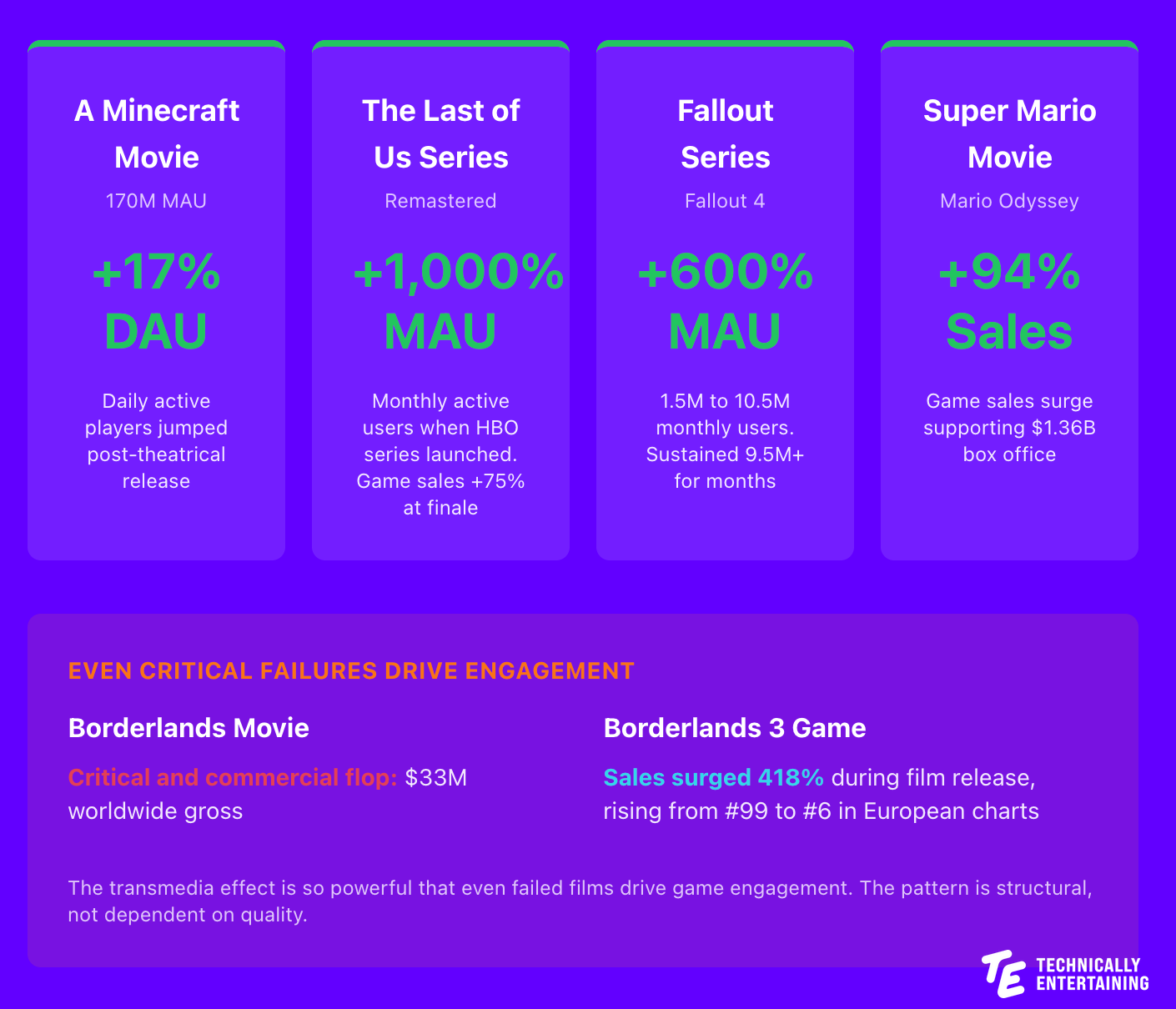
But Minecraft isn’t an outlier—it’s the pattern:
The Last of Us (HBO) drove 1,000% month-over-month growth in monthly active users for The Last of Us Remastered when the series launched in January 2023. The game maintained elevated engagement for months, with sales jumping 75% at the series finale as viewers turned to the game after finishing the show.
Fallout (Amazon Prime) generated even more dramatic results. When the show released to 100 million viewers, Fallout 4 saw monthly active users surge from 1.5 million to 10.5 million—a nearly 600% increase. The game maintained over 9.5 million monthly users for months after the show’s release, and European sales exceeded half a million units in April alone, up 345% compared to pre-show levels.
Super Mario Bros Movie demonstrated the pattern works in reverse. The film’s $1.36 billion global box office was supported by Nintendo’s strategic game promotions. Mario Kart 8 Deluxe sales rose 25% in March and another 2% in April. Super Mario Odyssey jumped 94% from February to March, then another 20% in April.
Even critical failures show the pattern. The Borderlands movie flopped spectacularly with just $33 million worldwide gross, yet Borderlands 3 game sales surged 418% during the film’s release window, rising from No.99 to No.6 in European charts.
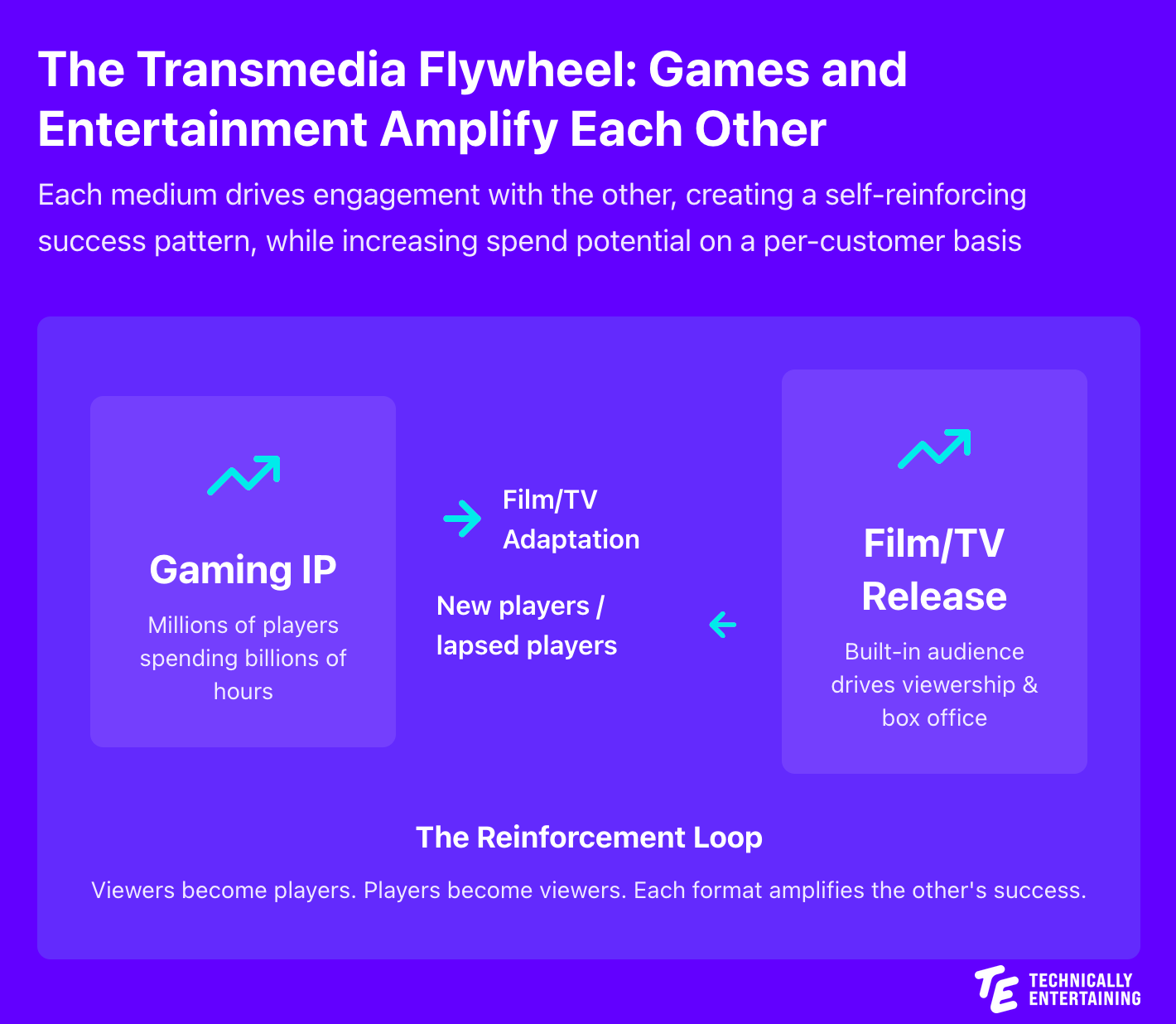
This isn’t simply cross-promotion—it’s a fundamental shift in how entertainment IP works. Gaming experiences and film/TV adaptations create reinforcing loops where each medium drives engagement with the other. Viewers want to inhabit the worlds they’ve watched. Players want to see their favorite games realized in new formats.
For Roblox, this pattern is crucial. When Jailbreak becomes a film franchise, those 7.6 billion gameplays represent not just proof of concept but a massive built-in audience that will drive theatrical attendance, streaming viewership, and merchandise sales. Simultaneously, the film will introduce Jailbreak to audiences who don’t play Roblox, driving new players to the experience and creating additional engagement hours on the platform.
This flywheel effect transforms gaming IP from a licensing opportunity into a transmedia ecosystem where each format amplifies the others’ success.
Why This Matters for Brands: Gaming as Cultural Relevance Engine
The game-to-entertainment flywheel creates a strategic imperative for brands that most CMOs are still missing: gaming isn’t just another marketing channel—it’s the entry point to transmedia cultural relevance.
Consider the engagement numbers that should have every CMO’s attention. Roblox’s 151.5 million daily active users spent enough time on the platform to drive 91% year-over-year growth in engagement hours. That’s not passive viewing—that’s active participation in entertainment experiences. When Fallout 4 went from 1.5 million to 10.5 million monthly active users during the TV show’s run, those weren’t casual viewers. They were deeply engaged players spending hours inhabiting that world.
These engagement levels dwarf traditional advertising. The average social media post gets 1.3 seconds of engagement. A successful Roblox experience keeps users engaged for hours. When The Last of Us drove 1,000% growth in monthly active users, each of those players spent an average of 15-20 hours completing the game—not watching a 30-second ad or scrolling past a sponsored post.
But here’s the strategic opportunity brands are missing: when a brand integrates authentically into a gaming experience that becomes broader entertainment IP, the brand grows in cultural relevance alongside the IP itself.
Imagine a brand that had integrated into Jailbreak years ago when it was “just” a Roblox experience. That brand would have reached players across 7.6 billion gameplays, building organic association with the IP. Now, as Jailbreak expands into film, animated series, and shorts, that brand relationship extends to theatrical audiences, streaming viewers, and merchandise buyers—all while maintaining authenticity because the brand was part of the original gaming experience.
This is fundamentally different from traditional sponsorship or product placement. Brands aren’t buying their way into a finished product—they’re becoming part of entertainment worlds that audiences actively choose to inhabit for hours at a time. When those worlds expand across media formats through the reinforcement flywheel, brand presence scales organically rather than through additional media buys.
The economic case is compelling. Roblox’s $6.57-6.62 billion in projected 2025 bookings represents users voluntarily spending money within these experiences. Brands that establish authentic presence in successful Roblox experiences gain access to this engaged audience, then benefit when those experiences become films, TV shows, and merchandise franchises.
For CMOs, the strategic question isn’t whether to invest in gaming—it’s whether to invest early in gaming experiences that could become the next transmedia franchise. The brands that figure out how to identify and authentically integrate into tomorrow’s Jailbreak will gain cultural relevance that compounds as those IPs expand across entertainment formats.
The Economic Arbitrage Opportunity
Compare this to Hollywood’s economics:
Average film development: $5-10 million before production
Average film production: $65 million
Average marketing: $35 million
Total investment: $105-110 million per film
Success rate: ~20% achieve profitability
Meanwhile, successful Roblox experiences:
Development cost: $10,000-$100,000 typically
User acquisition cost: $0 (organic discovery through platform)
Market validation: Real-time through engagement metrics
Revenue generation: Immediate through Roblox economy
Studios could identify proven Roblox concepts, acquire adaptation rights for relatively modest sums, and develop them into films or series with the confidence that comes from knowing millions of people have already voluntarily engaged with the core concept for hours.
Creator Games is a company that is at the forefront of this development, having identified Roblox’s IP factory potential. The company uses a unique set of algorithms to identify future Jailbreak opportunities long before they become obvious - and hence more expensive to invest in or acquire.
What Hollywood Should Do (And Some Are Starting To)
The Jailbreak adaptation proves the model works. Wind Sun Sky recognized that 7.6 billion gameplays represent more market validation than any Hollywood market research could provide. They’re building a franchise around IP that has already demonstrated multi-year staying power with global audiences.
The strategic move for forward-thinking studios is now obvious: establish Roblox monitoring teams that track engagement metrics, identify breakout experiences, and move quickly to secure adaptation rights before concepts become too expensive or competitive.
This would look like:
Dedicated teams tracking Roblox’s trending experiences and engagement metrics
Relationship-building with successful Roblox creators
Fast-track development processes for adapting proven concepts
Revenue-sharing models that incentivize Roblox creators to partner with studios
Netflix has already started moving in this direction, partnering with Roblox creators to develop experiences based on Stranger Things and other Netflix IP. But they’re approaching it backwards—using Roblox to promote existing IP rather than discovering new IP through Roblox the way Wind Sun Sky is doing with Jailbreak.
The real opportunity is using Roblox as an IP discovery engine, not just a marketing platform. Find the experiences that are organically generating billions of gameplays, partner with their creators, and adapt those concepts for film and television while the consumer validation is fresh.
The Obstacles to This Working
Of course, Hollywood won’t embrace this easily. The industry has structural and cultural barriers that make radical strategy shifts difficult:
Creative Resistance
Writers, directors, and producers may resist adapting “game concepts” as beneath them creatively. The industry still largely views games as derivative of “real” entertainment rather than recognizing them as legitimate creative expressions.
Rights Complexity
Roblox experiences often incorporate elements from various sources, creating potential rights issues for adaptation. Untangling what’s original versus borrowed can be complicated.
Translation Challenges
Not every successful Roblox experience translates to passive viewing. Interactive engagement is fundamentally different from watching a screen, and what works in one medium may not work in another.
Studio Inertia
Hollywood moves slowly. By the time studios identify a hot Roblox experience, secure rights, develop a script, greenlight production, and release the adaptation, the cultural moment may have passed.
But the biggest obstacle is mindset. Studios are structured to develop IP internally or license established franchises, not to monitor emergent entertainment concepts on gaming platforms and move quickly to secure adaptation rights.
The Inevitable Future
The Jailbreak adaptation makes the future clear. Roblox isn’t just a gaming platform—it’s an entertainment laboratory continuously testing thousands of concepts with 151.5 million daily users. When an experience generates 7.6 billion gameplays, it has passed a validation test more rigorous than any Hollywood market research could provide.
The platform’s Q3 2025 results reinforce this notion. It isn’t speculative growth—it’s proven consumer spending on entertainment experiences that are demonstrating their value in real-time.
Wind Sun Sky’s move to adapt Jailbreak into a franchise demonstrates the playbook other studios should follow. They identified IP with billions of engagements, partnered with the creators, and are building a transmedia ecosystem around a concept that has already sustained audience interest for eight years.
The question isn’t whether Hollywood will treat Roblox as an IP factory. The question is which studios will recognize this opportunity next and build the processes to capitalize on it systematically rather than opportunistically - and create an enormous competitive advantage.
The intersection of gaming platforms and traditional entertainment continues to reshape how IP is discovered and developed. Subscribe to Technically Entertaining for ongoing analysis of how these dynamics are transforming Hollywood’s and what brands need to do to capitalize on these shifts.