


The single most useful thing I heard about video game Skate this year didn’t come from a brand pitch deck or an earnings call. It came from a recent conversation with Pete Hawley, the General Manager at EA overseeing the development of the franchise.
His framing of where Skate sits in the market is the reason this piece exists. Skate is more grown up than Roblox and more laid back than Fortnite. Inside the game you can have fun and hang out with your friends, and you do not need a gun or anything to blow up to do it. That is rarer than it sounds, and it changes the brand opportunity completely.
This is Part 3 of the platform concentration series. In Part 2 I placed Skate in the top-left of the matrix: niche scale, very high cultural specificity. This week I want to make the affirmative case for why brand teams should consider that quadrant seriously, and what the first integrations are already telling us.
The Position Nobody Else Has
The positioning insight Hawley dropped is worth unpacking, because it identifies a gap the two dominant platforms have left uncovered.
Roblox is built for play that skews younger, even though the platform is desperately trying to age up (though it remains to be seen if their efforts bare fruit). Fortnite, despite its cultural curation, is fundamentally a shooter. Both platforms serve their audiences well. They also leave a space in the middle empty. Players who have aged out of Roblox and don’t want a combat-driven experience have, until recently, had no obvious next stop in immersive gaming.
Skate fills that gap from both directions. It functions as the intermediate step between Roblox and Fortnite for younger players growing into more sophisticated experiences, and as the off-ramp for Fortnite players who want a lower-intensity place to hang out with friends. The activity inside the game is rooted in something physical, something that exists in the real world, and something built around skill and self-expression rather than survival.
That positioning is the structural reason the brand opportunity in Skate behaves differently from the brand opportunity inside the two dominant platforms.
Previously released posts in this special series


Grounded in Everyday Life
The deeper reason Skate’s positioning matters for brand integration is that the in-game activities map directly to real-world habits.
Roblox and Fortnite, by design, transport players into invented worlds with invented physics, invented economies, and invented logic. Brand integrations inside those worlds have to play by the world’s rules. A real-world brand showing up in a fantasy game has to translate itself into the fantasy.
Skate works the opposite way. Players are skating in cities that feel like cities, past storefronts that feel like storefronts, in clothing and gear that the same person would buy in real life. The in-game footwear matters because real-world footwear matters in the culture. The boards matter because boards matter. The fashion matters because fashion is half the point.
This is the substrate brands have been looking for. An immersive game where brand integration does not require the brand to become something it isn’t. A Vans skate shoe in Skate is a Vans skate shoe. A Nike SB Dunk is a Nike SB Dunk. The fictional layer is minimal, and the everyday-life layer is the dominant frame.
The Nike SB Blueprint
The first proof point of this thesis is already live. From April 14 to May 5, 2026, EA ran a Nike SB Pop-Up Event in Skate, the most extensive brand collaboration the game has attempted to date.
The event delivered a Nike SB park takeover, a long-requested night-skating mode called Grom at Night, a series of challenges modeled on famous Nike SB skate videos, and a deep cosmetic catalog: the Nike SB Dunk Low, Dunk Low Pro, Dunk High, Zoom Blazer Mid, and over eight new footwear styles plus Nike SB hoodies, jorts, headwear, and bottoms. Players could earn select items by completing event challenges and purchase the rest from the in-game store.
The significant part of the Nike integration is not the cosmetics. It’s the structure. Nike is not parachuting into a fantasy game and asking players to suspend disbelief. The audience is already inside a skate experience where Nike SB is part of the cultural language. The integration meets players where they already are. That is exactly the authentic-fit dynamic Roblox and Fortnite struggle to manufacture, and it is the model for what comes next.
What Comes Next: Brands as Functional Roles
In my conversation with Hawley, one of the more compelling future directions the Skate team is exploring is in-game jobs. Players in Skate could take on roles that match the lived texture of a real city. One example currently being discussed: a delivery driver who brings packages to other players’ doorsteps.
Sit with that for a moment from a brand strategist’s perspective. If players can become delivery drivers in Skate, FedEx or UPS should be in the room before that mechanic ships. Every player who takes on the role becomes a moving FedEx or UPS billboard, in full uniform, doing the job the brand actually does, inside a city full of other players who see it dozens of times per session. That’s not a sponsored skin. That’s functional brand integration where the brand’s real-world category and the in-game role are the same thing.
The list extends quickly. A coffee shop run opens the door for Starbucks or Blue Bottle. A bike messenger gig invites cycling brands. A photo run for a magazine maps cleanly onto Thrasher. The principle is the same each time: the game’s everyday-life substrate gives brands a way to integrate as themselves, doing what they do in the real world, rather than as an awkward fantasy stand-in.
Skateboarding’s Concentric Circles
The other reason this opportunity is larger than the raw player numbers suggest is the cultural surface area of skateboarding itself.
Industry estimates put the global active skateboarding population at roughly 62 million people. That is a meaningful base on its own. It also dramatically undersells the audience for a brand integrating into skate culture, because skateboarding has been a cultural nucleus for fifty years with concentric circles of influence radiating outward into streetwear, music, fashion, art, film, and youth identity.
Louis Vuitton has put a skateboarder on its runways. Supreme built a billion-dollar brand on skate codes. Palace, Thrasher, Stüssy, Carhartt WIP, and Vans owe a meaningful share of their cultural relevance to skateboarding’s gravity. That radiating quality is why a brand entering Skate reaches dramatically more than the active participants. It reaches the streetwear consumer who has never touched a board. It reaches the fashion shopper who saw Vans Old Skools come back into style. It reaches the music fan whose favorite act references skate culture in its visuals. The audience is many multiples larger than the skater count, and it is the audience most brands actually want.
What the Data Says About Skate’s Audience
To pressure-test the concentric-circles argument, I recently ran a research pass on the global skateboarding fanbase using Elaris, an audience-intelligence platform. The fanbase segments cleanly into four core psychological personas. The more interesting finding for brand leaders sits in the cross-category cultural affinities of the largest segment.
The top 20 films and series this segment loves span Stranger Things, Rick and Morty, Star Wars, Breaking Bad, Naruto, The Office, The Vampire Diaries, Family Guy, Peaky Blinders, and The Flash. The breadth is the point. This is an audience with mainstream entertainment appetite across prestige drama, sitcom comfort food, anime, fantasy IP, and global phenomena.
The top 20 brands the same segment loves include Nike, Adidas, Vans, Gucci, Converse, Samsung, Nintendo, Volcom, Coca-Cola, Walmart, Google, and Target. Read that list again. Skate-native footwear, luxury fashion, consumer electronics, gaming hardware, beverages, fast food, and big-box retail all coexist as top-tier brand loves for the same audience.
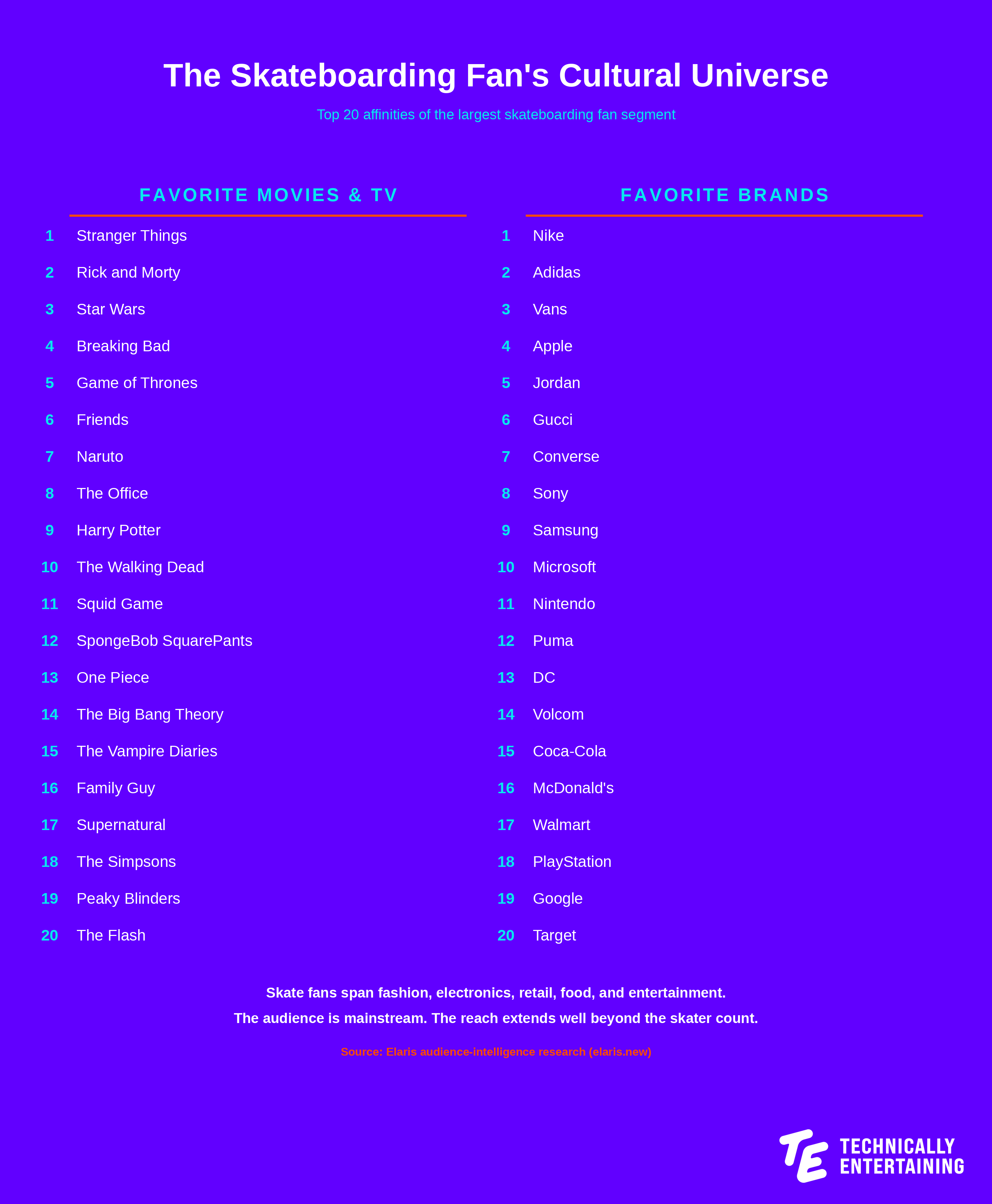
This is the concentric-circles argument in data. The skateboarding fan is a mainstream entertainment consumer with broad brand affinities that span the entire consumer-spending landscape. The brand opportunity inside Skate is for far more than the obvious skate-adjacent brands. It is for anyone whose target audience overlaps with this profile, which is most of the Fortune 500.
What This Means for Brand Leaders in 2026
Skate is not a Roblox-scale platform, and it never will be. It also does not need to be. The case for putting real strategy behind a Skate integration rests on three factors that no other immersive game on the matrix combines.
First, the structural positioning gap. Skate sits between the two dominant platforms on tone, intensity, and life-stage, and that gap is genuinely empty everywhere else in immersive gaming today.
Second, the everyday-life substrate. The mechanics of Skate let brands integrate as themselves, doing the real-world thing they actually do, rather than as fantasy stand-ins translated through a foreign world’s rules.
Third, the cultural surface area of skateboarding itself. Concentric circles of streetwear, music, and fashion give even smaller-scale activations a reach that no Roblox awareness play can replicate, and Elaris’s data shows the audience profile extends across the full consumer-brand landscape.
The Nike SB pop-up event is the early proof. What the Skate team is contemplating with in-game jobs is the more interesting frontier, because that is where the brand category and the in-game function start to align in ways that do not exist anywhere else in immersive gaming today.
Next week closes the series with a deeper conversation with Pete Hawley, General Manager at EA overseeing Skate, on how he and the team are thinking about the brand opportunity, what they want from partners, and where the franchise goes from here. You don’t want to miss it.
Which brand category in your portfolio could integrate authentically into Skate’s everyday-life substrate, and which still depends on fantasy-world translation to land in Roblox or Fortnite? Let me know in the comments.
Technically Entertaining is the publication for marketing, brand, and strategy leaders navigating the intersection of gaming, technology, and entertainment. Subscribe to get next week’s closing interview with Pete Hawley, General Manager at EA overseeing the Skate franchise.