


Dear Readers,
When was the last time you yelled “Uno!” across the dinner table? For me that was just a few days ago when I played a couple of rounds of the card game with my daughter. If it’s up to toy maker Mattel, we’ll all be shouting “Uno!” a lot more soon - while playing on our mobile phones.
Mattel made a an important move two weeks when it announced that it had acquired the remaining 50% of its mobile gaming joint venture Mattel163 from NetEase. While the amount Mattel needed to spend ($159 million) pales in comparison to the overall revenue the company makes, it marks an important step in its transformation towards an immersive entertainment company.
“Our vision is to extend physical play to the virtual world by creating digital experiences and games based on Mattel IP that drive sustained engagement for fans of all ages.”
- Ynon Kreiz, Chairman and CEO of Mattel
“Our strategy isn’t Roblox. Our strategy is creator.” When Mattel VP Marcus Liassides said this, he wasn’t being clever. He was articulating something most legacy brands still haven’t figured out. Mattel’s gaming strategy isn’t about picking the hot platform of the moment and throwing money at it. It’s about understanding that gaming is no longer a channel. It’s infrastructure. And if you’re going to survive as a consumer brand in 2026, you better figure out how to make gaming integral to everything you do.
Mattel did. And the transformation from a struggling toy manufacturer to an IP-driven entertainment powerhouse is one of the most underappreciated strategic pivots in modern business. This isn’t a story about a company that “went digital.” It’s a story about a company that fundamentally reimagined what it sells, who it sells to, and how it captures value in a world where screens have replaced playrooms.
The Existential Crisis: Why Mattel Had to Change or Die
Let’s rewind to 2017. Mattel was a mess. The company was defined by its ability to design, manufacture, and distribute physical toys. That model worked great for seven decades. It stopped working when kids started spending more time on iPads than with action figures.
The numbers tell the story. Traditional retail was collapsing. Toys “R” Us filed for bankruptcy. Kids were choosing Fortnite over Fisher-Price. And Mattel’s leadership was churning through CEOs like they were disposable. The company was stuck in a death spiral: declining sales leading to cost cuts leading to less innovation leading to more declining sales.
More fundamentally, Mattel was operating under a fatal assumption: that it was a toy company that makes products. It wasn’t. It was a manager of franchises that happened to express those franchises as physical toys. That distinction might seem semantic. It’s not. It’s the difference between survival and obsolescence.
Enter Ynon Kreiz: The Media Executive Who Saw What Others Missed
When Ynon Kreiz became CEO in April 2018, he brought something Mattel desperately needed: a media perspective. Kreiz had run Maker Studios and Endemol Group. He understood that in the modern entertainment landscape, IP is currency. Distribution is table stakes. And the companies that win are the ones that can take a single franchise and stretch it across every possible medium where audiences live.
Kreiz looked at Mattel’s portfolio and saw what Wall Street couldn’t: Barbie, Hot Wheels, Fisher-Price, and Monster High weren’t declining toy lines. They were under-monetized entertainment franchises with decades of cultural equity and virtually no digital presence. The opportunity was staggering. The execution would be brutal.
The strategic pivot was clear. Mattel would stop being a manufacturing company and become an IP management company. Film, television, live events, music, and critically, digital gaming would become core pillars. Not nice-to-haves. Not experimental side projects. Core revenue drivers with dedicated investment and world-class execution.
Phase I: The Mobile Foundation (2018-2020)
Kreiz’s first move was the least sexy but most important: establish a beachhead in mobile gaming. In early 2018, Mattel formed a 50/50 joint venture with NetEase called Mattel163. The logic was simple. NetEase had world-class mobile development and publishing capabilities. Mattel had iconic card and board game IP that translated naturally to mobile. Together, they could build a portfolio that generated high-margin recurring revenue.
The results were immediate and dramatic. Uno! Mobile launched in 2018 and became a phenomenon. Not because it was innovative. Because it was Uno, executed flawlessly, available everywhere, with live-service mechanics that kept players coming back. Phase 10 and Skip-Bo followed, building out the casual card game vertical.
By 2020, Mattel163 had achieved 600% revenue growth. The joint venture attracted 20 million monthly active users and generated over 550 million downloads. More importantly, it proved that Mattel’s IP had digital elasticity. These weren’t just nostalgic adults playing digital versions of physical games. These were global audiences engaging with Mattel brands in new contexts.
The financial implications were profound. Mobile gaming offered significantly higher operating margins than physical toy manufacturing. It was less capital intensive. It wasn’t subject to seasonal fluctuations. And it provided first-party data that Mattel had never had access to in the traditional retail model. By 2022, Mattel163 was generating over $175 million in annual revenue and climbing.
Phase II: High-Fidelity Gaming and the Kidult Demographic (2021-2022)
Mobile established the floor. But to reach the “kidult” demographic, adult collectors and core gamers with nostalgic connections to Mattel brands, the company needed high-fidelity console and PC experiences. That meant partnering with real game developers who understood how to build premium titles.
In February 2021, Mattel announced a partnership with Milestone to create Hot Wheels Unleashed. This wasn’t a licensed cash-grab. This was a serious arcade racing game built in Unreal Engine with the production values to compete with established franchises. The game recreated the experience of racing die-cast cars on iconic orange plastic tracks, complete with a track builder and livery editor that let players customize everything.
The commercial success exceeded expectations. Hot Wheels Unleashed reached 1 million copies sold by December 2021, becoming the fastest-selling game in Milestone’s history. By April 2023, it had surpassed 2 million units sold and registered over 8 million players across all platforms, bolstered by inclusion in Xbox Game Pass and PlayStation Plus. The user community created over 1 million custom car designs and 350,000 original tracks.
This validated Kreiz’s strategy of working with world-class partners. Mattel didn’t need to build game studios from scratch. It needed to find the right developers for each franchise and ensure they had the resources and creative freedom to deliver quality. Hot Wheels Unleashed proved that toy-based games could be critically acclaimed and commercially successful when executed properly.
Phase III: The Barbie Phenomenon (2023-2024)
Then came 2023. The Barbie movie wasn’t just a box office success. It was the ultimate proof-of-concept for the “Barbie Playbook”, Mattel’s coordinated strategy to use major media events to drive engagement across every channel simultaneously.
The gaming component was critical. Mattel partnered with Gamefam to launch Barbie DreamHouse Tycoon on Roblox. The experience was designed to mirror the “Barbie Land” aesthetics of the film while using the popular tycoon mechanic where players build and manage their own environments.
The performance was staggering. Barbie DreamHouse Tycoon recorded over 3 million unique visits during beta. Following the official launch and strategic marketing tied to the movie release, the experience surpassed 29 million lifetime visits in weeks, eventually reaching close to 500 million visits. Players spent hours per session, with some reporting four-hour sessions to complete their DreamHouse builds.
This wasn’t just about reach. It was about understanding platform fit. Roblox’s user base skewed heavily toward Gen Z and Gen Alpha, exactly the audience Mattel needed to capture to secure its future. By creating an experience that felt native to Roblox while staying true to Barbie’s core play pattern of roleplaying and customization, Mattel demonstrated a sophisticated understanding of how IP translates across platforms.
The halo effect was immediate. Worldwide gross billings for the Dolls category surged by 29% in Q4 2023, driven by growth in Barbie, Disney Princess, and Monster High. More importantly, the digital-first engagement created a feedback loop. Data from the Roblox experience informed physical toy development, marketing strategies, and content creation. Mattel could now see in real-time which rooms, outfits, and activities resonated most with users.
But Mattel didn’t stop at Roblox. The company partnered with Xbox for a comprehensive Barbie campaign that included adding the pink 1956 Chevrolet Corvette and Ken’s 2022 GMC Hummer EV to Forza Horizon 5, creating custom Barbie DreamHouse-themed Xbox Series S consoles, and launching fashion-inspired controller faceplates. The integration was everywhere.
Phase IV: Full Control and the Shift to Self-Publishing (2025-2026)
By 2025, Mattel’s gaming strategy had matured to the point where the company sought greater operational control. The partnership model had worked. But partnerships mean sharing profits, sharing data, and compromising on strategic alignment.
On February 10, 2026, Mattel announced it would acquire NetEase’s 50% stake in Mattel163 for $159 million, valuing the total entity at $318 million. This was a watershed moment. By taking full ownership, Mattel would retain 100% of profits from titles like Uno! and Phase 10. More importantly, it brought several hundred specialized mobile game developers and digital marketing experts directly into the Mattel organization.
The acquisition was capital efficient. More than half of the purchase price was funded using Mattel’s existing share of the joint venture’s cash reserves. And the strategic rationale was clear: full control allowed Mattel to align digital game releases more closely with its broader product roadmap and theatrical slate, including the upcoming Masters of the Universe film.
In tandem with the acquisition, Mattel announced plans to become a first-party publisher, with its first two self-published mobile titles launching in 2026. This marked the completion of the transformation from licensing partner to active participant to full owner of its gaming destiny.
Mattel also deepened its commitment to user-generated content platforms. In October 2025, the company expanded its Roblox partnership to introduce a new slate of standalone titles, starting with a major Monster High experience. But the real innovation was the Roblox License Manager, which allowed independent developers to pitch and create officially licensed experiences using Mattel assets.
This was a radical shift in corporate IP philosophy. Historically, large corporations protect their trademarks zealously. Mattel chose to democratize its IP, turning millions of Roblox creators into an extension of its development team. By providing official assets through a centralized oversight system, Mattel scaled its digital footprint while maintaining brand integrity.
The Financial Transformation: From Manufacturing to High-Margin Media
The impact on Mattel’s financial profile has been profound. While net sales have remained relatively stable (around $5.4-5.5 billion from 2021-2024), the revenue mix has shifted dramatically toward high-margin digital income.
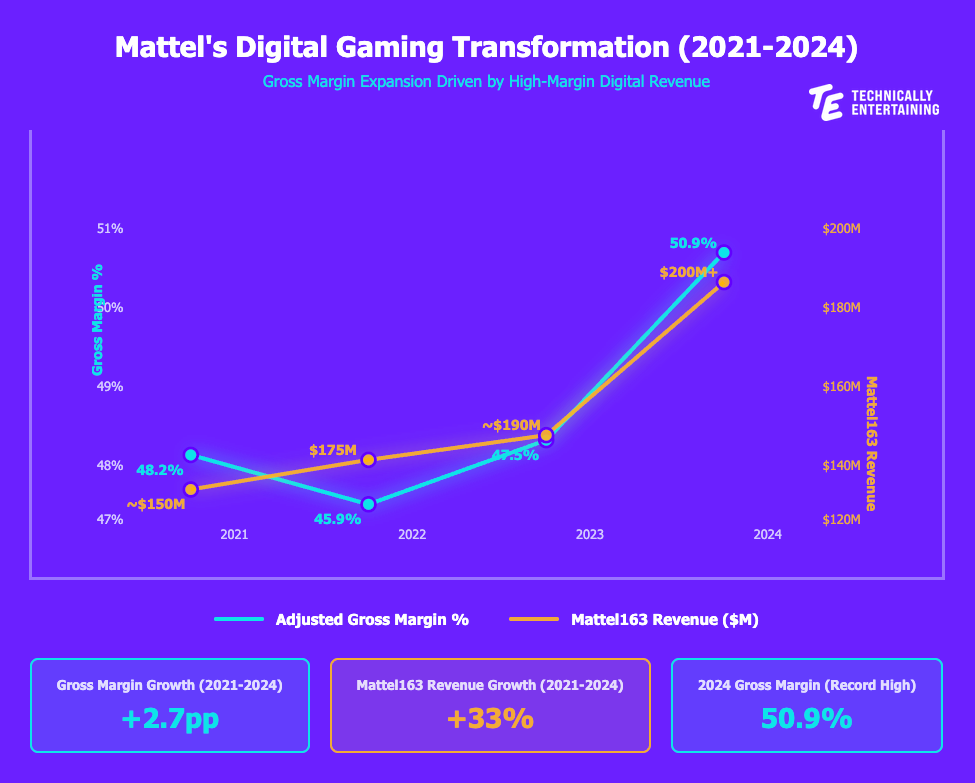
Mattel163 consistently exceeded targets, reaching over $200 million in revenue by 2024. Analysts estimated the fully-owned entity would contribute approximately $150 million in net sales in its first partial year of consolidation in 2026. More importantly, the gross margin story tells the tale. Mattel’s adjusted gross margin reached 50.9% in 2024, the strongest level in the company’s recent history. Digital gaming’s high-margin nature is a primary driver.
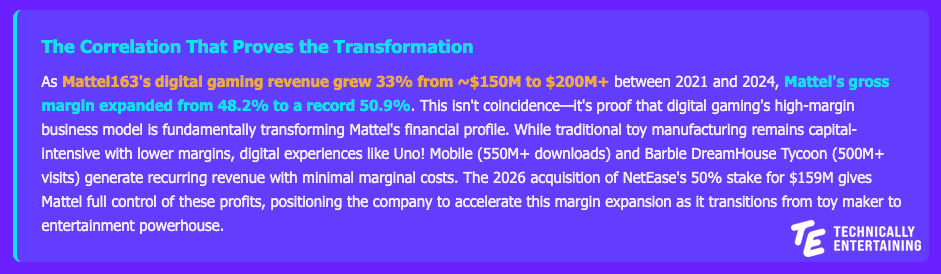
This matters because it changes the investment thesis. Mattel is no longer purely a manufacturing company subject to inventory risk and seasonal volatility. It’s a diversified entertainment company with recurring digital revenue streams that compound over time.
The Strategic Framework: What Mattel Got Right
Looking across the eight-year transformation, several strategic principles emerge that other legacy brands should study.
Platform Agnostic, Not Platform Dependent
When Marc Liassides said “our strategy is creator,” he was articulating a fundamental insight. Mattel doesn’t build for Roblox or Fortnite or mobile. It builds for wherever its audience is, using whatever platform best serves the core play pattern of each franchise. Barbie is about roleplaying and customization, so it thrives on Roblox. Hot Wheels is about speed and competition, so it thrives on console racing games. This platform flexibility prevents Mattel from being held hostage to any single distribution channel.
World-Class Partners Over In-House Hubris
Mattel recognized early that building game studios from scratch would be slow and expensive. Instead, it partnered with best-in-class developers: NetEase for mobile, Milestone for racing, Gamefam for UGC platforms. This allowed Mattel to move fast and learn from experts while maintaining creative control over how its IP was expressed.
Data-Driven Feedback Loops
The shift to digital gaming provided Mattel with unprecedented first-party data. Through games like Barbie DreamHouse Tycoon, the company can track precisely which elements resonate with users. This data now informs physical toy development, creating a virtuous cycle where digital engagement drives physical sales and vice versa.
The Barbie Playbook: Coordinated Transmedia Execution
The 2023 Barbie movie campaign demonstrated the power of synchronized execution across all channels. Film, gaming, physical products, and partnerships launched in coordinated waves that created cultural momentum. This wasn’t siloed marketing. It was orchestrated IP management where each channel amplified the others.
The Risks and What Could Still Go Wrong
Despite the progress, Mattel faces real challenges. In early 2026, the stock plummeted over 30% following a lackluster Q4 2025 report where revenue and earnings missed analyst estimates. This volatility underscores the high stakes of the transformation. Investors worry that weak performance in the traditional toy business can’t yet be fully offset by digital gains.
There’s also execution risk. Becoming a first-party publisher is hard. Mobile game publishing is brutally competitive. User acquisition costs are rising. The App Store top charts require $150 million just to break into the top 10 and $1 billion to stay there, according to Boston Consulting Group. Mattel plans to invest approximately $40 million in performance-based marketing for its digital games in 2026. That’s significant, but it may not be enough in a market where scale determines winners.
The UGC platform strategy also carries risk. By democratizing its IP through the Roblox License Manager, Mattel gains scale but loses some control. Quality varies. Brand safety becomes harder to manage. And if platforms like Roblox or Fortnite change their terms or lose relevance, Mattel’s investments could be stranded.
What This Means for Every Other Legacy Brand
Mattel’s transformation isn’t just a toy story. It’s the blueprint for how legacy consumer brands survive the shift to digital. The lessons are clear.
First, recognize that you’re not in the product business. You’re in the IP management business. Your brands have value beyond the physical goods you manufacture. The question is whether you’ll capture that value or let platforms and licensees take it.
Second, gaming isn’t a marketing channel. It’s infrastructure. If your customers, especially young ones, spend hours per day in gaming environments, you need a presence there that’s as sophisticated as your retail strategy. That means dedicated teams, real investment, and world-class execution.
Third, platform flexibility is survival. Don’t bet everything on one platform. Build a portfolio approach where you meet audiences wherever they are with experiences tailored to each environment’s unique characteristics.
Fourth, data is the moat. The real value of digital gaming isn’t just revenue. It’s the first-party data that creates feedback loops between digital and physical, allowing you to build better products and market more efficiently.
The Next Chapter
Mattel’s transformation from toy maker to entertainment company is far from complete. The company still generates the majority of its revenue from physical products. The digital segment, while growing, isn’t yet large enough to carry the business on its own. And the market remains skeptical, as evidenced by the stock volatility.
But the fundamentals are sound. Record gross margins. A massive digital player base across mobile, console, and UGC platforms. A robust pipeline of theatrical content (14 films in development) designed to create coordinated gaming moments. And most importantly, an organizational mindset that no longer sees plastic and pixels as separate categories but as different expressions of the same underlying franchises.
When Ynon Kreiz took over in 2018, Mattel was a manufacturing company in crisis. Eight years later, it’s an entertainment company with a gaming problem to solve: how to scale digital revenue fast enough to offset structural declines in traditional retail. The 2026 acquisition of Mattel163 and the shift to self-publishing suggest the company is serious about solving it.
Whether Mattel fully succeeds remains to be seen. But the strategy is right. The execution has been strong. And for every other legacy brand watching from the sidelines, wondering if they should “do gaming,” Mattel has provided the answer: you don’t have a choice. The only question is whether you’ll do it strategically or desperately.
Is your brand taking gaming seriously enough? Let me know in the comments.
We’ll be dissecting the transformational strategies of other brands and companies that use video games to future proof their businesses in upcoming posts. If there’s a company you think needs to be on our list, let us know below!