


“Our brands were out of position with where people wanted to play.”
- Chris Cocks, CEO Hasbro
Dear Readers,
When Chris Cocks said this after becoming Hasbro CEO in 2022, he wasn’t making excuses. He was diagnosing a terminal condition. Hasbro’s stock had crashed 70% from its pandemic peak. Traditional toy sales were in freefall. The $4 billion acquisition of Entertainment One, meant to vertically integrate film and TV production, had become a financial albatross. And the company that invented modern board gaming was watching its core business die in real time.
But Cocks had a secret weapon: Wizards of the Coast, the division Hasbro had quietly acquired in 1999 for what now looks like the deal of the century. The home of Magic: The Gathering and Dungeons & Dragons wasn’t just profitable. It was printing money at margins that would make software companies jealous. While physical toys struggled to break 5% operating margins, Wizards was running at 46%.
What happened next wasn’t a turnaround. It was a complete inversion of the business model. Hasbro didn’t save the toy company by making better toys. It killed the toy company and became a gaming company that happens to still make some toys on the side.
This is the story of how a 100-year-old manufacturer executed one of the most radical strategic pivots in consumer goods history. And why every other legacy brand should be paying very close attention.
The First Digital Disaster: When Hasbro Tried This Before and Failed
Hasbro’s current gaming dominance isn’t its first attempt at digital transformation. It’s actually the third. And the first two were spectacular failures that cost the company hundreds of millions of dollars and nearly two decades of wasted time.
In 1995, Hasbro launched Hasbro Interactive, a dedicated subsidiary to bring its board game portfolio to PC gaming. The strategy worked initially. Revenue grew 145% in 1997 by digitizing Monopoly, Scrabble, and Clue. Emboldened by early success, Hasbro went on an acquisition spree, buying Atari assets for $5 million, MicroProse for $70 million, and Avalon Hill for $6 million.
By 1998, Hasbro Interactive had become the third-largest video game publisher globally, with $196 million in revenue and $23 million in profit. It looked like the future. It was actually a house of cards.
The division had scaled too fast with too many concurrent projects and a bloating headcount. By 1999, despite revenue growth, it recorded a $74 million loss. When the dot-com bubble burst in 2000, Hasbro’s stock plummeted 70% and the company posted its first net loss in two decades. In January 2001, Hasbro sold the entire division to French publisher Infogrames for $100 million, ending its first gaming experiment in humiliating retreat.
The lesson learned was wrong. Instead of recognizing they’d executed poorly, Hasbro concluded that internal game development was too risky. For the next 20 years, they licensed everything to external partners like Electronic Arts and collected royalties. Safe. Low-risk. Low-reward. And completely irrelevant to where gaming was actually going.
The Silent Rise of Wizards: How D&D Saved Hasbro Without Anyone Noticing
While Hasbro was licensing Monopoly to EA and watching physical toy sales stagnate, something remarkable was happening inside Wizards of the Coast. The tabletop gaming division that Hasbro had acquired in 1999 was quietly building its own digital capabilities and proving that the company’s IP could thrive in interactive formats.
Magic: The Gathering Arena launched and immediately attracted millions of players who had never touched a physical card. Dungeons & Dragons, a 50-year-old tabletop role-playing game, was experiencing a cultural renaissance driven by streaming shows like Critical Role and digital tools that made the game accessible to new audiences.
By the mid-2010s, Wizards was contributing an estimated 20% of Hasbro’s total revenue but represented a much higher percentage of actual profit. The “omni-screen” strategy emerged, where leadership began to recognize that digital gaming wasn’t secondary to physical products. It was the primary engagement driver that actually made physical products relevant.
The COVID-19 pandemic made this undeniable. In Q2 2021, Wizards of the Coast and Digital Gaming revenue more than doubled as consumers flocked to Magic: The Gathering Arena and D&D digital toolsets during lockdowns. While physical retail was disrupted and film production shut down, digital gaming thrived.
But Hasbro’s leadership at the time, still committed to the “Brand Blueprint” strategy of vertical integration, spent $4 billion acquiring Entertainment One to control film and TV production. The logic was that owning the entire value chain from toys to movies would create sustainable competitive advantage. The reality was that high-capital film production with unpredictable returns was the exact opposite of what the business needed.
The Cocks Revolution: Killing the Old Hasbro to Save It
When Chris Cocks became CEO in early 2022, he came from inside Wizards of the Coast. He understood something the previous leadership didn’t: Hasbro wasn’t a toy company with a successful gaming division. It was a gaming company with a dying toy problem.
Cocks introduced “Blueprint 2.0,” a complete strategic reorientation around “fewer, bigger, better” brands and a shift of all investment toward digital and licensed gaming. The eOne acquisition was recognized as a mistake. The vertical integration dream was dead. Asset-light, high-margin digital gaming was the future.
The moves came fast and decisively. In April 2022, Hasbro acquired D&D Beyond from Fandom for $146.3 million. D&D Beyond had nearly 10 million registered users and was the essential digital companion for the tabletop game. By bringing it in-house, Hasbro secured direct customer relationships and eliminated royalty payments it had been making to Fandom. The acquisition was immediately accretive.
Then came the painful but necessary surgery. In August 2023, Hasbro sold the eOne film and TV business to Lionsgate for approximately $500 million, taking a massive loss on the original $4 billion investment. But the sale retired $400 million in floating-rate debt and freed Hasbro to transition to an asset-light entertainment model where it licenses IP to partners rather than funding production.
The financial impact was immediate. While traditional toy revenue continued declining, gaming exploded. And two external licensing deals proved just how valuable Hasbro’s gaming IP had become when paired with world-class developers.
The Proof: When Two Games Made More Than Entire Toy Lines
In August 2023, Larian Studios released Baldur’s Gate 3, a massive RPG based on Dungeons & Dragons. The game was a critical and commercial phenomenon, earning Hasbro approximately $90 million in royalties with zero development risk or capital investment.
Then came Monopoly Go!, developed by Scopely for mobile. The game became the fastest mobile title in history to reach $6 billion in lifetime revenue, generating $112 million in royalties for Hasbro in 2024 alone and approximately $168 million for the full year 2025.
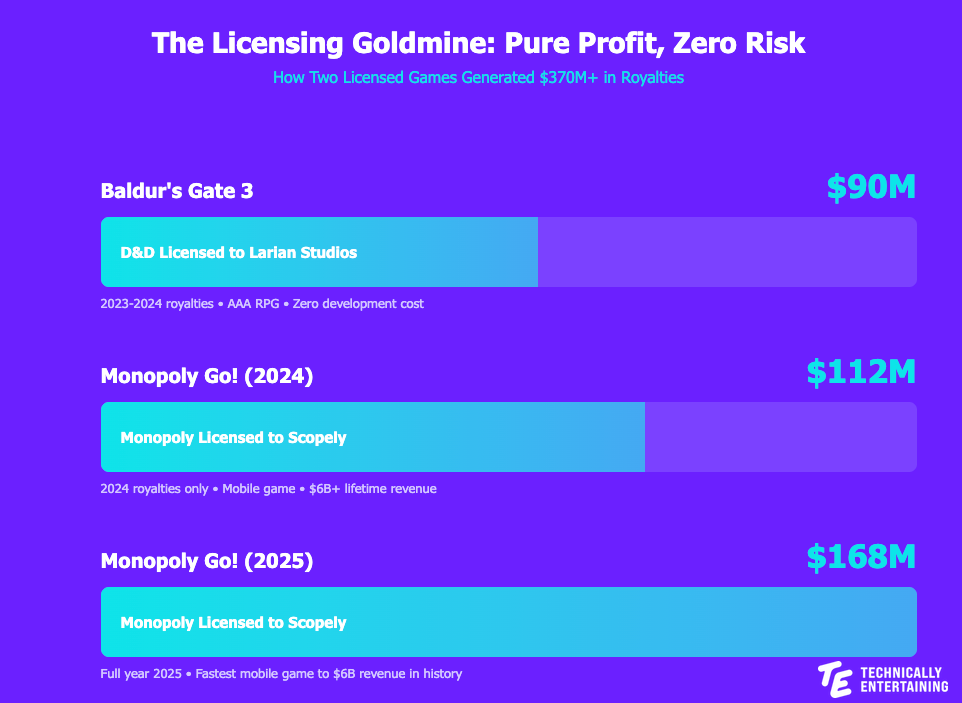
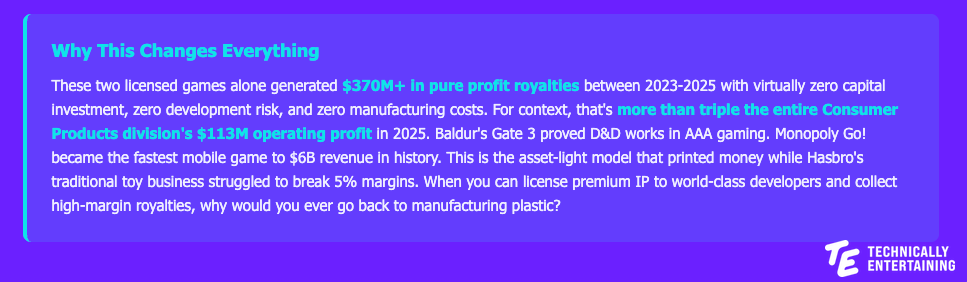
Think about that. Two licensed games, neither developed by Hasbro, generated over $200 million in pure profit royalties. That’s more operating profit than most of Hasbro’s physical toy brands combined. And it required virtually zero capital, no inventory risk, no manufacturing costs, and no retail distribution headaches.
This was the model. License premium IP to best-in-class developers. Collect high-margin royalties. Use that cash to fund internal development of the most strategic franchises while maintaining the asset-light approach for everything else.
Going All In: The $1 Billion Bet on Internal AAA Development
Licensing proved the value of gaming IP. But Cocks wanted more. In 2025, Hasbro unveiled “Playing to Win,” a strategy built on five pillars: leading with IP, scaling digital, expanding into new markets, optimizing the portfolio, and driving operational excellence. At the center was a massive commitment: $1 billion invested in internal AAA game development.
Hasbro established four internal studios, each tasked with building high-fidelity titles:
Archetype Entertainment, led by BioWare veterans James Ohlen and Chad Robertson, is developing Exodus, a sci-fi RPG targeting a 2027 release. This is Hasbro’s bet on creating new IP that can compete with Mass Effect and The Witcher.
Invoke Studios, formerly Tuque Games in Montreal, is working on Warlock: Dungeons & Dragons, a third-person action-adventure game also slated for 2027. This represents Hasbro’s push to expand D&D beyond turn-based RPGs into action genres.
Skeleton Key, based in Austin and led by Christian Dailey, is reportedly developing an unannounced horror project, likely leveraging Hasbro’s library of genre IP.
Atomic Arcade was working on a G.I. Joe Snake Eyes game, but in a significant setback, Hasbro closed the studio in February 2026. The project’s status remains unclear, described only as being “evaluated.”
This internal studio strategy is high-risk. AAA game development is notoriously difficult, expensive, and unpredictable. Studios regularly go over budget and miss release windows. For every Baldur’s Gate 3, there are dozens of expensive failures. Hasbro is betting it can build the talent and infrastructure to compete with established gaming giants.
The company also hedged by announcing a partnership with Saber Interactive, the studio behind Warhammer 40,000: Space Marine 2, to co-develop a project based on a tentpole Hasbro IP, widely speculated to be Transformers. This represents a middle path between pure licensing and pure internal development.
The UGC Strategy: Meeting Players Where They Actually Are
While betting big on AAA, Hasbro simultaneously pursued a platform-agnostic UGC strategy, recognizing that younger audiences live inside Roblox, Fortnite, and Minecraft rather than traditional gaming or toy stores.
On Roblox, Hasbro launched Nerf Strike, which has recorded over 84 million visits. The strategy creates a bridge between physical and digital: Roblox-themed Nerf blasters include redeemable codes for virtual items, driving digital engagement while supporting physical sales.
In Fortnite, Transformers appeared through high-profile crossover packs featuring skins for Optimus Prime, Bumblebee, and Megatron. The use of Unreal Editor for Fortnite allowed community-driven maps, keeping legacy brands relevant within the world’s largest battle royale ecosystem.
Minecraft collaborations followed a narrative-driven model. The 2024 Transformers DLC offered a story-driven adventure from Earth to Cybertron with vehicle-to-robot transformation mechanics, released alongside physical Minecraft-themed Nerf blasters.
This wasn’t experimental marketing. It was strategic distribution, ensuring Hasbro’s brands remained culturally relevant in the ecosystems where Gen Alpha and Gen Z actually spend their time.
The Financial Inversion: When Gaming Becomes the Entire Company
The 2025 financial results tell the story of complete business model inversion. Hasbro reported total revenue of $4.701 billion, up 14% year-over-year. But the growth was entirely driven by one segment.
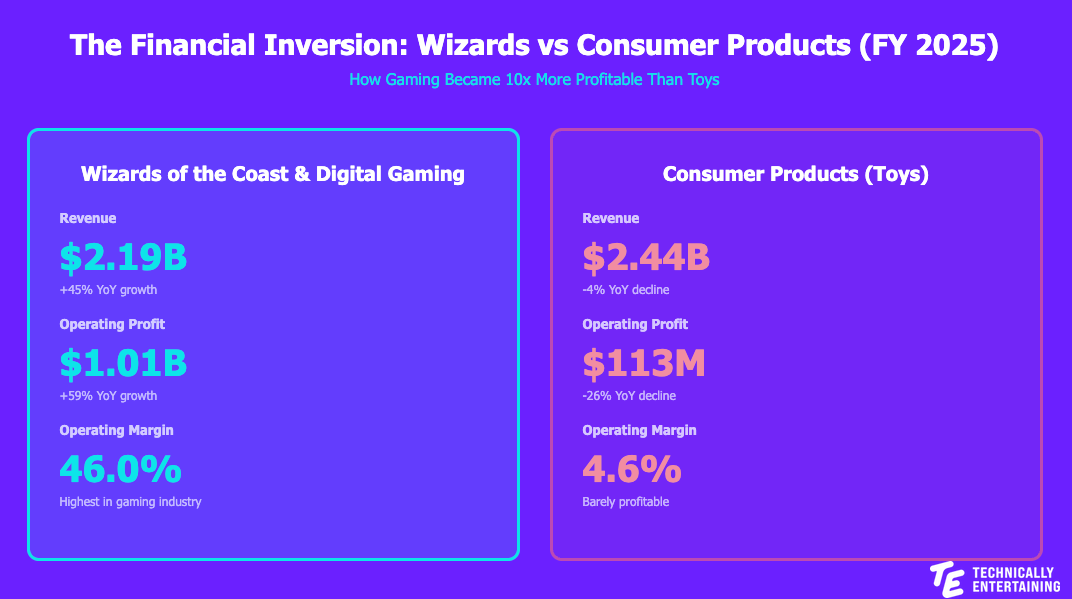
Wizards of the Coast and Digital Gaming saw 45% revenue growth to $2.187 billion. Operating profit grew 59% to $1.007 billion, representing nearly the entire adjusted operating profit for the company. The operating margin of 46.0% is among the highest in the gaming industry.
Magic: The Gathering finished its strongest year ever, up 59%, driven by the “Universes Beyond” strategy that integrated external IP like Lord of the Rings and Warhammer 40,000 into the game’s ecosystem.
Meanwhile, the Consumer Products segment declined 4% to $2.438 billion. Adjusted operating profit dropped 26% to just $113 million, with margins contracting to 4.6%. The traditional toy business that once defined Hasbro now barely breaks even.
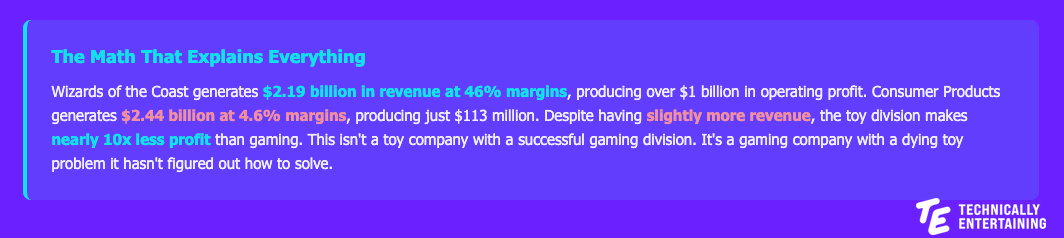
The math is brutal and clear. Wizards generates $2.2 billion in revenue at 46% margins, producing over $1 billion in operating profit. Consumer Products generates $2.4 billion at 4.6% margins, producing $113 million. One division makes nearly ten times the profit of the other despite similar revenue.
Hasbro isn’t a toy company with a gaming division anymore. It’s a gaming company with a legacy toy business it hasn’t figured out how to shut down without destroying brand equity.
The Failures: When Ambition Meets Reality
The transformation hasn’t been without painful setbacks. In late 2025, Hasbro canceled “Project Sigil,” an ambitious 3D Virtual Tabletop for Dungeons & Dragons powered by Unreal Engine 5. The platform was intended to provide a high-fidelity, Baldur’s Gate 3-like experience for remote players. But internal restructuring and the realization that it was being treated as a video game rather than a utility tool led to a 90% reduction in the development team in March 2025. Servers shut down on October 31, 2026.
The closure of Atomic Arcade in February 2026 represents another setback. The loss of a dedicated studio working on G.I. Joe underscores the difficulty of managing internal AAA development in a volatile market where even established studios struggle.
These failures are expensive. But they’re also expected in AAA development. The question isn’t whether Hasbro will have more failures. It’s whether the hits will be big enough to justify the misses.
What Comes Next: The 2027 Moment of Truth
Hasbro projects mid-single-digit revenue growth and 50-100 basis points of annual operating margin improvement through 2027. For fiscal 2026, the company anticipates 3-5% revenue growth with adjusted operating margins reaching 24-25%.
A key focus is the “Seasonal Model” for Dungeons & Dragons, transitioning the tabletop game to a live-service-style release schedule beginning with the “Season of Horror” in June 2026. This move sustains community engagement and drives consistent sales of digital and physical accessories through D&D Beyond.
But 2027 is the defining year. The releases of Exodus and Warlock: Dungeons & Dragons will prove whether Hasbro’s $1 billion investment in internal studios was visionary or reckless. If these titles succeed critically and commercially, Hasbro completes its transformation from toy maker to top-tier interactive media company. If they fail, the company faces serious questions about whether it should abandon internal development entirely and return to pure licensing.
The Blueprint for Every Legacy Brand
Hasbro’s transformation reveals several principles that apply far beyond toys.
First, recognize when your core business is dead. Hasbro didn’t save itself by making better toys. It recognized that physical play patterns had fundamentally shifted and pivoted to where engagement actually happens.
Second, bet on your highest-margin assets. Wizards of the Coast was always more profitable than Consumer Products. The mistake was treating it as secondary for so long. When margins tell you where value lives, listen.
Third, asset-light beats vertical integration in volatile creative industries. The eOne acquisition looked strategic. Film and TV production looked like natural extensions. But high-capital, unpredictable creative production is the opposite of high-margin digital licensing. Hasbro learned this the expensive way.
Fourth, licensing can be as strategic as ownership. Baldur’s Gate 3 and Monopoly Go! generated over $200 million in royalties with zero development risk. The old model said you need to own and control everything. The new model says pair premium IP with world-class partners and collect pure profit.
Fifth, internal development is high-risk but necessary for strategic control. Licensing works until platform holders or publishers have too much power. Hasbro is building internal studios not because it’s safer but because it can’t afford to be entirely dependent on external partners for its most valuable franchises.
The Existential Question
Hasbro has successfully navigated the first phase of transformation. It divested the entertainment production albatross. It elevated gaming to the core strategy. It demonstrated that its IP has massive value in digital formats. And it’s investing in the capabilities to control its own destiny.
But the company faces an existential question it hasn’t fully answered: What is Hasbro if Consumer Products continues to decline?
The 2025 results suggest a future where Wizards generates $3+ billion at 45%+ margins while Consumer Products shrinks to $2 billion at sub-5% margins. At that point, why maintain the Consumer Products infrastructure at all? Why not spin it off, sell it, or simply wind it down and become a pure gaming and licensing company?
Hasbro’s leadership hasn’t articulated this endgame. They talk about “optimizing the portfolio” and “fewer, bigger, better brands.” But the financial logic points toward an eventual exit from most physical manufacturing. The brands can live through licensing. The community can engage through digital gaming. The profits flow from royalties and internal studios, not injection-molded plastic.
Chris Cocks inherited a company in crisis and turned it into a gaming powerhouse. The stock is up significantly from its 2022 lows. Margins are expanding. The gaming pipeline is robust. But the transformation isn’t complete. It’s just entering its most dangerous phase, where Hasbro has to prove it can execute AAA development at scale while managing the slow decline of the business that built the company.
2027 will tell us whether Hasbro becomes the model for how legacy brands survive digital disruption or a cautionary tale about the limits of transformation when you’re carrying a century of manufacturing baggage.
What’s your take on Hasbro’s strategy? Can a toy company really become a gaming giant? Let me know in the comments.