


Dear Readers,
I was sitting in the audience at Google Playtime in Brussels this week when Sam Bright, VP of Google Play, made a statement that should be obvious but apparently still needs saying:
“Games are a big priority for us.”
The understatement was almost comical. Gaming doesn’t just matter to Google - it’s the economic foundation of their entire app ecosystem. According to Google Play Store revenue data, gaming generated $40.1 billion in 2025, representing 63% of the Play Store’s total $63.4 billion revenue. This isn’t a “priority” - it’s the profit engine that funds everything else Google does in mobile.
But here’s why this matters beyond Google’s balance sheet: the strategic decisions Google is making about gaming reveal where consumer attention is going and how brands need to think about engagement in 2025 and beyond - which brings us to this week’s TE chart of the week.
Google’s Gaming Dominance and Dependance
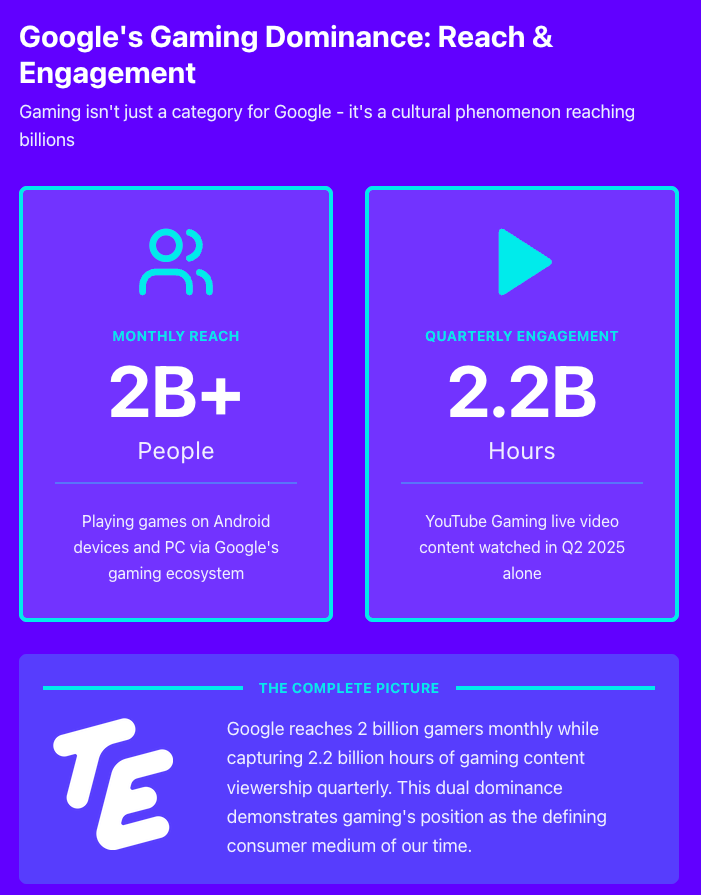
Google reaches over 2 billion people every month through games across mobile and PC. At the same time, in just the second quarter of this year over 2.2 billion hours of live gaming content were watched on YouTube Gaming. In other words: 25% of the global population engage with Google via games and 251 million years of gaming content were consumed in just 3 months this year. It’s the dual dominance of reach and engagement that exemplify Google’s dominance in gaming, as well as its dependence on it as one thing is strikingly clear:
Gaming is the defining consumer medium of our time.
If you’re not thinking about gaming as a core consumer touchpoint, you’re missing the single most important shift in how people spend their time and money.
The Numbers That Explain Everything
Gaming’s dominance of the Play Store isn’t new, but the consistency is remarkable. From 2023 to 2025, gaming has maintained its iron grip on roughly two-thirds of all Play Store revenue:
2023: $34.3B gaming revenue (65% of $52.7B total)
2024: $37.1B gaming revenue (64% of $58.1B total)
2025: $40.1B gaming revenue (63% of $63.4B total)
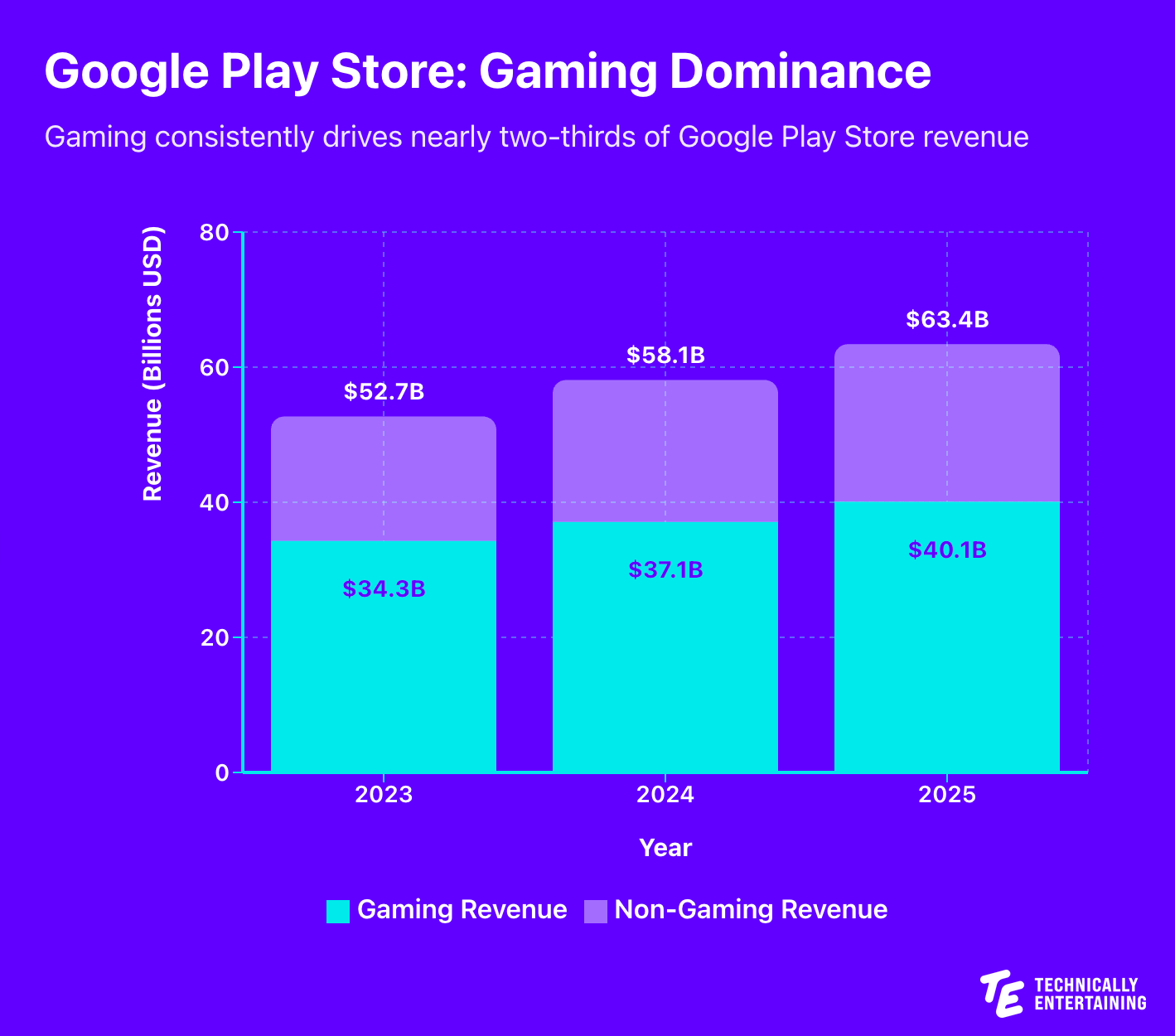
That’s $5.8 billion in growth over three years while maintaining the same dominant market share. Meanwhile, non-gaming apps and content struggle to compete for the remaining third of revenue despite having far more developers and content creators fighting for attention.
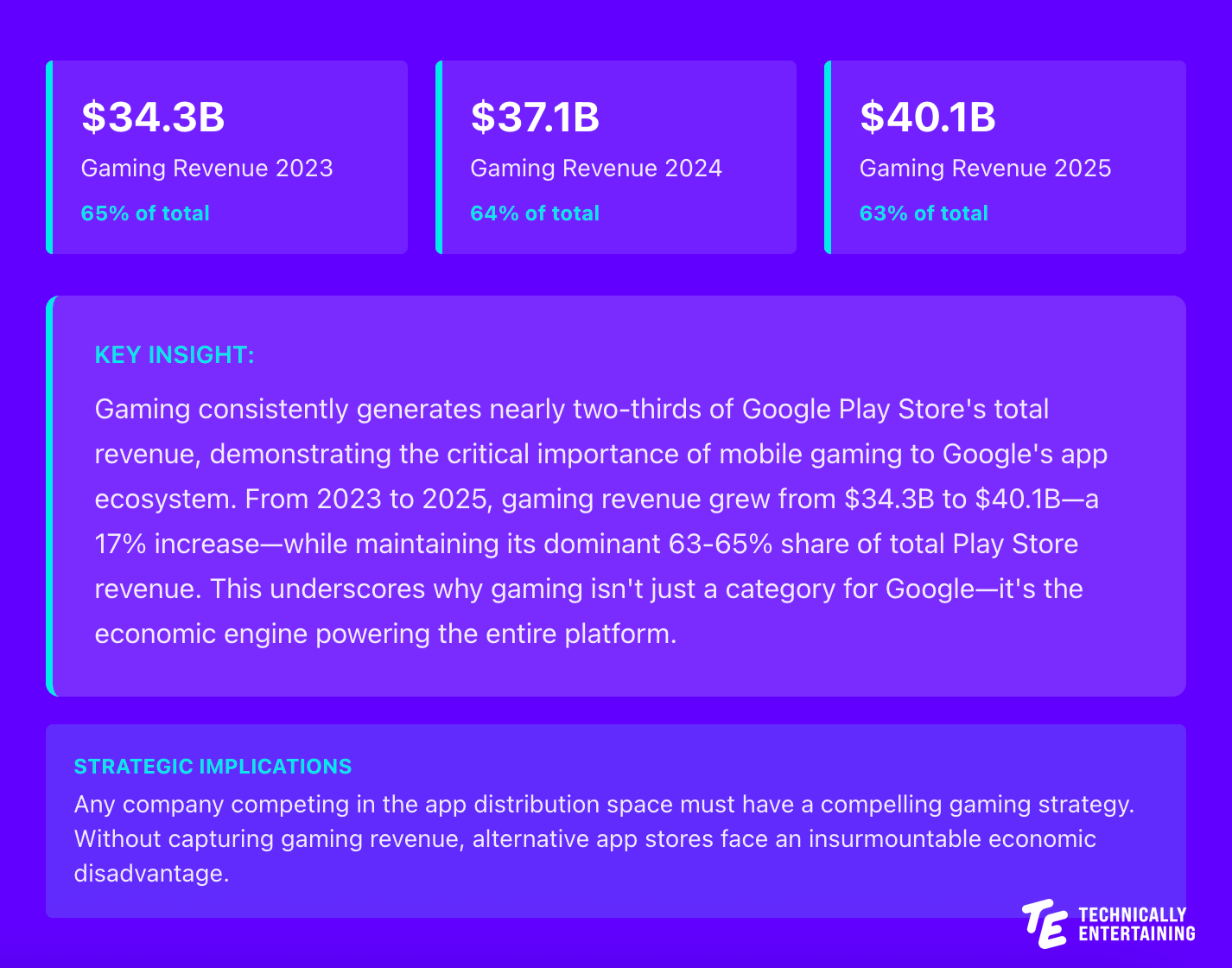
The strategic implication is brutal: any company competing in app distribution without a compelling gaming strategy faces an insurmountable economic disadvantage. This is why Apple, Epic Games, Netflix, Amazon Prime and every other platform player obsesses over gaming - it’s not just a category, it’s the category that determines whether your platform survives.
Google’s Friction-Elimination Strategy
At Google Playtime, the company unveiled a suite of features designed around a single objective: remove every possible friction point that might cause a player to disengage. The strategy is elegant in its simplicity - keep people playing longer, spending money faster, and coming back sooner.
Play Store for Games on PC has graduated from beta, creating a cross-device ecosystem that lets consumers discover and play games regardless of whether they’re on mobile, tablet, or desktop. Over 2 billion people play games on Android devices and via the Google universe - that’s the addressable market Google is unifying under one platform.
Google Pay with Play leverages billions of transaction data points to suggest the optimal payment method for each user. This isn’t just convenience - it’s conversion rate optimization at massive scale. Every fraction of a second removed from the purchase flow translates to millions in additional revenue.
YouTab creates a personalized landing space showing players their recent activity, recommendations, promotional content, offers, and rewards. The Roblox implementation demonstrates the power: players see exactly where they left off, what their friends are doing, and what rewards they can claim - all designed to pull them back into the game immediately.
Sidekick represents the most ambitious play: a Gemini-powered sidebar that helps players figure out what to do next, what resources to use, and what rewards to claim without ever leaving the game. It’s AI as engagement optimization, keeping players in-flow rather than forcing them to consult external guides or forums.
The roadmap emphasizes social features - feeds showing what friends are playing, progress sharing, intelligent matchmaking via AI. Every feature is designed to increase time spent and money spent while reducing any reason to leave the ecosystem.


Why This Matters for Every Brand
Gaming isn’t just important because Google makes $40 billion from it. Gaming matters because it represents the evolved form of consumer engagement that every brand needs to understand.
Consider the fundamental difference between traditional advertising and gaming engagement:
Traditional advertising: Interruption-based, measured in seconds, one-way communication
Gaming engagement: Permission-based, measured in hours, interactive participation
According to research I’ve covered previously, the average engagement with a social media post is 1.3 seconds. The average engagement with a branded experience on Roblox lasts 11 minutes. That’s not just better - it’s a different category of consumer relationship entirely.
Brands that have figured this out are already winning. Gucci’s gaming activations, BMW’s racing game partnerships, and Peloton’s fitness gaming integration demonstrate that gaming isn’t just for entertainment companies - it’s for any brand trying to build meaningful consumer relationships.
The question isn’t whether gaming is relevant to your business. The question is whether you’re willing to meet consumers where they’re actually spending their time and attention.
The Flip Side: Discovery May Get Even Harder
While Google’s new features sound impressive, they reveal a troubling reality for new content creators: the discovery problem is likely getting worse, not better.
YouTab and the personalized recommendation systems prioritize games users have recently played or are currently playing. The logic makes business sense - Google can reliably forecast incremental revenue from engaged players returning to their current games. But this creates a self-reinforcing cycle where established games dominate user attention while new games struggle to break through.
App store featuring and promotional benefits are now gated behind Google’s Level Up program, which requires games to meet specific UX requirements. This isn’t inherently bad - quality standards benefit players. But it creates another barrier for independent developers and new entrants who lack the resources to optimize for Google’s specific criteria.
The fundamental challenge: Google’s economic incentives align with maximizing revenue from proven games, not discovering the next breakthrough hit. This is the Innovator’s Dilemma playing out in real-time - the systems optimized for today’s revenue actively work against tomorrow’s innovation.
What This Means for Strategic Planning
If you’re a brand or organization thinking about consumer engagement strategy, Google’s $40 billion gaming revenue should force a fundamental rethinking of where and how you allocate attention and resources.
Gaming is no longer optional
When a single category drives two-thirds of the revenue for one of the world’s largest consumer platforms, it’s not a niche - it’s the mainstream. Any consumer engagement strategy that doesn’t include gaming is incomplete.
Platform power is consolidating
Google’s friction-elimination strategy makes it harder for alternative platforms and new entrants to compete. The network effects around payment data, social graphs, and personalization algorithms create moats that only deepen over time.
Early positioning matters more than ever
With discovery becoming increasingly difficult for new content, brands need to establish gaming presence now rather than waiting for “perfect” execution. The cost of entry increases as platforms mature and optimize for incumbent players.
Multi-platform thinking is mandatory
Google’s PC gaming expansion demonstrates that platform boundaries are dissolving. Brands need to think about gaming engagement across mobile, desktop, console, and emerging platforms rather than treating each as separate channels.
The Opportunity Hidden in Plain Sight
Here’s the counterintuitive opportunity: while Google makes discovery harder for new games, they’re simultaneously making engagement deeper for brands that earn their way in. The personalization features, social integrations, and AI-powered assistance all amplify the value of games that successfully capture player attention.
For brands, this means the ROI of successful gaming initiatives increases even as the difficulty of achieving success increases. A well-executed gaming experience gets more valuable over time as platform features enhance and extend the engagement you’ve built.
The winners will be brands that understand gaming isn’t just another marketing channel to “activate” with a one-off campaign. Gaming is a consumer relationship platform that requires sustained investment, authentic engagement, and genuine value creation for players.
The Strategic Imperative
Google’s gaming revenue didn’t reach $40 billion by accident. It reached that scale because gaming represents the most effective way to engage consumers in the attention economy. Every hour spent gaming is an hour not spent on traditional media, social platforms, or e-commerce sites.
For brands and organizations, the question isn’t whether gaming matters - the data makes that unambiguous. The question is whether you’re prepared to make the strategic investments required to compete for attention in the medium that’s already won.
The companies that treat gaming as a core consumer touchpoint - not a marketing experiment or youth-focused initiative - will build sustainable advantages as consumer time continues flowing toward interactive experiences. Those that continue viewing gaming as someone else’s problem will find themselves fighting for scraps of attention in declining channels.
Google’s $40 billion bet on gaming isn’t just about Google’s business. It’s a signal about where consumer engagement is heading and what kinds of experiences will define brand-consumer relationships for the next decade.
The only question is whether you’ll be positioned to capitalize on that shift or left explaining why you missed it.
The gaming industry continues to reshape how brands engage consumers and how platforms generate revenue. Subscribe to Technically Entertaining for ongoing analysis of the strategic implications of gaming’s rise as the dominant consumer medium.