


Dear Readers,
I just returned from Helsinki where I attended RovioCon, the annual gaming conference hosted by Rovio (the company behind Angry Birds). RovioCon is an absolute staple in my calendar due to the quality of content and attendees. It’s where the brightest minds in the industry let down their guard and take an honest look at where gaming is headed.
There is also something magical about visiting Helsinki and Finland this time of year. There are not many other places where a public football field is intentionally prepared and watered to create an open air hockey rink for the winter months.
As a former hockey player, I’m obviously biased. But Helsinki is a special place.
Let’s look at the major headlines from RovioCon 2025.
Gaming continues its steady growth trajectory
The industry is growing at approximately 5% CAGR through 2028, as more people worldwide adopt gaming as a primary form of entertainment and social connection.
Platforms are reaching unprecedented scale
Games are evolving and platforms like Roblox are seeing record numbers in concurrent audience sizes, demonstrating gaming’s position as a social infrastructure, not just entertainment.
Mobile gaming revenue hits pandemic highs
Mobile gaming revenue from in-app purchases has recovered and reached its pandemic high of $21 billion in the third quarter this year. The last time it reached that number was the same quarter four years ago.
Market consolidation accelerates
However, downloads are continuing to decline, the top 50 publishers drive 80% of the revenue, and new game launches reached a new low. In a market where it’s incredibly hard to successfully launch and scale new games, developers and publishers are doubling down on what already works.


Consumer apps are winning with game mechanics
More than 50% of the App Store’s revenue from in-app purchases now comes from consumer apps, not games. This is ironic given that mobile games popularized the entire concept of in-app purchases. Consumer apps are adopting the very playbook that made games so successful to drive their own revenues. In simplified terms, consumer apps are using gamification (the elements that make games so engaging) for their own products and services.
Gamification, alongside personalization, is one of the most abused and misunderstood terms in business over the past 15 years, which is why I wrote an entire section in my book Press Play on what true gamification really is. But this shift in App Store revenues signals a larger takeaway: any company can learn from video games how to better reach and engage their customers. The growth in in-app purchase revenue in consumer apps is clear evidence of that.
Content formats must adapt to evolving attention patterns
How players and consumers spend their time is evolving, which will lead to new gaming and content formats. The average TikTok video is 42.7 seconds, and users watch 133 videos daily (95 minutes total). The best performing video length on YouTube is 10 minutes, with users watching an average of 46 minutes per day. Games and entertainment content must adapt to fit these changed consumption behaviors.
Gaming is fundamentally social
66% of all people who play games globally play weekly, 83% play with other people, and 77% of parents play with their kids. If you’re a parent who has played a game with your kid, you know how rewarding that experience is and how it strengthens your bond.
The generational opportunity is widening
Fewer players are aging out while new players continue aging in, giving video games a compelling and sizeable audience at each end of the demographic spectrum. Which leads us to this week’s TE chart.
Games are Gen Alpha’s gateway
You may have already heard (especially if you’re subscribing to this newsletter) that young audiences play video games. A lot. But what is truly unique and happening for the first time is this: Gen Alpha spends more time in video games than in any other medium. Yes, they stream content. Yes, they’re on social media. Yes, they read (thank God). But what they do more than anything else is play video games.
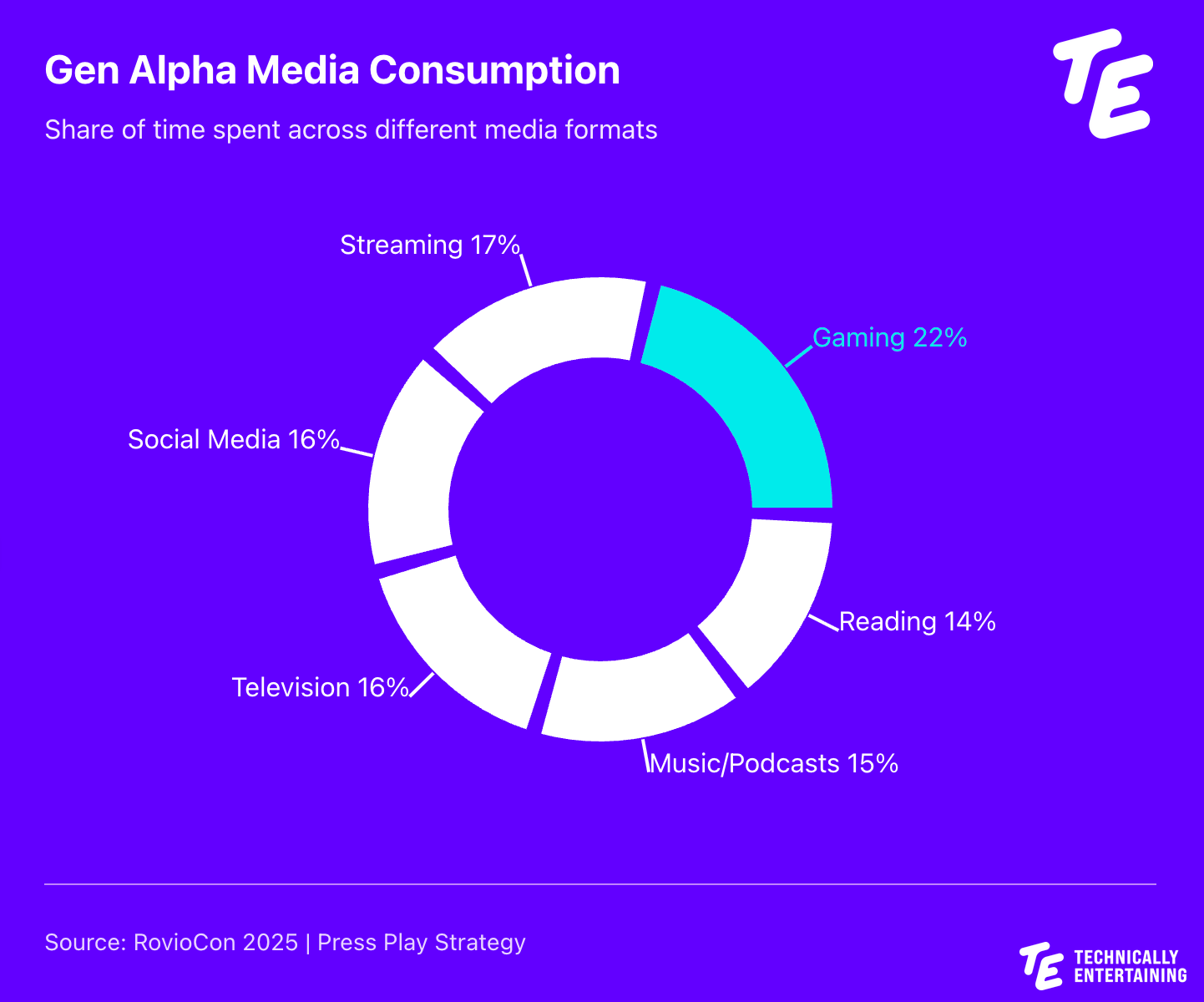
That is why every brand or company wrestling with how to reach and engage young audiences must look at video games. You cannot successfully reach an audience and turn them into loyal customers if you’re not showing up where they spend the most time. This is true for brands creating awareness and for companies enhancing their service offerings to appeal to young people.
In the former case, a company may establish an actual in-game experience, like Adidas just did with Minecraft by launching Stripe City. In the latter, companies look to games to understand how to tailor their services to young people (see above: gamification and in-app purchases in consumer apps). I’m currently speaking to half a dozen financial service providers all actively facing this exact challenge: how do we make our financial products relevant for young audiences?
Companies that build a deep understanding of video games and develop a strategy for leveraging gaming will hold the keys to the next generation of consumers.
This week also marked a turning point for the largest platforms that underpin the gaming industry in store. Arch rivals Epic Games and Unity will cooperate by bringing Unity games into the game Fortnite. Subscribe today to not miss our take on why this is the biggest headline of 2025.