


Paramount Skydance had itself quite the week. First, it announced something that I had been discussing with Paramount’s executives for months. The company established a unified gaming division that combines the game teams that Paramount and Skydance each had, and will give emphasis to its gaming projects going forward by elevating it as a dedicated content vertical next to Film, TV, and other media. Second, to commemorate the announcement, it announced the release of its latest game TMNT: The Last Ronin. It’s the newest game release based on original Paramount IP that looks to engage fans and consumers beyond the movie theater and the TV.
Yet what Paramount’s move signals is that gaming has far greater importance than just delivering great games in isolation based on IP that already exists. It’s about acknowledging that games can be the source of new IP as well, while giving fans the ability to immerse themselves more deeply into all of the worlds of their favorite characters.
“We firmly believe that games is a great place where IP and stories can originate from — not just from TV and film. Games truly is the deepest level of engagement for fans.”
- Dan Prigg, EVP and Head of Games at Paramount Games Studio.
Structure Follows Strategy
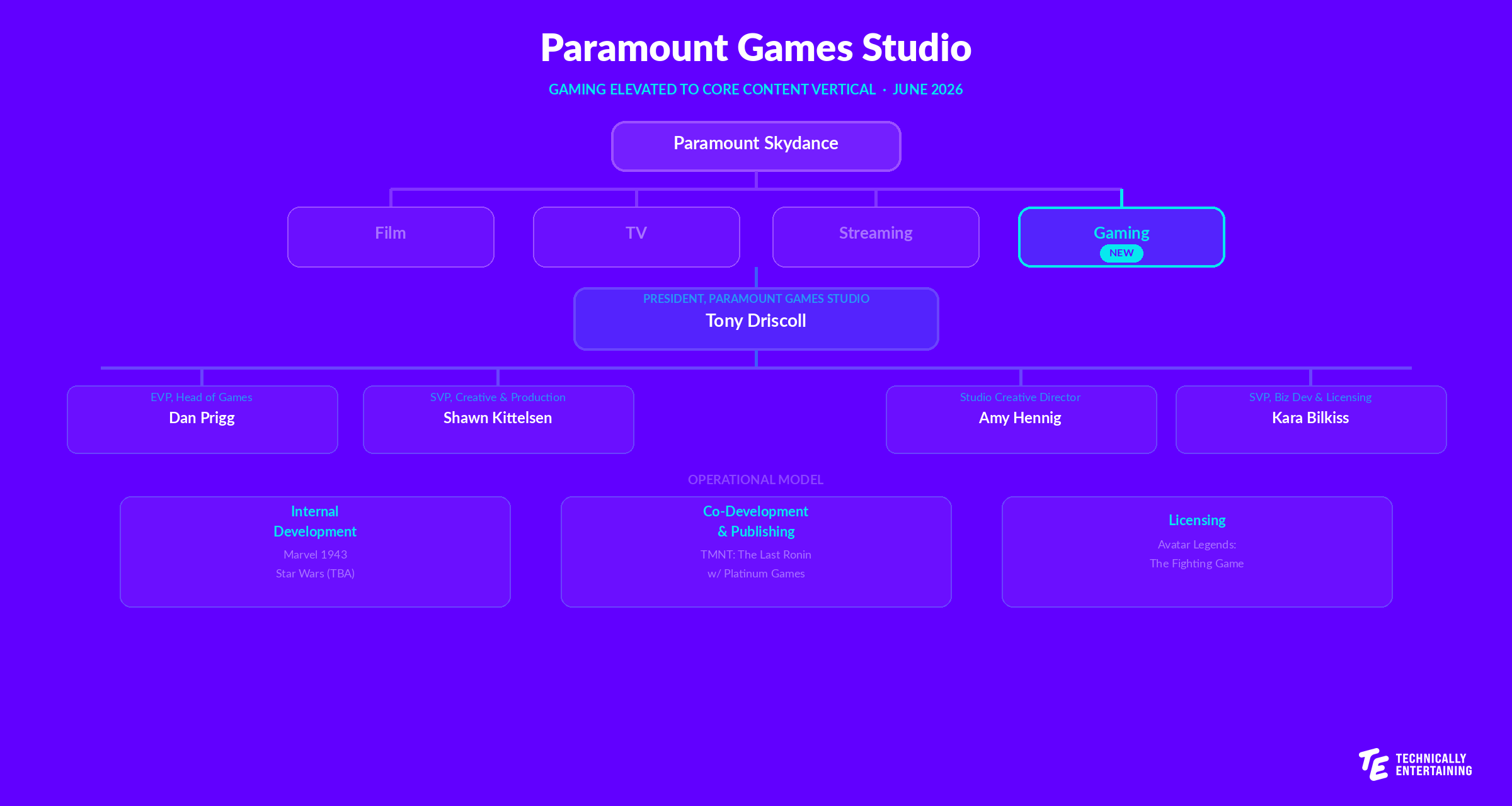
By elevating games into its dedicated vertical next to all other media formats, Paramount Skydance is walking its talk regarding the importance of games for the company going forward. It’s a perfect example of the foundational business strategy principle that Alfred Chandler coined in 1962: structure follows strategy. The idea is that an organization needs to define its objectives and the strategy to achieve those objectives first, and only then shape the organizational structure in a way that optimally supports the strategy. For a company that strategically views gaming as a “core pillar” of its content strategy alongside film, television, and streaming, it’s only consequential to make gaming its own vertical.
Previously released post relevant to this

Why Paramount-Skydance Just Rewrote Hollywood's Gaming Playbook (And What Happens If They Lose WBD)
How Paramount Games Studio Is Built
The newly formed Paramount Games Studio consolidates three previously separate entities under one roof: Skydance Interactive, Skydance New Media, and Paramount’s historically licensing-focused game business. Tony Driscoll, Paramount’s head of corporate strategy and development, was named president of the studio. Dan Prigg, previously head of Skydance Interactive, steps up as EVP and Head of Games. Shawn Kittelsen takes the role of SVP of Creative and Production, and Amy Hennig — the acclaimed creative director who co-headed Skydance New Media — moves into the role of Studio Creative Director. The model spans three tracks: internal development, co-development with external partners such as Platinum Games on TMNT: The Last Ronin, and licensing, with all three now reporting through a single organization. Additional titles in active development include Marvel 1943: Rise of Hydra and an untitled Star Wars game, both inherited from Skydance New Media.
They Are Not the Only Ones
Paramount is not the first major entertainment company to draw this conclusion. Two others are worth benchmarking against.
Netflix established its gaming division in 2021 as a standalone content vertical, treating games as a pillar on par with original series. It now offers over 100 titles on its platform, has acquired studios including Night School Studio and Boss Fight Entertainment, and continues to expand the offering without ads or in-app purchases. Netflix made a deliberate organizational choice early: games would not live inside its content licensing team. They would have their own leadership, their own budgets, and their own mandate.
The New York Times built the same logic from scratch. NYT Games started with the flagship crossword and a string of acquisitions — most notably Wordle in 2022 — and grew into a standalone content vertical with its own subscription product, its own creative team, and its own growth mandate. By 2025, NYT Games had over 10 million daily players and more than one million standalone subscribers. Games is now one of the most important drivers of the company’s digital subscription growth. And the IP is beginning to flow in the other direction too: Wordle is being adapted into an NBC television show. A game that originates IP that then travels to TV, not the other way around. This is precisely the dynamic Prigg described. The New York Times arrived there because it chose to give games its own organizational home rather than fold it into the news product.
In my book Press Play, I make the case that the companies winning in gaming are the ones that let their gaming efforts breathe and run according to gaming’s own inner clock — not the production schedules and approval chains that govern TV and film. That means giving games their own organizational home, their own senior leadership, and the latitude to build differently. Paramount’s move is exactly that principle in action.
Three Learnings for Organizations Serious About Gaming
The Paramount announcement offers a clear template. If you are a marketing, brand, or strategy leader at any entertainment company or consumer brand with meaningful IP, here is what the move tells you.
First: organizational structure is a strategic statement
How you house gaming inside your business signals what you actually believe about it. A gaming function buried inside a licensing department is a licensing business. A gaming function with its own president, its own executive bench, and its own mandate to develop original IP is a content business. The structure tells your organization, your talent market, and your partners what the ambition really is.
Second: gaming is an IP origin engine, not just an IP extension
Prigg’s conviction — that games are where new stories can begin, not just where existing stories get adapted — reframes the entire economic case for gaming investment. The companies that treat gaming as downstream of film and TV will always be playing catch-up. The ones that treat it as a peer medium will own franchises the others will eventually try to license.
Third: talent specificity matters
Paramount did not promote a general entertainment executive to run Paramount Games Studio. It assembled a leadership team with experience at Epic Games, EA, WB Games, Unity, Scopely, and NetherRealm Studios. Gaming runs on different rhythms, different creative cultures, and different player expectations than any other medium. The right org structure falls apart without the right talent inside it.
The question for every executive audience here is the same one Paramount just answered for itself: if you believe gaming matters to your business, does your organizational structure reflect that belief?
Technically Entertaining covers business strategy at the intersection of gaming, technology, and entertainment — for the decision-makers shaping what comes next. The executives who understand gaming’s strategic value today are the ones setting the agenda tomorrow. Join them.