


Dear Readers,
In February 2024, Disney CEO Bob Iger went on record to say this:
“This marks Disney’s biggest entry ever into the world of video games and offers significant opportunities for growth and expansion. This new universe from Disney and Epic provides us with a tremendous opportunity to not only meet more consumers where they are, but to allow more audiences to cultivate a bond with Disney’s iconic brands and franchises.”
What Iger was commenting on was Disney’s $1.5 billion dollar investment into Fortnite maker Epic Games. At the time, the move was met more with skepticism and question marks regarding what this investment would actually result in and how this would tie into Disney’s actual business than with excitement.
After the events of the past seven days, the pendulum has to swing into the excitement direction. A mere 20 months after this announcement, Epic Games and Disney are showing us what the future of immersive entertainment powered by gaming can look like and what profound opportunities this opens up for companies like Disney to be relevant with modern-day, predominantly digital (gaming) consumers as well as to drive its existing core business.
What Took Place Last Week?
First, Epic Games brought The Simpsons to its game Fortnite (which still sees over 80 million monthly active players at the moment). Unlike most crossovers that comprise themed skins and emotes, this was a complete takeover—an entire stylized map based on Springfield to explore, rendered with unprecedented detail.
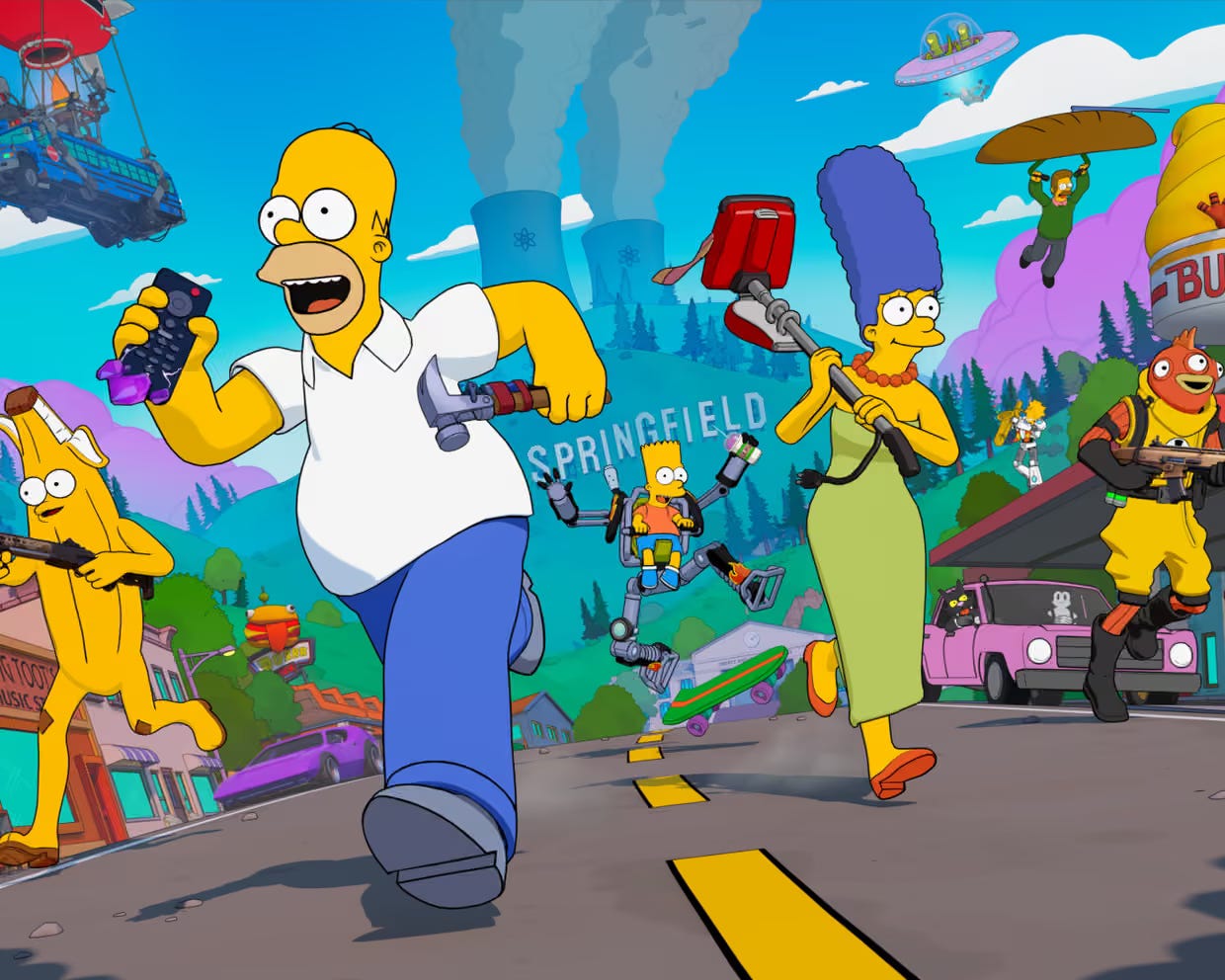
The familiar sights are all here: the Simpsons home on Evergreen Terrace, the sloping lawns of Burns Manor, a town square with Moe’s Tavern and a statue of Jebediah Springfield (detachable head and all), the nuclear power plant pumping cartoon steam into the sky, Cletus’s farm, and even Springfield Gorge from the memorable “Bart the Daredevil” episode. Every match starts with a charming recreation of the show’s intro—complete with parting clouds, title card, and iconic theme song—before players thank Otto as they leave the battle bus.
The map is dense with references for longtime fans: the 33 cents store, the forever-burning tire yard, optional quests with fun cameos where picking up car keys leads to a joyride at Homer’s behest, or answering a ringing payphone results in a prank call to Moe’s. Boss characters like Krusty appear across the map, with Nelson briefly showing up to let out his telltale “Ha ha!” upon their demise.
The crucial part about the integration of The Simpsons into the video game was the sequential rollout and the strategic connection to Disney’s streaming service Disney+, taking the integration away from a high spike at launch activity to a carefully orchestrated IP rollout across multiple consumer touchpoints that Disney owns.
Secondly, Epic Games launched Disneyland Game Rush - effectively a world within Fortnite that is a nearly perfectly authentic virtual version of the Disney theme parks. When you first enter, you’re welcomed into an esplanade modeled after the one between Disneyland and Disney California Adventure, complete with the 70th anniversary castle structure in the middle. On the perimeter, you can see Sleeping Beauty Castle, Haunted Mansion, Pixar Pier, the Matterhorn, and more—all of these pieces making a visually appealing Disney puzzle to explore.
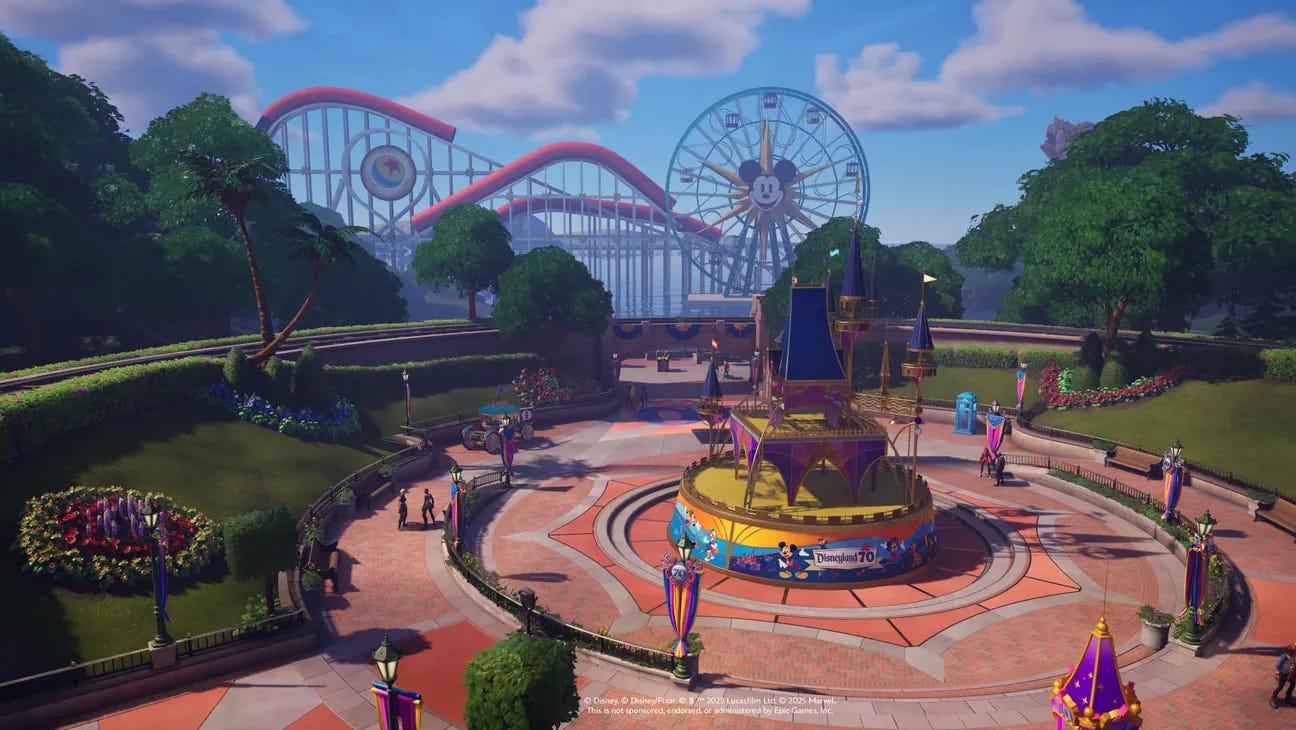
Players can enjoy seven different mini-games that accommodate up to 12 players, go on quests, open presents inspired by attractions and Nighttime Spectaculars, participate in Disneyland trivia for points, and trade tokens earned in mini-games for island-exclusive Disneyland 70th-inspired cosmetics like Mickey Ears, a Spider-Bot hat, the head of a Disneyland 70th-themed R2-D2, and even a Hatbox Ghost Back Bling. In a clever nod to the physical park’s 70th anniversary celebration, players can find one Disneyland Key in each land and redeem it for golden versions of these cosmetics—mirroring the physical toy keys used on locks around the real Disneyland.
This is the prelude and a glimpse into what the eventual fully scaled and living/breathing Disney Universe in Fortnite could feel like.
The seven mini-games transform beloved Disney attractions into competitive experiences:
Disney Haunted Mansion: Scavenger Haunt - Run through the spooky halls with a flashlight, starting with the iconic Stretching Room and its welcome speech. Collect coins while Grim Grinning Ghosts plays and you explore the Dining Room with dancing ghosts—offering a freedom you don’t have on the real attraction.
Star Wars: Stormtrooper Showdown - Battle Stormtroopers aboard a First Order Star Destroyer, take on Kylo Ren and Captain Phasma, and claim their weapons if you defeat them. Fans of Rise of the Resistance will recognize the AT-ATs and laser cannons, with hidden lightsabers scattered throughout.
Matterhorn: Slip-and-Climb - Scale the Matterhorn with a Grappler while your feet turn to blocks of ice, creating chaotic moments of slipping and sliding. The challenge requires strategy as you swing up the mountain face, with Disneyland Keys hidden along the way.
Guardians of the Galaxy - Mission: Sneakout! - A 2D adventure through a space prison set to Jackson 5’s “I Want You Back,” where you avoid guards to reach the Collector’s office. Throw Boogie Bombs at guards and friends, with the Milano floating outside for added authenticity.
Indiana Jones: Tomb Runner - Race through trap-filled levels featuring giant boulders, floor spikes, and poison darts from the walls. Speed boosts help your mission, but any hazard contact slows you down in this test of treasure-hunting skills.
WEB Slingers: Spider-Bot Blaster - A shooting gallery featuring the same Spider-Bot models and animations as the physical WEB Slingers attraction in Disney California Adventure, with normal bots, golden bots, and giant boss bots to defeat.
Space Mountain: Rocket Race - Grind on rails through space with that classic Space Mountain music, starting in a space modeled after the actual attraction with an authentic sense of speed.
Why Does This Matter?
Both The Simpsons integration and the Disneyland Game Rush launch have a key aspect in common: because of the integration into Fortnite, they’re making each brand, each IP, playable. Not only is Disney taking its brands into the medium where people spend their most time and engage the most. They’re making them an authentic and fully integrated part of the game experience itself. You could go as far and say that the brands are becoming the game itself.
The Simpsons: A Blueprint for Transmedia IP Launches
With respect to The Simpsons, the rollout was strategically brilliant and signals a lot about the future of entertainment IP and what it takes to be successful in a transmedia world powered by games. A few observations:
Interaction is the first consumer touchpoint
See above: the games make brands experiential at scale. Which makes games the release surface rather than a promotional area.
Streaming is the second touchpoint
Disney+ featured curated short episodes for The Simpsons that were based on and set in the Fortnite game.
Sequencing
The rollout was staged into a weekly cadence with content chapters, carefully curating what is released when, and across which consumer touchpoint to drive holistic audience engagement across platforms and touchpoints.
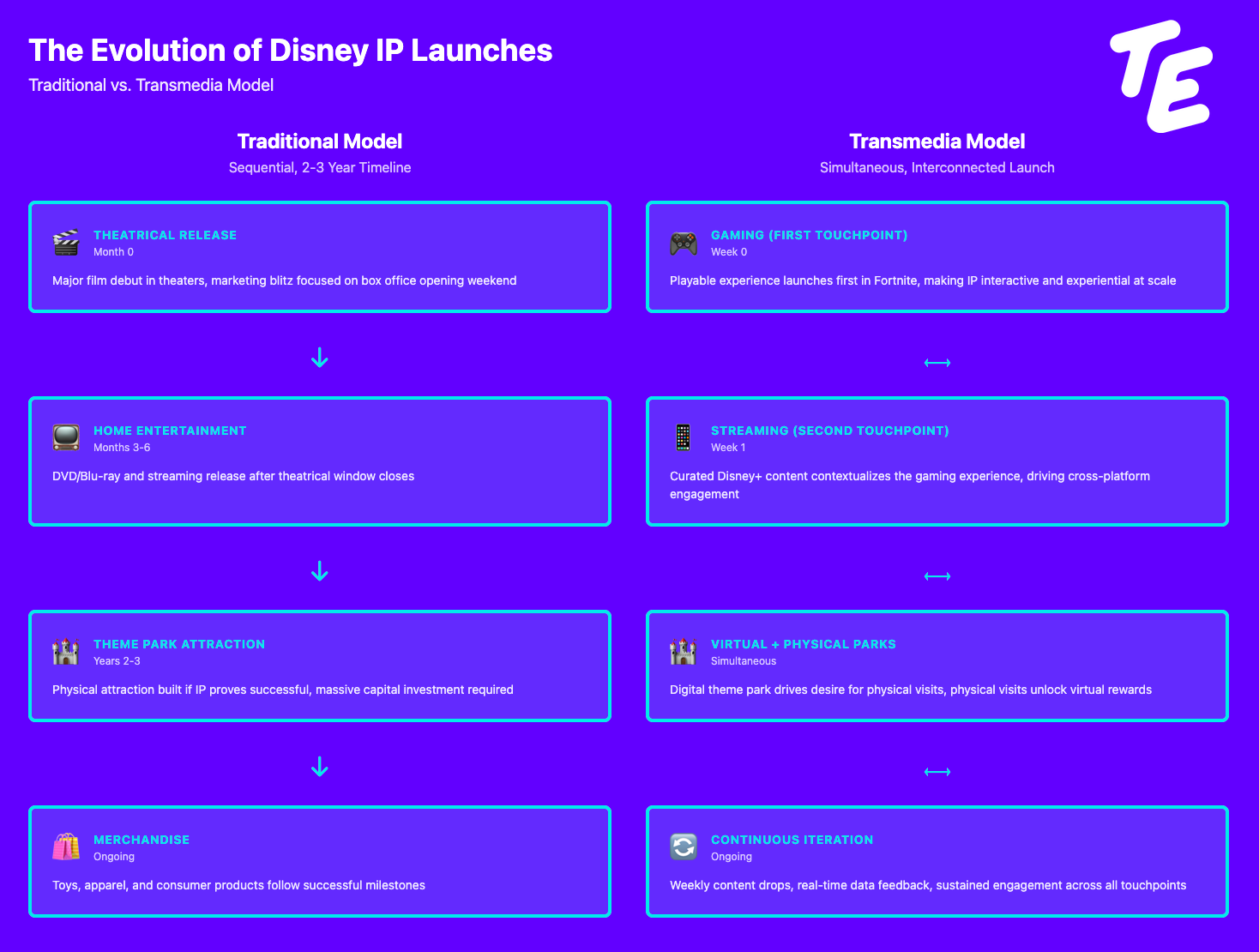
And that is really the key in how the value of IP is likely being assessed in this brand new transmedia entertainment world: rather than obsessing over the opening spike in attention or engagement upon launch, it is really about how well an IP can be re-contextualized along the consumer journey over an extended timeframe to drive continued engagement.
In a world where consumer attention is so scarce and every interaction is fleeting, the ability to sustain consumer attention once captured is arguably more valuable than a higher initial attention spike that fades.
Disneyland Game Rush has even more fundamental implications when it comes to Disney’s current core business.
Connecting the Physical to the Digital
For now, the mini-games, gifts, and items unlocked inside Disneyland Game Rush stay in the virtual realm of Disneyland Game Rush.
But what happens when players can start to unlock an early access ticket for the opening of a new theme park ride in the physical Disneyland? What if the game knows the next time I log in what the last ride was that I took on my trip to Disneyland Paris and lets me continue my visit there?
Let’s explore the most impactful areas where connecting the digital to the physical world can redefine how Disney treats its guests, engages consumers, and ultimately makes money:
1. Dynamic Pricing and Yield Management
Disney could use engagement in the virtual parks to inform and personalize pricing for physical park visits. If a player spends hours exploring virtual Fantasyland, Disney knows that guest will likely prioritize those attractions during a physical visit, allowing for targeted package offerings or FastPass upsells.
Impact Example: A family that completes virtual quests in Galaxy’s Edge receives a personalized offer for a discounted Star Wars-themed hotel package. Similar to how Netflix increased user engagement by 75% through personalized recommendations, Disney could leverage virtual park behavior data to drive higher conversion rates from digital engagement to physical bookings.
2. Pre-Visit Training and Optimization
Virtual Disneyland becomes an onboarding experience that helps first-time visitors plan more efficient park days, reducing frustration and increasing satisfaction scores. Guests familiar with the layout and attractions through the game spend less time lost and more time on rides and purchasing merchandise.
Impact Example: Visitors who “train” in the virtual park before visiting could mirror the success of mobile app pre-planning. According to Disney’s own research, guests who use the My Disney Experience app spend more time on attractions and less time waiting, with similar patterns likely to emerge from virtual park familiarity leading to optimized spending windows for merchandise and food.
3. Cross-Platform Loyalty Programs
Achievements, badges, and progression earned in Disneyland Game Rush could tie directly into Disney’s existing loyalty programs, creating a unified engagement ecosystem where digital play earns physical rewards and vice versa.
Impact Example: A player who reaches “Gold Status” in the virtual park by completing 50 ride experiences unlocks priority boarding for one attraction during their next physical park visit. This mirrors successful programs like Starbucks Rewards, which drives 40% of the company’s sales by bridging digital engagement with physical purchases, demonstrating how integrated loyalty systems drive both continued engagement and incentivize physical visits.
4. Virtual Queuing and Crowd Distribution
Disney could integrate real-time physical park data into the virtual experience, showing current wait times and allowing guests to “hold” their spot in line virtually before arriving at the physical attraction, while also using virtual rewards to direct crowds away from bottlenecked areas.
Impact Example: During peak hours, guests are notified in the virtual game that completing a specific challenge earns them priority access to underutilized attractions in the physical park. Universal Studios’ Virtual Line system has already demonstrated how digital queue management can improve guest flow, with similar gamification mechanics potentially enhancing crowd distribution while maintaining engagement.
5. Perpetual Engagement and Seasonal Revenue
Virtual seasonal events and limited-time attractions keep Disney top-of-mind year-round, even for guests who can only visit physical parks occasionally. Virtual Halloween or Christmas celebrations maintain engagement during off-seasons and drive merchandise sales through exclusive virtual-physical item bundles.
Impact Example: A virtual Mickey’s Not-So-Scary Halloween event in Fortnite could follow the model of Fortnite’s own seasonal events, which generate significant revenue through cosmetic sales while building cultural momentum. When Nike sold $185 million worth of virtual sneakers on its Web3 platform, it demonstrated how virtual seasonal items can drive both digital revenue and desire for physical products, suggesting Disney’s virtual Halloween events could similarly boost physical party ticket sales.
The Revenue Potential
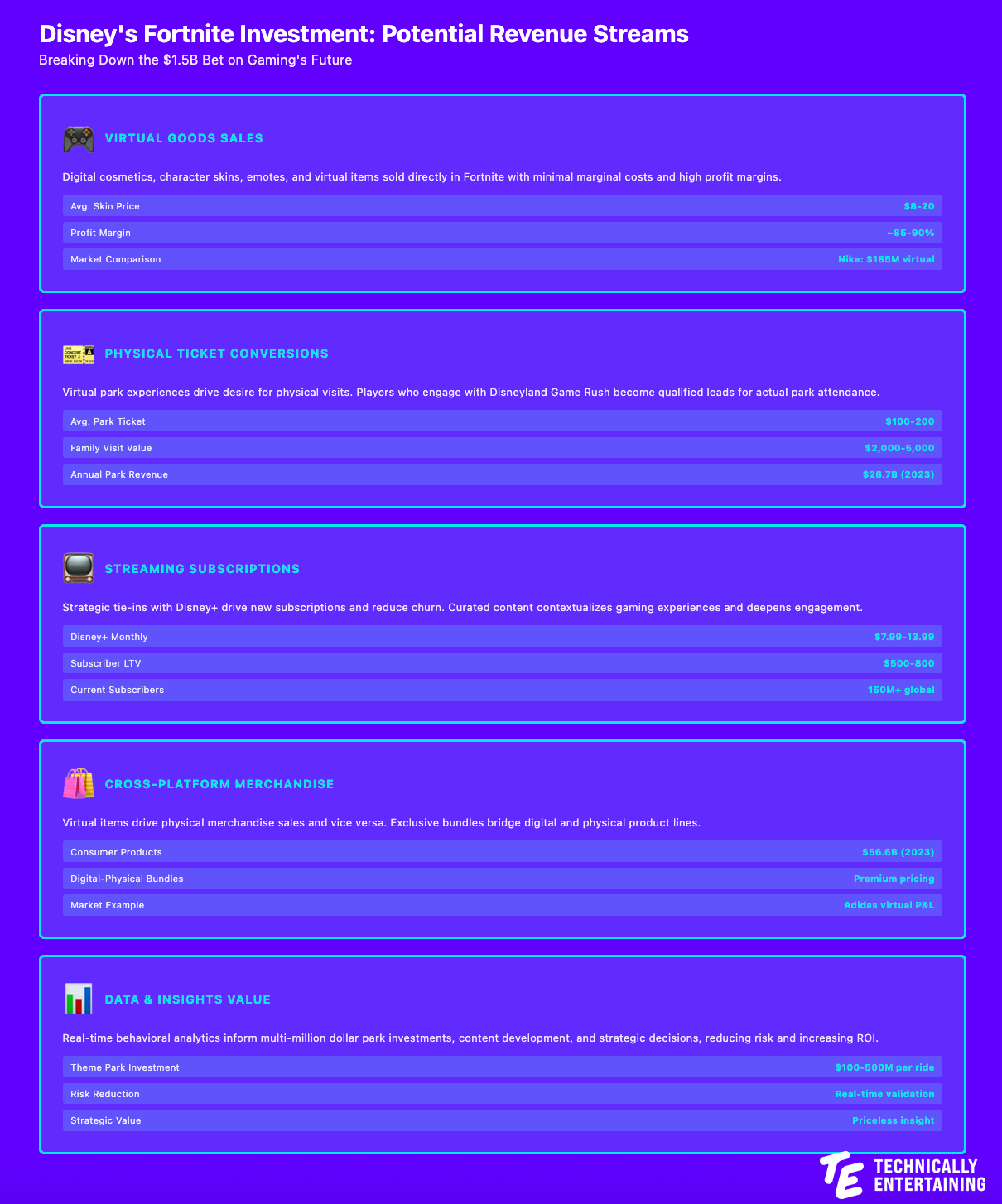
The avenues for connecting the physical and digital worlds are nearly endless and offer a tremendous amount of revenue potential for Disney. But even the revenue potential for Disney’s virtual world is big. It doesn’t take a lot to imagine a Disney fan spending $50 on a digital Mickey Mouse they can carry around in a virtual theme park.
A company that is a very good comparison here that can offer perspective into what’s ahead of Disney is actually apparel giant Adidas, who managed to create a thriving business purely based on monetizing virtual goods that now has its own P&L internally and is posting strong profit margins.
The Bigger Picture
For decades, Disney has mastered the art of the physical experience. From Main Street USA to Pandora, the company has built its reputation on immersive, tangible environments where families create lasting memories. But as Generation Alpha grows up in Fortnite and Roblox rather than just Disneyland, Disney faces a crucial question: How do you remain the world’s premier entertainment company when entertainment itself is going digital?
Disney’s $1.5 billion investment in Epic Games isn’t just about being present in gaming—it’s about fundamentally reimagining what a theme park can be, who can access it, and how physical and digital experiences can amplify each other.
The Simpsons and Disneyland in Fortnite aren’t just partnerships—they’re experiments in the future of entertainment itself. They’re testing whether the magic kingdom can be as compelling in pixels as it is in person, and whether a company built on physical experiences can thrive in an increasingly virtual world.
The question isn’t whether entertainment will exist in games like Fortnite. It’s whether traditional entertainment companies can adapt quickly enough to remain relevant when the definition of “place” includes both physical parks you visit and virtual worlds you inhabit.
Disney’s bet—backed by $1.5 billion—is that they can. And if they succeed, the theme park of tomorrow might be one you can visit with or without a plane ticket.
This week, I’m speaking at Brand Week Istanbul on the power of play for brands. Next month, I’ll be speaking at the GamesBeat Summit on Hollywood and Games - subscribe today to get access to the same insights executives across brands and entertainment are getting.