


Dear Readers,
Over the past few weeks, the conversation about AI has shifted from AI boom to AI bubble with remarkable speed. The narrative has turned decidedly skeptical. Numerous reports detail organizations failing to realize tangible results from their AI efforts. AI-generated slop floods the internet, making the jobs of marketers harder instead of easier. Circular investments between big AI players have raised eyebrows, creating the appearance of a self-reinforcing hype cycle designed to keep everything champagne and cocaine for those at the top. Meanwhile, company valuations seem entirely detached from any sort of business fundamentals like revenue and profit.
So is AI just all hype, at least for now?
If the data from the recent Black Friday is any indication, we have our first piece of very tangible, economic evidence of AI impacting a critical area of the global economy: shopping and advertising. Your TE chart of the week.
The Black Friday Wake-Up Call
Research from Adobe Analytics clearly demonstrates the impact AI is already having on commerce and advertising, and the numbers are staggering.
First, Black Friday sales rose 10% year over year. That in and of itself isn’t particularly astonishing when you consider that prices on average have gone up and consumers actually purchased fewer items. It’s growth, but it’s the kind of growth you’d expect in an inflationary environment where dollar amounts rise even as unit volumes stay flat or decline.
What is astonishing is what’s happening underneath that top-line number. AI-driven e-commerce traffic (clicks to shopping sites routed via AI tools like Gemini or ChatGPT) rose 800%. Read that again: an eight-fold increase, or a nine-fold multiplier depending on how you calculate it. This isn’t a marginal improvement or a modest uptick. This is a fundamental shift in how consumers are discovering and accessing shopping destinations.
But traffic alone doesn’t pay the bills. What matters is conversion. And here’s where it gets really interesting: consumers were 38% more likely to make a purchase if they were routed to a website from an AI tool compared to traditional search or direct navigation.
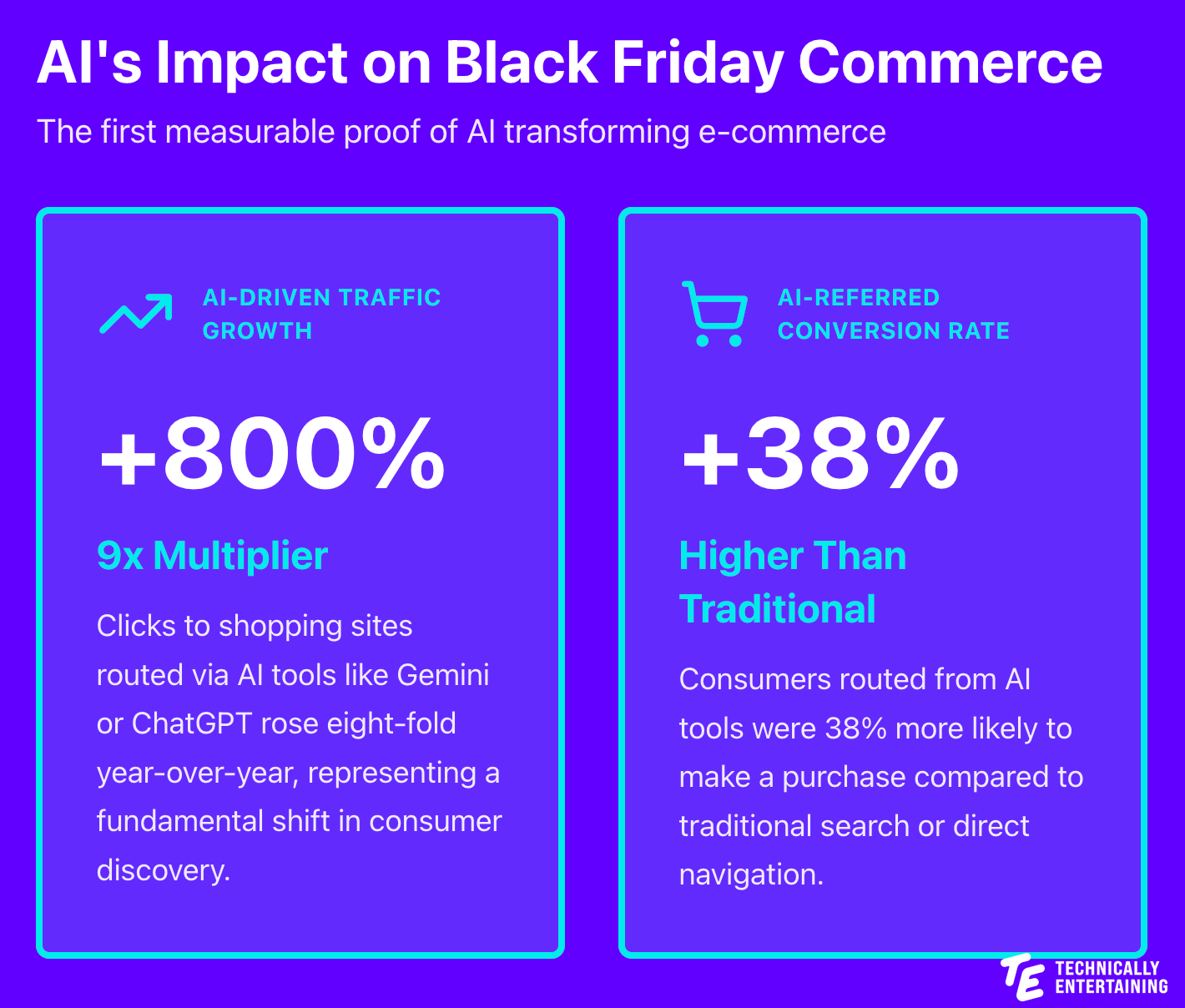
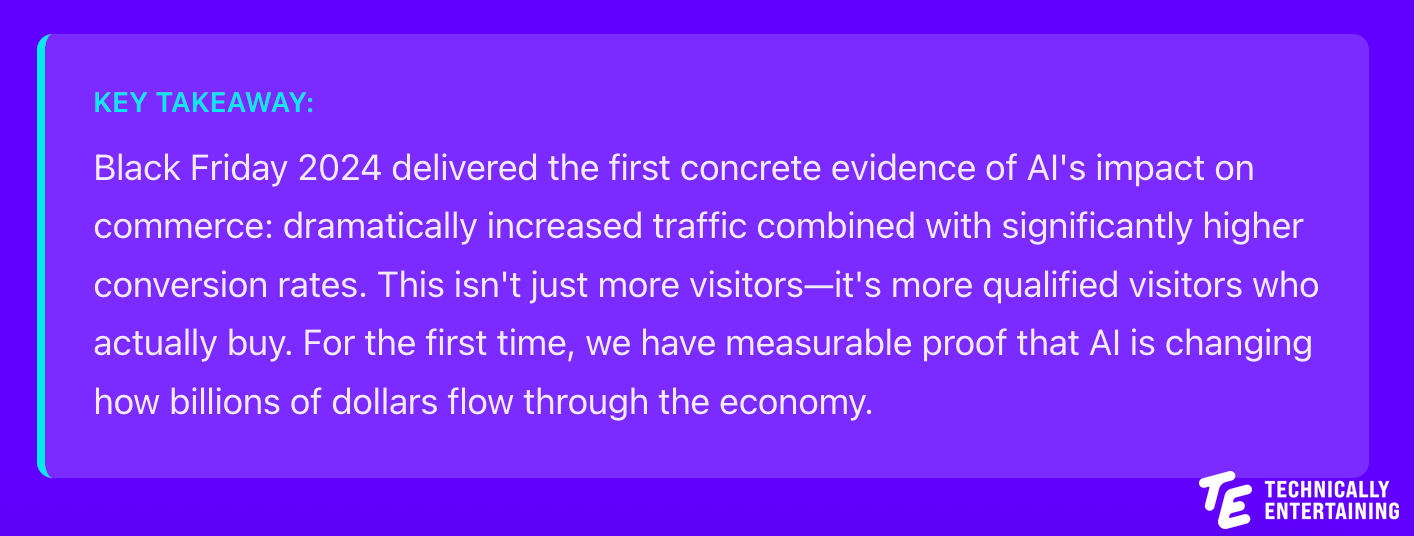
Let that sink in. Dramatically increased traffic combined with a significantly higher conversion rate. It’s the stuff marketers have dreamed about for decades. Every e-commerce executive knows that the holy grail isn’t just more visitors, it’s more qualified visitors who actually buy. AI tools are apparently delivering exactly that.
With over 60% of Americans now using AI daily, AI seems to have found its footing with a highly relevant real-world use case. Not generating mediocre blog posts or questionable images, but actually helping people shop more effectively and helping businesses reach customers more efficiently.
Why This Matters More Than You Think
This isn’t just about one strong shopping weekend. Black Friday represents a proof point for something much larger: AI’s ability to fundamentally reshape one of the largest sectors of the global economy.
E-commerce and digital advertising represent trillions of dollars in annual economic activity. If AI can demonstrably improve conversion rates by 38% while simultaneously driving an 800% increase in qualified traffic, we’re not talking about marginal optimization. We’re talking about a potential step-function change in how commerce operates.
Consider what this means from a business model perspective. Retailers and brands have spent the last two decades optimizing their digital presence around search engine algorithms, social media feeds, and display advertising. Entire industries have been built on top of Google’s PageRank algorithm and Facebook’s EdgeRank. Billions of dollars flow through these systems annually.
AI tools are creating an entirely new channel that sits on top of (or perhaps alongside) these existing systems. When a consumer asks ChatGPT or Gemini for shopping recommendations, they’re bypassing traditional search entirely. They’re not clicking through ten blue links or scrolling through sponsored posts. They’re getting curated recommendations that lead directly to purchase decisions.
The 38% higher conversion rate suggests these AI-driven recommendations are better matched to consumer intent than what traditional search and discovery mechanisms deliver. That makes sense when you think about it. A conversational AI can ask clarifying questions, understand context, and refine recommendations in real-time in ways that keyword-based search never could.
But the current 38% conversion advantage may be just the beginning. The next evolution in AI-driven commerce will come from psychological personalization.
The Psychology Layer: Where AI Commerce Gets Really Powerful
Right now, AI tools are making recommendations based primarily on stated preferences and contextual clues from the conversation. A user asks for “running shoes for trail running” and the AI provides relevant options. That’s already more effective than traditional search, but it’s still relatively surface-level.
The real opportunity lies in AI systems that understand not just what users are looking for, but how, and why, they make decisions based on their unique psychology. Companies like Solsten are pioneering tools like Elaris that map individual psychological traits and decision-making patterns. When integrated into AI systems, this psychological layer could dramatically enhance the quality of recommendations - and provide a substantial and enduring competitive advantage for those AI chats leveraging unique data like this. Better insight leads to better recommendations, leads to better conversions, which means more usage and more ad dollars driven towards the AI chat that can outperform on quality.
Consider two users both searching for the same product, say a laptop. One user has a psychology profile that indicates they prioritize social validation and brand prestige. Another user’s psychological traits show they’re analytically driven and focused on specifications and value optimization. The same laptop recommendation will resonate very differently with these two individuals.
AI systems equipped with psychological insights could tailor not just which products to recommend, but how to present them, what features to emphasize, and even the language and framing used in the recommendation. For the first user, the AI might highlight the laptop’s brand reputation and design aesthetics. For the second user, it might lead with technical specifications and price-performance comparisons.
This works both ways. CMOs who invest in understanding the psychological profiles of their target audiences can optimize their websites, product presentations, and offers to align with those psychological traits. When a user arrives from an AI recommendation, the landing experience can be tailored to match their decision-making psychology.
There’s a reason why Forbes called human psychology “The Missing Piece Of The $2 Trillion AI Market”.
Imagine a seamless journey: an AI system that understands your psychology recommends a product in a way that resonates with how you think, then routes you to a website that’s dynamically personalized to reinforce those same psychological drivers. The entire experience from initial query to purchase feels deeply personal and frictionless because it’s aligned with your unique cognitive and emotional patterns.
Tools like Elaris make this possible by providing the psychological intelligence layer that sits between the AI recommendation engine and the commerce experience. As AI-driven traffic continues to grow, the brands and AI platforms that leverage psychological personalization will likely see conversion rates that make the current 38% advantage look modest.
This is where the real competitive differentiation will emerge over the next 18 to 24 months. It’s not just about being present in AI recommendations. It’s about understanding the psychology of the users being referred and creating experiences that align with how they actually make decisions.
The CMOs Are Paying Attention
This comes at a time when ad agency Dentsu released its latest Global Ad Spend Forecast, and four key statistics jump out immediately.
Global advertising spend is forecast to rise by 5.1% in 2026, surpassing the $1 trillion mark for the first time, reaching $1.04 trillion. That’s not just a psychological milestone. That’s a trillion dollars flowing through the advertising ecosystem annually, and an increasing share of that is being reshaped by AI.
Dentsu forecasts that 71.6% of advertising spend will be algorithm-driven by 2026. By 2028, this number is projected to reach more than three quarters of total spend at 76.0%, as artificial intelligence continues to permeate the media and marketing ecosystem. We’re not talking about AI as a future consideration. We’re talking about AI becoming the dominant mechanism through which advertising is bought, sold, and optimized within the next 18 to 36 months.
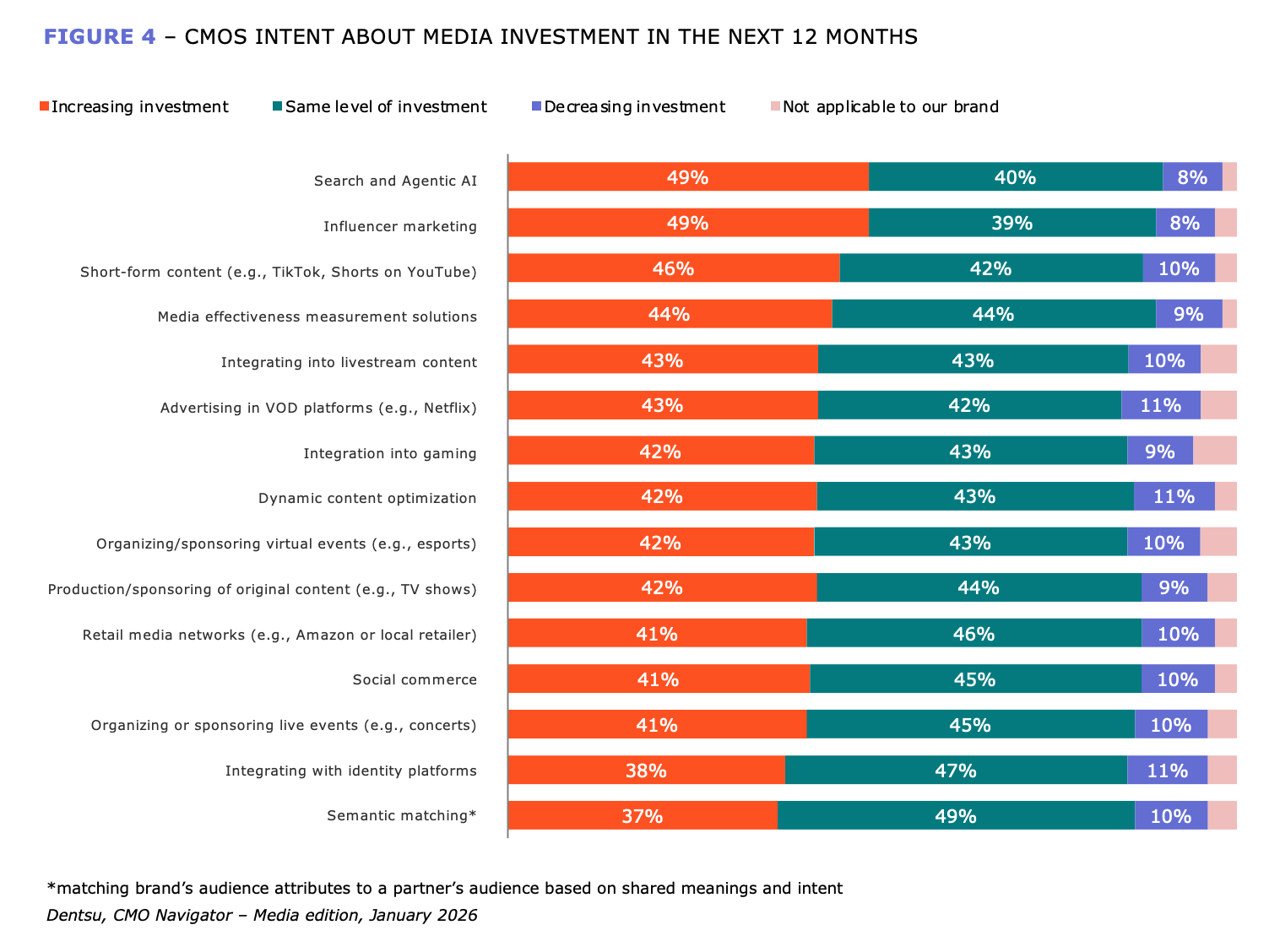
But perhaps the most telling statistic is this: 45% of CMOs prioritize AI adoption to enhance marketing effectiveness and efficiency. This isn’t consultants or technologists pushing AI adoption from the bottom up. This is C-suite marketing leaders making AI a strategic priority because they see tangible business value.
And they’re not just prioritizing AI generally. They’re putting money behind specific use cases: 49% of CMOs plan to increase their investment in search and agentic AI. That’s nearly half of marketing leaders at major companies planning to spend more money specifically on AI-driven search and autonomous AI agents.
Why Black Friday Is The Proof Point That Changes Everything
The reason the Black Friday data matters so much is that it moves AI out of the realm of speculation and into the realm of measurable business impact.
For the past two years, we’ve heard endless proclamations about how AI will transform everything. Most of it has been aspirational. Companies have announced AI initiatives, hired AI teams, and talked about AI strategies, but hard evidence of actual business value has been scarce. Yes, some companies have improved operational efficiency. Yes, some developers are more productive with AI coding assistants. But clear, measurable impact on revenue at scale? That’s been harder to demonstrate.
Black Friday 2024 gives us that proof point. An 800% increase in AI-driven traffic and a 38% higher conversion rate isn’t a pilot program or a small-scale test. This is happening at a massive scale during the single most important shopping period of the year, across the entire e-commerce ecosystem.
It demonstrates several critical things: consumers are actually using AI tools for shopping at scale. AI recommendations are effective enough to drive real purchases. The infrastructure exists to support AI-driven commerce. And the business model appears to work, with retailers seeing actual sales, not just traffic.
From Hype to Reality (Maybe)
The narrative around AI has been whipsawing between breathless hype and dismissive skepticism for the past two years. The Black Friday data offers something we haven’t had much of: concrete evidence of measurable impact.
An 800% increase in AI-driven shopping traffic and a 38% higher conversion rate during Black Friday isn’t hype. That’s data. When 45% of CMOs make AI a strategic priority and 49% plan to increase investment specifically in search and agentic AI, they’re responding to something real.
But let’s be clear about what we don’t know as well: whether this is a sustainable trend or a one-time spike. Whether these conversion rates will hold as AI-driven traffic becomes more mainstream. Whether the infrastructure can scale to handle continued growth. Whether new advertising models will emerge that prove economically viable for AI platforms, retailers, and brands simultaneously.
Black Friday is one data point. A significant one, but still just one. The real test will be whether these trends persist through the full holiday shopping season and into 2025. If Cyber Monday, the December shopping period, and early 2025 show similar patterns, then we’ll have confirmation that something fundamental has shifted. If the numbers revert or the growth slows dramatically, then Black Friday may have been more of an anomaly than an inflection point.
The holiday season and consumer spending patterns over the next few months will be the real litmus test. CMOs are making investment decisions now based on the Black Friday data, but they’ll be watching the next wave of results closely to validate whether those investments make sense.
What This Means Going Forward
The trillion-dollar advertising ecosystem is starting to be reshaped by AI. Black Friday 2024 might be remembered as the moment when AI’s impact on commerce became visible and measurable rather than theoretical.
For CMOs and marketing leaders, the message is straightforward: this is worth watching closely and potentially worth investing in, but it’s still early. The Black Friday results are encouraging, but they’re not yet proof of a permanent shift. The next few months of data will matter enormously.
We’ve moved from the phase where AI impact on commerce was purely speculative to the phase where we have actual data to analyze. That’s progress. But we haven’t yet reached the phase where we can confidently say this is the new normal.
The hype phase may be giving way to something more substantive. Or it may turn out that Black Friday was an outlier. Either way, we’ll know a lot more after the full holiday season plays out.
For now, the most reasonable position is cautious optimism: the Black Friday data suggests AI is starting to have real impact on commerce, and that impact appears significant enough to warrant serious attention and strategic consideration. But the jury is still out on whether this represents a fundamental and lasting shift or a temporary spike in a still-evolving landscape.
The Dentsu Global Ad Spend Forecast revealed another important figure: 42% of CMOs want to invest more into video gaming integrations. I’ll be speaking at the Hollywood and Games Summit in Los Angeles next week (Dec. 11) on exactly how companies make sure their gaming strategy is a success. Subscribe today to receive the latest updates straight to your inbox.