


One week after Fox Corporation announced its $22 billion acquisition of Roku, I found myself in Cannes for the Lions festival, sitting in the audience of a panel that included Anna Miller, Head of Ads Measurement and Research at Roku, talking about the future of streaming, media, and advertising.
The timing was almost absurd. The deal had just landed. The press was full of takes on what it means. And here was a senior Roku executive on stage, sharing data and strategic thinking that completely reframes what this acquisition is actually about.
Most analysts have gotten the story half right. The other half is sitting in the Roku Channel Store’s games section.
The Deal, Briefly
Rupert Murdoch spent billions in the 1990s and 2000s chasing what media insiders called the TV Guide of the Future, an on-screen interface that would give whoever owned it control over how consumers navigated television. He never got there. The technology moved faster than the strategy.
Now his son Lachlan has done it in one transaction.
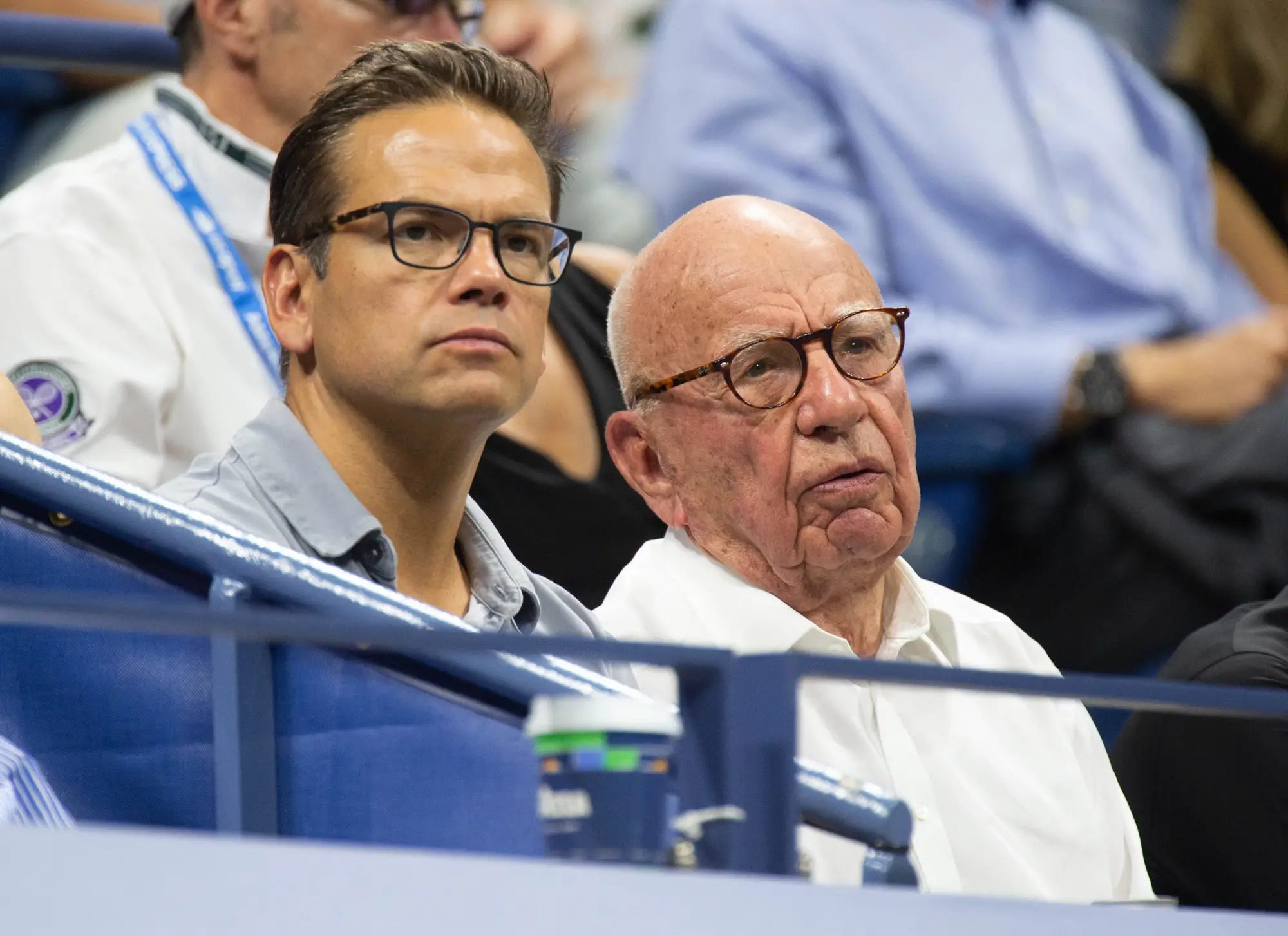
On June 15, 2026, Fox Corporation announced a definitive agreement to acquire Roku for $160 per share, a combination of cash and Fox Class A stock, valuing the company at approximately $22 billion. Roku reaches over 100 million global streaming households, more than half of all US broadband households. According to Nielsen, the Roku Channel commands 3% of all US streaming viewership. The platform generates $4.7 billion a year in advertising and subscription revenue. Together with Fox’s free, ad-supported streaming service Tubi, the combined company becomes the third-largest television business in the United States by viewership, behind Disney and YouTube.
Lachlan Murdoch called it “a defining moment.” Investors were less enthusiastic. Fox stock dropped more than 15% on the announcement.
The strategic rationale, as laid out in the official press release and picked up by every major outlet, covers the obvious ground.
Fox secures premier real estate on living room screens, with the ability to prominently promote its premium sports content, Fox News, and paid services directly through the Roku interface. It gains a direct relationship with more than half of all US broadband households. It picks up Roku’s first-party data on user viewing habits, enabling highly targeted advertising that commands significantly higher CPMs than traditional cable metrics. And rather than relying solely on cable carriage fees, Fox now captures ad revenue and subscription cuts from every app and service accessed through a Roku device.
These are real, valuable strategic assets. They also happen to be the obvious ones.
What most analysts evaluating this deal have missed is what comes next.
The Attention Problem
At Cannes, Anna Miller was direct about the strategic challenge Roku is actively working to solve: how do you turn attention into intention?
The reach is not the problem. Roku reaches 100 million US households. People spend 25 days per month on the platform. The attention numbers are exceptional.
The problem is converting passive attention into active engagement. Someone navigating to Netflix on their Roku device is using Roku as a gateway. The session starts and ends with Roku, but the time and value in between belong to Netflix.
Here is what makes this tension so difficult to resolve through conventional means. Netflix and YouTube are too large to be displaced or disadvantaged on the platform. When Roku went public in 2017, Netflix generated roughly a third of its total viewing while paying immaterial revenue. YouTube, its most-watched app, paid nothing. The biggest names in streaming carry their own leverage, and no amount of Murdoch ownership changes that dynamic. Fox cannot out-Netflix Netflix. It cannot redesign the home screen in ways that make its content dominant at the expense of services users refuse to give up.
This is the fundamental challenge at the heart of the Roku business. And it is precisely why the gaming angle matters so much. Games are the one category where Fox and Roku can build genuine engagement that they own entirely, a parallel lane that does not require displacing Netflix or YouTube at all.
What the Channel Store Is Already Telling Roku
Here is what is not in any of the analyst reports: Roku already has a games offering. Through the Roku Channel Store’s Games section, users can download and play titles directly on their devices, including PAC-MAN, Tetris, Trivia Crack, and Wheel of Fortune.
It is early. But the data coming back is significant. A small group of Roku users plays games with high frequency, and the engagement numbers are striking. Roku’s partner Super League Gaming found that Roku users spend an average of 19 minutes in the Roku gaming channel. For context: the average consumer spends 16 minutes just trying to find something to watch on streaming. They spend more time in the gaming channel than they do looking for a show.
Talk about signal.
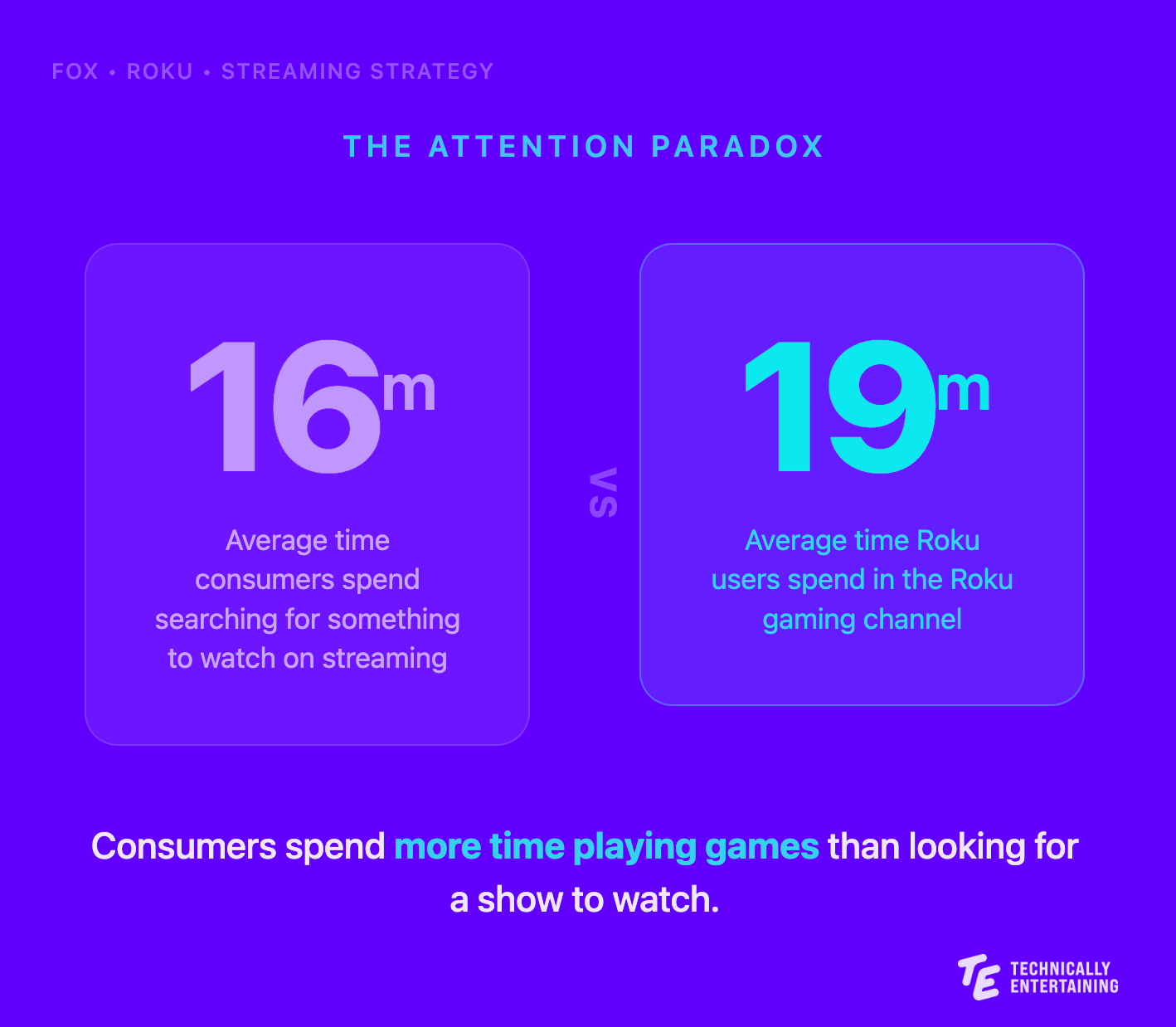
And Roku knows it. Gaming, Miller told the Cannes audience, is proving to be a powerful strategy for the company to increase engagement and turn passive viewing time into active participation.
The Churn Problem Gaming Solves
Here is the underlying business problem that makes this signal so important for Fox and Roku.
Approximately 20% of consumers regularly cancel streaming app subscriptions to move to a different service. When you finish the latest season of your favorite show, the calculus is simple: is there enough on this platform to justify staying, or is the next thing I want on a different service? Consumer loyalty is tied to content, not to the platform delivering it. When you have watched the latest season of House of the Dragon, you do not necessarily stick around.
This churn dynamic is a structural weakness of the streaming model. No matter how strong the content library, the moment a subscriber’s favorite series ends or a competitor drops something unmissable, the subscription is at risk.
Games change this calculus. A game does not end like a ten-episode season. The engagement loop of a well-designed game is fundamentally different from the engagement loop of a TV series. It demands active participation, it is ongoing, and it builds daily habits in ways that passive content consumption simply cannot.
For a platform like Roku, that means a user who plays games regularly has a fundamentally different relationship with the device and the service. The Roku box is no longer just a remote control for Netflix. It becomes a place they actively choose to spend time.
What Fox Brings to the Table
This is where the acquisition logic goes beyond the press release. And where the Rupert Murdoch comparison starts to break down in an important way.
Rupert imagined owning the only way to get to television. In 2026, that is not how it works. Roku competes with YouTube, Apple, Amazon, Samsung, Vizio, and cable providers, all of which function as home screens in their own right. Owning Roku gives Fox a commanding position, but it is one position among several. The scale advantage matters. It is not sufficient on its own.
Fox brings a library of intellectual property that can directly accelerate Roku’s gaming strategy. Sports IP in particular. The NFL. MLB. NASCAR. The FIFA World Cup. These are properties with enormous built-in audiences and proven engagement models. Sports gaming is one of the fastest-growing segments in the entire games market.
Fox also brings Tubi, which offers an immediate content bridge. Tubi’s free, ad-supported library gives Roku a native streaming destination sitting inside its own ecosystem, reducing its dependence on third-party streamers for content value.
The gaming angle is where the real long-term upside lives. A Roku gaming experience built around Fox Sports IP, available directly on the device, without a console or a separate subscription, changes what the Roku platform is capable of delivering. It also changes the CPM conversation with advertisers. Advertisers have consistently paid a premium for engaged audiences. A user playing a sports trivia game on their living room TV is a fundamentally different advertising opportunity than a user passively watching a show.
Netflix Saw This Coming
The closest comparable in terms of executing this exact strategy is Netflix. Since 2021, Netflix has been building games as part of its subscription, initially on mobile and increasingly moving toward TV. The explicit strategic goal: retention. Netflix’s thesis is that gameplay has a measurable positive impact on subscriber retention, giving members additional reasons to open the app between seasons and building a daily habit that passive content alone cannot sustain.
Netflix’s gross churn rate sits at approximately 1.8% per month, one of the lowest in the streaming industry. The gaming strategy is one piece of that. The company has now shifted its gaming push explicitly toward TV-based interactivity, including party games using smartphones as controllers and real-time voting features for live shows, directly targeting the living room screen.
Fox and Roku, post-merger, are sitting on an opportunity to execute this playbook at a scale Netflix cannot match on its own. Roku owns the hardware relationship with more than half of all US broadband households. Fox brings the IP and the content muscle. The gaming layer is what binds those two assets into something more durable than either company could build independently.
What This Means for Brand and Marketing Leaders
The standard read on this deal focuses on scale and advertising. Bigger audience, better data, higher CPMs. Those arguments are correct and they matter.
The real opportunity for brand and marketing leaders is the engagement model shift. If Roku becomes a meaningful gaming platform, built around familiar IP and accessible mechanics on a device already in most US living rooms, the nature of the advertising inventory on that platform changes fundamentally.
Interactive ad formats tied to game mechanics, branded content that lives inside a game, and sponsorship models built around sports gaming experiences are already being tested in other contexts. The Fox and Roku combination creates the infrastructure to deliver those formats at television scale.
The brands that understand this now will have a meaningful head start over those still optimizing for pre-roll impressions on passive viewing.
The $22 billion headline number has dominated the coverage. The Games section of the Roku Channel Store is where the next chapter of this story actually begins.
What do you think? Have you seen gaming start to show up as a serious priority in your organization’s media planning? Let me know in the comments.
Technically Entertaining covers gaming, technology, and entertainment strategy for decision-makers at the world’s leading brands. Published weekly. Free to read.