


NBCUniversal is exploring acquisitions of digital gaming and entertainment companies once it separates from Comcast, according to a Reuters exclusive that ran in late June. No deal is imminent, and any move would come well after the split closes. But the signal matters more than the timeline. A media company built on broadcast television, film, and theme parks is telling the market that gaming is now core to how it plans to grow.
Netflix, Amazon, Paramount, Mattel, Hasbro, and a Swedish broadcaster most American executives have never heard of have all already made this same bet, in different sizes and with different conviction. NBCUniversal isn’t pioneering anything. It’s catching up to a decision the rest of the industry made years ago, and the split from Comcast is exactly the clean break that makes catching up possible.
Why the Timing Is Actually Perfect
Comcast announced the split on June 29, separating its cable, wireless, and broadband business from a standalone NBCUniversal that keeps Universal Pictures, NBC and Telemundo, NBC News, Peacock, Bravo, the theme parks, and Sky. Mike Cavanagh takes over as CEO. The deal requires regulatory approval and is expected to close in about a year.
That structure matters more than it sounds. For two decades, NBCUniversal’s capital allocation competed against Comcast’s cable and broadband priorities, businesses that are large, profitable, and structurally in decline. Every dollar it wanted for a bold content or platform bet had to be justified against that far larger, more predictable cash machine. Once the split closes, that competition disappears, and NBCUniversal has to define its own growth story. Gaming is one of the only entertainment categories still growing at double digits.
This Isn’t a New Idea. It’s an Overdue One
Here’s the part most coverage missed. This isn’t Comcast’s first flirtation with gaming. CEO Brian Roberts previously explored acquiring both Activision and Electronic Arts, and considered an equity stake in Epic Games, the maker of Fortnite. None of those deals happened, though his son, Tucker Roberts, now runs Comcast’s gaming division and is reportedly eager to push further in.
That history reframes the story. This is an organization that wanted in for years, got outmaneuvered or lost its nerve each time, and is now getting a cleaner structure and a fresh mandate to finally act.
Every Legacy Media and Toy Company Already Made This Bet
NBCUniversal would be entering a race already well underway, and the results so far favor the companies that moved early.
Netflix made the loudest move in industry history in December 2025, agreeing to acquire Warner Bros. for a total enterprise value of $82.7 billion following Warner Bros. Discovery’s separation of its Discovery Global networks business. The deal was primarily a film and television play, built around HBO and a century of Warner Bros. storytelling IP. But it’s also the clearest evidence yet that the largest streaming company in the world sees content ownership at this scale as the only way to keep growing. Netflix’s own game division, built since 2021 through acquisitions like Night School Studio and Boss Fight Entertainment, has been a smaller, quieter version of the same instinct.
Amazon took the opposite path, and it’s been messier. Amazon bought Twitch for roughly $970 million in 2014 and poured billions into internal development since, but 2025 brought major layoffs and the end of active development on New World, its flagship MMO, as the company pivots toward its Luna cloud gaming platform. Scale and capital alone don’t guarantee gaming success. Execution and focus do.
Paramount has been the most disciplined recent mover. The newly formed Paramount Games Studio combines Skydance Interactive, Skydance New Media, and Paramount’s licensing business under one roof, built on the belief that games are, as EVP Dan Prigg put it, “the deepest level of engagement for fans.” I covered Paramount’s structure-follows-strategy approach here, and it’s the template NBCUniversal should study: build a real studio structure from day one instead of bolting gaming onto the org chart as an afterthought.
The toy industry got here first. Mattel bought out NetEase’s stake in its mobile gaming joint venture for $159 million earlier this year to take full control of a business now central to its transformation into an IP management company. Hasbro’s Wizards of the Coast division generated over $1 billion in operating profit in 2025 at a 46% margin, nearly ten times the profit of the entire legacy toy business, the single clearest data point in this piece for why content owners should be paying attention.
Then there’s Modern Times Group, a Swedish broadcaster that spent the last decade doing exactly what NBCUniversal is reportedly now considering: buying its way into gaming, one studio at a time. MTG acquired Kongregate, InnoGames, Hutch, Ninja Kiwi, and Plarium, and is now organized around two gaming divisions that generate the bulk of its business. Nobody outside the industry has heard of MTG. That’s the point. It became a gaming company through a string of mid-sized, unglamorous acquisitions rather than waiting for one perfect deal, a legitimate blueprint for a portfolio strategy over a single trophy purchase.
None of these companies moved because gaming was trendy. They moved because gaming is where the engagement, margins, and audience relationships already are, and every year a legacy media company waits is a year a platform holder like Roblox or Fortnite captures that relationship instead.
The Shopping List: Who NBCUniversal Should Actually Call
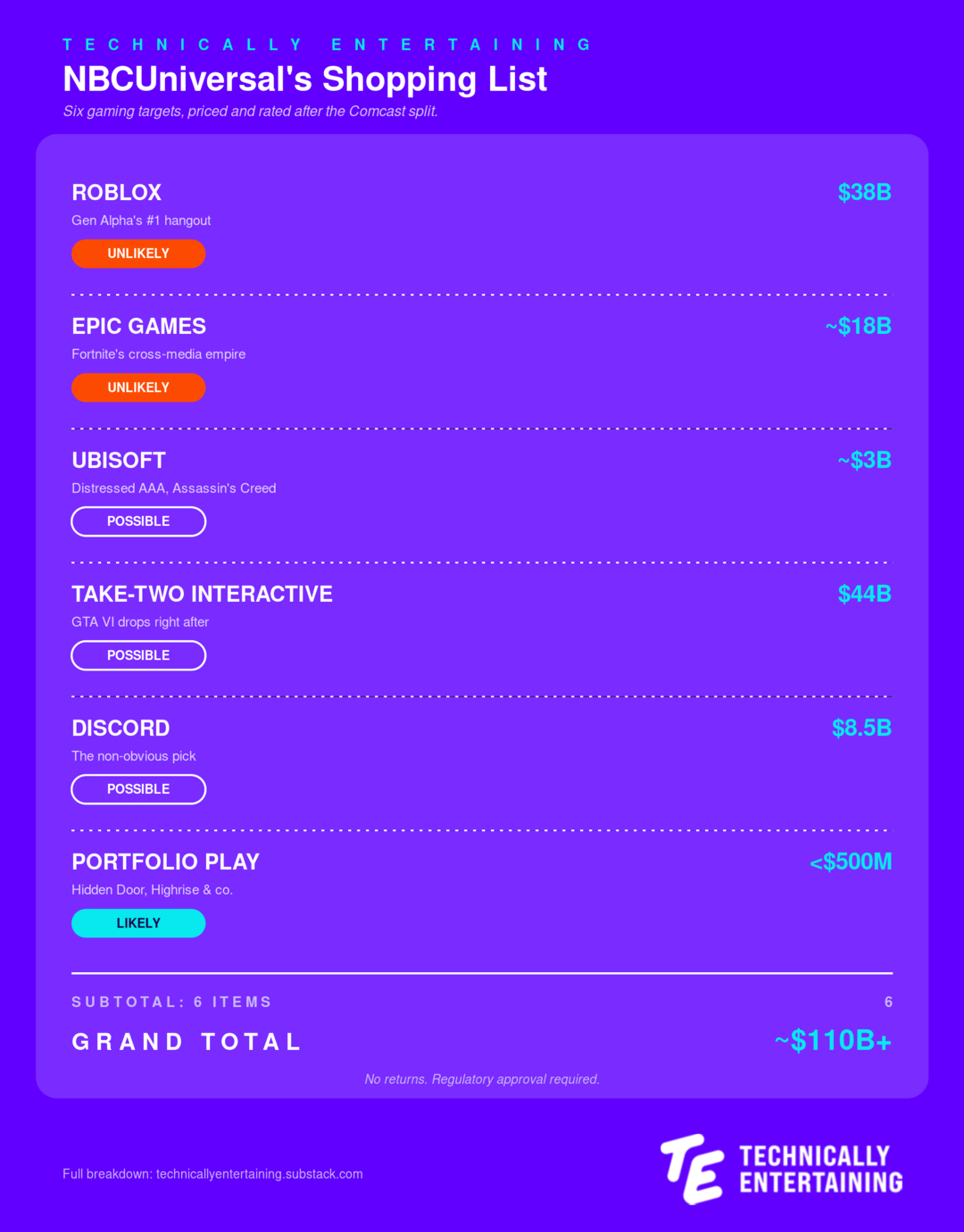
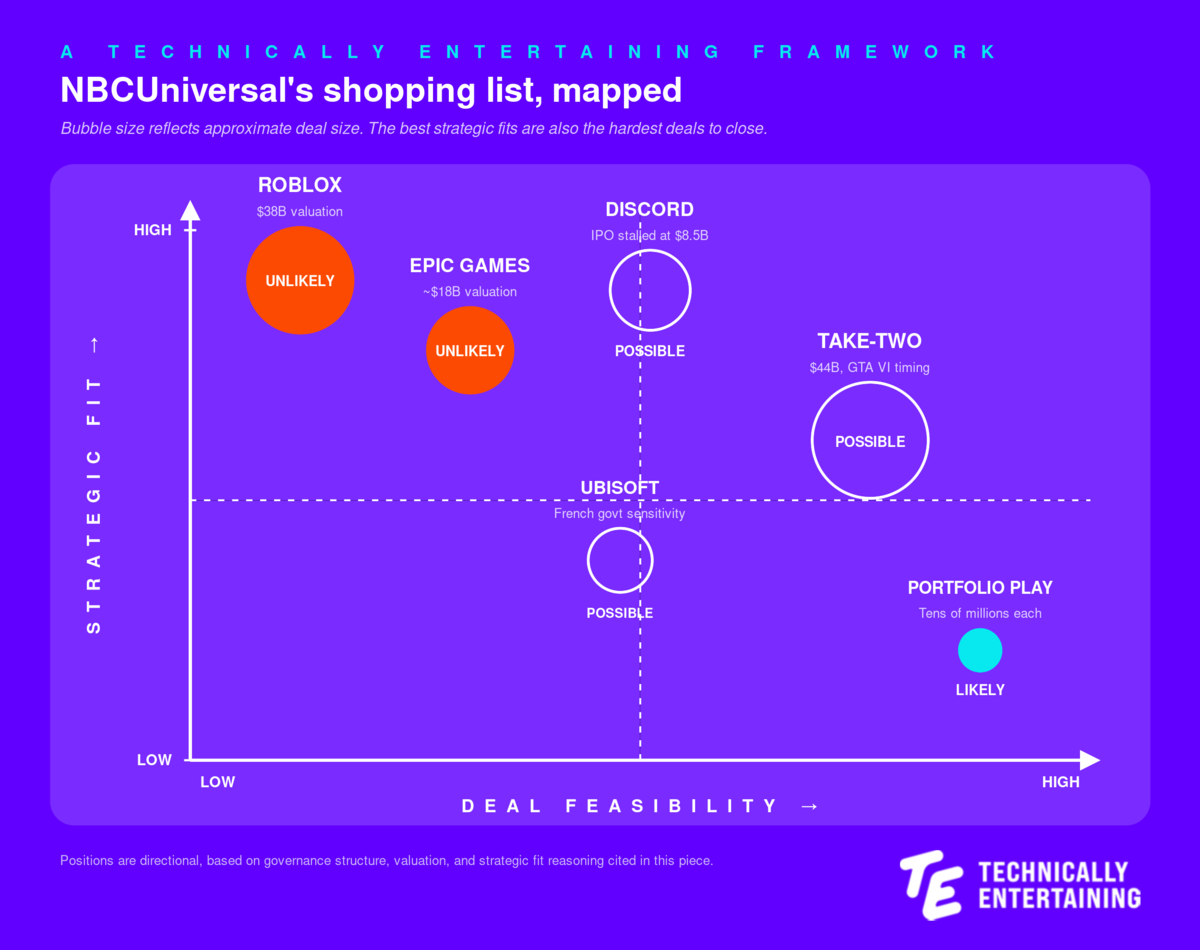
If NBCUniversal really goes shopping, who’s on the list? Some obvious names turn out to be structurally impossible to buy. A couple of unexpected ones might be exactly right. Here are the six I’d put in front of Cavanagh, including one that has nothing to do with making games.
Roblox
The single best strategic fit and the hardest deal to close. Roblox is where Gen Alpha and younger Gen Z already spend their time, and NBCUniversal’s core broadcast and cable audience skews older every year. But CEO David Baszucki controls the company through a dual-class structure giving him roughly 20 times the voting power of an average shareholder on a stake worth only about 7% of the economics.
Why it can happen: at a $38 billion market cap it’s expensive but not unaffordable, and Baszucki has shown he’ll sell smaller Roblox-native studios when the price is right.
Why it won’t: nobody acquires a company against the will of a founder with effective board control, and there’s no sign Baszucki wants out.
Ubisoft
A genuinely distressed AAA publisher with a portfolio built for cross-media exploitation: Assassin’s Creed, Rainbow Six, Far Cry, all franchises with obvious film and TV extensions. Tencent already paid roughly €1.16 billion for a 26% stake in Vantage Studios, the subsidiary housing those three franchises, at a €3.8 billion valuation, proving the appetite and price floor already exist.
Why it can happen: the company has been distressed enough to sell down a piece of its crown jewels once already this year, and the Guillemot family’s grip has weakened.
Why it won’t: the French government treats Ubisoft as a national champion and has quietly discouraged past foreign takeovers, and an American buyer would draw exactly that scrutiny.
Epic Games
The Fortnite ecosystem is arguably the closest thing gaming has to its own cross-media universe already, complete with concerts, movie tie-ins, and a creator economy that rivals YouTube’s.
Why it can happen: Tencent’s 40% stake is non-controlling, Comcast itself previously explored an equity position, and a strategic investment short of full acquisition is a realistic starting point.
Why it won’t: Tim Sweeney has said repeatedly he intends to keep control of Epic and has never taken it public by choice, and a buyer looking for operational control runs straight into that wall.
A portfolio of smaller studios
Rather than chase one marquee name, NBCUniversal could do what Modern Times Group did: acquire a handful of mid-sized, profitable studios and scale them with distribution and IP a standalone studio could never access. Companies like Hidden Door, which builds AI-driven narrative games, or Highrise, the social avatar platform, get bought for tens of millions rather than billions and can be folded in without betting the balance sheet.
Why it can happen: it’s the lowest-risk, most capital-efficient path in, and Roblox-native studios already change hands regularly.
Why it won’t: it’s slow and unglamorous, and doesn’t hand a board the single visible headline it wants.
Take-Two Interactive
The most financially realistic marquee deal here, and the one with the worst timing. Take-Two has no founder or family stake standing in the way. CEO Strauss Zelnick has said outright that as a public company, any credible offer has to be considered, and its GTA, NBA 2K, Red Dead Redemption, and Borderlands portfolio is exactly the prestige IP a media company would want.
Why it can happen: unlike Roblox, Epic, or Ubisoft, no single shareholder or government can block a deal, and Take-Two’s board has engaged before when the price is right.
Why it won’t: the company sits at roughly a $44 billion market cap heading into Grand Theft Auto VI, arguably the most anticipated release of the decade, meaning NBCUniversal would be buying right before the number gets bigger.
Discord
The non-obvious pick, and the one I think matters most. Discord isn’t a game studio. It’s the community and identity layer sitting underneath gaming, esports, and fandom broadly, with over 200 million monthly active users. It walked away from a reported $12 billion acquisition offer from Microsoft in 2021, bet on going public instead, and filed confidentially for an IPO this year that has since stalled, with secondary valuations now below the number it turned down. NBCUniversal’s real gap isn’t content. It’s a persistent community layer around Peacock, Bravo, and its biggest fandoms, exactly what Discord already does for gaming communities.
Why it can happen: a company that turned down a buyer is now watching its own IPO underperform that offer, the exact condition that reopens acquisition talk.
Why it won’t: reversing course after a stalled IPO reads to the market as an admission of failure, a hard needle for any management team to thread.
The Real Bet
None of this is guaranteed to happen the way I’ve laid it out. Deals this size take years, egos get in the way, and regulators have opinions of their own. But the direction is no longer in question. Six very different companies reached the same conclusion from different starting points: owning a real position in gaming isn’t optional anymore for a company that depends on audience attention to survive.
NBCUniversal spent two decades sharing a balance sheet with a cable business that had no reason to fund this bet. That excuse is gone in about a year. The only question is whether Cavanagh moves fast enough to buy in before the good targets are gone, or ends up explaining years from now why the company waited too long, the same way Comcast once did.
What do you think? Which of these six would actually move the needle for NBCUniversal, and did I miss the right target? Let me know in the comments.
Technically Entertaining is a weekly briefing on how gaming, technology, and entertainment are reshaping brand strategy for decision-makers at the world’s biggest brands. If this resonated, subscribe below.