


Dear Readers,
At the risk of you getting tired of hearing from me, welcome to our second post this week.
Why? The news cycle doesn’t want to stop these days and we’re seeing big announcements almost on a daily basis right now with potentially massive implications for our daily lives.
Arguably the biggest bombshell was dropped on us yesterday. OpenAI announced that it will acquire io, the company run by famous former Apple design guru Jony Ive, for $6.5 billion. The goal: to rethink hardware devices in an age dominated and powered by AI.
More on that below. Here’s a look at other headlines you should be aware of.
Telegram profits jump
Messaging app Telegram led by its founder Pavel Durov, who is still wrapped up in a messy lawsuit in Paris battling French intelligence agencies, reported that its revenues increased 3.5x to a total of $1.4 billion in 2024. Profits surged in the process as well, with Telegram bringing in $540 million compared to making a loss of $173 million the previous year, meaning its profit margins jumped from -50.4% to 38.6%.
The key driver behind this astonishing surge? Mini-apps developed on Telegram, especially games and commerce. While advertising and premium subscribers accounted for $250 million and $292 million of revenue respectively, the partnerships and ecosystem segment accounted for more than half of the revenue - it’s the segment that aggregates all developer-driven mini-apps on its platform. Given that the platform has over 1 billion monthly active users, there’s still a lot of financial upside for Telegram that, if it can get past the aforementioned lawsuit, could IPO sooner than later.
Netflix adds more ads and Sesame Street
We explored one beloved company and iconic IP earlier this week (I’m talking about LEGO in case you missed it), but there was another important headline that took me back straight to my childhood.
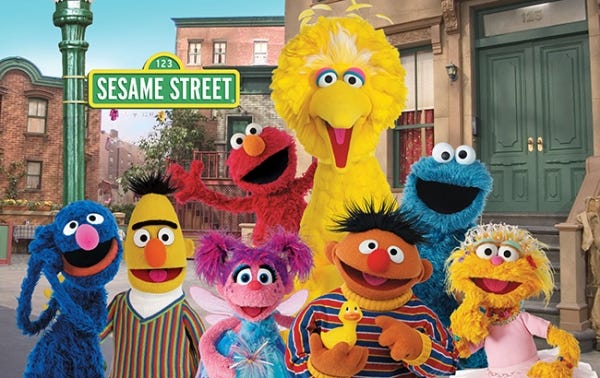
Netflix had itself a big week. First, it announced that it acquired the rights to the famous Sesame Street IP. The streaming giant will become home to all Sesame Street content. This makes a ton of sense for Netflix for two major reasons:
While Netflix dominates streaming overall, Disney+ is still the premier destination for families due to its content library and iconic IP geared towards families and bridging generations. This is a fiefdom within the streaming market Netflix hasn’t been as strong in, and owning Sesame Street will certainly bolster its own lineup in an attempt to bring more families onto its service - which brings us to reason number 2.
Netflix Games for kids. Games is an area Netflix continues to invest in and they specifically want to expand its offering with games for children. There are few IPs that have the nostalgia and the pull that Sesame Street has when it comes to attracting kids to play as well as convince parents that it’s good content for their children.
Secondly, Netflix demonstrated native advertising in its shows. Brands would have the ability to advertise to consumers in the moment when their products, or similar products, are just naturally on screen as a part of the scene of a show or movie the audience is watching. It would be a whole new way for dynamic, contextual advertising that undoubtedly is geared towards impulse shoppers - imagine the snap reaction you’d have to make because you see Denzel Washington put on a jacket and a small pop-up on the screen opens up that shows you the exact jacket with an option to buy it. Conceptually, this type of advertising is a smart idea, but the success of it will depend a lot on the implementation to not disrupt the viewing experience too much. Ideally, these ads would lead directly to commerce functionality built into Netflix, so that you won’t have to leave your screen and you can simply select your size and check out with one click.
There’s ways to go for Netflix here, but it demonstrates the potential of how Netflix can become the central hub in your living room, and beyond, for entertainment and commerce.
Warner Bros. Discovery is now junk
WBD stock was downgraded to BB+, just one rung above the absolute lowest level, by S&P Global Ratings. That means the company will soon face higher borrowing costs on its total debt of $38 billion. A key driver behind the downgrade are continuously declining revenues and cashflows from its traditional cable TV business. I have said it before and I’ll say it again.
Linear cable TV is dead.
It’s just a mattere of time until WBD finally follows in the footsteps of Comcast and spins off its TV assets into a bad bank type of setup.
Elon Musk thinks he’s done enough in political spending
You think so, Elon? Not sure you want to make other parts of the public sector more “efficient” or free other countries from “censored speech”?
Moving on to two other tech titans and what could be the most genius, or worst, merger of the century.
OpenAI goes after hardware
ChatGPT maker OpenAI announced that it is acquiring former Apple design chief Jony Ive’s hardware start-up io. The transaction comes out to a total of $6.5 billion in an all-equity deal. Given OpenAI’s last valuation of roughly $300 billion, this means only a 2% dilution for OpenAI to bring Ive and his team on board. Not bad.
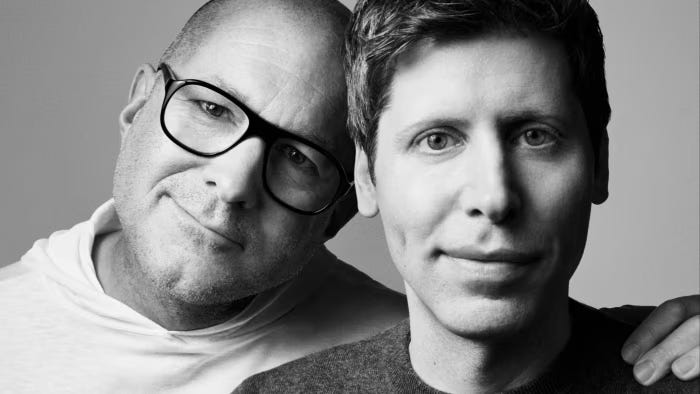
Is it just me or is the official photo OpenAI chose to accompany the announcement a bit weird? Anyway, moving on.
Ive has been pursuing AI-powered device alternatives to smartphones and laptops. He has been working on solutions to address the, as he called it, “unintended consequences” of the iPhone, meaning the harmful off gasses that come with extensive use of smartphones and social media. On the other side is OpenAI, which has been looking into creating “a family of products for the AGI era”. This has the potential not to be the next big evolution in AI, but the next revolution in how we as consumers interact and engage with technology everyday - similar to what the iPhone did when it was first launched in 2007.
This move inevitably pits OpenAI directly against Apple. And while you never want to count out Apple, the company has struggled with delivering meaningful product innovation and has more often than not relied on incremental improvements (Airpods aside, which are the fastest growing hardware device in history). Apple’s fate currently still depends heavily on the iPhone - which is why the following quote by Eddy Cue, Apple’s head of services, earlier this month, should give you pause.
“You may not need an iPhone 10 years from now, as crazy as it sounds”.
You’re probably wondering what kind of devices Ive and team are working on. OpenAI CEO Sam Altman apparently has a prototype in his home that he uses, and there are reports of the device using “a completely new surface”. One hypothesis is that this new-age device will be controlled using our voice. But other than that - a speaker that projects a holographic image of your AI assistant, a wristband with similar holographic capabilities - your guess is as good as mine. What it certainly won’t be is a pin, because that experiment has failed already.
It seems like all the ingredients are in place to usher in a new era of hardware, and if there’s any one person that has the pedigree to do it, it’s likely Jony Ive. Still, the challenge with making great hardware is in its name: it’s hard - especially when a software-first company acquires a hardware-first company. Those two don’t always go together. Google’s acquisition of Nest, developer of the beloved smart thermostat, is a cautionary tale. It was a rocky ride at best which recently culminated in Google shuttering the device entirely.
In case you’re wondering, this is how Google’s AI Gemini summarizes the relationship with Nest when I prompted it “how Google ruined Nest”:
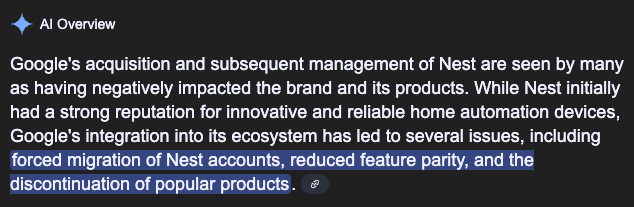
At least it’s honest (for now).
Jesse Armstrong, creator of the hit HBO show Succession, sees his new movie air on May 31. Mountainhead “revolves around four wealthy CEOs who have gathered at the mansion for their annual poker weekend, which is going ahead despite an AI-induced global crisis sparked by the company owned by the richest of the friends.” Armstrong call is “where clever and stupid meet.” Oh, how he may have absolutely nailed the Zeitgeist again.